Class 9 English Kaveri Chapter 2 Poem Gifts of Grace: Honouring Our Vocations Important Questions with Answers
The Class 9 English Kaveri Chapter 2 Poem Important Questions cover the contributions of different workers, the meaning of the poet's descriptions, and the importance of respecting every occupation. The practice set also includes questions about free verse, repetition, personification, metaphor, alliteration, visual and auditory imagery, and the poem's central message.
Class 9 English Chapter 2 Poem Gifts of Grace: Honouring Our Vocations Multiple Choice Questions
Q1. Who is credited as the poet of Gifts of Grace: Honouring Our Vocations?
(a) Temsula Ao
(b) Subramania Bharati
(c) Anonymous
(d) R. L. Stevenson
Answer: (c) Anonymous.
Explanation: The poem is attributed to Anonymous in the Kaveri textbook. It celebrates the contributions of workers from different professions.
Q2. Which quality of carpenters does the poet particularly admire?
(a) Their ability to perform music
(b) Their mathematical precision while working with wood
(c) Their skill in repairing electrical cables
(d) Their experience of life at sea
Answer: (b) Their mathematical precision while working with wood.
Explanation: The poet describes carpenters creating useful objects from wood with accuracy. This highlights the measurement, planning and practical knowledge involved in carpentry.
Q3. Why are electricians described as brightening people's lives?
(a) They decorate houses with flowers.
(b) They repair boats and fishing nets.
(c) They work with cables and wires to provide electrical services.
(d) They create handmade musical instruments.
Answer: (c) They work with cables and wires to provide electrical services.
Explanation: Electricians help make electricity available for lighting and other everyday needs. The description recognises the usefulness of their work.
Q4. What is the main effect of the repeated expression about Bharat celebrating different vocations?
(a) It suggests that some occupations are more important than others.
(b) It emphasises appreciation for the varied work performed across the country.
(c) It describes a single festival celebrated by workers.
(d) It suggests that workers should change their professions.
Answer: (b) It emphasises appreciation for the varied work performed across the country.
Explanation: The poem begins and ends with the speaker hearing Bharat celebrate its vocations. This repetition reinforces the message that different kinds of work deserve recognition.
Q5. Which literary device is suggested by the expression 'delicious singing' associated with the cook?
(a) Metaphor
(b) Simile
(c) Irony
(d) Pun
Answer: (a) Metaphor.
Explanation: The description connects the pleasure of singing with the enjoyable experience of tasting delicious food. The unusual combination makes the cook's work sound creative and appealing.
Q6. Which statement best describes the structure of the poem?
(a) It follows a strict AABB rhyme scheme.
(b) It is written entirely in rhyming couplets.
(c) It uses free verse with varying line lengths.
(d) It follows the structure of a sonnet.
Answer: (c) It uses free verse with varying line lengths.
Explanation: The poem does not have a fixed rhyme scheme. Its varied line lengths and flowing descriptions reflect the diversity of the vocations being celebrated.
Class 9 English Chapter 2 Poem Very Short Answer Questions
Q7. What does the word 'vocation' mean?
Answer:
A vocation is a particular occupation or type of work, especially one involving a person's skills, interests or training.
Q8. Which musical instrument is mentioned in the poem?
Answer:
The poem mentions the lute, a stringed musical instrument associated with the artisans' expression of emotions and dreams.
Q9. What does the word 'myriad' mean in the poem?
Answer:
Myriad means a very large number or variety. In the poem, it highlights the many colours associated with handmade crafts.
Q10. What do boatmen bring back besides their fishing nets?
Answer:
The boatmen return with stories of their experiences at sea, which the poet presents as tales of life on the water.
Q11. Which two qualities are highlighted through the shoemakers' work?
Answer:
The poem highlights craftsmanship and quality. Shoemakers create footwear that supports people in everyday activities such as walking, running and dancing.
Class 9 English Chapter 2 Poem Short Answer Questions
Q12. Why does the poet mention colours and varied hues when describing craftspersons?
Answer:
The references to colours and varied hues highlight the creativity and beauty of handmade crafts. Different colours suggest the range of designs, materials and artistic choices involved in such work.
The poet wants readers to recognise that a craftsperson's work is not merely a way to earn money. It can also be a form of artistic expression.
This colourful imagery makes the description lively and helps students imagine the richness of traditional craftsmanship.
Q13. How do carpenters and electricians contribute differently to everyday life?
Answer:
Carpenters use their knowledge of wood, measurement and construction to create useful objects. The poet particularly appreciates the precision involved in their work.
Electricians work with cables and wires to provide electrical services that support everyday activities.
Although their skills are different, both occupations make life more comfortable and functional.
By celebrating them together, the poet shows that different professions contribute in their own ways and deserve equal respect.
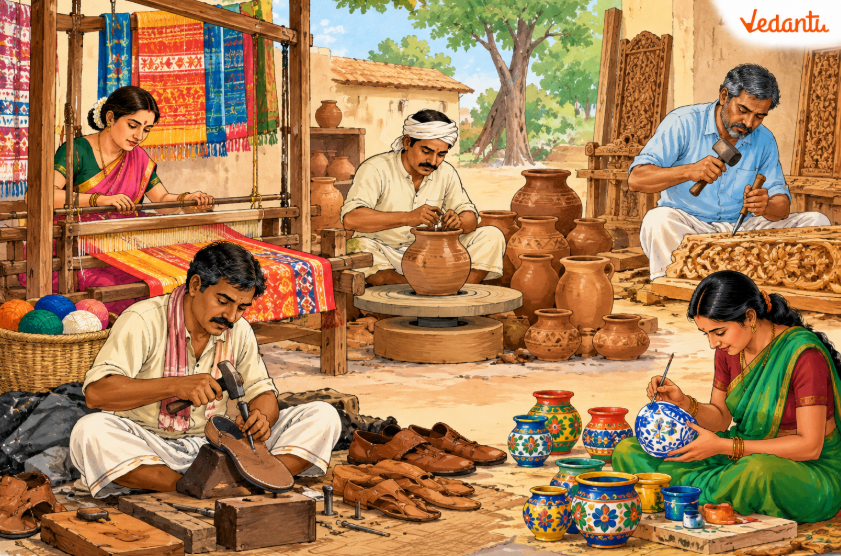
Q14. Observe the illustration of different crafts. Identify two activities and explain how they represent skill and creativity.
Answer:
The illustration shows workers engaged in different forms of craftsmanship, including preparing bamboo materials, decorating a pot and weaving cloth.
A person decorating a pot uses artistic judgement and control to create colourful patterns. The finished object reflects both practical skill and creativity.
A weaver uses careful hand movements to produce cloth. Weaving requires patience, coordination and an understanding of patterns.
Both activities show that traditional crafts depend on training, imagination and repeated practice.
Q15. Why does the poet mention the shoemakers and the different actions performed by people's feet?
Answer:
The poet mentions activities such as walking, dancing, running and jumping to explain the everyday importance of footwear.
Shoemakers help people perform these activities comfortably and safely by producing suitable shoes.
The description reminds readers that even ordinary objects, such as shoes, require someone's effort and expertise.
By highlighting the practical value of footwear, the poet encourages appreciation for the people who make it.
Q16. Explain the significance of the idea that a person's vocation forms part of their identity.
Answer:
The poem suggests that a vocation is more than a way to earn a living. It can also express a person's talents, interests, knowledge and creativity.
A carpenter may take pride in precise woodwork, while a craftsperson may express artistic ideas through colours and designs. Similarly, a boatman's experiences and a cook's creativity reflect the distinctive nature of their occupations.
The poet therefore connects work with personal identity. Each worker contributes something unique to society, and that contribution deserves recognition.
Q17. What is the importance of auditory imagery in the poem? Give examples.
Answer:
Auditory imagery refers to words or descriptions that create an impression of sound.
The poem uses sound-related descriptions to make different vocations feel active and lively.
The artisans with lutes suggest music and emotional expression. The electricians are described as humming as they prepare for work. The boatmen sing while carrying out their duties.
The cook's singing and the rhythm associated with other workers also contribute to the poem's soundscape.
Through these examples, the speaker presents everyday work as a collection of different voices contributing to Bharat's life and culture.
Class 9 English Chapter 2 Poem Gifts of Grace: Honouring Our Vocations Long Answer Questions
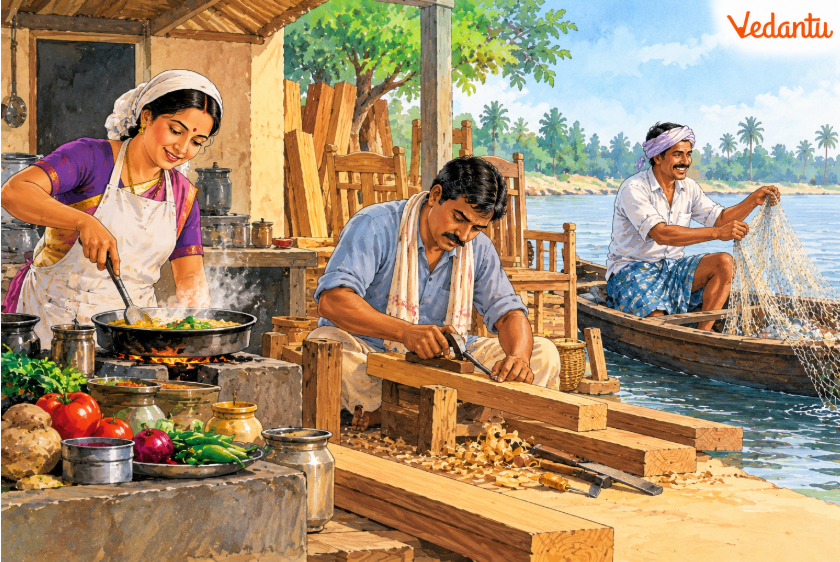
Q18. Study the illustration showing a cook, carpenter and boatman. How does it help explain the poet's message about the dignity of labour?
Answer:
The illustration presents three different occupations and helps readers understand why the poet celebrates the contributions of every worker.
1. The Cook: The cook prepares food using practical knowledge, care and creativity. Cooking provides a basic necessity while also involving taste, presentation and skill.
2. The Carpenter: The carpenter shapes wood into useful objects. The work requires planning, measurement, accuracy and experience.
3. The Boatman: The boatman works on the water and uses knowledge of boats, nets and the environment. His occupation supports activities such as fishing and transport.
4. Different Skills: The three workers do not perform the same tasks, but all possess abilities developed through learning and practice.
5. Everyday Importance: Their work supports people's daily needs. Food, furniture and services connected with waterways all have practical value.
6. Dignity of Labour: The poem encourages readers to respect the skill and effort behind every profession rather than judging people by their occupation.
7. Individual Identity: Each worker's knowledge and way of working contribute to their personal identity.
Conclusion: The illustration makes the poem's message easier to understand by showing that every vocation contributes something valuable to society.
Q19. Read the following adapted extract based on Gifts of Grace: Honouring Our Vocations and answer the questions.
The speaker notices the shoemakers taking pride in the quality of their footwear. Their work supports people in many activities, from walking and running to dancing and returning home. The speaker also celebrates cooks, designers and masons, recognising the different skills and rhythms associated with their professions.
This is a paraphrased practice extract based on the poem, not a direct quotation.
(i) What does the shoemakers' pride in quality reveal about their attitude towards work?
Answer: It reveals that they value good craftsmanship and take responsibility for the products they create.
(ii) Why are different movements such as walking and dancing mentioned?
Answer: These movements show how footwear supports people in different daily activities. They emphasise the usefulness of shoemakers' work.
(iii) What can returning home suggest beyond the literal action?
Answer: It can suggest comfort, belonging and the completion of everyday journeys, all of which are supported by the work of people who make footwear.
(iv) Why are cooks, designers and masons mentioned together?
Answer: They represent different practical and creative occupations. Their inclusion highlights the diversity of skilled work.
(v) Which central idea does this extract convey?
Answer: The extract conveys that every vocation has value and that the efforts of skilled workers deserve appreciation.
(vi) How does the poet turn ordinary work into something worth celebrating?
Answer:
The poet uses descriptive and rhythmic language to make everyday occupations appear lively and meaningful.
The shoemakers are presented as people who take pride in quality. The cook's work is associated with a pleasant musical expression, while the designer and mason are connected with the rhythm of their activities.
These descriptions encourage readers to notice the skill and creativity involved in ordinary tasks.
Instead of ranking different jobs, the speaker celebrates their distinctive contributions. This supports the poem's broader message of respect for all forms of work.
Q20. Explain the important poetic devices used in Gifts of Grace: Honouring Our Vocations with examples.
Answer:
The poem uses several poetic devices to celebrate different occupations and make its descriptions lively.
Conclusion: The poet uses repetition, imagery, metaphor, personification, alliteration and symbolism to celebrate different vocations. These devices make the poem lively and highlight the creativity, individuality and dignity of every worker.
Q21. Why is the title Gifts of Grace: Honouring Our Vocations appropriate? Explain the central message, tone and structure of the poem.
Answer:
The title Gifts of Grace: Honouring Our Vocations is appropriate because the poem celebrates the skills and contributions of people involved in different occupations.
The word gifts suggests that each worker possesses abilities that benefit others. The idea of honouring reminds readers that these abilities deserve recognition and respect.
1. Celebration of Different Occupations
The poem mentions craftspersons, artisans, carpenters, electricians, boatmen, shoemakers, cooks, designers and masons.
These professions involve different kinds of knowledge, but each makes a useful contribution.
2. Dignity of Labour
The poem teaches that work should be valued for the skill, effort and purpose involved rather than for its social status.
3. Skill and Creativity
Craftspersons use colour and design, carpenters work with precision, and cooks combine practical knowledge with creativity.
4. Work and Identity
The speaker suggests that a person's vocation reflects their abilities, interests and experiences. Work therefore becomes part of individual identity.
5. Respect for Diversity
The different professions represent a range of skills within society. The poem celebrates this diversity instead of suggesting that one vocation is superior to another.
6. Celebratory Tone
The speaker's attitude is appreciative and respectful. The descriptions are positive and convey admiration for workers.
7. Joyful Mood
References to singing, music, humming and colourful crafts create a lively, uplifting mood.
8. Free Verse Structure
The poem uses varying line lengths without a strict rhyme scheme. Its flexible structure helps convey the variety of occupations and their different rhythms.
9. Repetition
The opening and closing celebration of Bharat's vocations brings the poem together and reinforces its main message.
Conclusion:
The title is suitable because the poem honours the abilities and efforts of working people. Its central message is that every vocation has dignity and contributes to the richness of society.
Q22. Vocabulary and Writing Practice – Based on the Poem
Part A. Complete the following vocabulary exercise.
Match each word with its correct meaning.
Answer:
1 – (b) A very large number or variety
2 – (c) Different colours or shades
3 – (a) Exactness or accuracy
4 – (e) An occupation or type of work
5 – (d) To state confidently that something is true
Part B. Your school is organising a Career Mela to help students learn about different professions. Prepare a poster announcing the event.
Answer:
ABC PUBLIC SCHOOL
CAREER MELA
Explore Skills. Discover Careers.
25 February | 9:00 AM – 6:00 PM
School Auditorium
Career guidance • Interactive sessions • Meet professionals
Free Entry for Students
Chart Your Future at Career Mela!
Organised by ABC Public School
This poster-writing exercise relates to the chapter's language activities and helps students practise a useful writing format.
Important Topics to Practise for Class 9 English Kaveri Chapter 2 Poem Exams
Students preparing for Gifts of Grace: Honouring Our Vocations should focus on different occupations, their contributions to society, and the poetic devices used to highlight the dignity of labour.
Students should practise explaining each occupation's importance with examples from the poem.
Download Class 9 English Kaveri Chapter 2 Poem Important Questions PDF from Vedantu
Vedantu's Class 9 English Kaveri Chapter 2 Poem Important Questions and Answers include MCQs, short and long answers, extract-based questions and poetic devices from Gifts of Grace: Honouring Our Vocations.
The Class 9 English Kaveri Chapter 2 Poem Important Questions PDF, when available, can help students:
Revise different vocations and their contributions.
Practise MCQs and extract-based questions.
Understand poetic devices, themes and structure.
Improve vocabulary and answer-writing skills.
Students can use these questions for quick revision and independent exam preparation.
Additional Study Material for Class 9 English (Kaveri) Chapter 2 Poem
Important Questions Class 9 English Kaveri (Poem)
Important Questions Class 9 English Kaveri (Prose)
Important Study Materials for Class 9 English
FAQs on Important Questions and Answers for Class 9 English (Kaveri) Chapter 2 Poem Gifts of Grace: Honouring Our Vocations | 2026–27
1. Why does the poet celebrate people working in different vocations?
The poet celebrates different workers because each person contributes something valuable to society. Craftspersons create beautiful products, electricians provide essential services, and carpenters make useful objects with precision. The poem encourages readers to respect the abilities and efforts behind every occupation.
2. What is the central message of Gifts of Grace: Honouring Our Vocations?
The central message is that every vocation deserves dignity and respect. The poem highlights the creativity, knowledge and dedication involved in different professions. It also shows how people's skills and occupations contribute to their identity and the wider community.
3. How should students prepare for Class 9 English Kaveri Chapter 2 Poem Important Questions MCQs?
Students should revise the occupations mentioned in the poem and understand the contribution of each worker. They should also practise identifying examples of imagery, metaphor, personification, alliteration and repetition. Understanding the poem's meaning will help with both factual and inference-based MCQs.
4. Where can students find Class 9 English Kaveri Chapter 2 Poem Important Questions PDF for revision?
Students can practise solved MCQs, short answers, long answers and extract-based questions on this Vedantu page. The Class 9 English Kaveri Chapter 2 Poem Important Questions PDF can also support offline revision once the downloadable file is available.
5. What does the poet mean by connecting a person's vocation with their identity?
The poet suggests that an occupation reflects more than the work someone performs. It can also represent their knowledge, creativity, training and experience. For example, a carpenter's precision and an artisan's designs show distinctive skills that form part of their individuality.
6. How are carpenters and electricians praised in the poem?
Carpenters are praised for their ability to create useful objects from wood with mathematical precision. Electricians are recognised for working with cables and wires to brighten people's lives. These descriptions highlight the skill and practical importance of both professions.
7. Why does the poet mention music and singing while describing different occupations?
Music and singing create a lively picture of everyday work. The references to lutes, humming electricians and singing boatmen suggest that working life has its own sounds and rhythms. These descriptions also make the poem more engaging through auditory imagery.
8. Which poetic devices are important in Gifts of Grace: Honouring Our Vocations?
The poem uses repetition, visual and auditory imagery, metaphor, personification, alliteration and symbolism. For example, the repeated opening and closing idea celebrates the diversity of vocations, while the reference to a vocation having a voice connects work with identity.
9. Why is Gifts of Grace: Honouring Our Vocations written in free verse?
The poem uses free verse, with no fixed rhyme scheme and lines of different lengths. This flexible structure allows the poet to describe many occupations without following a strict pattern. It also helps convey the variety and movement associated with everyday work.
10. How do Class 9 English Kaveri Chapter 2 Poem Important Questions and Answers help students prepare for exams?
These questions help students understand different vocations, the poem's central message and the literary devices used by the poet. Practising MCQs, descriptive answers, and extracts develops comprehension and helps students explain ideas using relevant examples.
11. Why does the poet begin and end by celebrating Bharat's varied vocations?
The repetition highlights the importance of appreciating every occupation. By returning to the same idea at the end, the poet brings the descriptions of different workers together and reinforces the message that their contributions deserve recognition.
12. What vocabulary and writing activities should students practise from this poem?
Students should revise words such as myriad, hues, precision, affirm and vocation. They can also practise identifying different occupations from their descriptions and preparing a Career Mela poster, as included in the chapter's exercises.