The State, the Government, and You – Class 7 Social Science Chapter 6
Save the Class 7 Social Science Part 2 Chapter 6 PDF to study offline. Use it to check whether you can explain the difference between the State and the government. Then connect that idea to everyday life by thinking about how a public service, such as a school or hospital, continues to serve people when the government changes.
Class 7 Social Science Part 2 Chapter 6 MCQs with Answers
Q1. Which feature makes a State sovereign?
A. It has several levels of government.
B. It can make its own laws without outside control.
C. It changes its borders after every election.
D. It follows laws made by another country.
Answer: B. It can make its own laws without outside control.
Q2. Which feature makes India a republic?
A. Its head of State inherits the position.
B. Its head of State holds office for life.
C. Its head of State is elected indirectly.
D. Its head of State is chosen by the courts.
Answer: C. Its head of State is elected indirectly.
Q3. Which organ of government makes laws?
A. Legislature
B. Executive
C. Judiciary
D. Police
Answer: A. Legislature.
Q4. A new government takes office after an election. Which statement best describes what has happened?
A. The country has become a new State.
B. The country has lost its sovereignty.
C. The permanent executive must be replaced.
D. The government has changed, while the State continues.
Answer: D. The government has changed, while the State continues.
Q5. Which pair correctly matches a tier of government with an example of its work?
A. Union government - maintaining neighbourhood streetlights
B. State government - running the country’s foreign affairs
C. Local government - maintaining neighbourhood drainage
D. Local government - issuing the country’s currency
Answer: C. Local government - maintaining neighbourhood drainage.
Class 7 Social Science Part 2 Chapter 6 Very Short Answer Questions
Q6. What are the four basic elements of a State?
Answer
A State has a population, a defined territory, a government and sovereignty.
Q7. How does the Constitution limit the powers of the head of State in a republic?
Answer
The Constitution sets rules for the office and defines the powers its holder can exercise. The head of State must act within those limits.
Q8. Why is decentralisation useful for solving local problems?
Answer
Decentralisation spreads decision-making across different levels of government. It lets local bodies deal with nearby problems and gives residents a greater say in decisions that affect them.
Q9. Why do officers in the permanent executive usually continue working after an election?
Answer
Their jobs do not depend on which political leaders win the election. They continue carrying out the government’s work when new leaders take office.
Class 7 Social Science Part 2 Chapter 6 Short Questions and Answers
Q10. Why is India called a democratic republic?
Answer
India is a democracy because people elect representatives who take part in governing the country. It is a republic because its President, the head of State, is elected indirectly and exercises powers within the limits set by the Constitution.
Q11. How do the political executive and the permanent executive work together?
Answer
The political executive makes major decisions and sets policies. The permanent executive advises ministers and puts government policies, programmes and schemes into practice. For example, ministers may decide to introduce a scheme, and government officers handle its day-to-day implementation.
Q12. How did citizens use the Right to Information Act to address the roadwork problem in Bagepalli?
Answer
A local citizen requested information about the money allocated for the roadwork. A group of residents used that information to raise the issue with the officials responsible. The officials then ensured the work was completed. The case shows how access to public information can help people hold officials accountable.
Q13. Look at the picture. One resident points to a blocked drain, and another points to a broken streetlight. Which tier of government should they approach, and why?
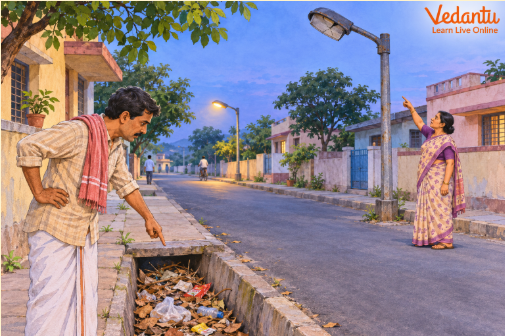
Answer:
The residents should approach their local government, such as the municipality. Drainage and streetlighting are local services, so the municipality can arrange to clear the drain and repair the streetlight.
Q14. How did giving panchayats and municipalities constitutional recognition strengthen democracy?
Answer:
Constitutional amendments made rural and urban local governments the third tier of government. This brought decision-making closer to villages, towns and cities. It also gave people more opportunities to take part in decisions about local needs.
Class 7 Social Science Part 2 Chapter 6 Long Answer Questions
Q15. Explain the difference between the State and the government. Use an election to show what can change and what continues.
Answer
An election can change who governs and what policies they follow. The new government exercises its authority within the same constitutional system.
Q16. How do the three organs of government play different roles in protecting a child’s right to education?
Answer
Legislature: It makes laws that set out children’s rights and the government’s responsibilities in education.
Executive: It puts those laws into practice. Government departments carry out education policies and manage services that help children attend school.
Judiciary: It interprets the law and can hear cases when someone claims that a child’s right to education has been denied.
For example, if a child is denied admission in a way that violates the law, the education authorities can look into the complaint. If the matter comes before a court, the court can examine whether the law was followed.
Q17. A town has a blocked public drain, a shortage of staff at a government hospital and a damaged national highway. Which tier of government would you associate with each issue? How could residents follow up on the drainage problem?
Answer
For the blocked drain, residents can report the location to the municipality or raise it with their local representative. If they need official information about funds allocated for drainage work or the status of a repair project, they can request it under the Right to Information Act.
Explain Government Roles Clearly in Class 7 Social Science Chapter 6 Answers
A clear answer names who is responsible and explains what they do. Use these checks when studying The State, the Government, and You.
Separate the State from the government: Use an election to explain what changes when new leaders take office and what continues as part of the State.
Explain both terms: When describing India as a democratic republic, explain how citizens choose their representatives and how the President is elected.
Keep organs and tiers separate: Use the legislature, executive and judiciary to explain different functions. Use Union, state and local governments to explain the levels at which decisions are made.
Match the service to the right tier: Connect a blocked neighbourhood drain to the municipality and explain why drainage is a local responsibility.
Show how citizens followed up: In the Bagepalli roadwork example, explain what information residents obtained and how they used it to approach officials.
Check Your Chapter 6 Answers with Vedantu
Use Vedantu’s extra questions and answers on The State, the Government, and You to check whether you can apply the chapter’s ideas to everyday situations.
Try a different example: After explaining who handles a broken streetlight, try the same reasoning with a staffing shortage at a state-run hospital.
Follow one law through all three organs: Use the right to education to explain who makes the law, who puts it into practice and who can hear a dispute about it.
Use a visible clue: In the neighbourhood illustration, point out the blocked drain or damaged lamp before explaining which authority residents should approach.
Check both sides of a comparison: When comparing the political and permanent executives, describe what each does and how they work together.
Improve one answer: Choose a response from the Class 7 Chapter 6 questions and answers PDF. Try it in your own words, then check whether you included a reason or example that supports your point.
Class 7 Social Science Part 2 Chapter 6 The State, the Government, and You Study Materials
Class 7 Social Science Chapter-wise Important Questions
Important Study Materials for CBSE Class 7 Social Science
FAQs on Important Questions for Class 7 Social Science (Exploring Society: India and Beyond Part 2) Chapter 6 The State, the Government, and You | 2026-27
1. What is the difference between the State and the government?
The State includes a country's people, territory, government, and sovereignty. The government runs public affairs and can change after an election, while the State continues.
2. Why is India called a democratic republic?
India is democratic because people elect their representatives. It is a republic because its head of State, the President, is elected indirectly and exercises powers within the limits set by the Constitution.
3. How are the three organs of government different from the three tiers?
The organs describe what the government does. The legislature makes laws, the executive implements them, and the judiciary interprets them. The tiers are the levels at which government works: Union, state and local.
4. What is the difference between the political executive and the permanent executive?
The political executive includes leaders who decide policies. The permanent executive consists of officers who advise those leaders and carry out policies. These officers generally continue their work when political leaders change.
5. Why were panchayats and municipalities made the third tier of government?
This brought decisions about local needs closer to the people they affect. Panchayats serve rural areas, while municipalities serve towns and cities. Both give residents opportunities to take part in local decision-making.
6. How did the Right to Information Act help residents in Bagepalli?
A resident used the Act to get information about the money set aside for roadwork. Residents then used that information to raise the issue with the officials responsible, who ensured the work was completed.
7. How can I use Vedantu’s The State, the Government, and You Class 7 questions and answers PDF?
Download the PDF to practise offline. Try answering in your own words, then compare your response with the solved answer to check whether you included a clear reason or a relevant example.