Practise Class 4 EVS Chapter 6 Important Questions on Happy and Healthy Living
Practise these solved questions on the journey of grains, people involved in food production, mindful eating, food wastage, physical activities, sleep and personal safety.
Class 4 EVS Chapter 6 Important Questions MCQ with Answers
Q1. Which of the following is necessary for a seed to grow into a healthy plant?
(a) Plastic and stones
(b) Soil, water, air and sunlight
(c) Only sunlight
(d) Only fertilisers
Answer: (b) Soil, water, air and sunlight.
Explanation: Plants need suitable conditions for growth. Soil provides support and nutrients, while water, air and sunlight help plants grow.
Q2. Who helps grow crops and harvest grains?
(a) Shopkeeper
(b) Doctor
(c) Farmer
(d) Tailor
Answer: (c) Farmer.
Explanation: Farmers prepare fields, sow seeds, care for crops and harvest them when they are ready.
Q3. What does mindful eating mean?
(a) Eating food very quickly
(b) Watching television while eating
(c) Paying attention to the food we eat
(d) Eating only our favourite foods
Answer: (c) Paying attention to the food we eat.
Explanation: Mindful eating means eating slowly and noticing the taste, smell and texture of food.
Q4. Which of the following activities helps keep our body active?
(a) Sitting in one place all day
(b) Cycling and playing outdoor games
(c) Watching television for many hours
(d) Avoiding all physical activities
Answer: (b) Cycling and playing outdoor games.
Explanation: Activities such as cycling, running, skipping and playing games help us stay active and strong.
Q5. What should a child do if someone's touch makes them feel uncomfortable or unsafe?
(a) Keep it a secret
(b) Ignore their feelings
(c) Say "No", move away when possible and tell a trusted adult
(d) Stay with the person without telling anyone
Answer: (c) Say "No", move away when possible and tell a trusted adult.
Explanation: Children have the right to feel safe. They should speak to a trusted adult, such as a parent or teacher, whenever someone makes them feel unsafe or uncomfortable.
Class 4 EVS Chapter 6 Very Short Answer Questions
Q6. What is the journey of grains?
Answer: The journey of grains is the process through which grains are grown, harvested, transported, sold, cooked, and finally served as food.
Q7. Why should we thank farmers for the food we eat?
Answer: Farmers work hard to grow crops. Their efforts help provide food for our families and us.
Q8. What is the role of our teeth during mindful eating?
Answer: Our teeth chew food and break it into smaller pieces, making it easier to swallow and digest.
Q9. Why is proper sleep important for children?
Answer: Proper sleep helps our body rest, reduces tiredness and helps us feel fresh and ready for daily activities.
Q10. Name two people you can tell if you feel unsafe.
Answer: We can tell our parents, teachers or another trusted adult if we feel unsafe.
Class 4 EVS Chapter 6 Short Answer Questions
Q11. Picture-Based Question: Arrange the Journey of Grains in the Correct Order.
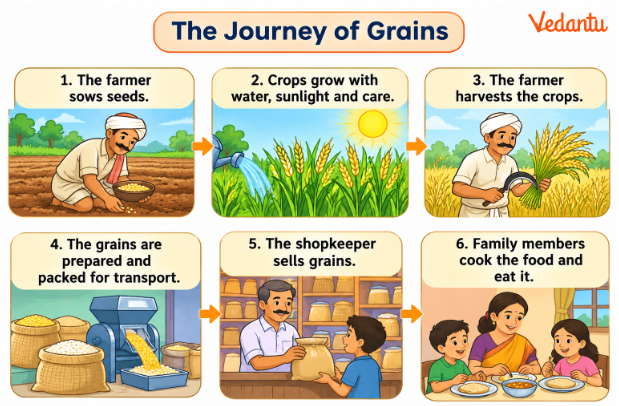
Look at the pictures showing how grains travel from the farm to our plate.
Arrange the following activities in the correct order:
A. The shopkeeper sells grains.
B. The farmer sows seeds.
C. Family members cook the food.
D. Crops grow with water, sunlight and care.
E. The farmer harvests the crops.
F. The grains are prepared and packed for transport.
Answer:
Conclusion: Many people and natural elements contribute to bringing food from farms to our plates.
Q12. Explain the roles of soil, water, sunlight and earthworms in growing crops.
Answer:
Each natural element supports crop growth differently.
Conclusion: These natural elements work together to support plants. Without suitable conditions, crops cannot grow properly.
Q13. How do farmers, cattle, shopkeepers and family members help bring food to our plates?
Answer:
Different people and animals contribute to food production and preparation.
Explanation: Food does not reach our plates through the work of one person. Many people contribute at different stages.
Q14. Why should we avoid wasting food? Suggest four ways to reduce food waste.
Answer:
We should avoid wasting food because many people, animals and natural resources contribute to its production.
Four ways to reduce food waste are:
Take only as much food as we need.
Ask for smaller servings and take more if needed.
Store food properly to prevent spoilage.
Use suitable leftovers safely instead of throwing them away.
Example: If someone offers more food than we can eat, we can politely ask for a smaller serving.
Conclusion: Avoiding food waste shows respect for food, people and natural resources.
Q15. What is mindful eating? Explain the steps followed by the students in the chapter.
Answer:
Mindful eating means paying attention to our food and how we feel while eating.
In the chapter, the teacher gave students a peanut and guided them through an activity.
Steps in Mindful Eating:
Observe or feel the food carefully.
Place it in the mouth slowly.
Notice its taste and texture.
Chew it gently with your teeth.
Pay attention to its flavour.
Swallow carefully after chewing.
Benefits:
Helps us notice different tastes and textures.
Encourages us to eat slowly.
Helps us appreciate our food.
Safety Note: Any classroom tasting activity should use a food that is safe for every student, taking food allergies into account.
Q16. How do our tongue, teeth and saliva help us while eating?
Answer:
Our mouth contains different parts that help us eat and begin digesting food.
These parts work together to make food easier to swallow.
Q17. Picture-Based Question: Identify Physical Activities That Keep Us Healthy.
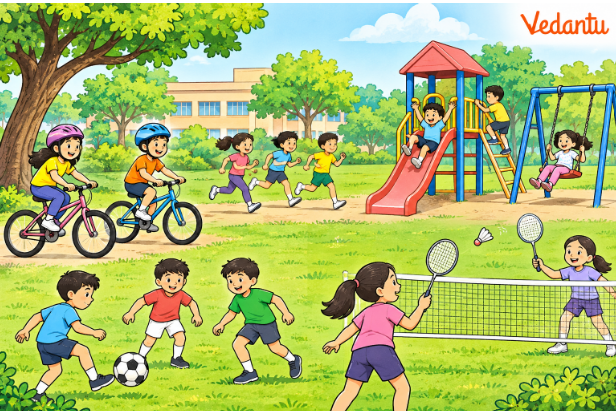
Observe the playground illustration in the textbook.
Answer the following questions:
(a) Name two activities children are doing.
(b) Which activity uses a bicycle?
(c) Which activities require running or jumping?
(d) How does playing outdoors help our body?
(e) Why should children balance physical activity with rest?
Answer:
(a) Children are playing football, badminton and other outdoor games.
(b) Cycling uses a bicycle.
(c) Football, running and skipping involve running or jumping.
(d) Outdoor play helps us stay active, develop physical skills and enjoy time with others.
(e) Our body also needs rest to recover from physical activities.
Q18. Picture-Based Question: Identify the Games and Yoga Activities.
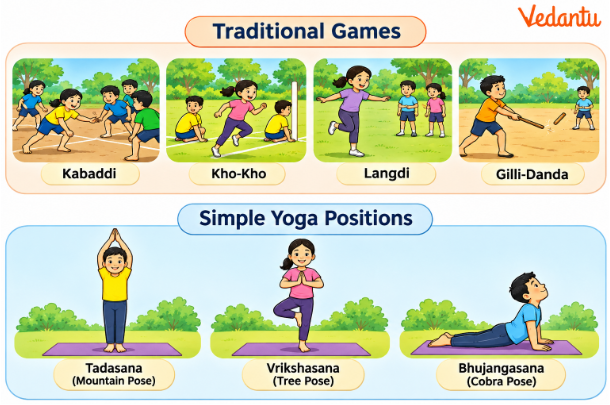
Look at the pictures showing children playing traditional games and practising yoga.
Name the games and explain how these activities help us.
Answer:
Remember: Yoga and games should be practised safely, with suitable guidance.
Q19. What happens when we do not get enough sleep?
Answer:
Our body needs sufficient sleep to rest and recover from daily activities.
Without enough sleep, we may:
Feel tired during the day.
Find it difficult to concentrate.
Feel sleepy while studying.
Become irritable.
Have less energy for games and other activities.
Conclusion: Proper sleep is just as important as eating nutritious food and staying physically active.
Class 4 EVS Chapter 6 Long Answer and Application-Based Questions
Q20. Explain the Journey of Grains from the Farm to Our Plate. Why Should We Respect Every Grain?
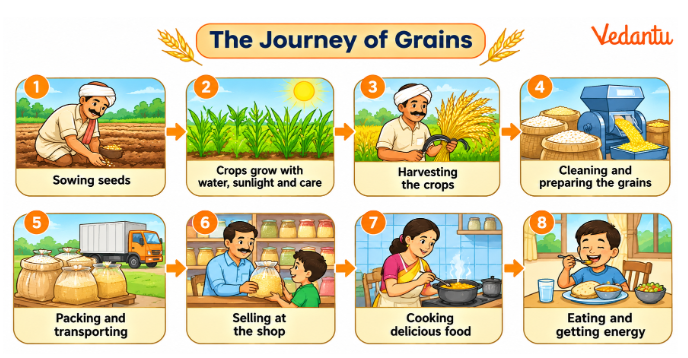
Answer:
The journey of grains involves natural resources, farmers, animals, transport workers, sellers and the people who prepare our meals.
1. Sowing Seeds
Farmers prepare the soil and sow seeds in their fields.
2. Growing Crops
Water, sunlight, air and nutrients from the soil help the plants grow.
3. Caring for Crops
Farmers care for their fields. Animals such as cattle and organisms such as earthworms also contribute to farming.
4. Harvesting
When crops mature, farmers harvest them.
5. Preparing and Transporting Grains
The harvested grains are collected, processed, packed and transported.
6. Selling Grains
Shopkeepers sell grains and other food items to people.
7. Cooking Food
Family members or cooks prepare meals using the grains.
8. Eating the Meal
The prepared food finally reaches our plates.
Why should we respect every grain?
Every grain represents the hard work of many people and the use of natural resources.
Wasting food also means wasting some of the time, water and effort used to produce it.
Conclusion: We should value food and be thankful to everyone who helps bring it to our plates.
Q21. Activity-Based Question: Prepare a Daily Routine for Happy and Healthy Living
Your teacher asks you to make a daily routine that includes healthy food, exercise, learning and rest.
Prepare a simple activity chart.
Answer:
My Healthy Daily Routine
Conclusion: Regular habits support both physical and mental well-being.
Q22. Picture-Based Case Study: Understanding Safe and Unsafe Situations.
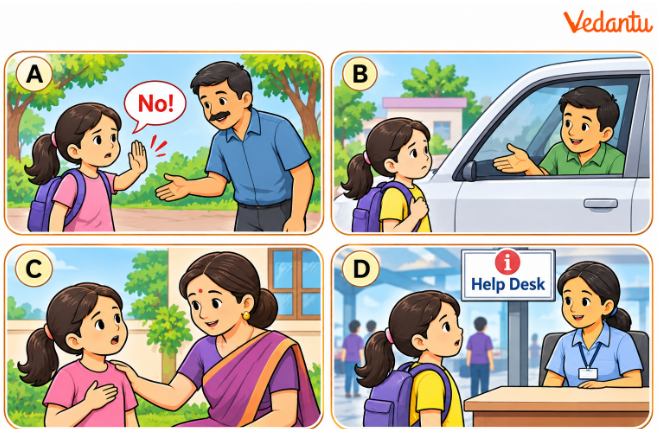
Look at the pictures showing different interactions between children and adults.
Read the situations and decide what the child should do.
Situation A: A trusted family member gives a child a welcome hug, and the child feels comfortable.
Situation B: Someone holds a child's arm even after the child asks them to stop.
Situation C: A healthcare worker examines a child while a parent or trusted caregiver is present and explains what is happening.
Situation D: Someone asks a child to keep an uncomfortable touch secret.
Questions:
(a) Which situations require the child to speak up or seek help?
(b) Can a child say "No" to an unwanted touch?
(c) What should a child do if someone asks them to keep an unsafe touch secret?
(d) Name two trusted adults the child can approach.
(e) Why is it important to listen to our feelings of discomfort?
Answer:
(a) Situations B and D require the child to speak up or seek help.
(b) Yes. A child can say "No" when a touch is unwanted or uncomfortable.
(c) The child should tell a trusted adult and should not keep unsafe touching secret.
(d) Parents, teachers or another trusted adult can help.
(e) Feeling uneasy or unsafe may be a sign that something is wrong. Speaking up can help a child get protection and support.
Remember: Even a familiar person can behave in an unsafe way. A child has the right to refuse unwanted touch, and an unsafe experience should never be blamed on the child.
Q23. Case-Based Question: Help a Classmate Develop Healthy Habits
Rahul often rushes through his meals, spends most of his free time watching videos and goes to bed very late.
He feels tired during school and rarely plays outside.
His teacher asks students to suggest a healthier daily routine.
Answer the following questions:
(a) Identify three habits Rahul should improve.
(b) How can Rahul practise mindful eating?
(c) Suggest two physical activities for him.
(d) Why should Rahul sleep at a regular time?
(e) Write a short plan to help Rahul develop healthier habits.
Answer:
(a) Habits to Improve
Rahul should avoid rushing through meals, reduce unnecessary screen time and follow a regular sleep schedule.
(b) Mindful Eating
Rahul can sit comfortably, eat slowly, chew food properly and pay attention to its taste and texture.
(c) Physical Activities
He can try cycling, running, skipping, yoga or outdoor games with friends.
(d) Importance of Sleep
Regular and sufficient sleep helps reduce tiredness and improves attention during daily activities.
(e) Healthy Habits Plan
Eat meals at regular times.
Pay attention while eating.
Spend time playing or exercising.
Limit unnecessary screen time.
Follow a regular bedtime routine.
Conclusion: Healthy eating, physical activity and sufficient sleep work together to support a happy and healthy life.
Key Topics and Revision Guide for Class 4 EVS Chapter 6 – Happy and Healthy Living
Revise these concepts before practising Class 4 EVS Chapter 6 important questions and answers.
Quick Preparation Tips for Class 4 EVS Chapter 6
Revise the stages in the Journey of Grains.
Learn the roles of farmers, animals and other food contributors.
Practise questions on mindful eating and avoiding food waste.
Identify outdoor games, yoga activities and personal-safety situations from pictures.
Understand why sleep and rest are important for good health.
Class 4 EVS Chapter 6 Important Questions PDF Download
Download Vedantu's Class 4 EVS Chapter 6 important questions PDF to practise solved MCQs, short answers, picture-based exercises and application questions from Happy and Healthy Living. The Class 4 EVS Chapter 6 important questions and answers PDF covers the journey of grains, mindful eating, food wastage, physical activities, sleep and safety for offline revision.
CBSE Class 4 EVS Chapter 6 Study Materials
Use these chapter-specific resources to understand Happy and Healthy Living and practise its activities.
CBSE Class 4 EVS Chapter-wise Important Questions
Practise important questions from other chapters of Our Wondrous World to explore topics related to communities, nature, health, everyday science and the environment.
Important Study Materials for CBSE Class 4 EVS
FAQs on Important Questions and Answers for Class 4 EVS (Our Wondrous World) Chapter 6 – Happy and Healthy Living | 2026–27
1. What is the Journey of Grains in Class 4 EVS Chapter 6?
The Journey of Grains describes how seeds are sown, crops are grown and harvested, grains are transported and sold, and food is cooked before reaching our plates. Many people and natural elements contribute to this process.
2. Why should we respect every grain of food?
Every grain represents the hard work of farmers, sellers, family members and others. Soil, water, sunlight and animals also support food production. Avoiding waste shows respect for these efforts and resources.
3. What does mindful eating mean in Happy and Healthy Living?
Mindful eating means paying attention to what we eat and how we feel while eating. It includes eating slowly, chewing properly and noticing the taste, smell and texture of food.
4. How can students avoid wasting food?
Students can take suitable portions, ask for more only when needed, store food properly and avoid throwing away safe, edible food. They can also learn to appreciate the work involved in producing meals.
5. Which festivals express gratitude towards nature and food?
The chapter mentions Makar Sankranti, Akshay Tritiya, Raja Utsav, Onam and Lohri as examples of festivals and traditions connected with gratitude towards nature and food.
6. How do outdoor games help children stay healthy?
Outdoor games encourage movement, strengthen physical skills and provide opportunities to play with others. Activities such as running, cycling, skipping, and football help children remain active.
7. What should a child do if someone makes them feel unsafe?
The child should say "No" if possible, move to a safer place and tell a trusted adult. They should continue seeking help if the first adult does not respond.
8. Where can I get the Class 4 EVS Chapter 6 important questions PDF download?
Students can download Vedantu's Class 4 EVS Chapter 6 important questions PDF from the PDF download section on this page. It contains solved questions on Happy and Healthy Living for offline practice and school exam revision.