Practise Class 4 EVS Chapter 2 Important Questions on Exploring Our Neighbourhood
Practise solved questions from Class 4 EVS (Our Wondrous World) Chapter 2, on Navya's journey, communication methods, transport facilities, public services, saving money, and neighbourhood maps.
Class 4 EVS Chapter 2 Important Questions MCQ with Answers
Q1. Which route did Navya want to take while returning home from school?
(a) River route
(b) Market route
(c) Forest route
(d) Railway route
Answer: (b) Market route
Explanation: Navya asked her Dada ji to take the market route while returning home from school. During the journey, she learned about different places and services in her neighbourhood.
Q2. What did Navya's grandfather use to communicate with his brother when he was young?
(a) Video calls
(b) Social media
(c) Letters
(d) Text messages
Answer: (c) Letters
Explanation: Dada ji wrote letters to his brother, who lived in another city. He dropped them into a postbox, and the postal service delivered them.
Q3. What is the main purpose of a flyover?
(a) To store vehicles
(b) To help vehicles pass above busy roads and crossings
(c) To send letters
(d) To provide medical treatment
Answer: (b) To help vehicles pass above busy roads and crossings.
Explanation: Flyovers help improve traffic movement and reduce delays at busy roads and crossings.
Q4. What is the full form of ATM?
(a) Automatic Travel Machine
(b) Automated Teller Machine
(c) Advanced Transport Method
(d) Automatic Ticket Machine
Answer: (b) Automated Teller Machine
Explanation: An ATM helps people withdraw money from their bank accounts. It is one of the banking facilities discussed in the chapter.
Q5. A student looks at a map where north is at the top. Which direction will be on the right side?
(a) West
(b) South
(c) East
(d) North
Answer: (c) East
Explanation: On a standard map, north is at the top, south is at the bottom, east is on the right and west is on the left.
Class 4 EVS Chapter 2 Very Short Answer Questions
Q6. What is communication?
Answer: Communication is the process of sharing information, messages, ideas or feelings with other people.
Q7. Name two older and two modern methods of communication.
Answer:
Older methods: Letters and telegrams.
Modern methods: Mobile phone calls and emails.
Q8. Why do people visit a hospital or health centre?
Answer: People visit hospitals and health centres to receive medical treatment, health check-ups and other healthcare services.
Q9. Why is it important to save money?
Answer: Saving money helps us meet future needs, manage unexpected expenses and avoid spending everything at once.
Q10. What is a landmark? Give one example.
Answer: A landmark is a place or object that helps us recognise a location or find our way.
Example: A school, hospital or post office can be used as a landmark.
Class 4 EVS Chapter 2 Short Answer Questions
Q11. How does a post office help people communicate with one another?
Answer:
A post office helps people send and receive letters, parcels and important documents.
How letters are delivered:
A person writes a letter and places it in a postbox.
A postal worker collects the letter.
The post office sorts letters according to their destinations.
Letters are sent to the correct areas.
Postal workers deliver them to the recipients.
Post offices provide other useful services, including some financial services.
Conclusion: Postal services help people stay connected, even when they live far away.
Q12. How have methods of communication changed from the past to the present?
Answer:
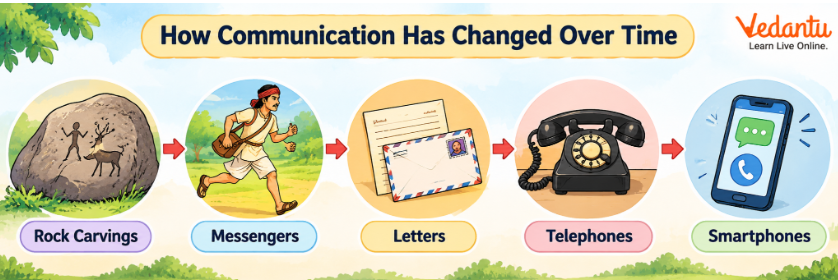
Communication methods have changed as new technologies have developed.
Long ago, people used drumbeats, rock carvings and messengers to share information.
Later, letters, postal services, telephones, radio and television became common.
Today, mobile phones, emails and the internet allow people to communicate much faster.
Conclusion: Modern communication is faster, but people must check information before sharing it.
Q13. Why should we check information before sharing it through mobile phones or the internet?
Answer:
Modern technology allows messages and news to reach many people quickly.
However, incorrect information can also spread quickly.
Before sharing information, we should:
Check whether it comes from a reliable source.
Ask a parent or teacher when unsure.
Avoid forwarding messages without checking them.
Compare important information with trusted sources.
Example: If a message says that school will remain closed tomorrow, students should check the official school announcement before sharing it.
Conclusion: Checking information helps prevent confusion and the spread of false news.
Q14. Picture-Based Question: Identify the Transport Facilities.
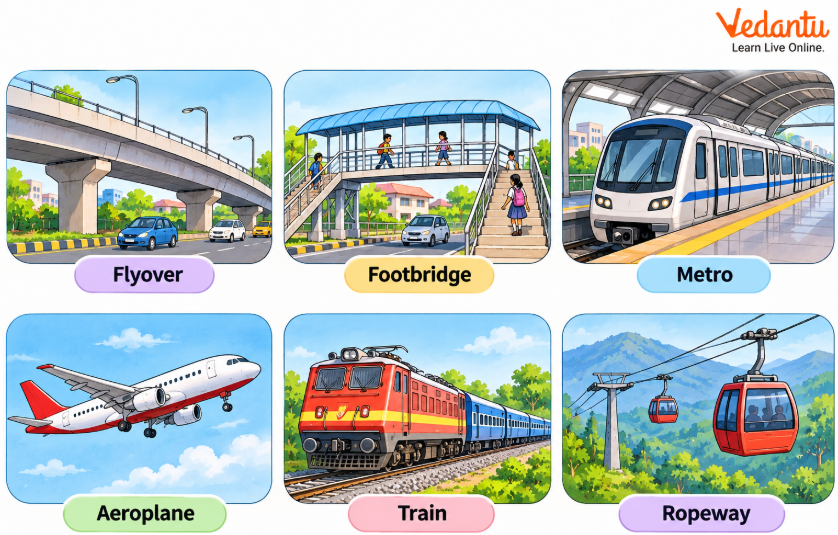
Look at the pictures of different transport facilities shown in the chapter.
Identify each and explain how it helps people travel.
Answer:
Explanation: Different transport facilities help people travel across roads, cities and difficult areas.
Q15. Why did Dada ji feel that modern transport facilities were both useful and harmful?
Answer:
Dada ji explained that modern transport facilities, such as metros and flyovers, have made travel faster and easier.
Benefits:
People can reach places more quickly.
Traffic movement becomes easier.
Different parts of a city become better connected.
Concerns:
Some trees may be removed during construction.
Birds and animals can lose their habitats.
Natural surroundings may be disturbed.
Navya wondered whether development could happen without harming the environment.
Dada ji explained that people should maintain a balance between development and nature.
Conclusion: Better transport is important, but we should also protect trees, animals and the environment.
Q16. Who works in a hospital, and how do they help patients?
Answer:
Different people work together to provide healthcare services.
In the chapter, Navya notices an eye check-up camp organised by a hospital.
Dada ji also tells her how doctors helped her grandmother see better after an eye operation.
Conclusion: Hospitals depend on different workers to provide care and maintain a safe environment.
Q17. What is the difference between a bank, an ATM and a Money Order?
Answer:
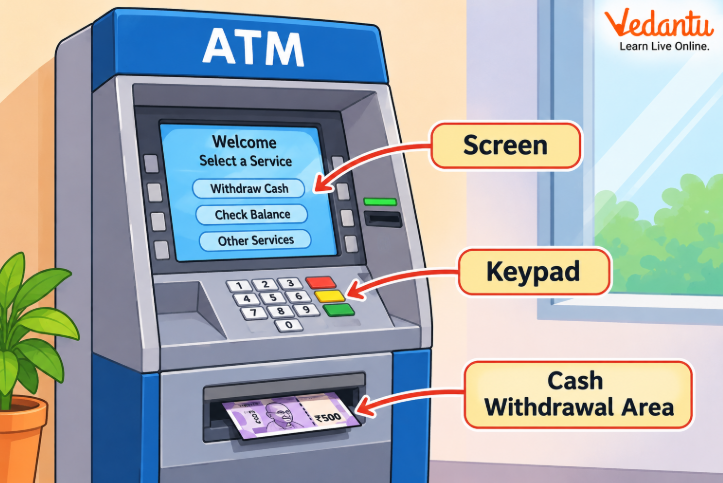
Banks, ATMs and Money Orders help people manage or transfer money in different ways.
Example from the chapter:
Dada ji explains that people earlier visited banks and used Money Orders to send money.
Navya tells him that her Mama sent money to her mother using a mobile phone.
Conclusion: Technology has made many financial services faster and more convenient.
Q18. Picture-Based Question: Find Places Around Navya's Home Using Directions
Study the neighbourhood map showing Navya's house and nearby places.
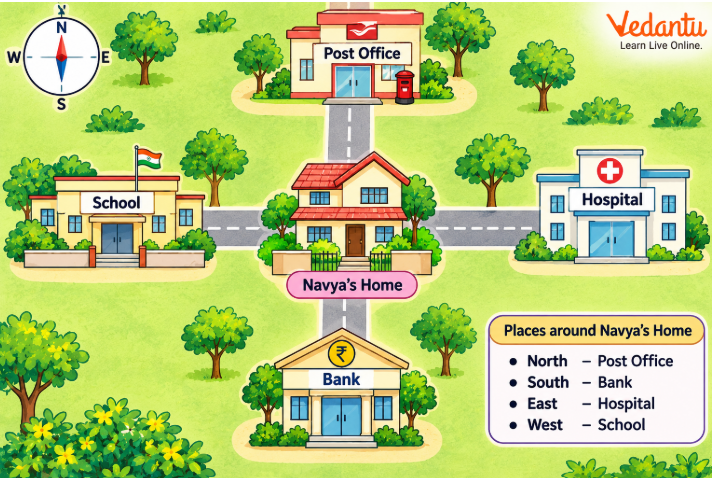
Answer the following questions:
(a) Which building is to the north of Navya's home?
(b) Which shop is to the east?
(c) What is located to the west?
(d) Which public place is to the south?
(e) In which direction does the Sun rise?
Answer:
Remember the Four Directions:
North – Top
South – Bottom
East – Right
West – Left
These positions apply when the map is oriented with north at the top.
Q19. What is the barter system, and why did people begin using money?
Answer:
The barter system is a method of exchanging goods or services without using money.
Example:
A farmer could exchange wheat with a shepherd to receive milk.
Difficulties of the Barter System:
Both people must want what the other person offers.
Deciding the correct exchange value can be difficult.
Some goods are difficult to divide or exchange.
Money made buying, selling and exchanging goods easier.
Conclusion: Money simplified trade because people no longer had to exchange one product directly for another.
Class 4 EVS Chapter 2 Long Answer and Application-Based Questions
Q20. Describe Navya and her grandfather's journey home from school. What did Navya learn along the way?
Answer:
After school, Navya saw her grandfather waiting outside the school gate.
She asked him to take the market route while returning home.
1. At the Bus Stop
Navya and Dada ji walked to a bus stop and boarded a bus.
Navya sat near the window and watched the neighbourhood.
2. Learning About the Post Office
She noticed a red postbox.
Dada ji explained how people earlier sent letters and how the postal service delivered them.
3. Learning About Communication
Navya learned that letters once took days or weeks to reach people.
Today, mobile phones and emails make communication much faster.
4. Seeing Modern Transport
She saw a metro train and learned how metros and flyovers improve travel.
Dada ji also explained the importance of protecting the environment while developing transport facilities.
5. Passing a Hospital
They saw a hospital organising an eye check-up camp.
Dada ji explained how doctors had helped Navya's grandmother.
6. Visiting a Bank
Near their home, Navya saw an ATM.
She learned about banks, saving money and different methods of transferring money.
7. Drawing a Neighbourhood Map
After reaching home, Navya shared her experiences with her brother and drew a map of nearby places using directions.
Conclusion: Navya's journey helped her understand transportation, communication, public services, money and directions.
Q21. Picture-Based Question: Match Public Services with Their Workers and Vehicles
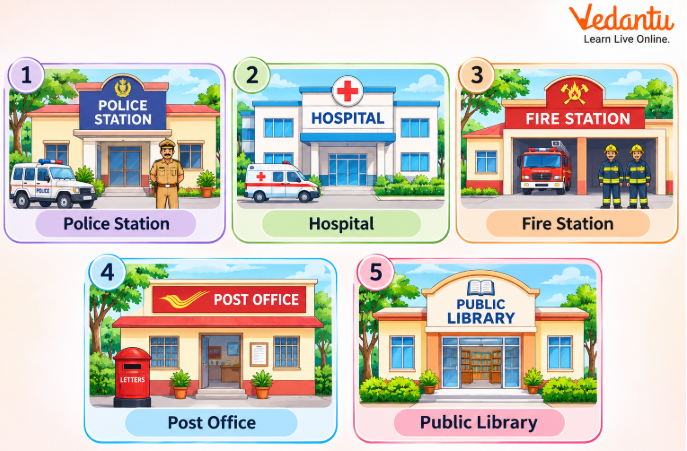
A neighbourhood has a police station, hospital, fire station, post office and library.
Identify the people who work at these places and the vehicles or resources they use.
Answer:
How do these services help?
Police stations help maintain public safety.
Hospitals provide healthcare and treatment.
Fire stations respond to fires and emergencies.
Post offices deliver letters, parcels and other services.
Libraries provide books and learning resources.
Conclusion: Different public services meet different needs of the people living in a neighbourhood.
Q22. Case-Based Question: Planning Better Facilities for a Neighbourhood
A neighbourhood has many houses but no nearby health centre. The roads become crowded in the morning, and some places have very few trees.
A group of residents decides to discuss improvements with local authorities.
Answer the following questions:
(a) What are the three main problems in the neighbourhood?
(b) Why would a health centre be useful?
(c) Suggest two ways to improve transport.
(d) How can residents protect the environment?
(e) Why should people work together to improve their neighbourhood?
Answer:
(a) Main Problems
The neighbourhood lacks a nearby health centre, experiences traffic congestion and has too few trees in some places.
(b) Importance of a Health Centre
A health centre would make basic medical care and check-ups more accessible to residents.
(c) Transport Improvements
Improve public transport facilities.
Maintain roads and provide safer crossings for pedestrians.
(d) Environmental Protection
Residents can plant suitable trees, protect existing green spaces and keep public places clean.
(e) Working Together
When residents cooperate, they can identify common needs, share suggestions and request suitable improvements from local authorities.
Conclusion: Better planning and cooperation can make neighbourhoods safer, cleaner and more convenient.
Q23. Activity-Based Question: You Have ₹100 for One Month. Prepare a Simple Spending and Savings Plan.
You have ₹100 to use for stationery, snacks and other small expenses.
Plan how much you will spend and save.
Answer:
My Monthly Budget
What did I learn?
I should plan my expenses before spending money.
I should distinguish between things I need and things I want.
I should save some money regularly.
Saving money can help me buy something useful later.
Conclusion: A simple budget helps us spend carefully and save for the future.
Q24. Map-Based Question: Draw a Route from Your School to a Public Library Using Landmarks.
Imagine your school is near a park, a bus stop and a public library.
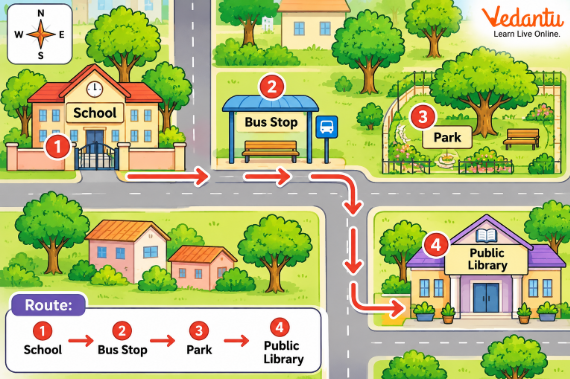
Create a simple route map and explain how you would reach the library.
Answer:
Sample Route:
School → Bus Stop → Park → Public Library
Directions:
Leave the school through the main gate.
Walk straight towards the bus stop.
Turn right near the bus stop.
Continue until you reach the park.
The public library is beside the park.
Important Landmarks:
School
Bus stop
Park
Public library
What should the map show?
The starting point and destination.
Roads connecting the places.
Important landmarks.
A compass showing north, south, east and west.
Learning: Simple maps and landmarks help people understand directions and locate places.
Key Topics and Revision Guide for Class 4 EVS Chapter 2 – Exploring Our Neighbourhood
Before practising Class 4 EVS Chapter 2 Important Questions, revise how transport, communication, public services and maps help us in everyday life.
Quick Preparation Tips for Class 4 EVS Chapter 2
Recall what Navya learned during her journey home.
Compare older and modern communication methods.
Practise identifying public places, vehicles and their uses.
Read neighbourhood maps and locate places using directions.
Solve simple spending and savings activities.
Exam Tip: For map-based questions, mark north first. Then identify east, west and south before locating the buildings.
Class 4 EVS Chapter 2 Important Questions PDF Download
Download Vedantu's Class 4 EVS Chapter 2 Important Questions PDF to practise solved MCQs, short answers, picture-based questions and real-life activities from Exploring Our Neighbourhood. The PDF includes answers covering transport, communication, banks, public services, maps and directions, making it useful for offline revision.
CBSE Class 4 EVS Chapter 2 Study Materials
Use these chapter-specific resources alongside the important questions to understand Exploring Our Neighbourhood.
CBSE Class 4 EVS Chapter-wise Important Questions
Practise important questions from other chapters of Our Wondrous World to learn more about community life, nature, health and the environment.
Important Study Materials for CBSE Class 4 EVS
FAQs on Important Questions and Answers for Class 4 EVS (Our Wondrous World) Chapter 2 – Exploring Our Neighbourhood | 2026–27
1. What is Class 4 EVS Chapter 2 Exploring Our Neighbourhood about?
The chapter follows Navya and her Dada ji as they travel home from school. It explains communication methods, transport facilities, hospitals, banks, saving money, public services and using maps to find places.
2. What are the main topics in Class 4 EVS Chapter 2 important questions?
Important topics include post offices, old and modern communication methods, metros, flyovers, hospitals, banks, ATMs, Money Orders, the barter system, public services, directions and neighbourhood maps.
3. What types of MCQs should students practise from Class 4 EVS Chapter 2?
Class 4 EVS Chapter 2 important questions MCQ practice should cover Navya's journey, communication methods, transport facilities, banking services and directions. Students should also practise picture-based MCQs on public places and their uses.
4. How did people communicate before mobile phones and the internet?
People used methods such as messengers, letters and telegrams. Earlier societies also used drumbeats and rock carvings to communicate information. Later, telephones, radio and television made communication easier.
5. How does a post office help people in a neighbourhood?
A post office helps people send and receive letters, parcels and documents. Postal services also offer other facilities, including some financial services, helping people stay connected across distances.
6. What is the difference between older and modern communication methods?
Older communication methods, such as letters, often took days or weeks. Modern methods, such as mobile calls, emails and text messages, allow people to communicate much faster. However, users must be careful not to share incorrect information.
7. How do flyovers and metro trains improve transportation?
Flyovers help vehicles cross busy roads and intersections more easily. Metro trains carry passengers through urban areas and improve connectivity. These facilities can reduce travel time and make journeys more convenient.
8. Why should we protect trees while developing roads and transport facilities?
Trees provide shade, support birds and animals, and improve the environment. Development projects should consider the effect on nature and protect existing green spaces wherever possible.
9. What is an ATM in Class 4 EVS Chapter 2?
ATM stands for Automated Teller Machine. It helps eligible bank account holders withdraw money without visiting a bank counter.
10. Why should children learn to save money?
Saving money helps children learn to plan spending, avoid unnecessary purchases, and prepare for future needs. A simple monthly budget is a useful way to practise saving.
11. What is the barter system in Exploring Our Neighbourhood?
The barter system is a method of exchanging goods or services without using money. For example, a farmer could exchange wheat for milk. Money later made such exchanges easier.
12. What information can be found in a bank passbook?
A bank passbook may include the account holder's name, account number, bank branch details, IFSC code and transaction information. Students should examine only a sample or a passbook shown by a trusted adult and avoid sharing private banking details.
13. What are the four main directions explained in Class 4 EVS Chapter 2?
The four main directions are north, south, east and west. On a standard north-up map, north is at the top, south at the bottom, east on the right and west on the left.
14. What places are shown around Navya's house in the textbook map?
The textbook map shows a hospital to the north, a chemist shop to the east, a bakery to the west and a post office to the south of Navya's house.
15. How can students use landmarks to find places in their neighbourhood?
Landmarks are recognisable places such as schools, parks, hospitals and bus stops. Students can use these places, along with directions such as left, right, and straight ahead, to describe a route.
16. How can I prepare Class 4 EVS Chapter 2 important questions and answers for exams?
Read Navya's journey carefully and revise the uses of different public services. Practise communication and transport comparisons, banking concepts, map reading and simple money-saving activities. Try picture-based questions without looking at the answers first.
17. Where can I get the Class 4 EVS Chapter 2 important questions PDF?
Students can download Vedantu's Class 4 EVS Chapter 2 important questions PDF from the PDF download section on this page. It contains solved questions on communication, transport, banking, directions and community services for offline revision.
18. Which textbook contains Class 4 EVS Chapter 2 Exploring Our Neighbourhood?
Exploring Our Neighbourhood is Chapter 2 of Our Wondrous World, under Unit 1, Our Community. It covers neighbourhood services, communication, transportation, saving money and directions.