Learn and Practise Class 4 EVS Chapter 5 Important Questions – Food for Health
Practise these solved questions on the school food festival, six tastes, millets, food groups, healthy meals, cooking methods and everyday food choices.
Class 4 EVS Chapter 5 Important Questions MCQ with Answers
Q1. What was the main purpose of the food festival organised at the school?
(a) To organise a sports competition
(b) To explore different foods and learn about healthy eating
(c) To sell only packaged food
(d) To conduct a drawing competition
Answer: (b) To explore different foods and learn about healthy eating.
Explanation: The school food festival helped children discover traditional dishes, different tastes and the importance of eating a variety of foods.
Q2. Which traditional dish contains six different tastes?
(a) Plain rice
(b) Ugadi Pachadi
(c) Boiled potato
(d) Bread toast
Answer: (b) Ugadi Pachadi.
Explanation: Ugadi Pachadi is a traditional dish associated with Andhra Pradesh, Karnataka and Telangana. It contains six tastes: sweet, sour, salty, pungent, bitter and astringent.
Q3. Which of the following is a body-building food?
(a) Rice
(b) Sugar
(c) Pulses
(d) Honey
Answer: (c) Pulses.
Explanation: Pulses contain protein and other nutrients that help the body grow, build muscles and become strong.
Q4. Which food did Surbhi and her friends order at the Super Food stall?
(a) Jowar upma
(b) Pizza
(c) Potato chips
(d) Burger
Answer: (a) Jowar upma.
Explanation: Surbhi and her friends visited a stall selling millet-based foods. They ordered jowar upma and learned about nutritious millets.
Q5. Which cooking method uses hot steam to prepare food?
(a) Frying
(b) Roasting
(c) Steaming
(d) Grilling
Answer: (c) Steaming.
Explanation: Steaming uses hot water vapour to cook food. Idli and idiyappam are examples of foods prepared by steaming.
Class 4 EVS Chapter 5 Very Short Answer Questions
Q6. What is meant by Shad Rasa?
Answer: Shad Rasa means the six tastes described in Ayurveda: sweet, sour, salty, pungent, bitter and astringent.
Q7. Name three millets or millet-based grains mentioned in the chapter.
Answer: Jowar, bajra and ragi are three millets mentioned in the chapter.
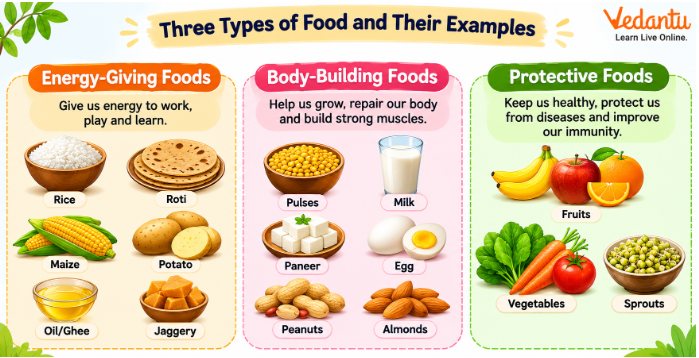
Q8. What are the three main food groups explained in Food for Health?
Answer:
Energy-giving foods
Body-building foods
Protective foods
Q9. Why do we need to drink sufficient water?
Answer: Water helps digest food, keeps our body healthy and removes waste through urine, sweat and faeces.
Q10. What is a balanced food plate?
Answer: A balanced food plate contains suitable amounts of protective, body-building and energy-giving foods to meet our body's needs.
Class 4 EVS Chapter 5 Short Answer Questions
Q11. Match the six tastes with suitable food examples.
Answer:
Explanation: Different ingredients have different tastes. The chapter uses these examples to introduce Shad Rasa.
Q12. Why are millets considered nutritious? Name three millet-based dishes.
Answer:
Millets are nutritious grains that provide energy and other important nutrients.
They can be used to prepare different traditional foods.
Three millet-based dishes are:
Jowar upma
Bajre-ki-khichdi
Ragi laddu
The chapter explains that millets are part of traditional diets in different regions of India.
Q13. Picture-Based Question: Identify the Three Food Groups
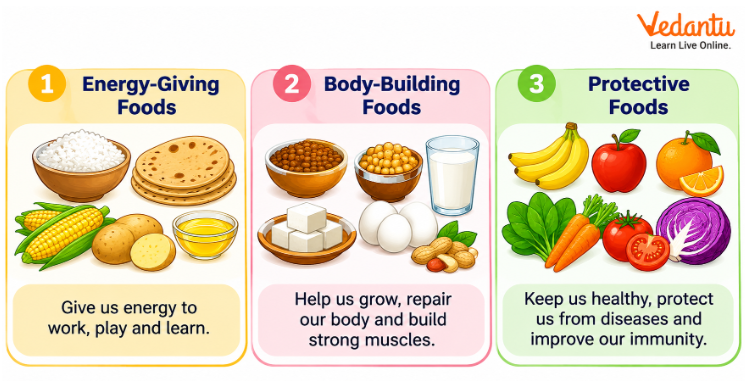
Look at three pictures showing different food items.
Picture A: Rice, wheat, maize and potatoes.
Picture B: Pulses, chickpeas, milk and eggs.
Picture C: Carrots, oranges, spinach and guava.
Answer the following:
(a) Which picture shows energy-giving foods?
(b) Which picture shows body-building foods?
(c) Which picture shows protective foods?
(d) Why should we eat foods from all three groups?
Answer:
(d) We should eat foods from all three groups because no single food group provides everything our body needs.
Q14. Why should we avoid eating too much junk food? Give examples.
Answer:
Junk foods often contain high amounts of salt, sugar or oil.
Eating too much of these foods regularly can be harmful to our health.
Examples from the chapter:
Potato chips
Soft drinks
Burgers
Pizza
Bread pakoda
Healthy eating habits:
Choose a variety of fresh, nutritious foods.
Eat fruits and vegetables regularly.
Limit foods containing too much sugar, salt or oil.
Prefer home-cooked meals whenever possible.
Conclusion: Eating a variety of nutritious foods helps our body stay healthy and active.
Q15. How can we prepare a balanced food plate?
Answer:
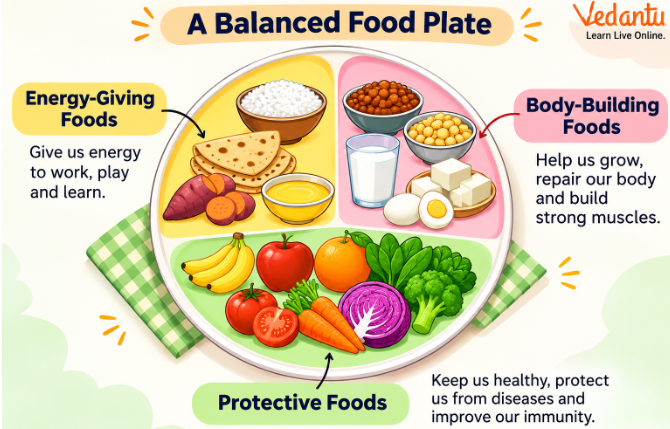
A balanced food plate should include suitable amounts of foods from all three food groups.
The chapter explains that protective foods should form the largest part of the illustrated plate, followed by body-building foods and some energy-giving foods.
Example of a balanced meal:
Roti or rice
Dal
Cooked vegetables
Salad or fruit
Clean drinking water
Remember: We need different foods in suitable quantities for good health.
Q16. Match the cooking methods with the correct food items.
Answer:
Explanation: Different food items require different methods of cooking. Some foods, such as fruit chaat and vegetable salads, can also be prepared without cooking.
Q17. Picture-Based Question: Identify the Cooking Methods
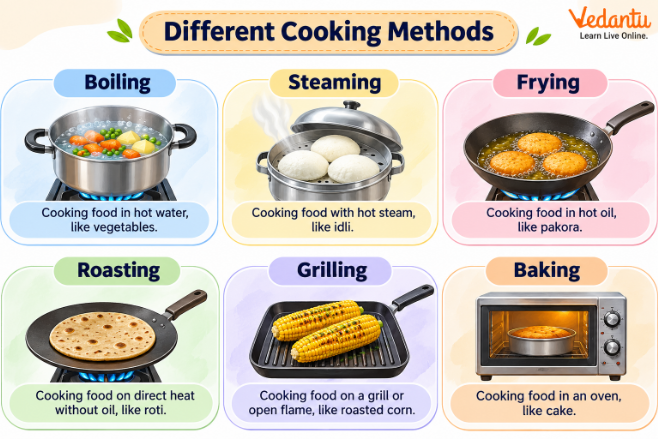
Look at six pictures showing different ways of preparing food.
Answer the following:
(a) Which method cooks food in boiling water?
(b) Which method uses steam?
(c) Which method cooks food in hot oil?
(d) Which method uses dry heat to cook or brown food?
(e) Which method cooks food over direct heat on a grill?
(f) Which method cooks food inside an oven?
Answer:
Q18. Why is water important for our body? Name two water-rich foods.
Answer:
Water is an important part of a healthy diet.
Water helps our body by:
Supporting digestion.
Removing waste through urine and sweat.
Helping regulate body temperature.
Supporting the normal functioning of the body.
Two water-rich foods:
Watermelon
Cucumber
Conclusion: We should drink sufficient clean water every day and include water-rich foods in our meals.
Q19. What information should we check on a packaged food label? Why is it important?
Answer:
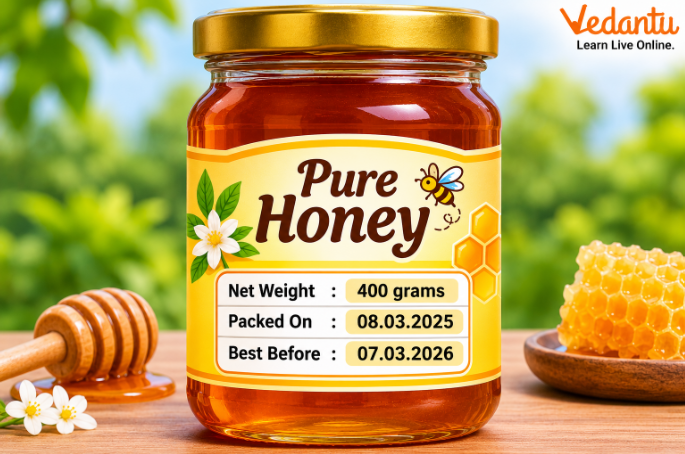
Food labels provide useful information about packaged products.
Important details include:
Name of the product
Ingredients
Net weight or quantity
Date of packing
Expiry date or best-before date
Storage instructions, when provided
Why should we read labels?
Labels help us understand what a product contains and whether it is within its recommended use period.
Example from the textbook:
The honey label on page 83 shows:
Important: The best-before date shown is part of the textbook's sample label. It should not be treated as a current product recommendation.
Class 4 EVS Chapter 5 Long Answer and Application-Based Questions
Q20. Explain how different kinds of food help our body stay healthy and strong.
Answer:
Our body needs different nutrients to grow, stay active and remain healthy.
The chapter divides foods into three main groups according to their important functions.
1. Energy-giving Foods
These foods provide energy for activities such as walking, running, playing and studying.
Examples: Rice, wheat, potatoes, maize, bananas and millets.
2. Body-building Foods
These foods help our body grow and develop muscles.
Examples: Pulses, chickpeas, soybeans, milk, eggs, fish and beans.
3. Protective Foods
These foods provide vitamins and minerals that help us stay healthy.
Examples: Carrots, spinach, oranges, guava, papaya and amla.
Why do we need all three groups?
No single food contains all the nutrients our body requires.
Eating foods from only one group may leave out important nutrients.
Conclusion: A variety of foods from all three groups helps us stay healthy, energetic and strong.
Q21. Case-Based Question: Plan Healthy Food Choices at a School Food Festival
Your school is organising a food festival. Three stalls are serving different foods.
Stall A: Rice, dal, vegetables and fruit.
Stall B: Jowar upma, ragi laddu and bajre-ki-khichdi.
Stall C: Potato chips, soft drinks and burgers.
Answer the following questions:
(a) Which stall offers a meal containing foods from all three food groups?
(b) Which stall serves millet-based dishes?
(c) Which stall mainly serves foods that should be eaten less often?
(d) Why is it useful to include fruits and vegetables in a meal?
(e) Suggest one way to make the festival menu more balanced.
Answer:
(a) Stall A offers rice, dal, vegetables and fruit, covering the three food groups.
(b) Stall B serves millet-based dishes such as jowar upma, ragi laddu and bajre-ki-khichdi.
(c) Stall C mainly serves foods that can contain high amounts of salt, sugar or oil.
(d) Fruits and vegetables provide important vitamins, minerals and other nutrients.
(e) The school can offer balanced meal combinations with vegetables, protein-rich foods, grains and water.
Learning: Making thoughtful food choices helps us enjoy different dishes while meeting our body's needs.
Q22. Activity-Based Question: Prepare a Food Diary and Identify Missing Food Groups
Record what you eat for breakfast, lunch and dinner.
Use this sample food diary to answer the questions.
Sample Food Diary
Questions:
(a) Which meal contains rice and dal?
(b) Which meal contains idli?
(c) Why is it important to record what we eat?
(d) What should we do if a food group is missing from our daily meals?
Answer:
(a) Lunch contains rice and dal.
(b) Breakfast contains idli.
(c) A food diary helps us observe our eating habits and identify whether we are eating different kinds of food.
(d) We can discuss our meals with a parent or caregiver and include suitable foods from the missing group.
What did I learn?
A food diary helps us understand our daily food choices and the importance of eating a variety of foods.
Note: This is a sample diary. Students should record their own meals for a week, as suggested in the textbook activity on page 79.
Q23. Create a Food Collage Showing the Three Main Food Groups
Your teacher asks you to prepare a food collage for the classroom.
Divide your chart into three sections: energy-giving foods, body-building foods and protective foods.
Answer:
My Food for Health Collage
Steps to Make the Collage:
Take a large sheet of chart paper.
Divide it into three sections.
Write the name of each food group.
Collect or draw suitable pictures of food items.
Paste the pictures in the correct sections.
Add a short line explaining the benefit of each group.
Key Topics and Revision Guide for Class 4 EVS Chapter 5 – Food for Health
Revise the important topics below before practising Class 4 EVS Chapter 5 important questions and answers.
Quick Preparation Tips for Class 4 EVS Chapter 5
Learn the six tastes and their examples from Ugadi Pachadi.
Practise sorting foods into the three food groups.
Identify cooking methods using pictures.
Understand how to make a balanced food plate.
Revise the uses of water and the importance of checking food labels.
Exam Tip: For food-group questions, mention the group, give two examples and explain how those foods help our body.
Class 4 EVS Chapter 5 Important Questions PDF Download
Download Vedantu's Class 4 EVS Chapter 5 important questions PDF to practise solved MCQs, short answers, picture-based questions and activities from Food for Health. The PDF covers six tastes, millets, food groups, balanced meals, cooking methods and food labels, making it useful for offline revision and school exam preparation.
CBSE Class 4 EVS Chapter 5 Study Materials
Use these study materials to understand the main concepts of Food for Health and practise chapter-related activities.
CBSE Class 4 EVS Chapter-wise Important Questions
Explore Class 4 EVS important questions from the other chapters of Our Wondrous World to practise topics related to communities, nature, health, science and the environment.
Important Study Materials for CBSE Class 4 EVS
FAQs on Important Questions and Answers for Class 4 EVS (Our Wondrous World) Chapter 5 – Food for Health | 2026–27
1. What did Surbhi and her friends learn at the school food festival?
Surbhi and her friends explored traditional Indian dishes, learned about six different tastes and discovered nutritious millet-based foods such as jowar upma. They understood why eating a variety of foods is important for good health.
2. What are Shad Rasa and Ugadi Pachadi in Class 4 EVS Chapter 5?
Shad Rasa means six tastes: sweet, sour, salty, pungent, bitter and astringent. Ugadi Pachadi is a traditional dish prepared during Ugadi celebrations that combines ingredients representing these six tastes.
3. Why are millets important in the Food for Health chapter?
Millets are nutritious grains that provide energy and other nutrients. The chapter introduces jowar, bajra and ragi through dishes such as jowar upma, bajre-ki-khichdi and ragi laddu.
4. What are the three main food groups in Class 4 EVS Chapter 5?
The three main groups are energy-giving foods, body-building foods and protective foods. They provide energy, support growth and help maintain good health. A balanced meal includes suitable amounts of foods from all three groups.
5. Why should we avoid eating too much junk food?
Many junk foods contain high amounts of sugar, salt or oil. Eating them too often can harm our health. Students should choose nutritious meals and include fruits and vegetables in their daily diet.
6. What cooking methods are explained in Class 4 EVS Chapter 5 Food for Health?
The chapter covers boiling, steaming, frying, roasting, grilling and baking. It also explains that some foods, such as fruit chaat and vegetable salads, can be prepared without cooking.
7. Why is drinking water important for good health?
Water helps digest food, maintain normal body functions and remove waste through urine and sweat. Water-rich foods such as cucumber and watermelon also help keep the body hydrated.
8. Why should we check the label on packaged food?
Food labels provide information about ingredients, quantity, packing date and expiry or best-before date. Reading these details helps students understand what they are eating and make informed food choices.
9. Where can I download Class 4 EVS Chapter 5 Food for Health Important Questions PDF?
Students can download the Class 4 EVS Chapter 5 Important Questions PDF from Vedantu. It includes solved MCQs, short-answer questions, picture-based exercises and activities on Food for Health for offline practice.