




Definition Types and Examples of Asexual Reproduction in Animals
Asexual reproduction is a simple way for certain organisms to create new individuals using just one parent. In this process, there is no fusion of gametes, and the offspring are often exact copies (clones) of the parent. Although it is more common among single-celled organisms, some multicellular animals can also reproduce asexually under the right conditions.
Definition of Asexual Reproduction
Asexual reproduction involves producing new individuals from a single organism without the need for male and female gametes. Since only one parent is involved, genetic variation is minimal or absent. The newly formed offspring inherit the same genetic information as the parent.
Features of Asexual Reproduction
Single Parent Involvement: It does not require two parents.
Absence of Fertilisation: There is no union of male and female gametes.
Rapid Process: It usually takes less time compared to sexual reproduction.
Genetically Identical Offspring: The offspring are exact genetic copies (clones) of the parent.
Fast Growth Rate: Asexual offspring often reach maturity quickly.
5 Types of Asexual Reproduction in Animals
Below are 5 types of asexual reproduction in animals commonly observed in nature:
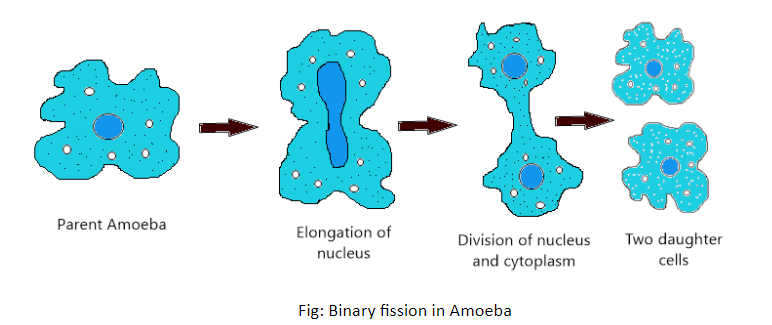
Fission (Binary Fission and Multiple Fission)
Binary Fission: The parent cell divides into two equal parts, each containing a nucleus. These two daughter cells are genetically identical to the parent. Amoeba and bacteria are classic examples.
Multiple Fission (in some protists): The nucleus divides multiple times before the cell splits into several daughter cells simultaneously.
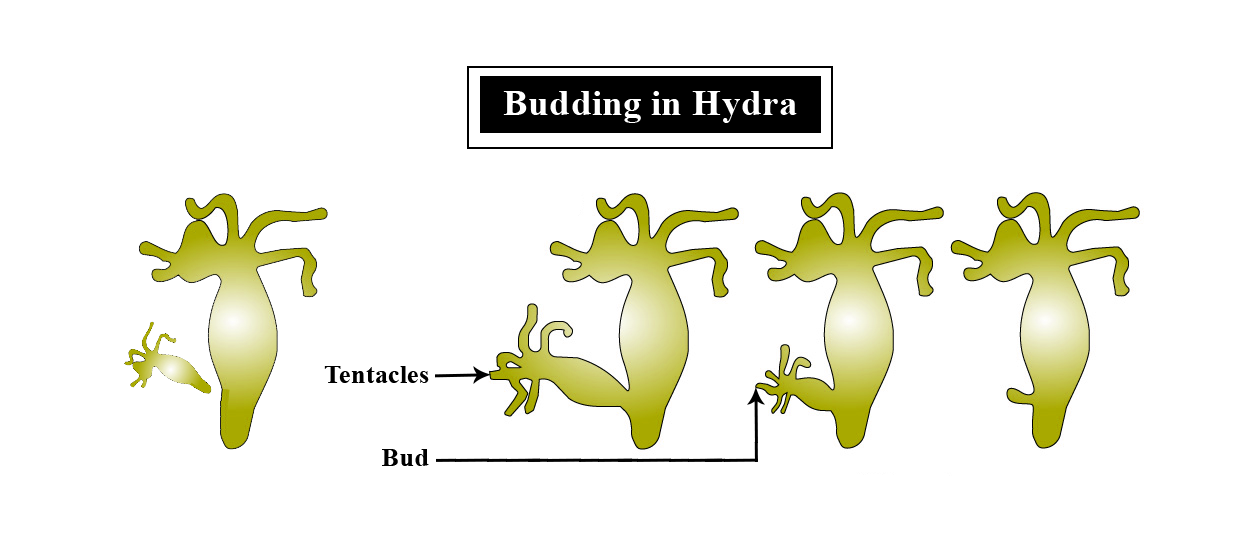
Budding
A small outgrowth or “bud” develops on the parent’s body. This bud receives nourishment from the parent until it can survive on its own. Once it matures, it detaches to become an independent organism. Asexual reproduction in animal budding is notably seen in Hydra.
Fragmentation
The parent body splits into two or more fragments, each capable of growing into a new individual. For instance, in Planaria, the body deliberately breaks into pieces, and each fragment regenerates into a complete organism.
Regeneration
In this process, a lost body part can grow into an entirely new individual. Many asexual animals, like some Echinoderms (e.g., starfish), exhibit remarkable regenerative abilities.
Parthenogenesis
In parthenogenesis, offspring develop from unfertilised eggs. While it is often considered an “incomplete form” of sexual reproduction, many scientists classify it under asexual modes because it does not involve sperm. Some insects (like aphids) and reptiles (like certain whiptail lizards) show parthenogenesis.
Asexual Reproduction Examples
Amoeba: Divides by binary fission.
Hydra: Forms buds that grow into new individuals.
Planaria: Shows fragmentation.
Starfish: Can regenerate an entire body from a single arm segment.
These asexual reproduction examples highlight the variety of ways animals can reproduce without two parents.
Advantages and Disadvantages
Asexual reproduction has its own set of advantages and disadvantages:
Differences Between Asexual and Sexual Reproduction
While asexual reproduction in animals involves just one parent, animals that reproduce sexually need two parents and the fusion of male and female gametes. This fusion leads to genetic variation, which increases the ability of offspring to survive in changing environments.
Key Takeaways
Asexual reproduction in animals occurs through methods such as fission, budding, fragmentation, regeneration, and parthenogenesis.
No gamete fusion is involved, and the offspring are often exact replicas of the parent (clones).
Although it is fast and energy-efficient, asexual reproduction provides little genetic variation.
Animals that reproduce sexually usually show more genetic diversity, giving them a better chance of adapting to environmental changes.
Quiz (With Answers)
Which of the following is NOT a form of asexual reproduction?
A. Budding
B. Fission
C. Parthenogenesis
D. Internal fertilisation
Answer: D. Internal fertilisation (it involves gamete fusion, which is sexual).
In which method does a new individual form from an outgrowth on the parent’s body?
A. Fragmentation
B. Budding
C. Parthenogenesis
D. Binary Fission
Answer: B. Budding
Which organism is known for regenerating into a complete individual if cut into fragments?
A. Hydra
B. Planaria
C. Amoeba
D. Starfish
Answer: B. Planaria (though starfish can also regenerate arms, planaria is known for fragmentation, leading to completely new individuals).
Parthenogenesis involves:
A. Fertilisation of male gametes with female gametes
B. Formation of buds on the parent body
C. Development of offspring from unfertilised eggs
D. A nucleus dividing multiple times in a cell
Answer: C. Development of offspring from unfertilised eggs
Related Topics


FAQs on Asexual Reproduction in Animals Explained Clearly
1. What is asexual reproduction in animals?
Asexual reproduction in animals is a mode of reproduction in which a single parent produces offspring without the involvement of gametes or fertilization. In this process, the offspring are genetically identical to the parent and are called clones.
- Only one parent is involved.
- No fusion of sperm and egg occurs.
- Common in simple and aquatic animals.
- Produces genetically identical offspring.
2. What are the main types of asexual reproduction in animals?
The main types of asexual reproduction in animals are budding, fission, fragmentation, and parthenogenesis.
- Budding: A new individual grows from a small outgrowth on the parent (e.g., Hydra).
- Fission: The parent divides into two or more individuals (e.g., planaria).
- Fragmentation: Body parts break off and regenerate into new individuals (e.g., starfish).
- Parthenogenesis: Development of an embryo from an unfertilized egg (e.g., honeybees).
3. How does budding occur in animals?
Budding occurs when a small outgrowth called a bud develops on the parent’s body and grows into a new individual.
- Rapid cell division occurs at a specific site.
- A bud forms due to repeated mitotic divisions.
- The bud grows and develops organs.
- It either detaches or remains attached as a colony.
4. What is fragmentation in asexual reproduction?
Fragmentation is a type of asexual reproduction in which the parent body breaks into pieces, and each fragment regenerates into a complete organism.
- Each fragment contains cells capable of regeneration.
- Common in simple animals like sponges and starfish.
- Relies on high regenerative ability.
5. What is parthenogenesis in animals?
Parthenogenesis is a form of asexual reproduction where an unfertilized egg develops into a new individual.
- No fertilization by sperm occurs.
- Common in honeybees, ants, and some lizards.
- In honeybees, unfertilized eggs develop into male drones.
6. What is the difference between asexual and sexual reproduction in animals?
The main difference between asexual and sexual reproduction is that asexual reproduction involves one parent without gamete fusion, while sexual reproduction involves two parents and fertilization.
- Asexual reproduction: One parent, no gametes, genetically identical offspring.
- Sexual reproduction: Two parents, fusion of sperm and egg, genetically varied offspring.
- Asexual reproduction is faster but produces less variation.
- Sexual reproduction increases genetic diversity.
7. What are examples of animals that reproduce asexually?
Common examples of animals that reproduce asexually include Hydra, sponges, planaria, starfish, and honeybees.
- Hydra – budding
- Planaria – fission
- Starfish – fragmentation
- Honeybees – parthenogenesis
8. What are the advantages of asexual reproduction in animals?
The main advantages of asexual reproduction in animals are rapid multiplication and no need for a mate.
- Only one parent is required.
- Fast population growth.
- Energy-efficient process.
- Maintains successful genetic traits.
9. What are the disadvantages of asexual reproduction?
The main disadvantage of asexual reproduction is the lack of genetic variation among offspring.
- Offspring are genetically identical (clones).
- Low adaptability to environmental changes.
- Higher risk if disease affects the population.
10. How does fission occur in animals?
Fission occurs when the parent organism divides into two or more individuals through mitotic cell division.
- The nucleus divides first.
- The cytoplasm splits into parts.
- Each part develops missing structures.



