






What Did Therizinosaur Eat and Why Did It Have Huge Claws?
The Therizinosaur was one of the strangest and most fascinating dinosaurs ever discovered. With a long neck, small head, big belly, feathers, and enormous curved claws, it looked like a mix between a bird and a reptile. Even though it had scary claws, it was actually a plant-eater. Therizinosaur facts surprise many students because this dinosaur broke the common idea that big claws always mean a fierce meat-eater!
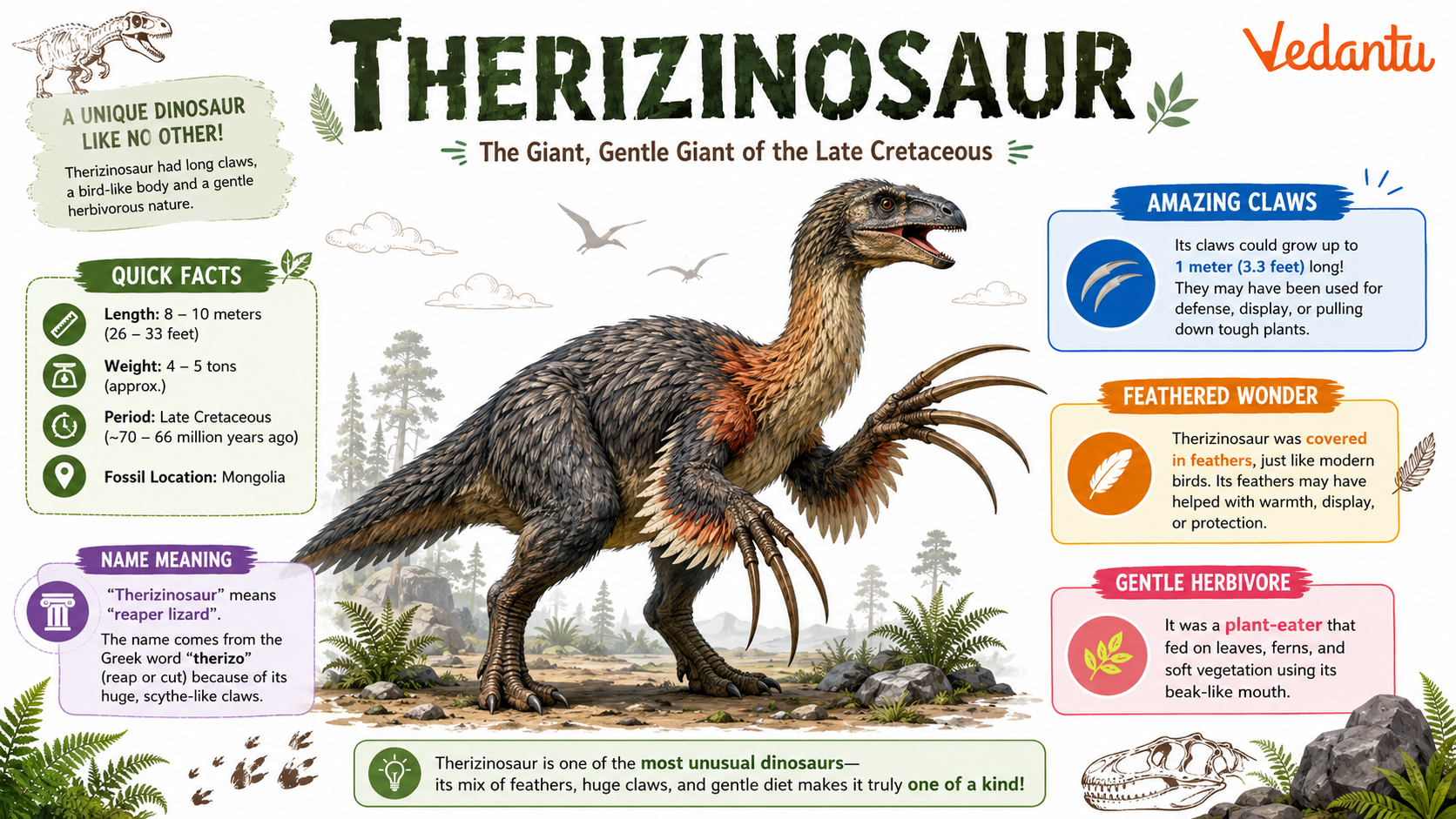
Quick Facts and Statistics
| Feature | Details |
|---|---|
| Common Name | Therizinosaur |
| Scientific Name | Therizinosaurus cheloniformis |
| Animal Group | Theropod Dinosaur |
| Period | Late Cretaceous (about 70 million years ago) |
| Length | Up to 10 meters |
| Weight | Around 5 tons |
| Diet | Herbivore (plant-eater) |
| Habitat | Forests and floodplains of Asia |
| Special Feature | Claws up to 1 meter long |
Appearance and Physical Characteristics
- Long neck and small head
- Wide, bulky body with a large belly
- Strong back legs and shorter front legs
- Three enormous curved claws on each hand
- Likely covered in feathers
Habitat and Distribution
- Wooded forests
- River valleys
- Floodplains
- Warm climates of ancient Asia
These areas were rich in plants, which provided plenty of food. The environment was warm and supported many other dinosaurs and prehistoric animals.
Diet and Feeding Habits
- Leaves from tall trees
- Shrubs and bushes
- Ferns and soft vegetation
- Used its long neck to reach high branches.
- Claws helped pull down branches.
- Leaf-shaped teeth were perfect for slicing plants.
In the food chain, it was a large herbivore and may have been prey for big carnivorous dinosaurs of its time.
Behaviour and Lifestyle
Life Cycle and Reproduction
- Egg Stage: Hatched from hard-shelled eggs laid in nests.
- Hatchling: Small and vulnerable, likely protected by adults.
- Juvenile: Grew rapidly and developed claws over time.
- Adult: Fully grown with massive claws and large body.
What Makes Therizinosaur Special?
Importance and Role in Nature
- Controlling plant growth
- Spreading seeds while feeding
- Serving as prey for large carnivores
- Maintaining ecological balance in prehistoric forests
Amazing Therizinosaur Facts
Interesting Facts About Therizinosaur
- Its name means “scythe lizard” because of its curved claws.
- It had a pot-shaped belly to digest tough plants.
- It may have used claws to attract mates.
- It is one of the strangest-looking dinosaurs ever discovered.
Fun Facts for Kids
FAQs on Therizinosaur Dinosaur Facts: The Long-Clawed Plant Eater
1. What is a Therizinosaur?
A Therizinosaur was a strange plant-eating dinosaur known for its long claws and feathered body.
- It lived during the Cretaceous Period, about 145–66 million years ago.
- Belonged to a group of dinosaurs called theropods, which also included meat-eaters like Tyrannosaurus rex.
- Had a small head, long neck, big belly, and huge curved claws.
- Fossils have been found mainly in Asia and North America.
2. Was Therizinosaur a carnivore or herbivore?
The Therizinosaur was mostly a herbivore, meaning it ate plants instead of meat.
- Used its long neck to reach leaves and branches.
- Had flat teeth designed for chewing plants.
- Its large belly helped digest tough vegetation.
- Although related to meat-eating dinosaurs, it adapted to a plant-based diet.
3. Why did Therizinosaur have such long claws?
The long claws of the Therizinosaur were mainly used for grabbing plants and self-defense.
- Some claws grew over 3 feet (1 meter) long.
- Helped pull down tree branches to eat leaves.
- May have scared away predators like Velociraptor.
- Are among the longest claws of any known dinosaur.
4. How big was Therizinosaur?
The largest species, Therizinosaurus cheloniformis, was a giant dinosaur about the size of a bus.
- Measured up to 33 feet (10 meters) long.
- Weighed around 5 tons.
- Stood on two strong legs.
- Had one of the biggest bodies among feathered dinosaurs.
5. Did Therizinosaur have feathers?
Yes, scientists believe Therizinosaurs had feathers covering their bodies.
- Fossil evidence from related species shows proto-feathers.
- Feathers may have helped with warmth and display.
- Shows that many theropod dinosaurs were feathered.
- Connects them closely to the evolution of modern birds.
6. Where were Therizinosaur fossils found?
Most Therizinosaur fossils have been discovered in Asia and parts of North America.
- Major discoveries were made in Mongolia and China.
- Some fossils were found in the United States.
- Often discovered in desert and rocky regions.
- Fossils include claws, bones, and partial skeletons.
7. How did Therizinosaur protect itself?
The Therizinosaur protected itself mainly using its massive claws and large body size.
- Swung its sharp claws at attacking predators.
- Its size made it hard to attack.
- May have lived in groups for extra safety.
- Feathers could have made it look bigger and more threatening.
8. Is Therizinosaur related to T. rex?
Yes, Therizinosaur and Tyrannosaurus rex are distant relatives in the theropod group.
- Both belong to Theropoda.
- T. rex was a carnivore, while Therizinosaur was a herbivore.
- They evolved different body shapes and diets.
- This shows how dinosaurs adapted in many unique ways.
9. When did Therizinosaur live?
The Therizinosaur lived during the late Cretaceous Period.
- Existed about 70–90 million years ago.
- Lived alongside dinosaurs like Tarbosaurus and Velociraptor.
- Disappeared during the mass extinction event 66 million years ago.
- Was part of the final age of dinosaurs.
10. Why is Therizinosaur considered unusual?
The Therizinosaur is considered unusual because it mixed features of plant-eaters and meat-eaters.
- Had huge claws like a predator.
- Ate plants like a typical herbivore.
- Had feathers but a large, pot-bellied body.
- Confused scientists when first discovered because it looked so different from other dinosaurs.
