






What Is a Mastodon? Size, Habitat, Diet, and Differences from Mammoths
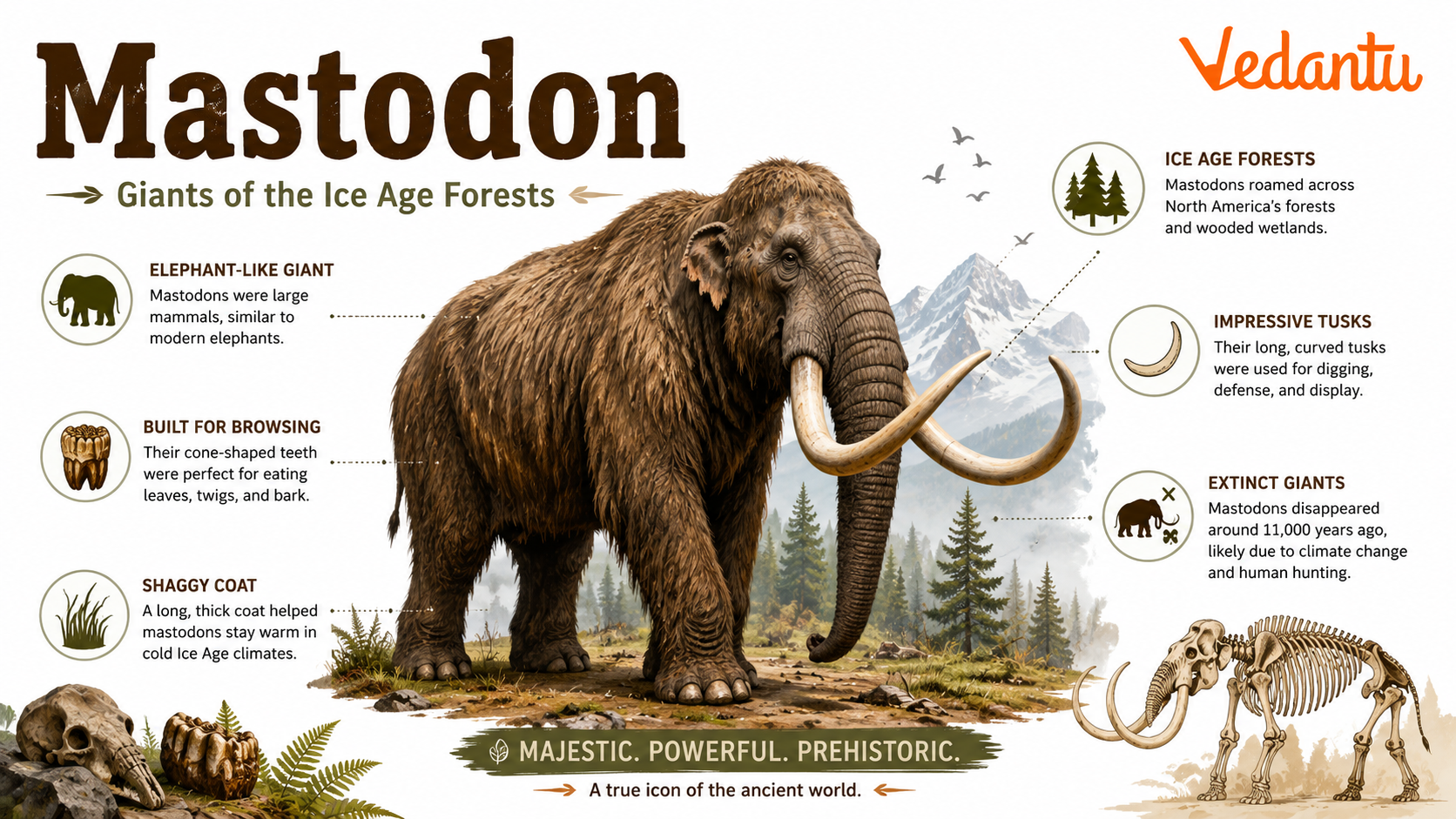
The Mastodon was a large, elephant-like animal that lived thousands of years ago during the Ice Age. It looked similar to a mammoth but had its own unique features and lifestyle. Mastodons roamed forests and wetlands in North and Central America. Today, we learn about them through fossils. Exploring Mastodon facts helps us understand prehistoric life, extinct animals, and how Earth has changed over time.
Quick Facts and Statistics
| Feature | Details |
|---|---|
| Common Name | Mastodon |
| Scientific Name | Mammut americanum |
| Animal Group | Mammal |
| Time Period | Ice Age (Pleistocene Epoch) |
| Length | Up to 3 meters (10 feet) tall at the shoulder |
| Weight | 4–6 tons |
| Diet | Herbivore (leaves, twigs, shrubs) |
| Habitat | Forests, wetlands, and woodlands |
| Status | Extinct (about 10,000 years ago) |
Appearance and Physical Characteristics
- Large, heavy body with strong legs.
- Long curved tusks made of ivory.
- Thick brown hair to survive cold climates.
- Shorter and stockier than mammoths.
- Teeth had cone-shaped cusps, perfect for crushing leaves and branches.
Mastodon Habitat and Distribution
- Lived mainly in North America.
- Also found in parts of Central America.
- Preferred forests filled with trees and shrubs.
- Often stayed near lakes and wetlands.
- Survived in cold Ice Age climates.
Mastodon Diet and Feeding Habits
- Ate leaves, twigs, bark, and shrubs.
- Used their trunks to pull down branches.
- Crushed tough plants using strong teeth.
- Browsers, not grazers (they did not mainly eat grass).
In the food chain, mastodons were primary consumers. They helped shape forests by eating large amounts of vegetation.
Behaviour and Lifestyle
- Likely lived in small family groups.
- Probably led by older females, similar to elephants.
- Used tusks for digging, defence, and fighting.
- Moved slowly but powerfully.
- Communicated using low sounds, like modern elephants.
Mastodon Life Cycle
- Birth: Females gave birth to live young after a long pregnancy.
- Calf Stage: Babies were called calves and depended on their mothers.
- Juvenile Stage: Young mastodons learned survival skills from adults.
- Adult Stage: Fully grown mastodons could weigh several tons.
Mastodons may have lived around 60 years, similar to elephants.
What Made the Mastodon Special?
Importance and Role in Nature
Amazing Mastodon Facts
- Mastodons lived alongside early humans.
- They became extinct about 10,000 years ago.
- Their fossils have been found across the United States.
- They were shorter but heavier-built than mammoths.
- The name “Mastodon” means “breast tooth,” referring to their tooth shape.
- Some scientists believe climate change and human hunting caused their extinction.
- Mastodons belonged to a different family than mammoths.
Interesting Facts About Mastodon
- They first appeared around 27 million years ago.
- They migrated across land bridges during ancient times.
- Their trunks worked like modern elephant trunks.
- Some mastodon skeletons have been found almost complete.
Fun Facts for Kids
FAQs on Mastodon Animal Guide: Facts, History, and Extinction Explained
1. What is Mastodon and how does it work?
Mastodon is a free and open-source social media platform where people share posts, follow others, and join communities.
- Mastodon is a decentralized social network, not owned by one single company.
- It is made up of many independent servers called instances.
- Users can post short messages called toots.
- It works similar to Twitter/X, but gives users more control and privacy.
- It is part of the Fediverse, a network of connected platforms.
2. Is Mastodon safe for kids?
Mastodon can be safe for kids if they join well-moderated servers and follow safety rules.
- Each instance has its own rules and moderators.
- Parents should check age requirements before sign-up.
- Users can block, mute, or report inappropriate content.
- Privacy settings allow control over who sees posts.
- Choosing family-friendly communities improves safety.
3. What is a Mastodon instance?
A Mastodon instance is a separate server that hosts user accounts and communities.
- Each server has its own theme, rules, and moderators.
- You sign up on one instance but can follow users on other instances.
- Instances connect through the Fediverse.
- Some focus on art, gaming, education, or technology.
- Popular examples include general and topic-based communities.
4. How is Mastodon different from Twitter (X)?
Mastodon is different from Twitter (X) because it is decentralized and community-owned.
- No single company controls the entire platform.
- No global algorithm controls what everyone sees.
- Posts are called toots instead of tweets.
- Stronger focus on privacy and open-source software.
- Communities set their own content rules.
5. What is the Fediverse?
The Fediverse is a group of connected social media platforms that communicate with each other.
- Mastodon is part of the Fediverse.
- Different platforms can interact using a shared system called ActivityPub.
- Users from different servers can follow and message each other.
- It supports decentralization and online freedom.
- Other platforms in the Fediverse include blogging and photo-sharing sites.
6. How do you create an account on Mastodon?
Creating a Mastodon account involves choosing a server and signing up with basic details.
- Visit the Mastodon website.
- Select a suitable instance based on your interests.
- Enter your email, username, and password.
- Agree to the server’s rules.
- Confirm your email to activate the account.
7. What are toots on Mastodon?
Toots are posts shared on Mastodon, similar to tweets on Twitter.
- Users can write text updates.
- Add images, videos, polls, or links.
- Use hashtags to reach more people.
- Choose privacy levels like public or followers-only.
- Boost (share) other users’ toots.
8. Is Mastodon free to use?
Mastodon is completely free to use because it is open-source software supported by communities.
- No subscription fee to create an account.
- Many servers are funded by donations.
- No required paid verification system.
- Open-source code means anyone can review or improve it.
- Some instances may ask for voluntary contributions.
9. Who created Mastodon?
Mastodon was created by Eugen Rochko in 2016 as an alternative to centralized social networks.
- Eugen Rochko is a German software developer.
- He launched Mastodon as open-source software.
- The goal was to promote decentralization and user control.
- The platform quickly grew worldwide.
- It remains community-driven.
10. Can you make your own Mastodon server?
Yes, you can create your own Mastodon server if you have technical knowledge and hosting space.
- Download the open-source Mastodon software.
- Set up web hosting and a domain name.
- Install and configure server settings.
- Create rules and moderation policies.
- Connect to the Fediverse using ActivityPub.
