






Where Do Coconut Crabs Live, What Do They Eat, and How Big Can They Grow?
The Coconut Crab is one of the most fascinating land crabs in the world. Famous for its strength and tree-climbing skills, this unusual creature is the largest land-living arthropod on Earth. Found on tropical islands, it is known for cracking open coconuts with its powerful claws. In this page, explore amazing Coconut Crab facts, its habitat, diet, characteristics, life cycle, and why it is so special in nature.
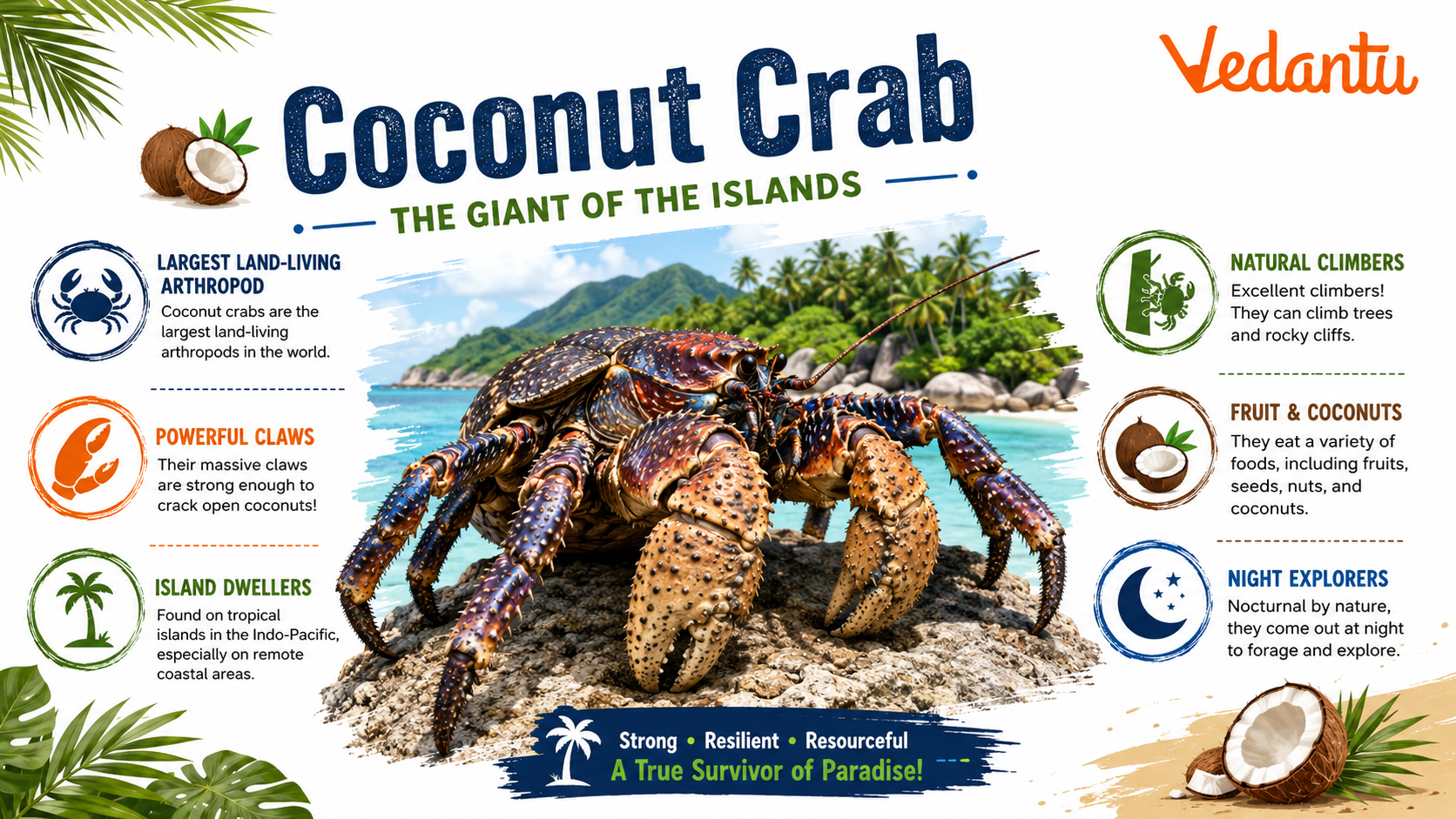
Quick Facts About Coconut Crab
| Feature | Details |
|---|---|
| Common Name | Coconut Crab |
| Scientific Name | Birgus latro |
| Animal Group | Crustacean (Arthropod) |
| Size | Up to 1 meter leg span |
| Weight | Up to 4–5 kg |
| Lifespan | 40–60 years |
| Habitat | Tropical islands and coastal forests |
| Diet | Omnivore |
| Conservation Status | Vulnerable (in some regions) |
Appearance and Physical Characteristics
- Large, heavy body with long, strong legs.
- Powerful front claws used for cracking coconuts.
- Hard outer shell (exoskeleton) for protection.
- Colours vary: blue, purple, red, or brown.
- Long antennae to sense smell and movement.
Coconut Crab Habitat and Distribution
- Found on tropical islands in the Indian and Pacific Oceans.
- Common in places like Christmas Island, Seychelles, and parts of Southeast Asia.
- Lives in coastal forests and sandy shores.
- Hides in burrows or rock crevices during the day.
Coconut Crab Diet and Feeding Habits
The Coconut Crab diet is omnivorous, meaning it eats both plants and animals.
- Fallen coconuts
- Fruits and seeds
- Leaves
- Dead animals (scavenger)
- Small animals and other crabs
Behaviour and Lifestyle
- Mostly nocturnal (active at night).
- Solitary animals.
- Very territorial.
- Climbs trees easily despite its large size.
- Uses strong claws for defence.
Coconut Crabs are cautious and hide during the daytime to avoid predators and heat.
Coconut Crab Life Cycle
- Egg Stage: Female releases eggs into the sea.
- Larva Stage: Tiny larvae float in the ocean for several weeks.
- Juvenile Stage: Young crabs use empty shells like hermit crabs.
- Adult Stage: Grows large and stops using shells.
The Coconut Crab life cycle is unique because it starts in the ocean but ends on land.
What Makes Coconut Crab Special?
One of the most powerful pinches among animals.
Climbs tall coconut trees with ease.
Biggest land-living crab in the world.
Can live more than 50 years.
Importance and Role in Nature
Helps spread plant seeds across islands.
Cleans up dead animals and keeps the ecosystem healthy.
Acts as both predator and prey.
Maintains balance in island habitats.
Amazing Coconut Crab Facts
- Can lift objects heavier than its own body weight.
- Has one of the strongest grips in the animal kingdom.
- Can climb trees up to 10 meters tall.
- Lives longer than many other crabs.
- Breathes using special organs similar to lungs.
- Young ones behave like hermit crabs.
- They cannot swim as adults.
Fun Facts for Kids
FAQs on Coconut Crab: Fascinating Facts About the World’s Largest Land Crab
1. What is a Coconut Crab?
Coconut Crab is the largest land-living crab in the world and is famous for cracking coconuts with its strong claws.
- Scientific name: Birgus latro
- Also called the robber crab or palm thief
- Lives on tropical islands in the Indian Ocean and Pacific Ocean
- Belongs to the hermit crab family but does not carry a shell as an adult
2. How big can a Coconut Crab grow?
Coconut crabs can grow up to 3 feet (1 meter) across from leg to leg and weigh over 9 pounds (4 kg).
- Body length: up to 16 inches (40 cm)
- Leg span: about 3 feet (1 meter)
- Weight: up to 9 pounds (4 kg) or more
3. Where do Coconut Crabs live?
Coconut crabs live on warm tropical islands near the ocean but spend most of their time on land.
- Found in the Indian Ocean and western Pacific Ocean
- Common on islands like Christmas Island
- Hide in burrows, rock crevices, or under tree roots
4. What do Coconut Crabs eat?
Coconut crabs are omnivores, which means they eat both plants and animals.
- Fallen coconuts and fruit
- Nuts and seeds
- Dead animals (scavenging)
- Small animals like other crabs
5. How do Coconut Crabs crack open coconuts?
Coconut crabs use their powerful claws to break open coconuts and reach the meat inside.
- Climb coconut trees to knock down coconuts
- Peel off the husk with sharp pincers
- Crack the hard shell using their strong grip
6. Are Coconut Crabs dangerous to humans?
Coconut crabs are not usually dangerous but can pinch very hard if threatened.
- They are shy and avoid people
- Their claws can cause painful pinches
- They rarely attack unless scared
7. Why are they called robber crabs?
Coconut crabs are called robber crabs because they are known to carry away shiny or loose objects.
- May drag pots, utensils, or metal items
- Attracted to strong smells and bright objects
- Carry items back to their burrows
8. How long do Coconut Crabs live?
Coconut crabs can live for more than 50 years, making them one of the longest-living crab species.
- Slow growth rate
- Reach adulthood after several years
- Long lifespan compared to other crustaceans
9. Do Coconut Crabs use shells like hermit crabs?
Young coconut crabs use shells for protection, but adults do not.
- Babies carry empty snail shells
- Adults develop a hard abdomen
- No longer need borrowed shells
10. Are Coconut Crabs endangered?
Coconut crabs are considered vulnerable in some areas due to human activities.
- Hunted for food
- Habitat loss on tropical islands
- Slow reproduction rate
