






Where Servals Live, What They Eat, and Unique Hunting Skills
The Serval is a wild African cat famous for its long legs, large ears, and beautiful spotted coat. It looks like a small cheetah but has a unique style of its own. Known for its powerful jumps and sharp hearing, the Serval is an expert hunter in grasslands and wetlands. Learning about Serval facts, Serval habitat, and Serval characteristics helps us understand how this amazing cat survives in the wild.
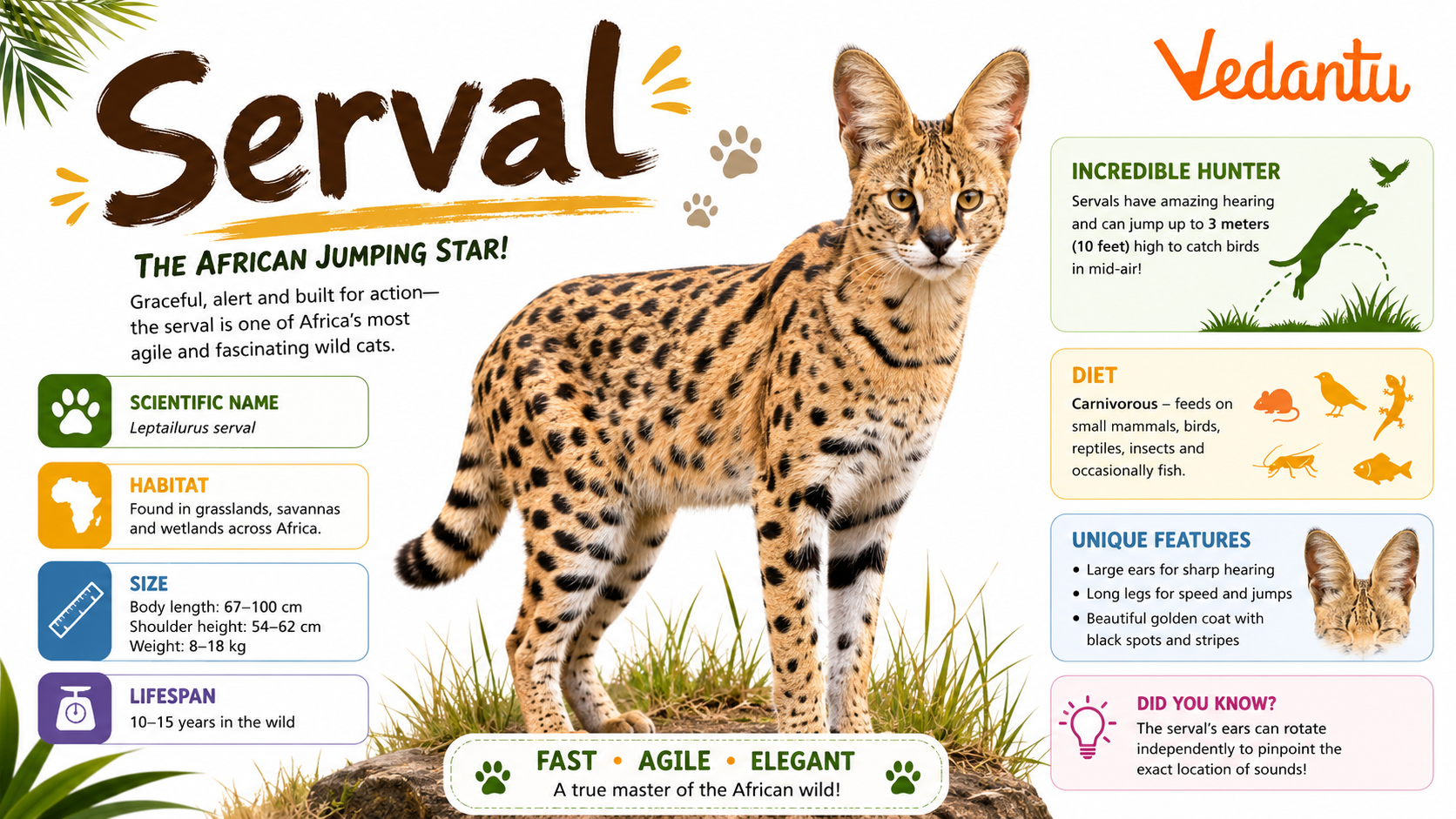
Quick Facts About Serval
| Feature | Details |
|---|---|
| Common Name | Serval |
| Scientific Name | Leptailurus serval |
| Animal Group | Mammal |
| Size | 67–100 cm (body length) |
| Weight | 9–18 kg |
| Lifespan | 10–12 years in the wild |
| Habitat | Grasslands, wetlands, savannas |
| Diet | Carnivore (rodents, birds, frogs) |
| Conservation Status | Least Concern (IUCN) |
| Found In | Africa |
Serval Characteristics and Appearance
- Long legs: Servals have the longest legs (relative to body size) of any cat.
- Large ears: Big, rounded ears help them hear tiny movements in grass.
- Spotted coat: Yellow-gold fur with black spots and stripes.
- Short tail: Their tail is shorter compared to other wild cats.
- Lean body: Slim and athletic build for quick movement.
Serval Habitat and Distribution
The Serval habitat mainly includes open areas with tall grass. They prefer places where they can hide and hunt easily.
- African savannas
- Grasslands
- Wetlands and marshy areas
- Near rivers and lakes
Servals are found in many parts of sub-Saharan Africa. They avoid deserts and thick rainforests.
Serval Diet and Hunting Style
Type: Carnivore (meat-eater)
- Rodents (rats and mice)
- Birds
- Frogs
- Insects
- Small reptiles
How Servals Hunt:
- Use sharp hearing to detect prey underground.
- Stay very still and listen carefully.
- Pounce quickly with powerful front legs.
- Catch prey with sharp claws and teeth.
Servals have a very high hunting success rate compared to many other wild cats.
Behaviour and Lifestyle
Servals usually live alone and meet only during mating season.
They are most active at night and early morning.
They mark their territory using scent markings.
They walk silently through tall grass to surprise prey.
Serval Life Cycle
- Mating: Can happen at any time of the year.
- Gestation: About 2–2.5 months.
- Birth: 1–4 kittens are born in a hidden den.
- Growing Up: Kittens stay with their mother for about 6–12 months.
- Adult Stage: Become independent hunters after leaving their mother.
What Makes the Serval Special?
Importance of Servals in Nature
- Control rodent populations.
- Maintain balance in the food chain.
- Help protect crops by reducing pests.
- Support healthy grassland ecosystems.
The Serval importance in ecosystems is significant because it helps keep prey populations under control.
Amazing Serval Facts
Interesting Facts About Serval
- Servals are sometimes confused with cheetahs due to their spots.
- They prefer areas with plenty of water.
- They communicate using hisses, growls, and purrs.
- Black-coated (melanistic) Servals are rare but exist.
Fun Facts for Kids
FAQs on Serval: The Long-Legged Wild Cat of Africa
1. What is a serval?
A serval is a wild African cat known for its long legs, big ears, and spotted coat.
- The serval (Leptailurus serval) is a medium-sized wild cat.
- It lives mainly in Africa, especially in grasslands and savannas.
- It is famous for its excellent hearing and jumping skills.
- Servals are related to other wild cats like lions, leopards, and cheetahs.
2. Where do servals live?
Servals live mostly in warm regions of Africa where there is tall grass and water nearby.
- They prefer savannas, wetlands, and grasslands.
- Servals avoid deserts and very dry areas.
- They need places with plenty of small animals to hunt.
- Water sources are important for their survival.
3. What do servals eat?
A serval’s diet mainly includes small animals that it hunts in the wild.
- They eat rodents, mice, and rats.
- They also hunt birds, frogs, and insects.
- Sometimes they catch small reptiles.
- Servals use their sharp hearing to find prey hiding in grass.
4. Why do servals have big ears?
Servals have very large ears to help them hear tiny sounds while hunting.
- Their ears can detect prey moving underground.
- They rotate their ears to find the exact location of sounds.
- Good hearing makes them excellent night hunters.
- This adaptation helps them survive in the wild.
5. How high can a serval jump?
A serval can jump up to 9 feet (3 meters) high to catch birds in mid-air.
- They use their long, powerful legs.
- Servals jump straight up from the ground.
- This skill makes them one of the best jumpers among wild cats.
- They succeed in catching prey almost half the time.
6. Are servals dangerous to humans?
Servals are generally shy wild cats and usually avoid humans.
- They prefer to run away rather than attack.
- Servals are not natural threats to people.
- However, they are still wild animals and should not be disturbed.
- It is best to observe them from a safe distance.
7. Can servals be kept as pets?
Servals are wild animals and are not ideal as household pets.
- They need large outdoor spaces to roam.
- Their hunting instincts are very strong.
- In many places, owning a serval as a pet is illegal.
- They are happiest living in their natural habitat.
8. How long do servals live?
Servals usually live around 10–12 years in the wild and longer in protected care.
- In zoos, they can live up to 20 years.
- Their lifespan depends on food and safety.
- Predators and habitat loss can shorten their lives.
- Healthy servals with good care live longer.
9. What are baby servals called?
Baby servals are called kittens.
- A mother serval gives birth to 1–4 kittens.
- Kittens are born blind and helpless.
- The mother teaches them how to hunt.
- Young servals stay with their mother for about a year.
10. Are servals endangered?
Servals are not currently endangered, but they face some threats in the wild.
- The IUCN lists them as Least Concern.
- Habitat loss is a major problem.
- Some are hunted for their fur.
- Protecting African grasslands helps keep servals safe.
