






Where Do Scorpion Fish Live and How Dangerous Is Their Venom?
The Scorpion Fish is one of the ocean’s most mysterious and well-hidden predators. Known for its powerful venom and incredible camouflage, this fish blends perfectly with rocks and coral reefs. Though it may look slow and quiet, it is a skilled ambush hunter. In this page, explore fascinating Scorpion Fish facts, its habitat, diet, characteristics, life cycle, and why it is important in marine ecosystems.
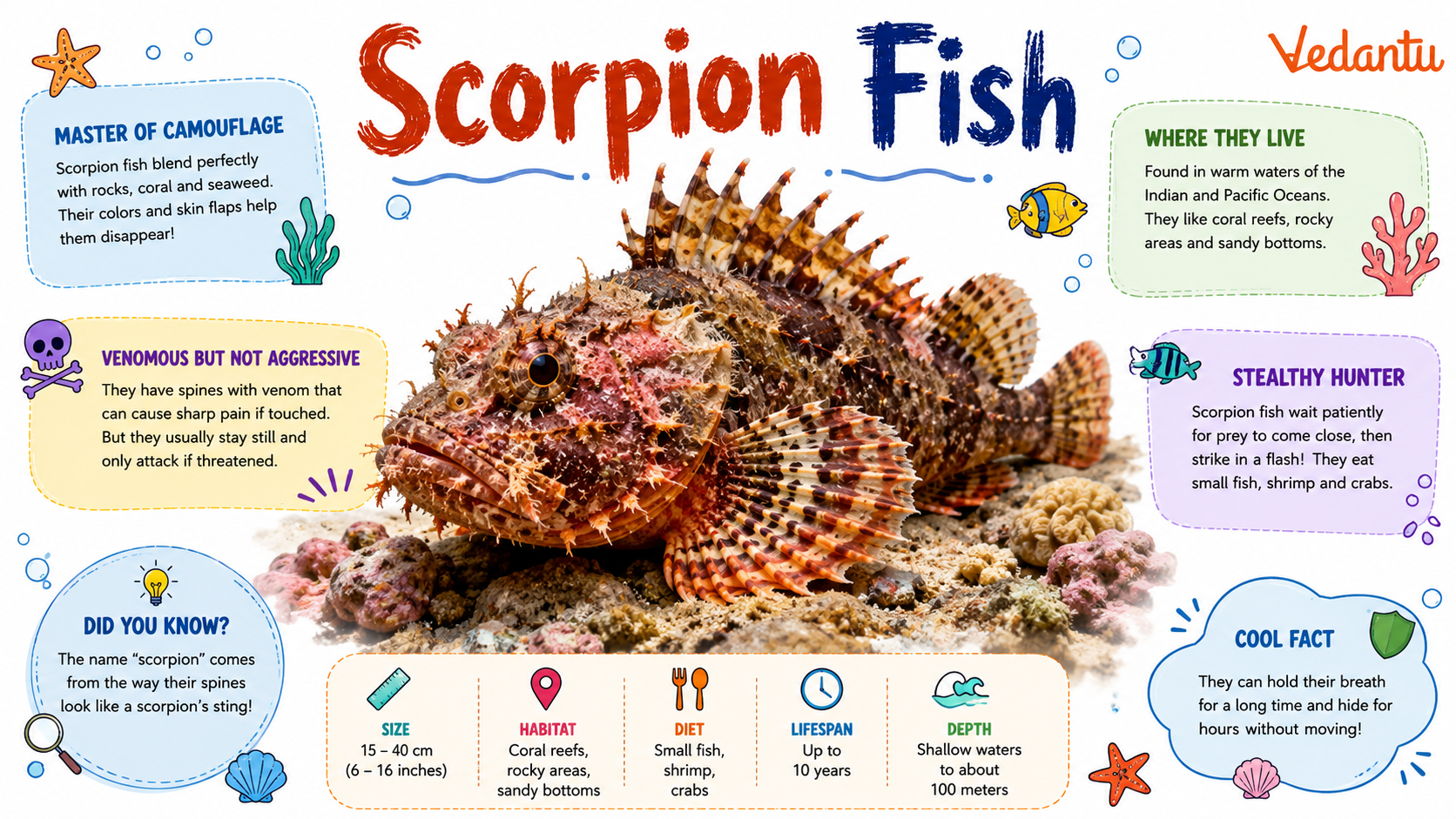
Quick Facts and Statistics
| Feature | Details |
|---|---|
| Common Name | Scorpion Fish |
| Scientific Family | Scorpaenidae |
| Animal Group | Fish (Marine) |
| Size | 5 cm to 50 cm (varies by species) |
| Habitat | Coral reefs, rocky seabeds, shallow coastal waters |
| Diet | Small fish, crustaceans, shrimp |
| Special Feature | Venomous dorsal spines |
| Distribution | Pacific, Indian, and Atlantic Oceans |
Appearance and Physical Characteristics
- Rough, bumpy skin that looks like rocks or coral.
- Colours include red, brown, pink, yellow, or orange.
- Large head with wide mouth for swallowing prey quickly.
- Sharp dorsal spines filled with venom.
- Frilly skin flaps that help in camouflage.
Scorpion Fish Habitat and Distribution
The Scorpion Fish habitat mainly includes warm and tropical ocean waters. It prefers places where it can easily hide and ambush prey.
- Found in coral reefs and rocky seabeds.
- Lives in shallow coastal waters, usually near the sea bottom.
- Common in the Indo-Pacific region.
- Some species are also found in the Atlantic Ocean.
Diet and Feeding Habits
The Scorpion Fish diet makes it a carnivorous predator in the marine food chain.
Small fish, shrimp, crabs, and other crustaceans.
Ambush predator – waits quietly and strikes suddenly.
Quick suction feeding using its wide mouth.
Mid-level predator that controls small fish populations.
Behaviour and Lifestyle
- Mostly solitary and territorial.
- Moves slowly and prefers staying hidden.
- Active both during day and night.
- Uses venomous spines only for defence.
- Relies more on camouflage than speed.
Life Cycle of Scorpion Fish
- Egg Stage: Females release eggs into the water; males fertilise them.
- Larval Stage: Tiny larvae float in open water.
- Juvenile Stage: Young fish settle near reefs and rocky areas.
- Adult Stage: Develop venomous spines and full camouflage features.
What Makes Scorpion Fish Special?
Sharp dorsal fins inject venom if touched.
Blends into coral and rocks.
Attacks prey in a fraction of a second.
Swallows prey almost its own size.
Importance and Role in Nature
- Helps control populations of smaller fish and crustaceans.
- Maintains balance in coral reef ecosystems.
- Serves as prey for larger marine animals.
- Contributes to marine biodiversity.
Amazing Scorpion Fish Facts
Fun Facts for Kids
- Scorpion Fish look like underwater rocks!
- They are masters of hide-and-seek in the sea.
- Their spines act like tiny syringes filled with venom.
- Some people mistake them for coral because of their colours.
- They are related to lionfish and stonefish.
FAQs on Scorpion Fish: Complete Guide to This Venomous Reef Predator
1. What is a Scorpion Fish?
A Scorpion Fish is a venomous marine fish known for its spiky body and excellent camouflage.
- Belongs to the Scorpaenidae family
- Found in tropical and temperate oceans
- Has sharp venomous spines on its back
- Blends into rocks and coral reefs for protection
- Also related to lionfish and stonefish
2. Where do Scorpion Fish live?
Scorpion Fish live mostly in warm ocean waters around reefs and rocky sea floors.
- Common in the Pacific Ocean and Indian Ocean
- Found near coral reefs, rocky crevices, and shallow coastal waters
- Some species live in deep sea habitats
- Prefer areas where they can easily hide and ambush prey
3. Are Scorpion Fish dangerous to humans?
Yes, Scorpion Fish can be dangerous because their spines inject painful venom.
- Their dorsal spines contain toxic venom
- A sting causes severe pain, swelling, and redness
- Rarely life-threatening but needs medical attention
- They sting only for self-defense, not to attack people
4. What do Scorpion Fish eat?
Scorpion Fish are carnivores that eat small sea animals.
- Feed on small fish and crustaceans
- Use a sit-and-wait hunting strategy
- Strike quickly with their large mouths
- Swallow prey whole in seconds
5. How do Scorpion Fish protect themselves?
Scorpion Fish protect themselves using venom and camouflage.
- Have sharp poisonous spines along their back
- Blend into rocks using natural camouflage
- Stay still to avoid being noticed by predators
- Their rough skin looks like coral or seaweed
6. What does a Scorpion Fish look like?
A Scorpion Fish has a bumpy body, wide mouth, and spiny fins.
- Covered in spikes and ridges
- Often colored red, brown, pink, or orange
- Large head with a wide jaw
- Looks similar to a stonefish or lionfish
7. How big can a Scorpion Fish grow?
Most Scorpion Fish grow between 6 inches and 15 inches long.
- Small species are about 15 cm (6 inches)
- Larger species can reach 45 cm (18 inches)
- Size depends on the species and habitat
8. Can you eat Scorpion Fish?
Yes, Scorpion Fish can be eaten if prepared carefully by experts.
- The venom is only in the spines, not the meat
- Spines must be removed safely before cooking
- Meat is white, firm, and tasty
- Popular in some seafood dishes around the world
9. How long do Scorpion Fish live?
Scorpion Fish can live for several years in the wild.
- Average lifespan is about 5 to 15 years
- Life expectancy depends on species and environment
- Face threats from predators and habitat loss
10. Why is the Scorpion Fish important to the ocean ecosystem?
Scorpion Fish help keep the ocean food chain balanced.
- Control populations of small fish and crustaceans
- Serve as prey for larger marine predators
- Contribute to healthy coral reef ecosystems
- Are part of the complex marine biodiversity
