






How Do Tardigrades Survive Extreme Conditions Like Space and Freezing Temperatures?
Tardigrades, often called “water bears,” are microscopic animals known for their extreme survival powers. Though they are smaller than a grain of sand, these tiny creatures can survive freezing cold, boiling heat, radiation, and even outer space! Tardigrade facts amaze scientists and students alike because of their strong body structure and unique survival techniques. Let’s explore the fascinating world of the tardigrade habitat, diet, life cycle, characteristics, and importance in nature.
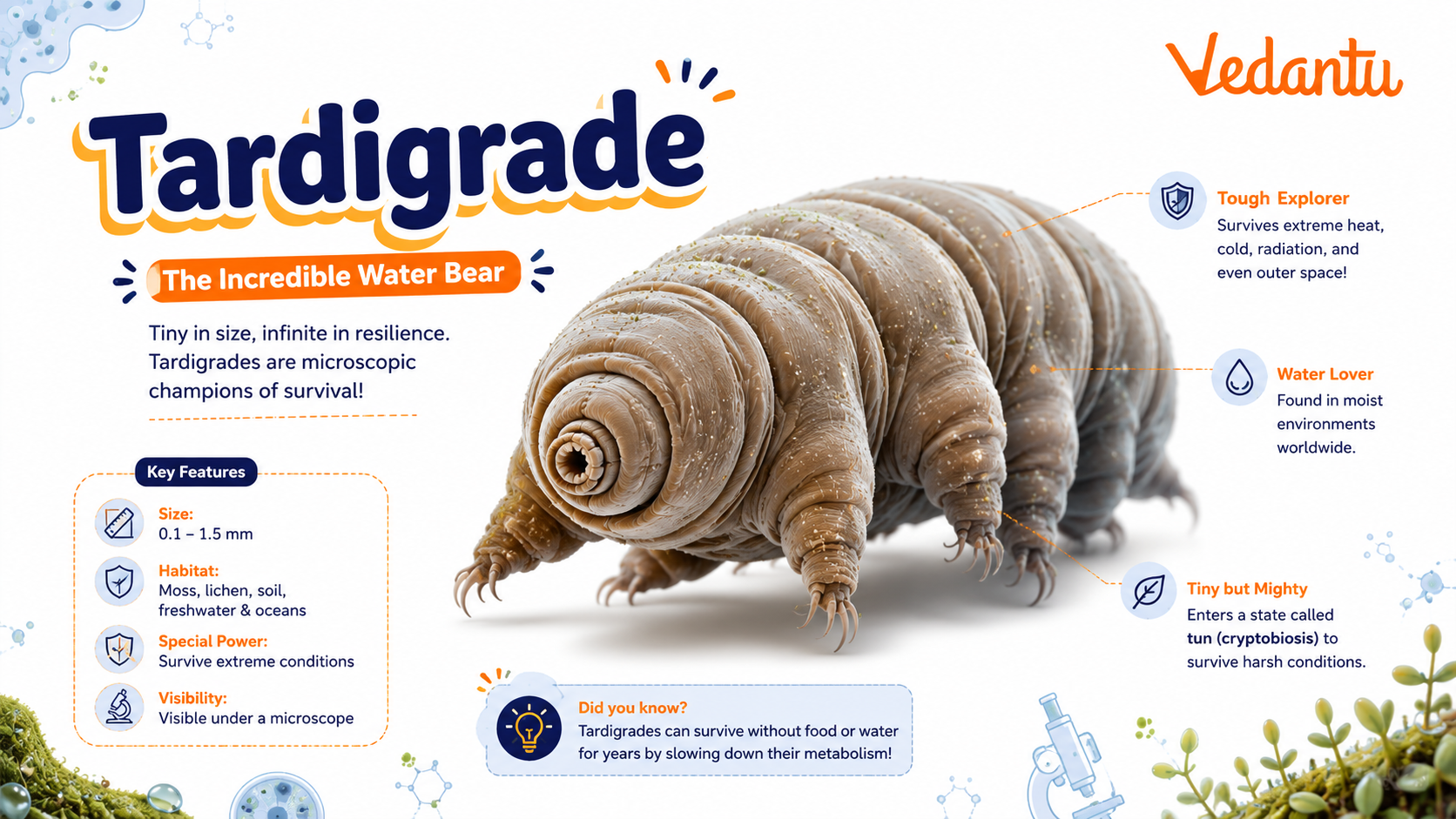
Quick Facts About Tardigrade
| Feature | Details |
|---|---|
| Common Name | Tardigrade (Water Bear) |
| Scientific Phylum | Tardigrada |
| Size | 0.3 – 0.5 mm (some up to 1 mm) |
| Habitat | Moss, soil, freshwater, oceans, icy regions |
| Diet | Plant cells, algae, bacteria, small invertebrates |
| Lifespan | Few months to years (longer in dormant state) |
| Special Feature | Can survive extreme heat, cold, and space |
Appearance and Physical Characteristics
- Plump, segmented body
- Eight short legs with tiny claws
- Soft, transparent or pale body
- Tube-like mouth to suck fluids from plants or prey
- No bones, but a strong outer cuticle
Tardigrade Habitat and Distribution
The tardigrade habitat is surprisingly wide. These tiny animals are found almost everywhere on Earth.
- In moss and lichen on rocks and trees
- In freshwater ponds and lakes
- In oceans from shallow waters to deep sea
- In soil and leaf litter
- Even in Antarctica and high mountains
Diet and Feeding Habits
The tardigrade diet depends on the species. Most are plant feeders, but some are tiny hunters.
- Suck juices from moss and algae
- Feed on bacteria
- Eat small microscopic animals
- Use sharp mouthparts to pierce cells
Behaviour and Lifestyle
- Move slowly using their eight legs
- Need water to stay active
- Enter a dry, curled-up state called a “tun” when conditions are harsh
- Can remain inactive for years
When water returns, they rehydrate and become active again, as if nothing happened!
Tardigrade Life Cycle
- Egg Stage: Females lay eggs, often inside their shed skin.
- Hatching: Tiny young tardigrades hatch from the eggs.
- Growth: They grow by molting (shedding their outer skin).
- Adult Stage: Mature tardigrades reproduce and continue the cycle.
The tardigrade life cycle is simple but very effective for survival in changing environments.
What Makes Tardigrades Special?
Can survive from near absolute zero to over 100°C for short periods.
Can handle radiation levels that would kill most animals.
Some have survived exposure to outer space in experiments.
Can dry out and pause their life processes until water returns.
Importance and Role in Nature
Amazing Tardigrade Facts
- Tardigrades have been on Earth for over 500 million years.
- More than 1,300 species have been discovered.
- They can lose almost all body water and still survive.
- They can survive high pressure in deep oceans.
- They can survive without food for long periods.
- Their nickname “water bear” comes from their bear-like walk.
Fun Facts for Kids
FAQs on Tardigrade: The Microscopic Animal That Can Survive Almost Anything
1. What is a tardigrade?
A tardigrade is a tiny, water-dwelling micro-animal famous for surviving extreme conditions.
- Also called a water bear or moss piglet
- Belongs to the phylum Tardigrada
- Has eight short legs with tiny claws
- Lives in water films around moss, soil, and lichens
- Known as one of the toughest organisms on Earth
2. How big is a tardigrade?
A tardigrade is extremely small and can only be seen clearly with a microscope.
- Usually measures about 0.3 to 0.5 millimeters long
- Smaller than a grain of sand
- Classified as a microscopic animal
- Despite its size, it has a complete body system
3. Where do tardigrades live?
Tardigrades live in many environments around the world, especially where there is moisture.
- Found in moss and lichens
- Live in soil, leaf litter, and freshwater ponds
- Some species survive in deep oceans
- Can be found from the Arctic to the Antarctic
4. Why are tardigrades called water bears?
Tardigrades are called water bears because they look like tiny bears when viewed under a microscope.
- They walk slowly like a bear
- Have a plump body shape
- Move using eight clawed legs
- The nickname makes them popular in science for kids
5. What do tardigrades eat?
Tardigrades feed on tiny plants, algae, and small microorganisms.
- Eat plant cells and algae
- Some species eat bacteria
- A few are predators that eat smaller micro-animals
- Use a sharp mouthpart called a stylet to pierce food
6. How do tardigrades survive extreme conditions?
Tardigrades survive harsh environments by entering a special survival state called cryptobiosis.
- Dry up into a protective form called a tun
- Can survive extreme heat and freezing temperatures
- Resist high radiation and pressure
- Slow down their metabolism almost completely
7. Can tardigrades survive in space?
Yes, tardigrades have survived the vacuum and radiation of outer space during scientific experiments.
- Tested by space agencies in orbit
- Survived exposure to cosmic radiation
- Withstood the vacuum of space without air
- Returned to Earth and continued living
8. How long can tardigrades live?
Tardigrades can live for many years, especially when in their dormant survival state.
- Active lifespan is a few months to 2 years
- In cryptobiosis, they may survive for decades
- Can pause life processes during dry periods
- Revive when water becomes available again
9. Are tardigrades dangerous to humans?
No, tardigrades are completely harmless to humans and are safe to study.
- Do not bite or sting
- Too small to cause harm
- Do not spread diseases
- Important for scientific research in biology and space science
10. Why are tardigrades important in science?
Tardigrades are important because scientists study them to understand survival and life in extreme environments.
- Help research in space biology
- Teach scientists about radiation resistance
- Provide clues about life on other planets
- Used in studies of extremophiles and adaptation
