






Dugong Habitat, Diet, Behavior, and Conservation Explained
Dugongs are large marine mammals that spend their lives peacefully grazing on underwater seagrass. Often called “sea cows,” they are closely related to manatees and even elephants. These gentle animals play an important role in keeping coastal ecosystems healthy. Dugong facts, habitat, diet, characteristics, and life cycle make them a fascinating topic for students who want to learn about ocean life and marine conservation.
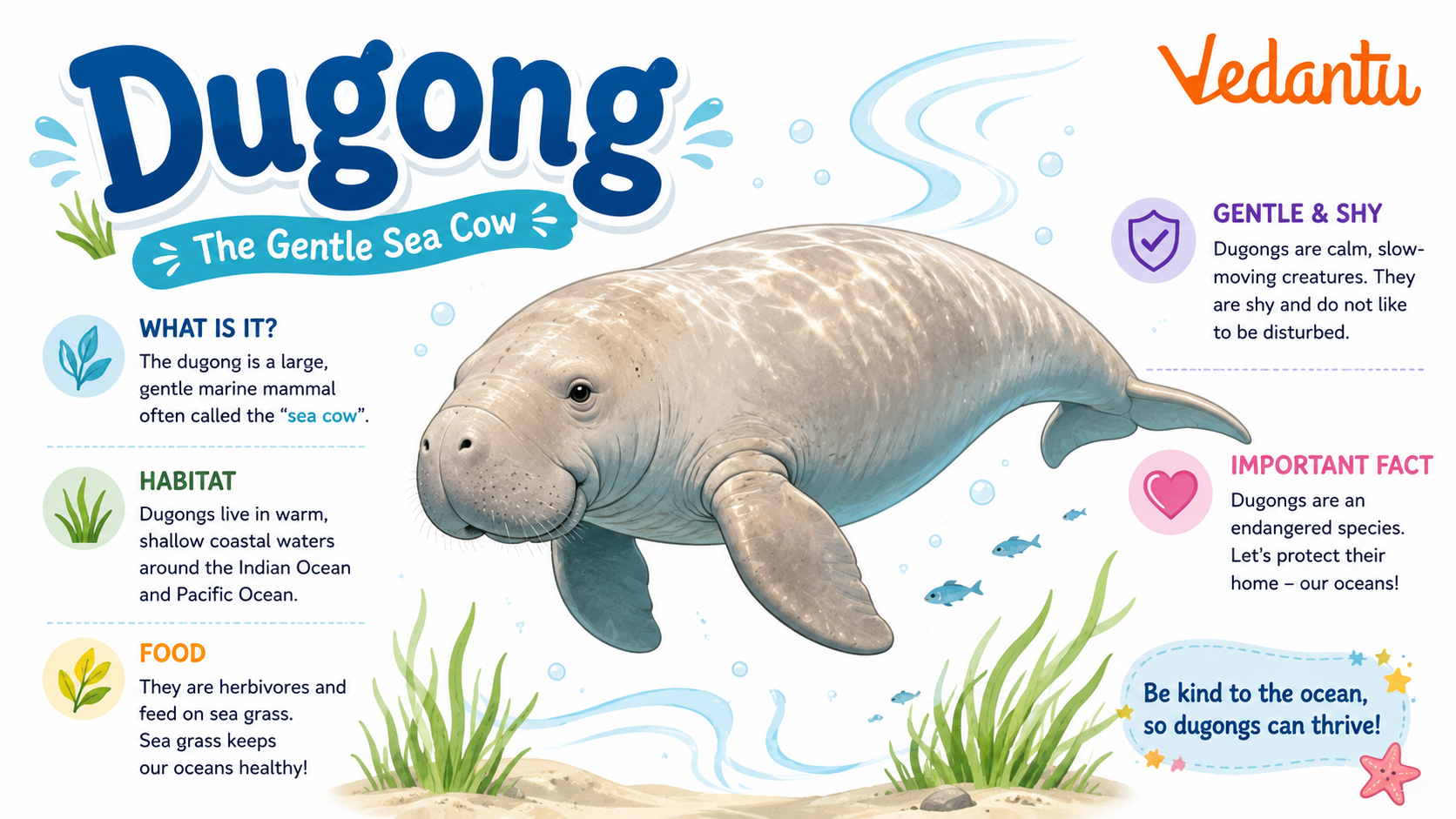
Quick Facts About Dugong
| Feature | Details |
|---|---|
| Common Name | Dugong |
| Scientific Name | Dugong dugon |
| Animal Group | Mammal (Marine) |
| Average Length | 2.5 to 3 metres |
| Average Weight | 250 to 400 kg |
| Lifespan | Up to 70 years |
| Diet | Seagrass (Herbivore) |
| Habitat | Warm coastal waters |
| Conservation Status | Vulnerable |
| Found In | Indian Ocean & Western Pacific Ocean |
Appearance and Physical Characteristics
- Large, smooth, grey or brown body.
- Rounded snout pointing downward for grazing.
- Flipper-like front limbs.
- Whale-like tail (fluked tail).
- Thick skin with sparse hair.
- They have small eyes and no visible external ears.
- Adult males may grow small tusks.
- Their heavy bones help them stay underwater while feeding.
Dugong Habitat and Distribution
- Shallow coastal waters.
- Seagrass meadows.
- Bays, lagoons, and sheltered reefs.
Dugongs are found in warm waters from East Africa to Australia. Large populations live near Australia, the Arabian Gulf, India, and Southeast Asia. They prefer calm, clear waters where seagrass grows in large quantities.
Dugong Diet and Feeding Habits
While feeding, dugongs leave visible trails on the seabed, showing where they have grazed.
Behaviour and Lifestyle
- Usually solitary or found in small groups.
- Slow swimmers but strong and steady.
- Come to the surface every few minutes to breathe.
- Communicate using chirps, whistles, and barks.
- Spend most of their time feeding and resting.
Dugong Life Cycle
- Birth: A female gives birth to one calf after about 13–15 months of pregnancy.
- Calf Stage: The baby drinks milk and stays close to its mother.
- Growing Up: Calves learn to graze on seagrass after a few months.
- Adulthood: They mature slowly and may reproduce after 8–18 years.
Dugongs have a slow reproduction rate, which is one reason their population grows very slowly.
What Makes Dugong Special?
Importance and Role in Nature
- Maintain balance of seagrass beds.
- Support biodiversity in coastal waters.
- Act as indicators of healthy marine environments.
Amazing Dugong Facts
Interesting Facts About Dugong
- Dugongs cannot turn their heads easily due to their body structure.
- Their name comes from a Malay word meaning “lady of the sea.”
- They use sensitive bristles on their snout to find food.
- They are protected in many countries due to their vulnerable status.
Fun Facts for Kids
FAQs on Dugong: The Gentle Sea Cow of Tropical Oceans
1. What is a Dugong?
A dugong is a large, gentle marine mammal that lives in warm coastal waters and eats seagrass.
- It belongs to the order Sirenia, related to manatees.
- Often called a “sea cow” because it grazes on underwater plants.
- Has a rounded body, paddle-like flippers, and a dolphin-shaped tail.
- Found mainly in the Indian Ocean and western Pacific Ocean.
2. Where do dugongs live?
Dugongs live in warm, shallow coastal waters where seagrass grows abundantly.
- Common in Australia, East Africa, India, and Southeast Asia.
- Prefer seagrass meadows near bays and lagoons.
- Stay in tropical and subtropical oceans.
- Avoid deep oceans because they need sunlight areas for food.
3. What do dugongs eat?
Dugongs are herbivores that mainly feed on underwater plants called seagrass.
- Eat large amounts of seagrass every day.
- Use their strong lips to dig up roots.
- Help maintain healthy marine ecosystems.
- Are important for balancing coastal habitats.
4. How are dugongs different from manatees?
Dugongs and manatees are similar sea mammals but have key physical differences.
- Dugongs have a fluked tail like a dolphin.
- Manatees have a round, paddle-shaped tail.
- Dugongs live mostly in saltwater oceans.
- Manatees can live in both freshwater and saltwater.
5. Are dugongs endangered?
Yes, dugongs are considered a vulnerable species due to environmental threats.
- Listed as Vulnerable by the IUCN Red List.
- Threatened by habitat loss and water pollution.
- Accidental capture in fishing nets is a major danger.
- Protected by wildlife conservation laws in many countries.
6. How big can a dugong grow?
A fully grown dugong can reach up to 3 meters (10 feet) in length.
- Can weigh between 250 to 400 kilograms.
- Females are usually slightly larger than males.
- Have thick, smooth gray skin.
- Grow slowly and can live up to 70 years.
7. How do dugongs breathe underwater?
Dugongs cannot breathe underwater and must come to the surface for air.
- Have lungs, not gills.
- Surface every few minutes to breathe.
- Can hold their breath for about 6 minutes.
- Have nostrils located on top of their snout.
8. Why are dugongs called sea cows?
Dugongs are called sea cows because they slowly graze on seagrass like cows on land.
- Spend most of their day eating plants.
- Move calmly and peacefully in water.
- Play an important role in marine grassland ecosystems.
- The nickname highlights their gentle nature.
9. How do dugongs reproduce?
Dugongs give birth to live young and care for them like other mammals.
- Females give birth to one calf at a time.
- Pregnancy lasts about 13–15 months.
- Calves drink their mother’s milk.
- Babies stay with their mother for up to 2 years.
10. Why are dugongs important to the ocean?
Dugongs are important because they keep seagrass beds healthy and support marine life.
- Trim seagrass, helping it grow better.
- Create habitats for fish and small sea animals.
- Support biodiversity in coastal ecosystems.
- Act as indicators of a healthy marine environment.
