






Where Do Racer Snakes Live and What Do They Eat?
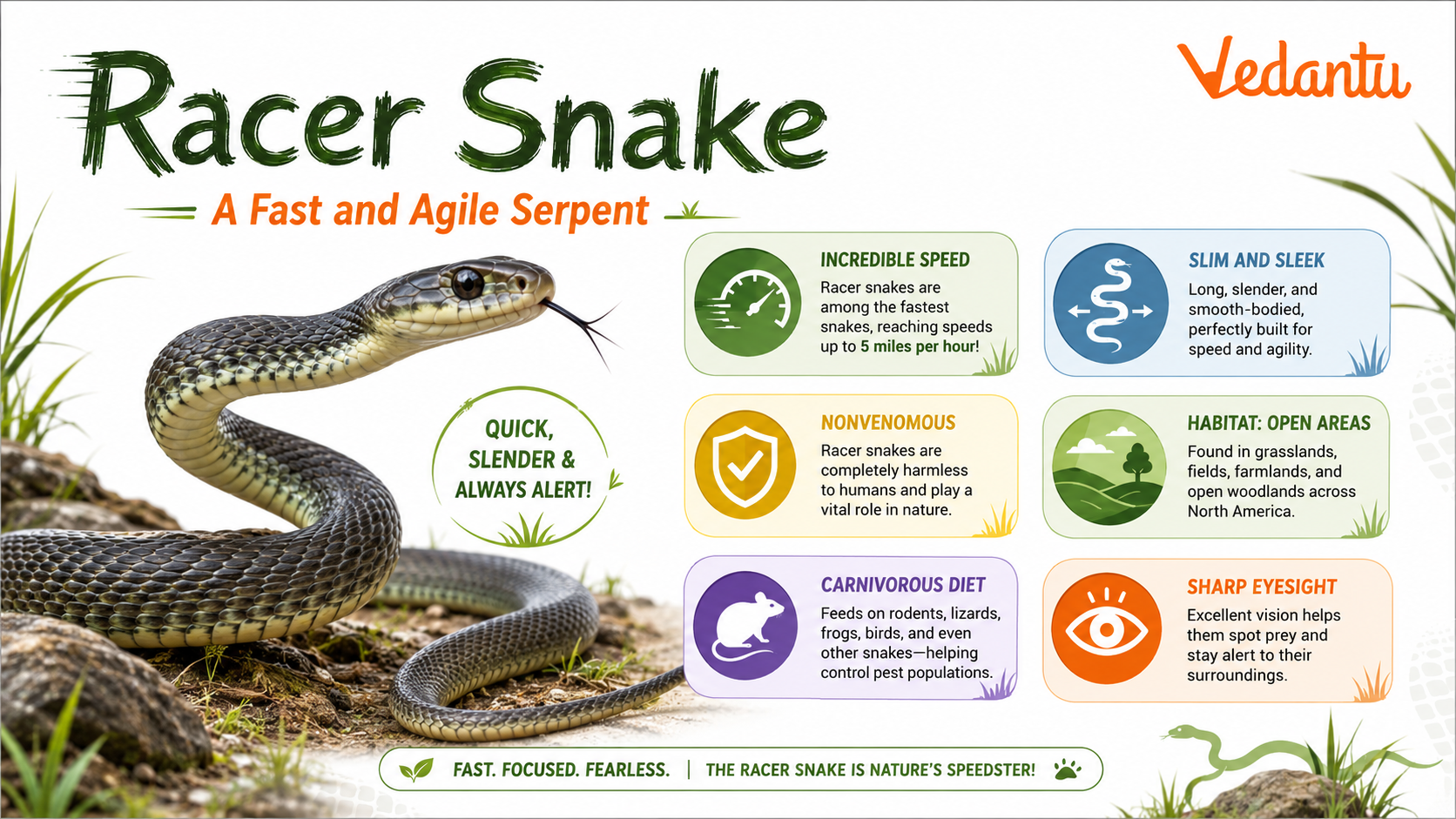
Quick Facts About Racer Snake
| Feature | Details |
|---|---|
| Common Name | Racer Snake |
| Scientific Name | Coluber constrictor |
| Animal Group | Reptile |
| Length | Up to 1–1.8 meters |
| Diet | Carnivore |
| Habitat | Grasslands, forests, deserts, fields |
| Activity Time | Diurnal (active during day) |
| Conservation Status | Least Concern |
Appearance and Physical Characteristics
- Slim and smooth body with shiny scales.
- Usually black, blue, brown, or gray in colour depending on region.
- Large eyes with round pupils for sharp daytime vision.
- Long tail that helps in balance while moving quickly.
- Young racers often have blotched patterns that fade as they grow.
Habitat and Distribution
The Racer Snake habitat includes a wide range of open and warm environments.
- Found across North America, Central America, and parts of South America.
- Lives in grasslands, forests, shrublands, farmlands, and even suburban areas.
- Prefers sunny places where it can warm its body.
- Often hides under rocks, logs, bushes, or in burrows.
Diet and Feeding Habits
The Racer Snake diet mainly includes small animals. It is a fast and active hunter.
Unlike ambush predators, racer snakes move quickly and actively search for food during the day.
Behaviour and Lifestyle
- Diurnal – active mostly during daytime.
- Very alert and quick to escape when threatened.
- Raises its head above grass to scan surroundings.
- May vibrate its tail in dry leaves to scare predators.
- Generally solitary except during mating season.
Life Cycle and Reproduction
- Mating: Takes place in spring.
- Egg Laying: Female lays 3–30 eggs in early summer.
- Incubation: Eggs hatch after about 1–2 months.
- Hatchlings: Young snakes are independent from birth.
- Adult Stage: Grow rapidly and may live up to 10 years in the wild.
What Makes Racer Snake Special?
Importance and Role in Nature
- Controls rodent populations.
- Reduces insect numbers in fields and farms.
- Serves as food for hawks, owls, and larger animals.
- Helps maintain a healthy food chain.
Amazing Racer Snake Facts
Fun Facts for Kids
- Racer snakes do not “race” each other – they are just very fast!
- They can lift their head high to look around like a periscope.
- They enjoy basking in the sun.
- They are helpful farmers’ friends because they eat pests.
- They can disappear quickly into tall grass.
FAQs on Racer Snake: Identification, Behavior, and Fun Facts
1. What is a Racer Snake?
A Racer Snake is a fast-moving, non-venomous snake known for its speed and slender body.
- Belongs to the Colubridae family
- Commonly called the Eastern Racer or Black Racer
- Scientific name: Coluber constrictor
- Found in North America
- Known for quick movements and sharp eyesight
2. Are Racer Snakes venomous or dangerous?
No, Racer Snakes are non-venomous and are not dangerous to humans.
- They do not have venom
- May bite if threatened, but bites are harmless
- Usually escape quickly instead of attacking
- Help control pests like mice and insects
3. Where do Racer Snakes live?
Racer Snakes live in warm and open habitats across North America.
- Grasslands and meadows
- Forests and woodlands
- Farmlands and fields
- Backyards and suburban areas
4. What do Racer Snakes eat?
A Racer Snake eats small animals and insects to survive.
- Mice and small rodents
- Frogs and lizards
- Bird eggs
- Large insects
5. How fast can a Racer Snake move?
The Racer Snake is one of the fastest snakes in North America.
- Can move up to 10 miles per hour
- Uses speed to escape predators
- Rarely relies on hiding
6. What does a Racer Snake look like?
A Racer Snake has a smooth, slender body and large eyes.
- Usually solid black, gray, or blue
- White or light-colored chin
- Smooth, shiny scales
- Long and thin body shape
7. How big do Racer Snakes grow?
Adult Racer Snakes can grow quite long compared to many backyard snakes.
- Average length: 3 to 5 feet
- Some can grow over 6 feet
- Slender body makes them look even longer
8. Do Racer Snakes climb trees?
Yes, Racer Snakes can climb trees and shrubs easily.
- Climb to hunt birds or eggs
- Use strong muscles for gripping
- May rest in bushes for safety
9. How do Racer Snakes protect themselves?
A Racer Snake mainly protects itself by running away quickly.
- Moves very fast to escape danger
- May shake its tail to scare predators
- Can release a strong smell if caught
- May bite as a last defense
10. Why are Racer Snakes important to the ecosystem?
Racer Snakes play an important role in keeping nature balanced.
- Control rodent populations
- Reduce insect numbers
- Serve as food for hawks and larger animals
- Support healthy ecosystems
