






Where Do Perch Fish Live and What Do They Eat?
The perch is a well-known freshwater fish famous for its striped body and sharp spiny fins. Found in lakes, rivers, and ponds, perch are active swimmers and skilled hunters. These fish are popular among anglers and are an important part of aquatic ecosystems. Learning about perch facts, perch habitat, perch diet, and perch characteristics helps us understand how this fascinating fish survives and thrives underwater.
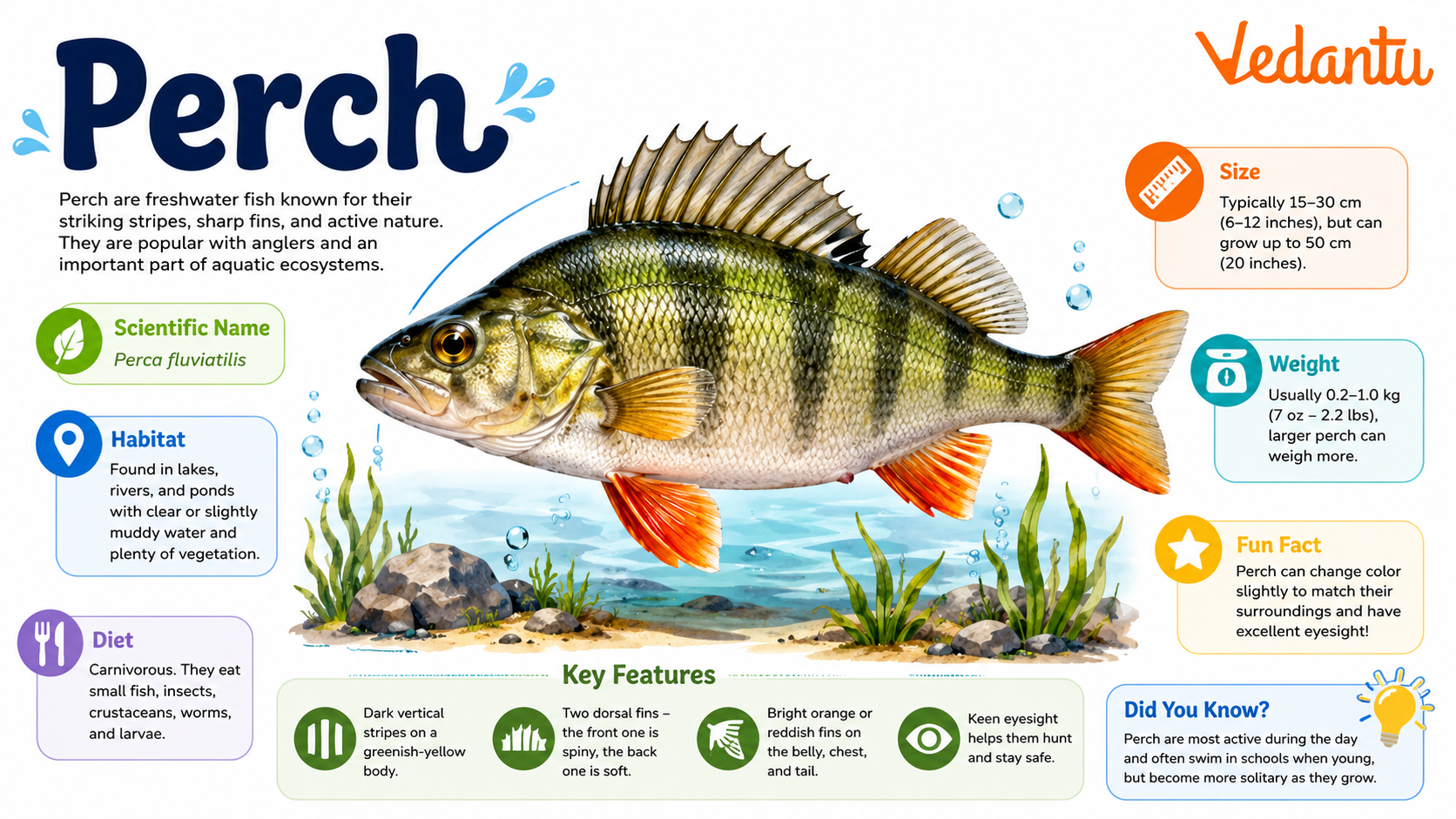
Quick Facts About Perch
| Feature | Details |
|---|---|
| Common Name | Perch |
| Scientific Name | Perca (e.g., Perca fluviatilis, Perca flavescens) |
| Animal Group | Fish |
| Habitat | Freshwater lakes, rivers, ponds |
| Diet | Small fish, insects, worms, crustaceans |
| Size | 15–50 cm (varies by species) |
| Lifespan | 5–10 years (some live longer) |
| Special Feature | Sharp spiny dorsal fin |
Appearance and Physical Characteristics
- Body Shape: Long, slightly flat body designed for smooth swimming.
- Colour: Greenish or yellow body with dark vertical stripes.
- Fins: Two dorsal fins, the first one has sharp spines for protection.
- Scales: Small, rough scales covering the body.
- Mouth: Wide mouth with small sharp teeth to catch prey.
Perch Habitat and Distribution
- Perch live mainly in freshwater habitats.
- Common in lakes, rivers, ponds, and reservoirs.
- Prefer cool or moderately warm water.
- Often found near plants, rocks, or submerged logs.
- Native to Europe, Asia, and North America.
The perch habitat usually includes areas where they can hide and hunt easily. They stay in groups when young and move to deeper water as they grow older.
Perch Diet and Feeding Habits
Perch are carnivores and eat other small animals.
Small fish, insect larvae, worms, and tiny crustaceans.
They quickly dart forward to catch prey.
They are both predators and prey in aquatic ecosystems.
Behaviour and Lifestyle
- Social Nature: Young perch swim in schools.
- Activity: Active during the day.
- Swimming Style: Fast and agile.
- Defence: Uses spiny fins and quick movement.
- Communication: Mostly through movement and body signals.
Perch Life Cycle
- Egg Stage: Female lays thousands of eggs in jelly-like ribbons in water.
- Larva Stage: Eggs hatch into tiny larvae that float and feed on plankton.
- Juvenile Stage: Young perch form schools for safety.
- Adult Stage: Grow larger and become skilled hunters.
The perch life cycle depends on clean water and safe habitats for eggs and young fish to survive.
What Makes Perch Special?
Importance and Role in Nature
- Help control insect and small fish populations.
- Serve as food for larger fish and birds.
- Important for recreational fishing.
- Indicate healthy freshwater ecosystems.
Amazing Perch Facts
Interesting Facts About Perch
- Perch belong to the Percidae family.
- They are closely related to pikeperch and darters.
- They have strong jaws despite their small size.
- Some species live in brackish water.
Fun Facts for Kids
FAQs on Perch Fish: Habitat, Diet, and Fascinating Facts
1. What is a perch?
A perch is a small to medium-sized freshwater fish known for its sharp spines and striped body.
- Belongs to the Percidae family
- Commonly found in lakes, rivers, and ponds
- Has vertical dark stripes on its body
- Popular as both a sport fish and food fish
- Examples include yellow perch and European perch
2. Where do perch live?
Perch live mainly in freshwater habitats like lakes and slow-moving rivers.
- Found in North America and Europe
- Prefer clear water with plants and vegetation
- Stay in areas with moderate temperatures
- Often swim in schools (groups of fish)
3. What do perch eat?
Perch are carnivorous fish, which means they eat other animals.
- Small insects and insect larvae
- Zooplankton and tiny water creatures
- Small fish and minnows
- Crustaceans like small crayfish
4. What does a perch look like?
A perch has a colorful body with stripes and sharp fins.
- Greenish or yellow body
- Dark vertical black stripes
- Bright orange or red fins
- Two separate dorsal fins (top fins), one with sharp spines
5. How big can a perch grow?
Most perch grow to a small or medium size, depending on the species.
- Average length: 6 to 12 inches
- Can weigh up to 1–3 pounds
- European perch can grow larger in ideal conditions
- Growth depends on food supply and habitat
6. Why are perch important?
Perch are important for both the environment and people.
- Play a key role in the aquatic food chain
- Help control insect and small fish populations
- Popular in recreational fishing
- Used as a food fish in many countries
7. Are perch good to eat?
Yes, perch are considered a tasty and healthy fish to eat.
- Have mild, white flaky meat
- Rich in protein and nutrients
- Often fried, baked, or grilled
- Popular in dishes around the Great Lakes region
8. How do perch reproduce?
Perch reproduce by laying eggs in freshwater during spring.
- Spawning season is usually in early spring
- Females lay long, jelly-like egg strands
- Eggs attach to plants and underwater objects
- Young fish are called fry
9. What predators eat perch?
Perch are eaten by many larger animals in their habitat.
- Larger fish like pike and bass
- Birds such as herons
- Water mammals like otters
- Humans through fishing
10. What is the difference between yellow perch and European perch?
The yellow perch and European perch are similar but live in different regions.
- Yellow perch live mainly in North America
- European perch are found in Europe and Asia
- European perch can grow slightly larger
- Both have striped bodies and spiny dorsal fins
