






Why Do Lantern Fish Glow? Habitat, Diet, and Unique Deep-Sea Adaptations
The Lantern Fish is one of the most fascinating creatures of the deep ocean. Known for its glowing body, this tiny fish lights up the dark waters thousands of metres below the surface. Lantern Fish are among the most abundant vertebrates on Earth and play an important role in the marine food chain. Let’s explore amazing Lantern Fish facts, their habitat, diet, life cycle, characteristics, and why they are so important to ocean life.
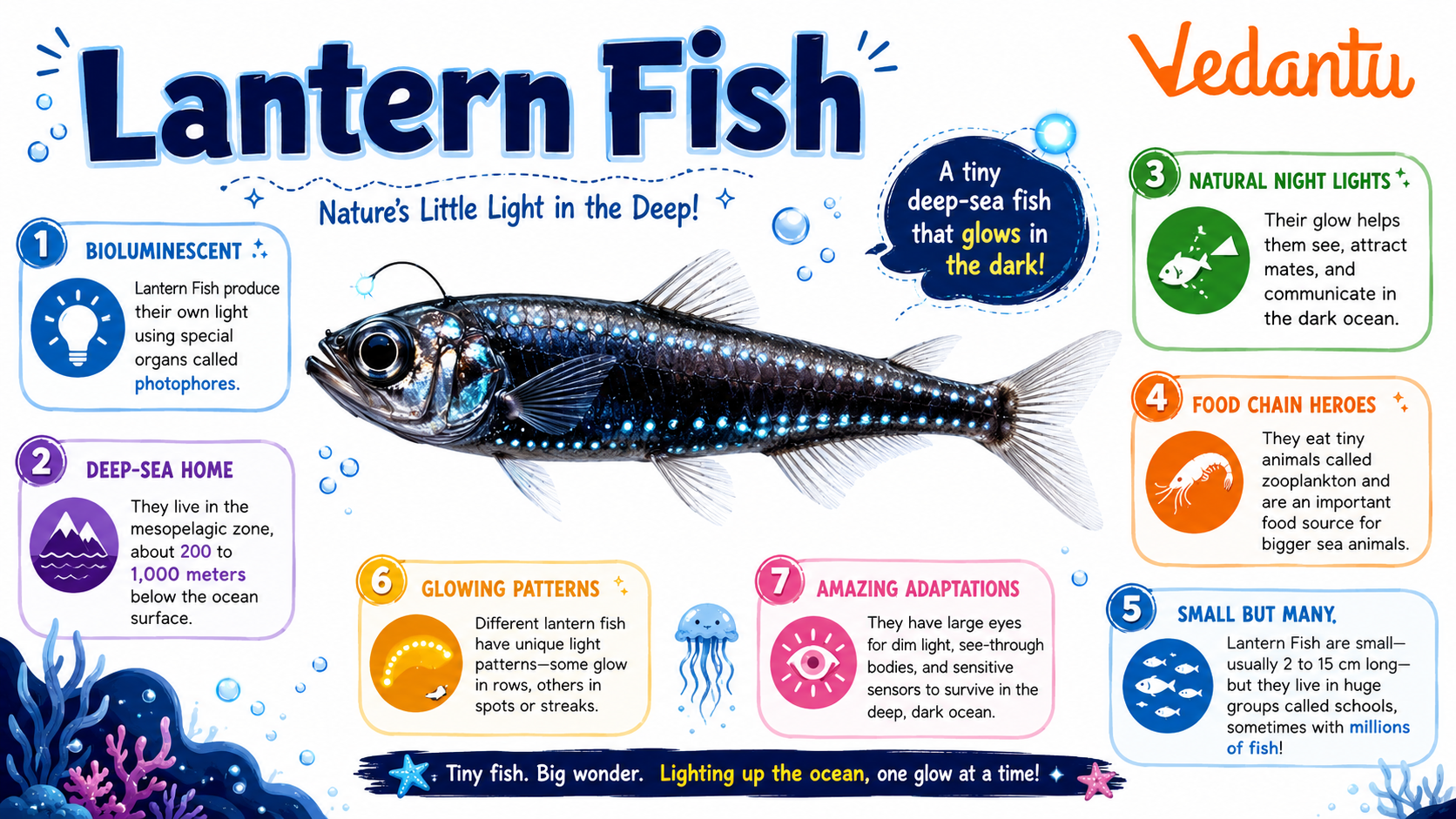
Quick Facts and Statistics
| Feature | Details |
|---|---|
| Common Name | Lantern Fish |
| Scientific Family | Myctophidae |
| Animal Group | Fish (Marine) |
| Size | 2–15 cm long |
| Habitat | Deep ocean waters worldwide |
| Diet | Plankton, small crustaceans |
| Special Feature | Bioluminescent light organs |
| Lifespan | Up to 5 years (varies by species) |
Appearance and Physical Characteristics
- Small, slender, and silvery body.
- Large eyes to see in dim deep-sea light.
- Covered with tiny light-producing organs called photophores.
- Soft fins and lightweight body for easy swimming.
- Usually dark blue, silver, or black in colour.
Lantern Fish Habitat
- Found in oceans all over the world.
- Live at depths of 200 to 1000 metres during the day.
- Prefer cold, dark waters of the deep sea.
- Come closer to the surface at night.
Lantern Fish Diet and Feeding Habits
- Mainly feed on plankton.
- Eat tiny crustaceans like krill and copepods.
- Sometimes eat small fish larvae.
- Are important prey for larger fish, whales, and seabirds.
Behaviour and Lifestyle
- Active mostly at night (nocturnal).
- Travel in large groups called schools.
- Use light to communicate and attract mates.
- Glow helps them confuse predators.
Lantern Fish Life Cycle
- Egg Stage: Females release eggs into open water.
- Larval Stage: Tiny larvae float near the surface.
- Juvenile Stage: Develop light organs as they grow.
- Adult Stage: Move to deeper waters and begin vertical migration.
What Makes Lantern Fish Special?
Importance and Role in Nature
Amazing Lantern Fish Facts
- There are more than 240 known species of Lantern Fish.
- They make up a large portion of the ocean’s total fish biomass.
- Their glow can be blue, green, or yellow.
- Some species can control the brightness of their light.
- They have sharp teeth despite their small size.
- Predators find it hard to spot them due to their counter-lighting ability.
Interesting Facts About Lantern Fish
- Their large eyes help them detect faint light in deep water.
- They rise closer to the surface every night to feed.
- The glow on their belly hides their shadow from predators below.
- They are rarely seen by humans because they live so deep.
Fun Facts for Kids
FAQs on Lantern Fish: Amazing Bioluminescent Creatures of the Deep Sea
1. What is a Lantern Fish?
A Lantern Fish is a small deep-sea fish that can produce its own light.
- It lives in the deep ocean, usually far below the surface.
- It belongs to the family Myctophidae.
- It has special light-producing organs called photophores.
- It is one of the most common fish in the mesopelagic zone (twilight zone).
2. Why is it called a Lantern Fish?
It is called a Lantern Fish because it glows like a tiny underwater lantern.
- The glow comes from bioluminescence.
- Light is made by special organs called photophores.
- The light helps it hide from predators and communicate.
- This glowing ability makes it famous among deep-sea creatures.
3. Where do Lantern Fish live?
Lantern Fish live in the deep ocean, mainly in the twilight zone.
- They are found in oceans all around the world.
- They stay between 200 to 1,000 meters below the surface.
- This area is called the mesopelagic zone.
- It is dark and cold, perfect for bioluminescent animals.
4. How do Lantern Fish glow in the dark?
Lantern Fish glow using a natural process called bioluminescence.
- They have tiny light organs called photophores.
- These organs create light through a chemical reaction.
- The light can be blue or green.
- This helps with camouflage and communication.
5. What do Lantern Fish eat?
Lantern Fish mainly eat tiny ocean animals called plankton.
- Their diet includes zooplankton and small crustaceans.
- They also eat small fish and shrimp.
- They come closer to the surface at night to feed.
- This movement is part of the vertical migration pattern.
6. What animals eat Lantern Fish?
Lantern Fish are an important food source for many ocean animals.
- They are eaten by whales, dolphins, and seals.
- Large fish like tuna and sharks feed on them.
- Seabirds also hunt them near the surface.
- They play a big role in the marine food chain.
7. How big is a Lantern Fish?
Most Lantern Fish are very small, usually only a few inches long.
- They grow between 2 to 6 inches (5–15 cm).
- Their bodies are slim and silver.
- Their small size helps them hide in deep water.
- Despite their size, they exist in huge numbers.
8. What is vertical migration in Lantern Fish?
Vertical migration is when Lantern Fish move up and down in the ocean each day.
- They swim to the surface at night to feed.
- During the day, they return to deep water.
- This daily movement is called diel vertical migration.
- It is one of the largest animal migrations on Earth.
9. Why are Lantern Fish important to the ocean?
Lantern Fish are important because they support the entire marine ecosystem.
- They are a key link in the ocean food web.
- They help transfer energy from plankton to bigger animals.
- Their migration helps move carbon deeper into the ocean.
- They are among the most abundant vertebrates on Earth.
10. Are Lantern Fish dangerous to humans?
Lantern Fish are not dangerous to humans at all.
- They are small and harmless.
- They live deep in the ocean, far from swimmers.
- They do not bite or attack people.
- They are fascinating examples of deep-sea wildlife.
