






What Did Pterodactyls Eat, How Big Were They, and Are They Dinosaurs?
The Pterodactyl was one of the most fascinating flying reptiles of prehistoric times. Often linked with dinosaurs, it actually belonged to a special group called pterosaurs. With long wings, a pointed beak, and sharp eyesight, this creature ruled the skies millions of years ago. Learning about Pterodactyl facts helps us understand how flying animals evolved and how life looked during the Jurassic period.
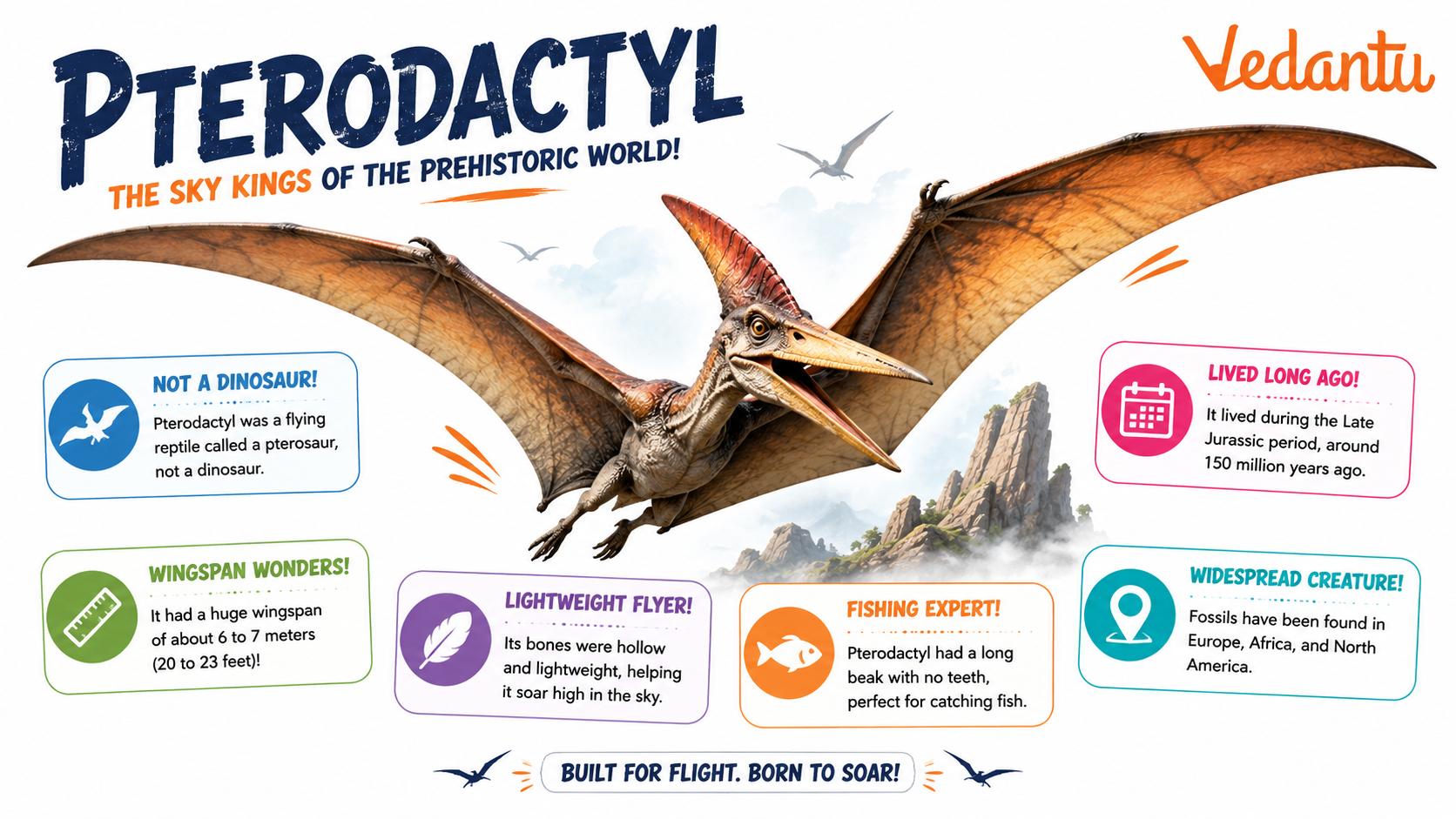
Quick Facts About Pterodactyl
| Feature | Details |
|---|---|
| Common Name | Pterodactyl |
| Scientific Name | Pterodactylus |
| Animal Group | Pterosaur (Flying Reptile) |
| Time Period | Late Jurassic Period |
| Wingspan | About 1–3 meters |
| Diet | Carnivore (mainly fish) |
| Habitat | Coastal areas, lagoons, cliffs |
| Extinction | Around 66 million years ago |
Appearance and Physical Characteristics
- Lightweight body built for flying.
- Long, narrow wings made of skin membrane.
- Sharp, pointed beak with small teeth (in some species).
- Short tail compared to other early pterosaurs.
- Large eyes for spotting prey from the sky.
Pterodactyl Habitat and Distribution
Fossils show that the Pterodactyl habitat included warm coastal regions of ancient Europe. They lived near:
- Shallow seas and lagoons
- Rocky cliffs
- Islands and coastal plains
These areas were perfect for catching fish and gliding over water. The climate during the Jurassic period was warmer than today.
Pterodactyl Diet and Feeding Habits
Behaviour and Lifestyle
- Likely active during the day.
- Could glide long distances using air currents.
- Probably rested on cliffs or rocky ledges.
- May have lived in groups near coastal colonies.
Pterodactyl Life Cycle
- Egg Stage: Laid soft-shelled eggs on land.
- Hatchling: Baby pterosaurs were able to move soon after hatching.
- Juvenile: Grew wings and practiced short flights.
- Adult: Fully developed flyer capable of long-distance gliding.
Flight Adaptations
What Makes the Pterodactyl Special?
Amazing Pterodactyl Facts
- Pterodactyls were not dinosaurs but closely related reptiles.
- Some pterosaurs had wingspans larger than a small airplane.
- Their fossils are mostly found in Germany.
- They had lightweight skeletons like modern birds.
- They lived around 150 million years ago.
- Their wings were made of skin, not feathers.
Fun Facts for Kids
Importance and Role in Nature
Studying Pterodactyl fossils helps scientists understand prehistoric life and the evolution of flying animals. These creatures were important predators in their ecosystems and give clues about climate, geography, and animal development during the Jurassic period.
FAQs on Pterodactyl: The Flying Reptile of the Dinosaur Age
1. What is a Pterodactyl?
A Pterodactyl was a flying reptile that lived during the time of the dinosaurs.
- It is often called a pterosaur, which means “winged lizard.”
- Its scientific name is Pterodactylus.
- It was not a dinosaur but a prehistoric flying reptile.
- It lived about 150 million years ago in the Late Jurassic period.
2. Was a Pterodactyl a dinosaur?
No, a Pterodactyl was not a dinosaur but a close relative of dinosaurs.
- It belonged to a group called Pterosaurs.
- Dinosaurs mostly walked on land.
- Pterosaurs were known for their ability to fly.
- Both lived during the Mesozoic Era.
3. How big was a Pterodactyl?
A Pterodactyl was about the size of a large bird.
- Its wingspan was around 3 to 5 feet.
- Some larger pterosaurs had wingspans over 30 feet.
- It had a long, pointed beak with sharp teeth.
- Its body was lightweight to help it fly easily.
4. What did a Pterodactyl eat?
A Pterodactyl mostly ate fish and small animals.
- It caught fish from rivers and oceans.
- It may have eaten insects and small reptiles.
- Its sharp teeth helped it grab slippery prey.
- It was a carnivore, meaning it ate meat.
5. How did a Pterodactyl fly?
A Pterodactyl flew using large wings made of skin and muscle.
- Its wings were stretched between a long fourth finger and its body.
- The wings were made of a thin membrane, not feathers.
- It used air currents to glide like modern birds.
- Its hollow bones made it lightweight.
6. When did Pterodactyls live?
Pterodactyls lived during the Late Jurassic period about 150 million years ago.
- They lived in the Mesozoic Era.
- This was the same time many dinosaurs existed.
- They became extinct around 66 million years ago.
- Their fossils have been found in Europe and Africa.
7. What is the difference between a Pterodactyl and a Pteranodon?
A Pterodactyl and a Pteranodon were different types of flying reptiles.
- Pterodactyls had teeth, but Pteranodons did not.
- Pteranodons were generally larger.
- Pteranodons had a long head crest.
- Both were types of pterosaurs.
8. Did Pterodactyls have feathers?
Pterodactyls did not have feathers like birds.
- Their wings were made of skin membranes.
- Some pterosaurs had hair-like fibers called pycnofibers.
- They were reptiles, not birds.
- Feathers are mainly linked to certain dinosaurs and modern birds.
9. Where have Pterodactyl fossils been found?
Fossils of Pterodactyls have been found mostly in Europe.
- Many fossils were discovered in Germany.
- Some were found in parts of Africa.
- Fossils were preserved in fine limestone rock.
- Scientists called paleontologists study these fossils.
10. Why did Pterodactyls become extinct?
Pterodactyls became extinct during the mass extinction that ended the age of dinosaurs.
- A large asteroid impact may have caused climate changes.
- There were big changes in weather and food supply.
- This event happened about 66 million years ago.
- Many dinosaurs and other prehistoric animals also disappeared.
