






What Is a Hagfish? Habitat, Slime Defense, and Surprising Facts
The hagfish is one of the strangest and oldest sea creatures on Earth. Often called a “slime eel,” this jawless marine animal has lived in oceans for over 300 million years. Hagfish are famous for producing huge amounts of sticky slime when threatened. In this page, explore amazing Hagfish facts, Hagfish habitat, Hagfish diet, Hagfish characteristics, and why this unusual animal is important to ocean ecosystems.
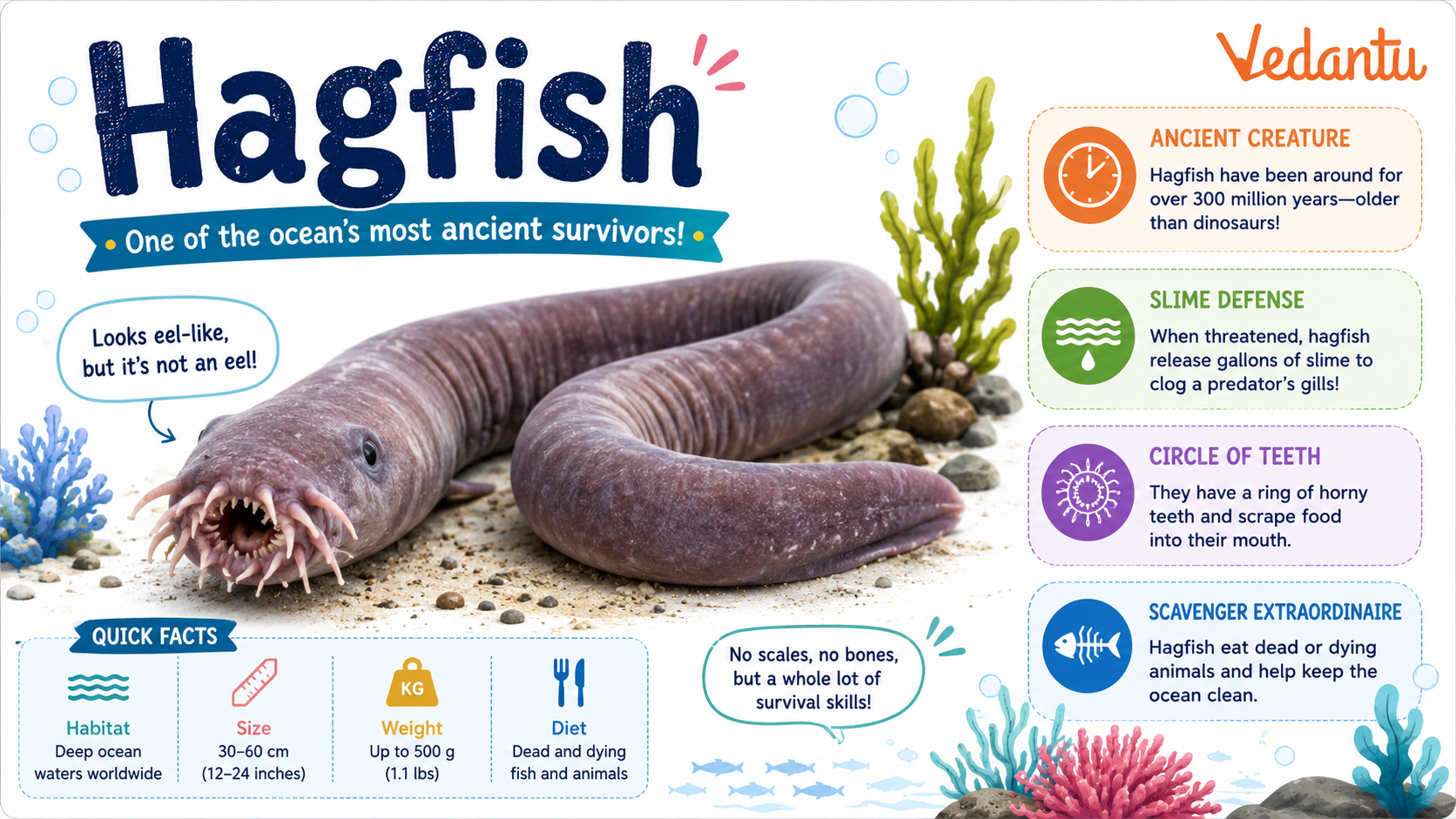
Quick Facts About Hagfish
| Feature | Details |
|---|---|
| Common Name | Hagfish |
| Scientific Class | Myxini |
| Animal Group | Jawless Fish (Agnatha) |
| Size | 20 cm to 80 cm (varies by species) |
| Habitat | Deep ocean floors |
| Diet | Dead and dying marine animals |
| Lifespan | Up to 40 years (estimated) |
| Special Feature | Produces large amounts of slime |
Appearance and Physical Characteristics
- Long, eel-like body without scales.
- No jaws – instead, it has rows of sharp, tooth-like structures.
- Soft, slippery skin.
- Pink, grey, or brown in colour.
- Small eyes and poor eyesight.
- Has a skull but no backbone like most fish.
Hagfish Habitat and Distribution
- Lives on the ocean floor, often at depths of 50 to over 1,000 metres.
- Found in cold marine waters around the world.
- Prefers muddy or soft sea bottoms.
- Often hides inside burrows or inside dead animals.
The Hagfish habitat is mainly deep and dark parts of the ocean where sunlight does not reach. They are commonly found in the Atlantic and Pacific Oceans.
Hagfish Diet and Feeding Habits
- Mostly scavengers – they feed on dead or dying fish and marine animals.
- Sometimes eat worms and small sea creatures.
- Enter the body of dead animals and eat from the inside out.
- Use their tooth-like plates to tear flesh.
The Hagfish diet plays an important role in cleaning the ocean floor by removing dead organisms.
Behaviour and Lifestyle
Hagfish Life Cycle
- Female lays a small number of large eggs.
- Eggs are protected by a tough outer covering.
- Young hatch as miniature versions of adults.
- They grow slowly and can live for decades.
What Makes Hagfish Special?
Importance and Role in Nature
- Clean up dead animals from the ocean floor.
- Help recycle nutrients back into the marine ecosystem.
- Part of the deep-sea food chain.
- Studied by scientists to understand early vertebrate evolution.
Amazing Hagfish Facts
Fun Facts for Kids
- Hagfish are sometimes called “slime eels,” but they are not true eels.
- They can sneeze to clear slime from their nostrils.
- They can tie themselves in knots like a rope.
- They have been around since the time of dinosaurs.
- They do not have jaws like most fish.
FAQs on Hagfish: Amazing Slime-Producing Deep Sea Fish
1. What is a hagfish?
A hagfish is a slimy, eel-shaped sea animal known for producing large amounts of slime to protect itself.
- It is a jawless fish that lives deep in the ocean.
- Hagfish are sometimes called slime eels, but they are not true eels.
- They belong to one of the oldest groups of living vertebrates.
- Hagfish are famous for their sticky slime defense mechanism.
2. Where do hagfish live?
Hagfish live in the deep ocean, mostly on the seafloor.
- They are found in cold marine environments around the world.
- Hagfish prefer muddy ocean bottoms where they can burrow.
- They usually stay at depths of hundreds or even thousands of meters.
- These deep-sea animals avoid bright sunlight.
3. Why do hagfish produce slime?
Hagfish produce slime as a defense mechanism to escape predators.
- The slime expands quickly in water.
- It can clog a predator’s gills, making it hard to breathe.
- This sticky slime helps the hagfish slip away safely.
- Hagfish slime is made of special protein threads and mucus.
4. Are hagfish blind?
Hagfish are almost blind but can still sense their surroundings.
- They have simple eyes that can detect light but not clear images.
- Hagfish rely more on their strong sense of smell and touch.
- They use whisker-like tentacles around their mouth to find food.
- This helps them survive in dark deep-sea habitats.
5. What do hagfish eat?
Hagfish are scavengers that feed mostly on dead or dying sea animals.
- They eat dead fish, worms, and small sea creatures.
- Hagfish can burrow into a carcass to eat from the inside.
- They sometimes hunt slow-moving prey.
- Their feeding habits make them important ocean cleaners.
6. Do hagfish have jaws or bones?
Hagfish do not have jaws or true bones.
- They are part of the jawless fish group.
- Instead of bones, they have a soft cartilage skeleton.
- They use a rough tongue with tiny tooth-like structures to grip food.
- This makes them very different from most modern fish.
7. How old is the hagfish species?
Hagfish are one of the most ancient living vertebrates on Earth.
- They have existed for over 300 million years.
- Some scientists believe their ancestors lived even earlier.
- Hagfish are often called living fossils.
- Their simple body design has changed very little over time.
8. Are hagfish dangerous to humans?
Hagfish are not dangerous to humans.
- They do not attack people.
- Their slime is harmless but very sticky.
- Humans rarely see them because they live in deep water.
- Some cultures even use hagfish as food and leather products.
9. How do hagfish breathe?
Hagfish breathe through gills that take in oxygen from water.
- They have multiple gill openings along their body.
- Water enters through their nostril and flows over the gills.
- Even when inside a carcass, they can still get oxygen.
- This helps them survive in low-oxygen deep-sea areas.
10. Why are hagfish important to the ocean ecosystem?
Hagfish are important because they help keep the ocean clean and balanced.
- They act as scavengers, removing dead animals.
- This prevents the spread of bacteria and disease.
- They are part of the marine food chain.
- Hagfish play a key role in maintaining a healthy deep-sea ecosystem.
