






What Do Labeo Fish Eat and Where Do They Live?
Labeo is a group of freshwater fishes commonly found in rivers and ponds. They belong to the carp family and are very important in fisheries and aquaculture. Many species of Labeo, like Rohu, are popular food fishes in Asia. Known for their smooth bodies and strong swimming ability, Labeo species play a big role in maintaining water ecosystems. Let’s explore interesting Labeo facts, habitat, diet, life cycle, and importance in nature.
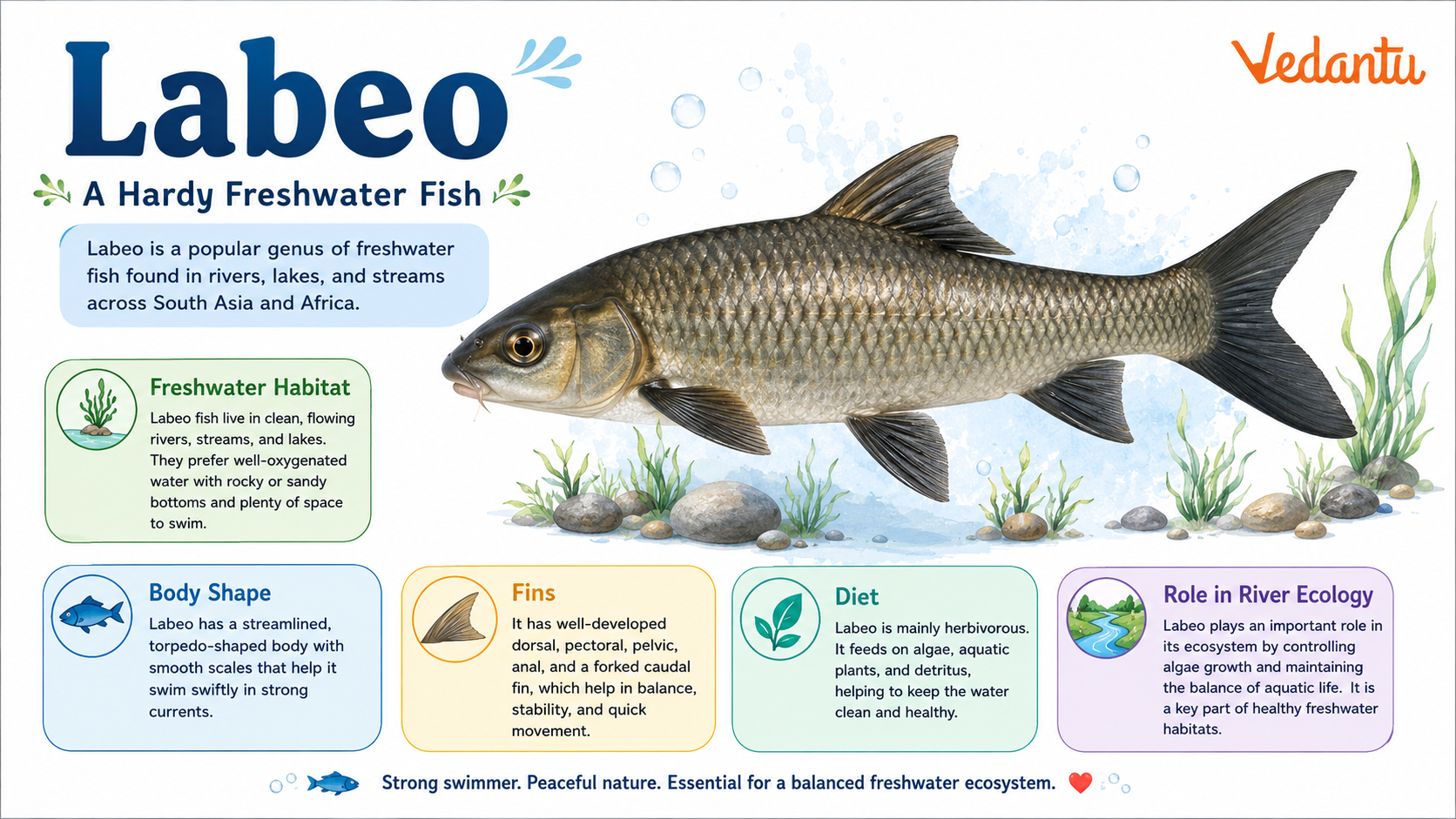
Quick Facts About Labeo
| Feature | Details |
|---|---|
| Common Name | Labeo (Example: Rohu) |
| Scientific Genus | Labeo |
| Animal Group | Fish |
| Family | Cyprinidae (Carp family) |
| Habitat | Rivers, lakes, ponds |
| Diet | Mainly herbivorous |
| Average Size | Up to 1 meter (varies by species) |
| Lifespan | 5–10 years (approx.) |
| Found In | South Asia and Africa |
Appearance and Physical Characteristics
- Long, spindle-shaped body.
- Covered with smooth, shiny scales.
- Usually silver, grey, or slightly bluish in colour.
- Forked tail for powerful swimming.
- Downward-facing mouth adapted for bottom feeding.
Labeo Habitat and Distribution
- Found in rivers, lakes, reservoirs, and ponds.
- Prefer warm tropical climates.
- Common in countries like India, Bangladesh, Nepal, Pakistan, and parts of Africa.
- Often seen swimming in the middle and bottom layers of water.
Diet and Feeding Habits
- Feeds on algae and aquatic plants.
- Eats decaying organic matter.
- Consumes plankton and small organisms.
- Uses its specialized mouth to scrape food from surfaces.
In the food chain, Labeo acts as a primary consumer and supports larger fish, birds, and humans.
Behaviour and Lifestyle
- Active swimmers with strong fins.
- Usually found in groups.
- Prefer clean and oxygen-rich water.
- Show seasonal migration during breeding time.
Labeo Life Cycle
- Egg Stage: Females lay eggs in flowing water during the monsoon season.
- Larval Stage: Eggs hatch into tiny larvae.
- Fry Stage: Young fish begin feeding on plankton.
- Juvenile Stage: Grow rapidly in nutrient-rich waters.
- Adult Stage: Reach maturity and reproduce during rainy seasons.
The Labeo life cycle is closely connected to seasonal river flooding, which provides safe breeding grounds.
What Makes Labeo Special?
Importance and Role in Nature
Amazing Labeo Facts
- Labeo belongs to the same family as common carp.
- Rohu is one of the best-known Labeo species.
- They are widely cultured in fish farms.
- Some species migrate long distances for spawning.
- They grow quickly under proper farming conditions.
- Labeo fish are rich in protein.
Interesting Facts About Labeo
- They prefer slightly muddy river bottoms.
- Their body shape reduces water resistance.
- They are commonly used in polyculture systems with other carp species.
- Young Labeo feed mostly on plankton.
Fun Facts for Kids
FAQs on Labeo Fish: Species, Characteristics, and Natural Habitat
1. What is Labeo?
Labeo is a group of freshwater fish commonly found in rivers and ponds in Asia and Africa.
- It belongs to the carp family (Cyprinidae).
- Many species are known as rohu or similar local names.
- They are important for aquaculture and food production.
- Labeo rohita is one of the most popular species.
2. Where do Labeo fish live?
Labeo fish live in freshwater habitats like rivers, lakes, and ponds.
- Common in South Asia, especially India, Bangladesh, and Pakistan.
- Also found in parts of Africa.
- Prefer slow-moving or calm waters.
- Often raised in fish farms and aquaculture ponds.
3. What does Labeo rohita eat?
Labeo rohita eats plants and tiny water organisms, making it mostly herbivorous.
- Feeds on algae and aquatic plants.
- Eats plankton and small invertebrates.
- In fish farms, it is given commercial fish feed.
4. Why is Labeo important for humans?
Labeo is important because it is a major food fish in many countries.
- Provides a rich source of protein.
- Supports fisheries and fish farming industries.
- Creates jobs in aquaculture and local markets.
- Affordable and widely available in South Asia.
5. How big can Labeo grow?
Labeo fish can grow quite large depending on the species.
- Labeo rohita can grow up to 1 meter in length.
- It can weigh over 20 kilograms in good conditions.
- Growth depends on food, water quality, and habitat.
6. What are the main species of Labeo?
There are several species of Labeo found in freshwater regions.
- Labeo rohita (Rohu)
- Labeo calbasu (Kalbasu)
- Labeo bata
- Various African Labeo species
7. Is Labeo a carnivorous fish?
Labeo is mostly herbivorous but can eat small organisms.
- Mainly feeds on plants and algae.
- Sometimes eats small insects and plankton.
- Considered an omnivorous freshwater fish.
8. How does Labeo reproduce?
Labeo reproduces by laying eggs in freshwater, usually during the rainy season.
- Spawning happens in rivers with flowing water.
- Eggs hatch into small fish larvae.
- In fish farms, breeding is done using induced breeding techniques.
9. What does Labeo look like?
Labeo has a long, silver or gray body with a slightly curved back.
- Streamlined body for easy swimming.
- Small mouth adapted for feeding on plants.
- Fins are usually darker in color.
10. Is Labeo safe and healthy to eat?
Yes, Labeo is safe and healthy to eat when properly cooked.
- Rich in protein and essential nutrients.
- Low in unhealthy fats.
- Widely consumed in South Asian cuisine.
- Must be cleaned and cooked properly for safety.
