






Where Do Komodo Dragons Live and What Do They Eat?
The Komodo Dragon is the world’s largest and heaviest living lizard. Found only in a few Indonesian islands, this giant reptile is famous for its strong bite, sharp claws, and powerful hunting skills. Komodo Dragon facts are truly amazing—they can run fast, swim well, and even take down large animals. Let’s explore the Komodo Dragon habitat, diet, characteristics, life cycle, and why this incredible reptile is so important in nature.
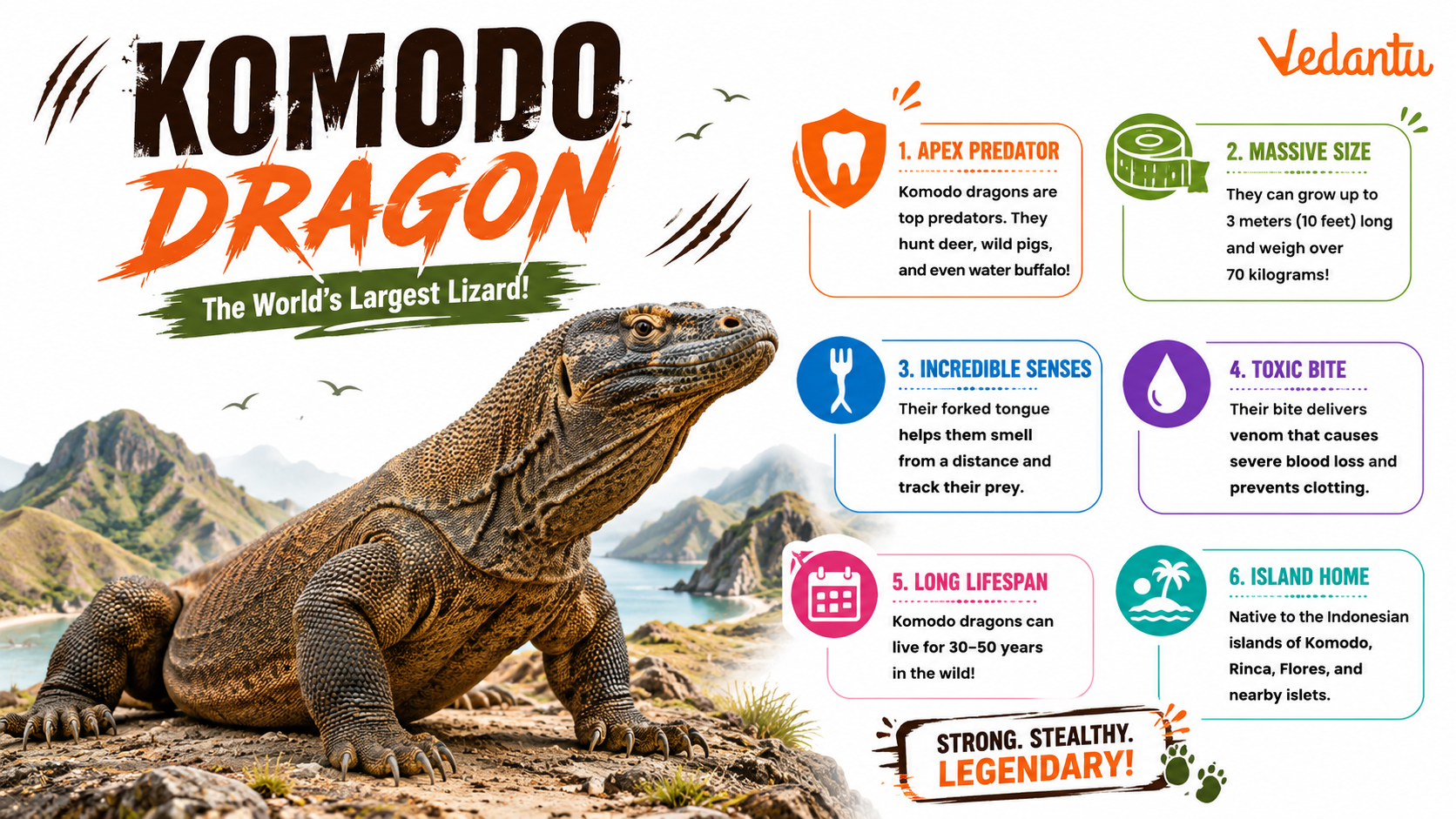
Quick Facts About Komodo Dragon
| Feature | Details |
|---|---|
| Common Name | Komodo Dragon |
| Scientific Name | Varanus komodoensis |
| Animal Group | Reptile |
| Length | Up to 3 meters (10 feet) |
| Weight | 70–90 kg (can be more in wild males) |
| Diet | Carnivore (meat-eater) |
| Lifespan | Up to 30 years |
| Habitat | Tropical savannas, forests, and islands |
| Conservation Status | Endangered |
Appearance and Physical Characteristics
- Long, strong body with a powerful tail.
- Rough, tough skin covered with small scales.
- Colour ranges from grey to brown.
- Sharp curved claws for tearing prey.
- Long, yellow forked tongue to sense smell.
- Strong jaws with sharp, serrated teeth.
Habitat and Distribution
The Komodo Dragon habitat is limited to a few islands in Indonesia. These include:
- Komodo Island
- Rinca Island
- Flores Island
- Gili Motang
- Hot and dry tropical climate
- Open grasslands and savannas
- Lowland forests
- Coastal areas
Komodo Dragon Diet and Feeding Habits
The Komodo Dragon diet mainly includes large animals.
- Deer
- Wild pigs
- Water buffalo
- Birds
- Small mammals
- Sometimes even other Komodo Dragons
- Wait quietly and ambush their prey.
- Use strong legs to chase short distances.
- Deliver a powerful bite.
- Follow the injured animal until it becomes weak.
Behaviour and Lifestyle
- Mostly solitary animals.
- Active during the day (diurnal).
- Excellent swimmers.
- Can run up to 20 km/h for short distances.
- Use their forked tongue to smell from far away.
Komodo Dragon Life Cycle
- Egg Laying: Female lays about 15–30 eggs in a nest.
- Incubation: Eggs hatch after about 7–8 months.
- Baby Stage: Hatchlings are about 40 cm long and live in trees to avoid predators.
- Juvenile Stage: Young dragons eat insects and small animals.
- Adult Stage: Fully grown by 8–9 years.
The Komodo Dragon life cycle shows strong survival skills from a very young age.
What Makes the Komodo Dragon Special?
Importance and Role in Nature
Amazing Komodo Dragon Facts
- They are the largest lizards in the world.
- They can eat up to 80% of their body weight in one meal.
- Their teeth are constantly replaced if broken.
- They can swim between islands.
- They sometimes dig up graves to eat buried animals.
- They have been living on Earth for millions of years.
Interesting Facts About Komodo Dragon
Fun Facts for Kids
- Komodo Dragons flick their tongue like snakes.
- They can open their mouths very wide.
- Baby dragons are bright and quick climbers.
- They love warm, sunny places.
- They are sometimes called “living dinosaurs.”
FAQs on Komodo Dragon: Size, Habitat, Diet, and Fascinating Facts
1. What is a Komodo dragon?
A Komodo dragon is the largest living lizard in the world and a powerful reptile predator.
- Scientific name: Varanus komodoensis
- Type: Monitor lizard
- Found in: Indonesia
- Diet: Carnivorous (meat-eater)
- Known for: Strong bite and sharp claws
2. Where do Komodo dragons live?
Komodo dragons live in a few Indonesian islands with hot and dry climates.
- Main islands: Komodo Island, Rinca, Flores, and Gili Motang
- Habitat: Tropical savannas, forests, and grasslands
- Region: Komodo National Park
3. How big can a Komodo dragon grow?
A Komodo dragon can grow up to 10 feet long and weigh over 150 pounds.
- Average length: 8–10 feet
- Average weight: 150–200 pounds
- Tail length: Almost half of its body
4. What do Komodo dragons eat?
Komodo dragons are carnivores that hunt and eat large animals.
- Deer
- Wild pigs
- Water buffalo
- Birds and small mammals
- Sometimes carrion (dead animals)
5. Are Komodo dragons dangerous to humans?
Yes, Komodo dragons can be dangerous because they are powerful wild predators.
- They have a venomous bite
- Very sharp, curved teeth
- Strong claws and muscular tails
- Excellent sense of smell
6. Do Komodo dragons have venom?
Yes, Komodo dragons have venom glands that help them weaken their prey.
- Venom lowers blood pressure
- Causes heavy bleeding
- Makes prey weak and tired
7. How do Komodo dragons hunt?
Komodo dragons hunt using stealth, power, and patience.
- They hide and ambush prey
- Bite and inject venom
- Track prey using their strong sense of smell
- Can detect blood from miles away
8. How long do Komodo dragons live?
Komodo dragons can live up to 30 years in the wild.
- Wild lifespan: Around 20–30 years
- Zoo lifespan: Sometimes longer with care
- Slow growth but strong survival skills
9. Are Komodo dragons endangered?
Yes, Komodo dragons are listed as Endangered due to habitat loss and climate change.
- Threats: Human activity and rising sea levels
- Small population: About 3,000–4,000 left
- Protected in Komodo National Park
10. How do Komodo dragons reproduce?
Komodo dragons lay eggs and can sometimes reproduce without a male.
- Lay about 15–30 eggs
- Eggs hatch after 7–8 months
- Young dragons climb trees for safety
- Can reproduce by parthenogenesis (asexual reproduction)
