






Where Do King Crabs Live, What Do They Eat, and How Big Do They Grow?
The King Crab is one of the largest and most fascinating crustaceans in the ocean. Known for its long legs, hard spiky shell, and strong claws, this marine animal lives in cold ocean waters. King Crab facts reveal that it can grow very large and survive in deep, icy seas. Despite its name, it is not a true crab! Let’s explore the King Crab habitat, diet, characteristics, life cycle, and importance in the marine ecosystem.
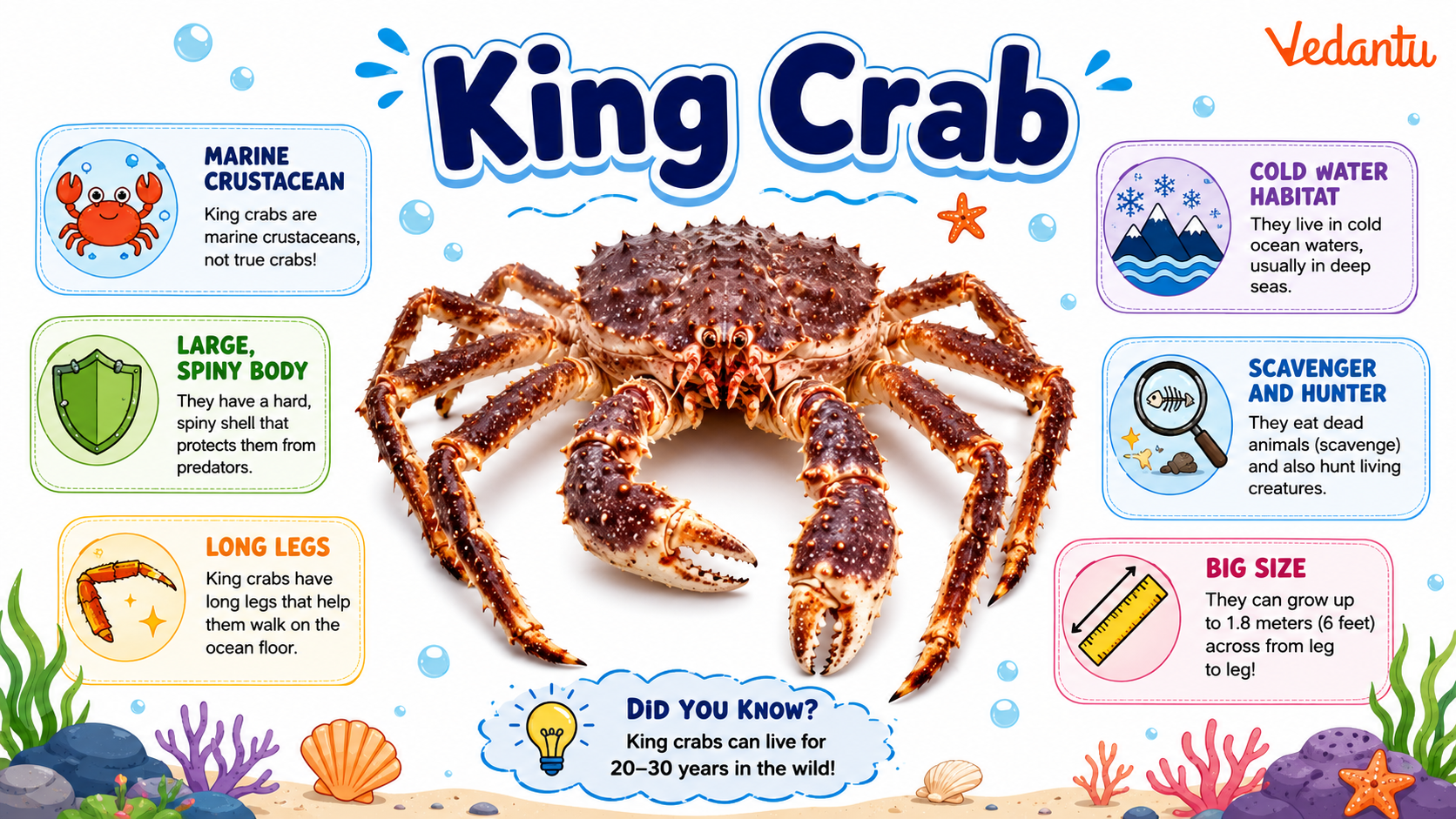
Quick Facts About King Crab
| Feature | Details |
|---|---|
| Common Name | King Crab |
| Scientific Family | Lithodidae |
| Animal Group | Crustacean (related to crabs and lobsters) |
| Size | Leg span up to 1.8 meters (about 6 feet) |
| Weight | Up to 10 kg (22 pounds) |
| Habitat | Cold ocean waters, deep sea floors |
| Diet | Carnivore and scavenger |
| Lifespan | 20–30 years |
| Found In | North Pacific Ocean, Bering Sea |
Appearance and Physical Characteristics
- Large, rounded body covered with a hard, spiky shell.
- Long walking legs that help it move across the ocean floor.
- Two strong front claws – one larger for crushing, one smaller for cutting.
- Colours range from reddish-brown to dark purple.
- Has five pairs of legs, but the last pair is small and hidden.
Habitat and Distribution
- Lives in cold ocean waters.
- Common in the North Pacific Ocean and Bering Sea.
- Found at depths from shallow coastal waters to over 200 meters deep.
- Prefers sandy or muddy sea floors.
Diet and Feeding Habits
- King Crab diet mainly includes clams, worms, snails, and small fish.
- Uses its large claw to crush hard shells.
- Also eats dead animals as a scavenger.
- Helps keep the ocean floor clean.
Behaviour and Lifestyle
- Usually walks slowly on the ocean floor.
- Migrates to shallow waters for breeding.
- Molts (sheds its shell) as it grows.
- Stays hidden under rocks when young.
Life Cycle of King Crab
- Egg Stage: Female carries thousands of eggs under her body.
- Larva Stage: Tiny larvae float in the ocean.
- Juvenile Stage: Young crabs settle on the sea floor.
- Adult Stage: Grow larger through molting and reach maturity after several years.
What Makes King Crab Special?
Importance and Role in Nature
Amazing King Crab Facts
- Some King Crabs have a leg span wider than a bicycle!
- They can weigh as much as a small child.
- They live up to 30 years in the wild.
- Red King Crab is the most famous species.
- They walk sideways, like most crabs.
- Their shell is called an exoskeleton.
Interesting Facts About King Crab
Fun Facts for Kids
FAQs on King Crab: Fascinating Facts About the Ocean’s Giant Crustacean
1. What is a King Crab?
A King Crab is a very large ocean crab known for its long legs and tasty meat.
- The most famous type is the Red King Crab.
- It lives in cold ocean waters like the Bering Sea and North Pacific Ocean.
- It is called “king” because of its huge size compared to other crabs.
- It is a popular seafood around the world.
2. Where do King Crabs live?
King Crabs live in very cold ocean waters near the bottom of the sea.
- Found in the Bering Sea near Alaska.
- Also live in the North Pacific Ocean and near Russia.
- They like sandy or muddy sea floors.
- They move to deeper water during winter.
3. How big can a King Crab grow?
A King Crab can grow very large, making it one of the biggest crabs in the world.
- Leg span can reach up to 5 to 6 feet.
- Can weigh over 20 pounds (9 kg).
- Males are usually bigger than females.
- Their large claws help them catch food.
4. What do King Crabs eat?
King Crabs are omnivores, meaning they eat both plants and animals.
- They eat small fish and other crabs.
- They enjoy clams, worms, and sea stars.
- Sometimes they eat dead sea animals on the ocean floor.
- Their strong claws help them crush shells.
5. Why are King Crabs so expensive?
King Crab is expensive because it is hard to catch and very popular as seafood.
- Fishing happens in dangerous, icy waters like the Bering Sea.
- Fishing season is short and carefully controlled.
- The meat is sweet, tender, and high-quality.
- High demand in restaurants increases the price.
6. How are King Crabs caught?
King Crabs are caught using large traps in deep ocean waters.
- Fishermen use heavy crab pots made of steel.
- Traps are baited with fish to attract crabs.
- Boats pull the traps up after several hours.
- Only legal-sized male crabs are kept to protect the species.
7. What does King Crab taste like?
King Crab meat tastes sweet, rich, and slightly salty from the sea.
- The meat is white with red edges.
- It is soft but firm and easy to pull from the shell.
- Often served steamed, boiled, or with butter.
- It is considered a luxury seafood delicacy.
8. How long do King Crabs live?
King Crabs can live for many years in the wild ocean.
- They can live up to 20 to 30 years.
- They grow by shedding their shell in a process called molting.
- Younger crabs molt more often than adults.
- They grow bigger after each molt.
9. Are King Crabs really true crabs?
King Crabs are not true crabs because they are more closely related to hermit crabs.
- They belong to the group called lithodid crabs.
- They have a smaller hidden back pair of legs.
- Scientists classify them differently from “true crabs.”
- They evolved from ancient hermit crab ancestors.
10. Why are King Crabs important to the ocean?
King Crabs play an important role in keeping the ocean ecosystem balanced.
- They help control populations of small sea animals.
- They clean the ocean floor by eating dead organisms.
- They are food for larger animals like octopuses and large fish.
- They support fishing communities and the seafood industry.
