






Why Is the Kakapo Endangered? Habitat, Diet, and Conservation Facts
The Kakapo is one of the most unique birds on Earth. It is a large, flightless parrot found only in New Zealand. Known for its owl-like face, moss-green feathers, and friendly nature, the Kakapo is also one of the rarest birds in the world. These nocturnal parrots cannot fly but are excellent climbers. Learning about Kakapo facts, habitat, diet, and life cycle helps us understand why this bird is so special and why it needs protection.
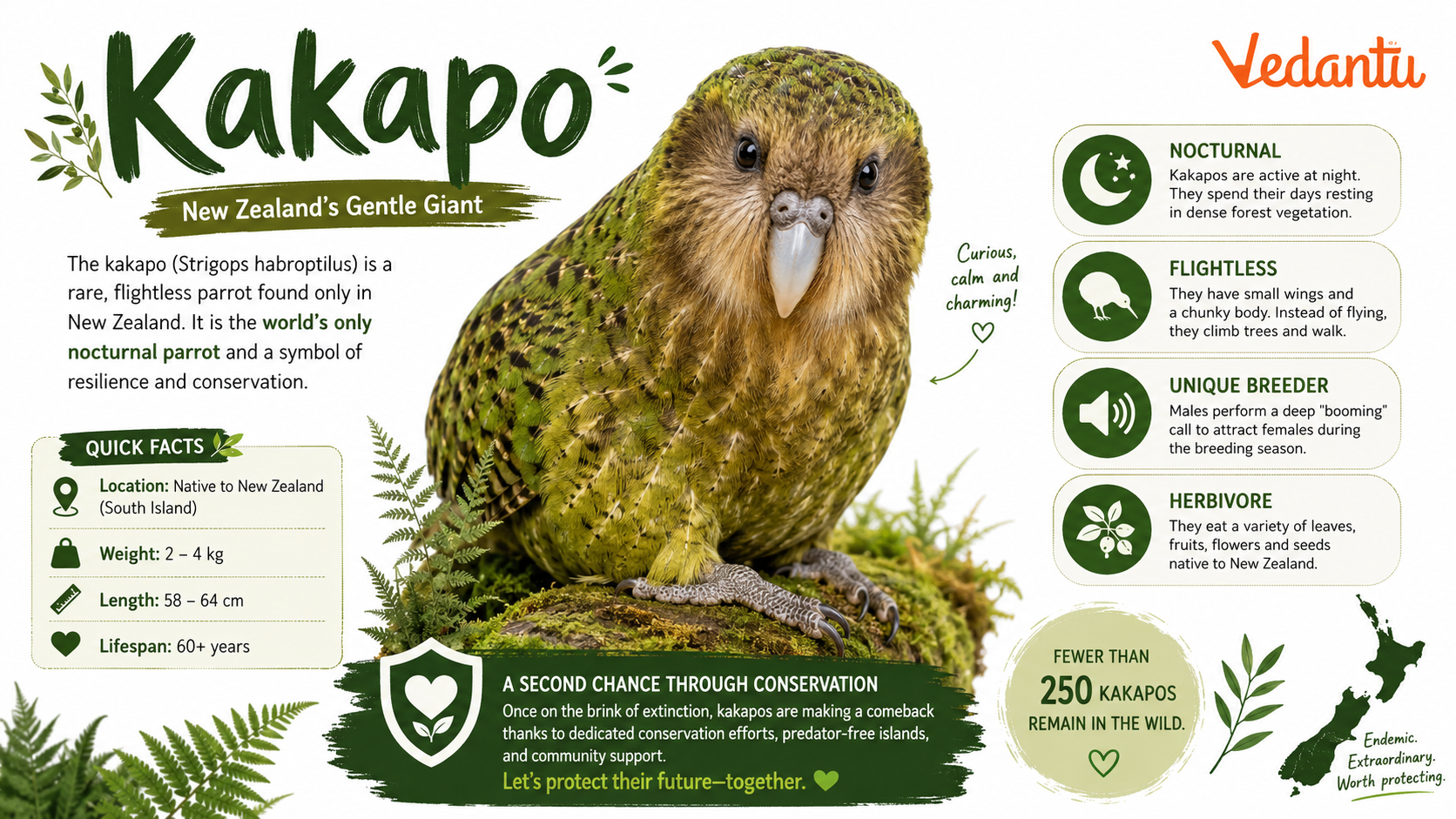
Quick Facts and Statistics
| Feature | Details |
|---|---|
| Common Name | Kakapo |
| Scientific Name | Strigops habroptilus |
| Animal Group | Bird (Parrot) |
| Size | Up to 60 cm long |
| Weight | 2–4 kg (heaviest parrot in the world) |
| Lifespan | 60–90 years |
| Habitat | Forests of New Zealand |
| Diet | Herbivore (plants, fruits, seeds) |
| Conservation Status | Critically Endangered |
Appearance and Physical Characteristics
- Large, round body with short legs.
- Moss-green feathers with black and yellow patterns for camouflage.
- Owl-like facial disc with whisker-like feathers.
- Strong curved beak for crushing plants.
- Small wings that cannot support flight.
These Kakapo characteristics help it blend perfectly into forest surroundings. Even though it cannot fly, it uses its strong legs to walk and climb trees.
Habitat and Distribution
- Found only in New Zealand.
- Lives in native forests and scrublands.
- Prefers cool, moist climates.
- Nests in tree roots, hollow logs, or rock crevices.
Today, Kakapos are kept on protected predator-free islands to ensure their safety. Protecting the Kakapo habitat is very important for its survival.
Diet and Feeding Habits
The Kakapo diet mainly depends on seasonal forest plants. It plays a role in spreading seeds in its habitat.
Behaviour and Lifestyle
- Nocturnal – active at night and rests during the day.
- Solitary and quiet bird.
- Walks long distances on the forest floor.
- Climbs trees and glides down using wings for balance.
- Uses a deep “booming” call during breeding season.
Sound or Call
Male Kakapos make a deep booming sound that can travel several kilometres. This call helps attract females during mating season.
Life Cycle and Reproduction
- Breeding Season: Occurs every 2–4 years when certain trees produce lots of fruit.
- Eggs: Female lays 1–4 eggs in a nest on the ground.
- Incubation: Eggs hatch after about 30 days.
- Chicks: Mother raises chicks alone for several months.
- Adult Stage: Slow growth but very long lifespan.
What Makes Kakapo Special?
Importance and Role in Nature
- Helps in seed dispersal.
- Maintains forest ecosystem balance.
- Important part of New Zealand’s natural heritage.
- Symbol of wildlife conservation efforts.
Amazing Facts About Kakapo
Fun Facts for Kids
- Kakapo means “night parrot” in Māori language.
- It looks like a mix between a parrot and an owl.
- It can live longer than many humans!
- It is one of the rarest birds on Earth.
- It loves climbing trees even though it cannot fly.
FAQs on Kakapo: The Rare Flightless Parrot of New Zealand
1. What is a Kakapo?
The Kakapo is a rare, flightless parrot from New Zealand and is one of the world’s most endangered birds.
- The Kakapo is a large, green parrot with owl-like features.
- It is also called the owl parrot because of its round face.
- It cannot fly and lives on the ground.
- It is native to New Zealand.
- It is known for being one of the rarest birds in the world.
2. Why is the Kakapo endangered?
The Kakapo is endangered mainly because of predators and habitat loss.
- Introduced animals like cats, rats, and stoats hunted them.
- Humans destroyed parts of their forest habitat.
- They reproduce slowly, making recovery harder.
- They nest on the ground, which makes eggs easy targets.
3. Where do Kakapos live?
Kakapos live in protected islands in New Zealand where predators are controlled.
- They once lived all over New Zealand forests.
- Now they survive on special predator-free islands.
- They prefer thick forests with plenty of plants.
- They hide during the day and come out at night.
4. Can Kakapos fly?
Kakapos cannot fly because they are heavy, ground-dwelling parrots.
- They have small wings compared to their body size.
- They use their wings for balance, not flight.
- They climb trees using strong legs and beaks.
- They glide short distances when coming down.
5. What do Kakapos eat?
Kakapos are herbivores and eat plants, fruits, and seeds.
- They enjoy native fruits like rimu berries.
- They eat leaves, roots, and bark.
- They chew food into small pieces.
- Their diet changes with the seasons.
6. How many Kakapos are left in the world?
There are only around a few hundred Kakapos left in the world, making them critically endangered.
- In the 1990s, fewer than 100 survived.
- Conservation efforts increased their numbers.
- Each bird is carefully monitored by scientists.
- They are part of a special Kakapo Recovery Program.
7. Why is the Kakapo called the owl parrot?
The Kakapo is called the owl parrot because its face looks like an owl’s face.
- It has a round, flat face.
- It has forward-facing eyes.
- Its feathers form a facial disc like an owl.
- It is active at night, like many owls.
8. How long do Kakapos live?
Kakapos can live for more than 60 years, making them one of the longest-living birds.
- They mature slowly.
- They breed only every few years.
- Some may live up to 90 years.
- They need long-term care and protection.
9. How do Kakapos reproduce?
Kakapos have a unique breeding system called lek mating where males compete to attract females.
- Males make deep booming sounds at night.
- They dig bowl-shaped nests in the ground.
- Females choose a mate based on the calls.
- They breed only when certain trees produce lots of fruit.
10. How are scientists saving the Kakapo?
Scientists are saving the Kakapo through conservation programs and careful monitoring.
- They move birds to predator-free islands.
- Each Kakapo has a tracking device.
- They provide extra food during breeding seasons.
- They protect eggs and chicks from danger.
