






What Is an Isopod? Habitat, Diet, Life Cycle, and Unique Adaptations
Isopods are small crustaceans that may look like simple bugs, but they are full of surprises. Found in oceans, freshwater, and even gardens, these fascinating creatures are known for their hard outer shell and segmented bodies. Some isopods live deep in the sea, while others roll into a ball on land for protection. Learning about isopod facts, habitat, diet, characteristics, and life cycle helps us understand how important they are in nature.
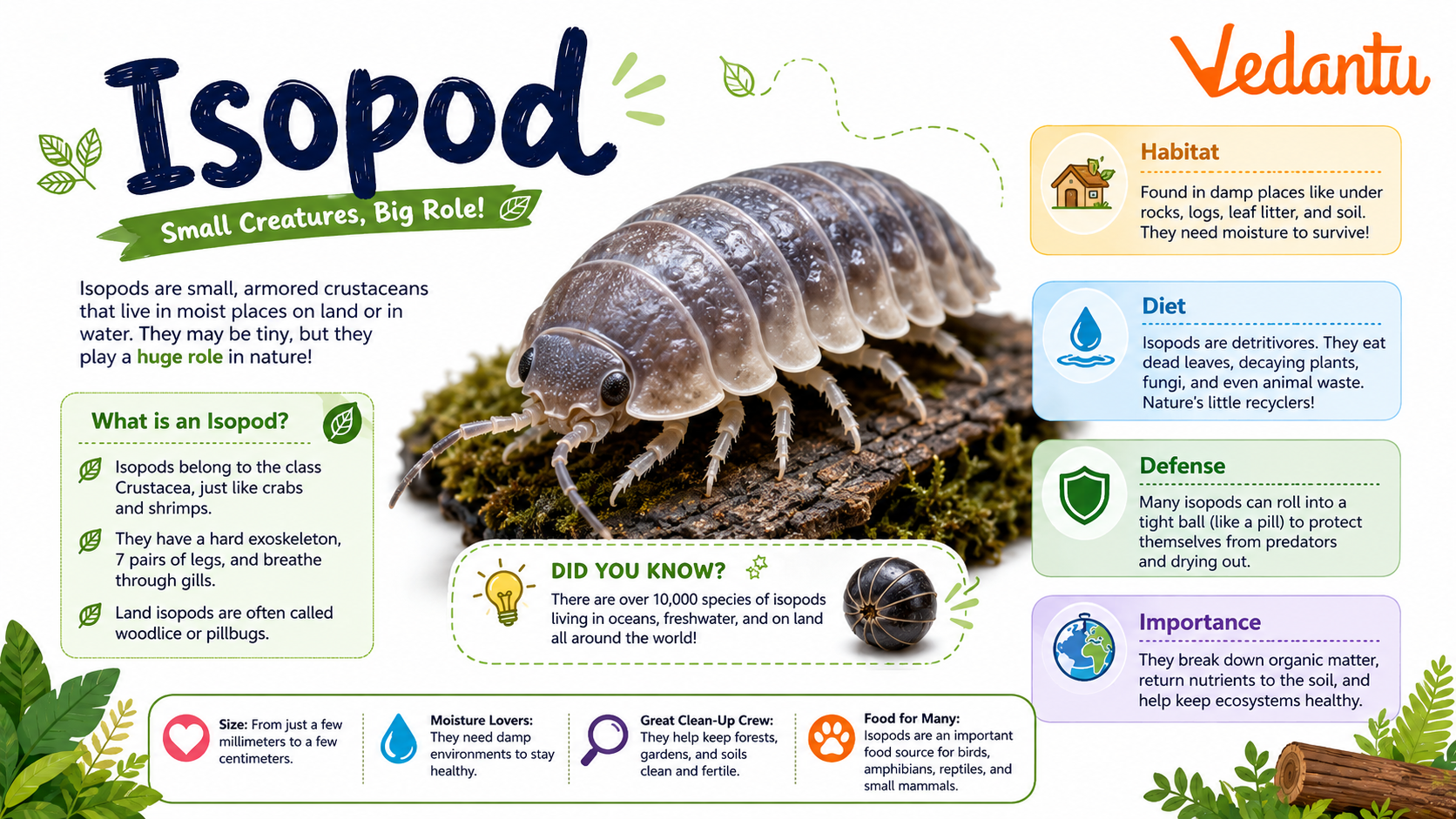
Quick Facts About Isopods
| Feature | Details |
|---|---|
| Common Name | Isopod (also called woodlouse or pill bug on land) |
| Scientific Order | Isopoda |
| Animal Group | Crustacean (related to crabs and shrimp) |
| Size | Usually 1–3 cm; some deep-sea species can grow much larger |
| Habitat | Oceans, freshwater bodies, forests, gardens, soil |
| Diet | Dead plants, algae, small organisms, decaying matter |
| Lifespan | 2–5 years (varies by species) |
| Special Feature | Hard exoskeleton and segmented body |
Appearance and Physical Characteristics
- Flattened, oval-shaped body.
- Hard outer shell called an exoskeleton.
- Body divided into clear segments.
- Usually grey, brown, or black in colour.
- Seven pairs of legs of similar size (that’s why they are called “iso-pod” meaning “equal feet”).
- Two antennae to sense surroundings.
Isopod Habitat and Distribution
Isopods are found almost everywhere in the world. Their habitat depends on the species.
- Marine isopods: Live in oceans from shallow shores to deep-sea floors.
- Freshwater isopods: Found in rivers, lakes, and ponds.
- Terrestrial isopods: Live in damp soil, under rocks, logs, and leaf litter.
- Prefer moist environments to prevent drying out.
Diet and Feeding Habits
The isopod diet mainly includes decaying organic matter. They play an important role in cleaning the environment.
- Dead leaves and wood.
- Algae and small plants.
- Fungi.
- Sometimes small insects or marine animals.
In the food chain, isopods act as decomposers and are also eaten by birds, fish, frogs, and small mammals.
Behaviour and Lifestyle
Isopod Life Cycle
- Egg Stage: Female carries eggs in a pouch under her body.
- Young Isopods: Hatch as tiny versions of adults.
- Growth: Shed their exoskeleton several times as they grow.
- Adult Stage: Reach full size and reproduce.
The isopod life cycle does not include dramatic metamorphosis like butterflies. They simply grow larger with each molt.
What Makes Isopods Special?
Importance and Role in Nature
- Break down dead plants and recycle nutrients into the soil.
- Improve soil health and fertility.
- Serve as food for many animals.
- Help maintain balance in ecosystems.
The importance of isopods in nature is huge because they act as natural cleaners and recyclers.
Amazing Isopod Facts
Fun Facts for Kids
- Pill bugs are actually isopods, not insects.
- They have 14 legs!
- They love damp and dark places.
- You can often find them under flower pots.
- They help gardens stay healthy.
FAQs on Isopod: Fascinating Facts About These Tiny Crustaceans
1. What is an isopod?
An isopod is a small crustacean with a hard outer shell and seven pairs of legs.
- Belongs to the group crustaceans (like crabs and shrimp)
- Has a flat, segmented body
- Includes pill bugs, woodlice, and rolly pollies
- Lives in oceans, freshwater, or on land
- Known for rolling into a ball for protection (in some species)
2. Where do isopods live?
Isopods live in many habitats, including oceans, freshwater, and damp land areas.
- Marine isopods live in seas and deep oceans
- Freshwater isopods live in rivers and lakes
- Terrestrial isopods live under rocks, logs, and soil
- Prefer dark, moist environments to prevent drying out
- Found on every continent, including Antarctica
3. What do isopods eat?
Isopods are mostly scavengers that eat decaying plants and animals.
- Feed on dead leaves and rotting wood
- Eat fungi and algae
- Some marine species eat dead fish or small sea animals
- Help recycle nutrients back into the soil
- Play an important role in the ecosystem
4. Are isopods insects?
Isopods are not insects; they are crustaceans related to crabs and lobsters.
- Insects have six legs, but isopods have 14 legs
- Isopods breathe with gill-like structures
- They belong to the order Isopoda
- Have a hard exoskeleton
- Often confused with bugs because of their small size
5. Why do some isopods roll into a ball?
Some isopods roll into a ball to protect themselves from predators.
- This behavior is called conglobation
- Protects their soft underside
- Makes them harder for predators to eat
- Common in pill bugs or rolly pollies
- Not all isopod species can roll up
6. How big do isopods grow?
Isopods range in size from tiny species to giant deep-sea forms.
- Most land isopods are less than 2 cm long
- Giant isopods can grow up to 50 cm (20 inches)
- Marine species are usually larger than land species
- Size depends on habitat and food supply
- Giant isopods live in the deep ocean
7. How do isopods breathe?
Isopods breathe using gills or gill-like structures depending on where they live.
- Marine isopods breathe through gills in water
- Land isopods have special gill-like organs called pleopodal lungs
- Need moisture to survive
- Can dry out quickly in hot environments
- Often hide during the day to stay moist
8. Are isopods helpful to the environment?
Yes, isopods are important decomposers that help keep ecosystems healthy.
- Break down dead plants and animals
- Improve soil quality
- Recycle nutrients into the ground
- Provide food for birds and small animals
- Support the natural food chain
9. How do isopods reproduce?
Isopods reproduce by laying eggs that hatch into tiny versions of adults.
- Females carry eggs in a pouch called a marsupium
- Babies are called mancae
- Young look like small adults but lack one pair of legs at first
- Grow by molting their exoskeleton
- Molting often happens in two stages
10. What is a giant isopod?
A giant isopod is a large deep-sea crustacean known for its size and armored body.
- Scientific genus: Bathynomus
- Lives deep in the ocean
- Can survive long periods without food
- Feeds on dead whales and fish on the sea floor
- Looks similar to a huge pill bug
