






Cerastes Habitat, Diet, Venom, and Unique Horn Adaptations
Cerastes, commonly known as horned vipers, are fascinating desert snakes famous for the small horn-like scales above their eyes. These reptiles are experts at surviving in hot, sandy environments. With excellent camouflage and powerful venom, Cerastes species are skilled hunters of the desert. Learning about Cerastes facts, habitat, diet, and life cycle helps us understand how animals adapt to extreme climates and maintain balance in desert ecosystems.
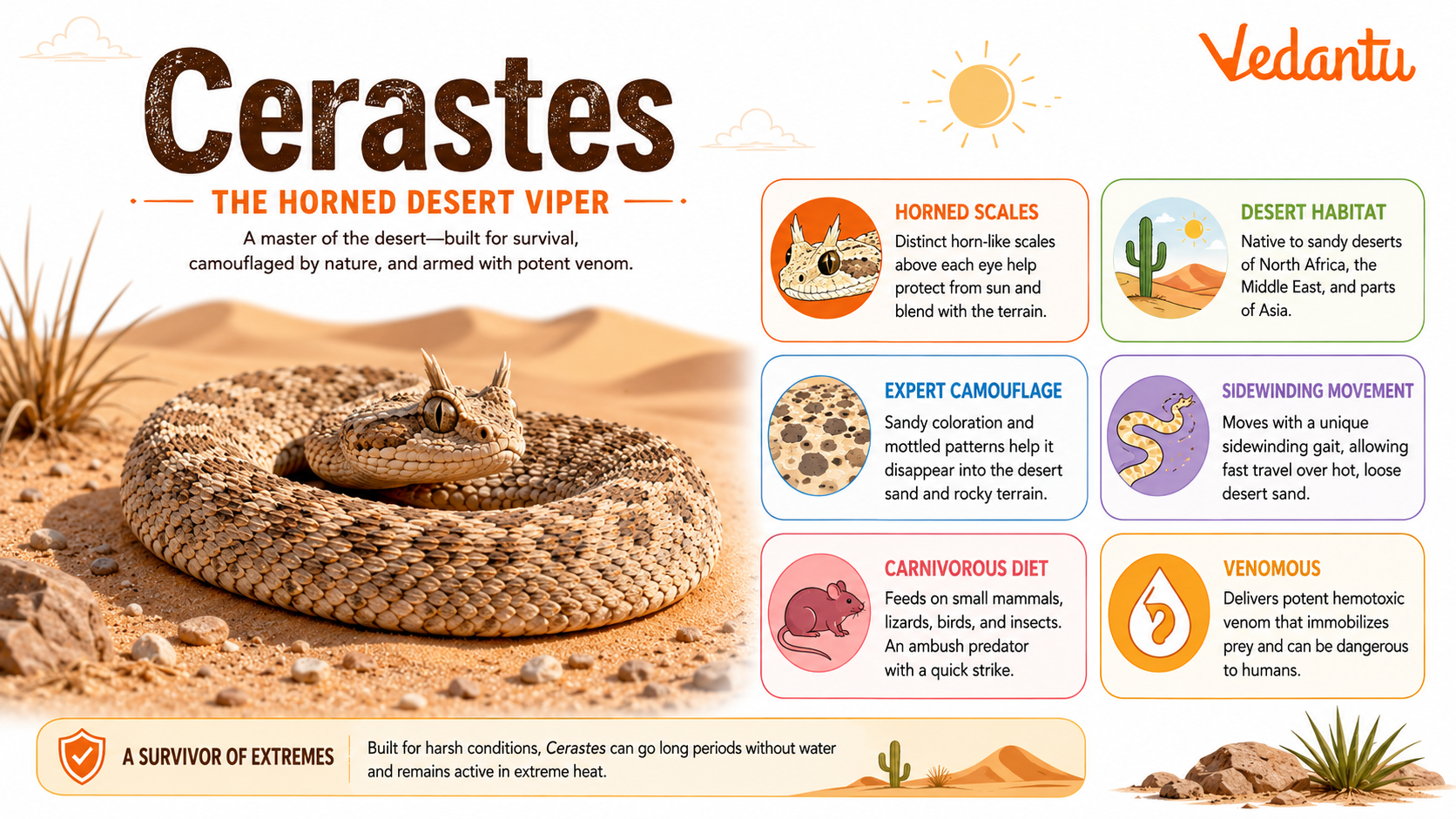
Quick Facts and Statistics
| Feature | Details |
|---|---|
| Common Name | Horned Viper |
| Scientific Name | Cerastes |
| Animal Group | Reptile |
| Length | 30–60 cm (varies by species) |
| Habitat | Deserts and sandy regions |
| Diet | Carnivore (rodents, lizards, birds) |
| Lifespan | 10–18 years (approx.) |
| Special Feature | Horn-like scales above eyes |
| Found In | North Africa and the Middle East |
Appearance and Physical Characteristics
- Short, thick body with rough, keeled scales.
- Sand-coloured skin with brown or grey patterns for camouflage.
- Distinct horn-like scales above each eye (in many species).
- Triangular head typical of vipers.
- Venomous fangs that fold back when not in use.
Habitat and Distribution
- Lives mainly in hot, dry deserts.
- Found in countries like Egypt, Libya, Morocco, and parts of the Arabian Peninsula.
- Prefers sandy dunes and loose soil.
- Often buries itself under sand, leaving only eyes and horns visible.
Diet and Feeding Habits
- Cerastes diet mainly includes small rodents.
- Also eats lizards and small birds.
- It is a carnivore and an ambush predator.
- Uses venom to paralyse prey quickly.
Behaviour and Lifestyle
- Mostly nocturnal (active at night).
- Moves using a special technique called sidewinding.
- Solitary animal.
- Hisses loudly as a warning when threatened.
Life Cycle and Reproduction
- Mating: Usually occurs in warmer months.
- Egg Laying: Females lay eggs in sand.
- Hatching: Baby snakes hatch fully independent.
- Growth: Young snakes shed skin as they grow.
- Adult Stage: Reach maturity in a few years.
What Makes Cerastes Special?
Importance and Role in Nature
Amazing Facts About Cerastes
- Cerastes can bury almost its entire body under sand.
- Its venom works quickly to immobilise prey.
- It leaves a J-shaped track in the sand due to sidewinding.
- The horns may vary in size or may be absent in some individuals.
- It can survive long periods without food.
- Cerastes has heat-sensitive pits to detect warm-blooded prey.
Fun Facts for Kids
FAQs on Cerastes Snake: The Desert Horned Viper Explained
1. What is Cerastes?
Cerastes is a genus of venomous desert snakes commonly known as horned vipers.
- Belongs to the viper family (Viperidae)
- Famous for the horn-like scales above their eyes
- Found mainly in North Africa and the Middle East
- Includes species like the Saharan horned viper and Arabian horned viper
2. Where do Cerastes snakes live?
Cerastes snakes live in deserts and dry regions across North Africa and parts of the Middle East.
- Common in the Sahara Desert
- Found in countries like Egypt, Morocco, Libya, and Saudi Arabia
- Prefer sandy dunes and arid habitats
- Hide under sand to escape heat
3. Why do Cerastes have horns?
The horns of Cerastes are modified scales above their eyes that may help protect them from sand.
- Shield eyes from blowing desert sand
- Help with camouflage
- Make them look larger to scare predators
- Not all individuals have visible horns
4. Are Cerastes snakes venomous?
Yes, Cerastes snakes are venomous vipers that use venom to hunt and defend themselves.
- Venom helps them catch small mammals and lizards
- Bites can be painful and dangerous to humans
- Rarely attack unless threatened
- Medical treatment is needed after a bite
5. What do Cerastes eat?
Cerastes feed mainly on small desert animals that live in sandy environments.
- Rodents such as mice
- Lizards
- Small birds
- Sometimes other small reptiles
6. How do Cerastes move in the desert?
Cerastes move using a special method called sidewinding to travel on hot sand.
- Lift parts of their body off the ground
- Move sideways in loops
- Reduce contact with hot surfaces
- Leave J-shaped tracks in sand
7. How big do Cerastes grow?
Cerastes snakes are medium-sized vipers that usually grow between 30 to 60 centimeters long.
- Most adults are about 1 to 2 feet long
- Females are often slightly larger than males
- Have thick, strong bodies
- Short tails compared to other snakes
8. How do Cerastes protect themselves?
Cerastes protect themselves using camouflage, hissing, and venom when they feel threatened.
- Bury themselves in sand for camouflage
- Rub scales together to make a hissing sound
- Strike quickly with venom if disturbed
- Stay still to avoid detection
9. Are Cerastes dangerous to humans?
Cerastes can be dangerous, but they usually avoid humans unless stepped on or threatened.
- Venom can cause pain, swelling, and bleeding
- Antivenom is available in many regions
- Most bites happen by accident
- They prefer to hide rather than attack
10. How many species of Cerastes are there?
There are three main recognized species of Cerastes in the viper family.
- Cerastes cerastes (Saharan horned viper)
- Cerastes gasperettii (Arabian horned viper)
- Cerastes vipera (Saharan sand viper)
