






Where Do Cassowaries Live and What Makes This Flightless Bird So Dangerous?
The cassowary is one of the most unusual and fascinating birds in the world. Known for its bright blue neck, helmet-like head, and powerful legs, it looks almost prehistoric. Even though it cannot fly, it is strong, fast, and extremely important for rainforest ecosystems. In this page, you will explore cassowary facts, cassowary habitat, cassowary diet, life cycle, characteristics, and why this amazing bird plays such an important role in nature.
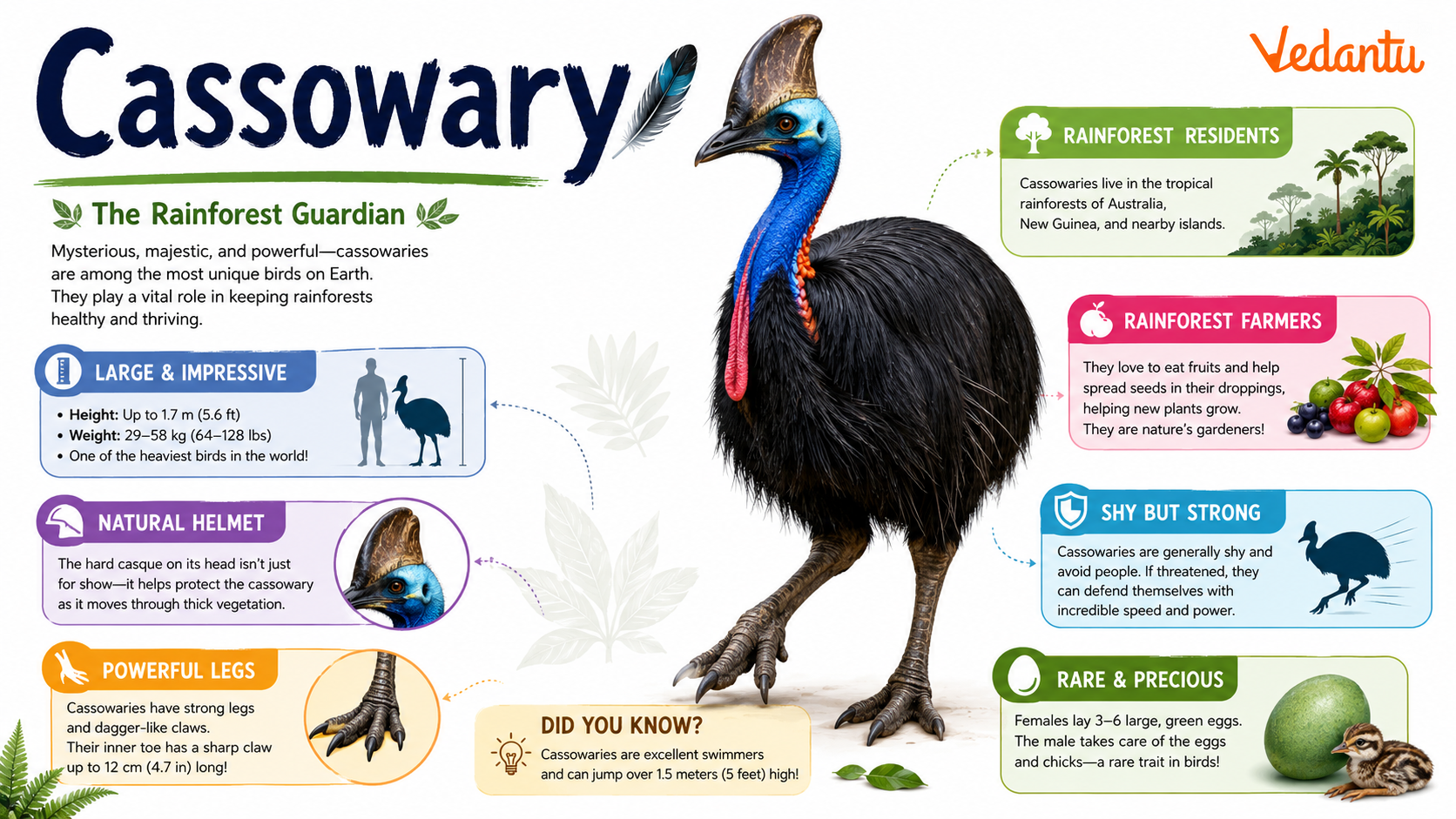
Quick Facts About Cassowary
| Feature | Details |
|---|---|
| Common Name | Cassowary |
| Scientific Name | Casuarius |
| Animal Group | Bird (Ratite – flightless bird) |
| Height | Up to 1.5–1.8 metres |
| Weight | 30–60 kg |
| Habitat | Tropical rainforests |
| Diet | Mainly fruits (omnivore) |
| Lifespan | Up to 40–50 years (in captivity) |
| Conservation Status | Vulnerable (some species) |
Appearance and Physical Characteristics
- Body: Large, heavy, and strong with a rounded body.
- Feathers: Black, coarse, and hair-like feathers.
- Neck: Bright blue and red skin with colourful wattles.
- Casque: A hard, helmet-like structure on top of the head.
- Legs: Very powerful with sharp claws.
- Claw Length: Inner claw can grow up to 12 cm long.
Cassowary Habitat and Distribution
- Lives mainly in tropical rainforests.
- Found in Northern Australia, New Guinea, and nearby islands.
- Prefers dense forests with thick vegetation.
- Needs areas with plenty of fruit trees.
The cassowary habitat is very important because these birds depend on rainforest fruits. Deforestation and road accidents are major threats to their survival.
Diet and Feeding Habits
The cassowary diet helps forests grow. Seeds pass through its body and are spread across the forest, helping new plants grow.
Behaviour and Lifestyle
- Usually solitary and prefers living alone.
- Can run up to 50 km per hour.
- Excellent swimmers.
- Uses deep booming sounds to communicate.
- Can jump high and move quickly through thick forests.
Sound or Call
Cassowaries make low-frequency booming sounds. These sounds can travel long distances through dense forests and help them communicate with other cassowaries.
Cassowary Life Cycle
- Egg Laying: Female lays 3–5 large green eggs.
- Incubation: The male sits on the eggs for about 50 days.
- Chicks: Brown striped chicks hatch and follow the father.
- Parental Care: Male protects and raises chicks for 9 months.
- Adult Stage: Grows into a large, independent bird.
In the cassowary life cycle, the male plays a major role in caring for the young, which is unusual among birds.
What Makes Cassowary Special?
Types of Cassowary
- Southern Cassowary – Found in Australia and New Guinea.
- Northern Cassowary – Lives in northern New Guinea.
- Dwarf Cassowary – Smaller species found in mountainous areas.
Importance and Role in Nature
Amazing Cassowary Facts
- Cassowaries are related to ostriches and emus.
- They are considered one of the most dangerous birds.
- Their casque may help them move through dense forest.
- They can swim across rivers and even the sea.
- They can leap up to 1.5 metres in the air.
- They swallow fruits as big as small apples.
Fun Facts for Kids
FAQs on Cassowary Bird Guide: Fascinating Facts, Diet, and Rainforest Life
1. What is a cassowary?
A cassowary is a large, flightless bird that lives in tropical rainforests and is known for its bright colors and powerful legs.
- It belongs to the ratite family, like ostriches and emus.
- Native to Australia, New Guinea, and nearby islands.
- Famous for the hard helmet-like structure called a casque on its head.
- Considered one of the most dangerous birds in the world.
2. Where do cassowaries live?
Cassowaries live in warm, wet tropical rainforests and forested areas.
- Found mainly in Northern Queensland (Australia).
- Also live in New Guinea and nearby islands.
- Prefer dense forests with plenty of fruit trees.
- Sometimes seen near swamps and mangroves.
3. Why are cassowaries considered dangerous?
Cassowaries are considered dangerous because they have strong legs and sharp claws used for defense.
- Each foot has a long, dagger-like inner claw.
- They can kick forward with great force.
- Usually shy but may attack if threatened.
- Protective of their chicks and territory.
4. What do cassowaries eat?
Cassowaries mainly eat fruit and play an important role in spreading seeds in the rainforest.
- Diet includes fallen fruits, berries, and seeds.
- Sometimes eat insects, small animals, and fungi.
- Known as a keystone species because they help forests grow.
- Swallow fruit whole and spread seeds through droppings.
5. How big is a cassowary?
A cassowary is one of the largest birds in the world and can grow very tall and heavy.
- Height: up to 6.5 feet (2 meters).
- Weight: up to 130 pounds (60 kg).
- Females are usually bigger and brighter than males.
- Second heaviest bird after the ostrich.
6. Can cassowaries fly?
Cassowaries cannot fly because they are flightless birds with small wings.
- Belong to the ratite group of birds.
- Have strong legs built for running, not flying.
- Can run up to 30 miles per hour (50 km/h).
- Excellent swimmers despite being flightless.
7. What is the casque on a cassowary's head?
The casque is a hard, helmet-like structure on top of a cassowary’s head.
- Made of keratin, the same material as human nails.
- May help push through dense forest plants.
- Could be used for communication or showing age.
- Unique feature of the southern cassowary and related species.
8. How do cassowaries take care of their babies?
In cassowaries, the father is the one who cares for the eggs and chicks.
- Female lays eggs and then leaves.
- Male incubates eggs for about 50 days.
- Protects and teaches chicks for up to 9 months.
- Chicks have brown stripes for camouflage.
9. Are cassowaries endangered?
Some cassowary species are considered threatened due to habitat loss and human activity.
- The Southern Cassowary is listed as Vulnerable.
- Main threats include deforestation and car accidents.
- Also threatened by dogs and climate change.
- Protected by wildlife conservation laws.
10. How many types of cassowaries are there?
There are three main species of cassowaries found in different regions.
- Southern Cassowary (Casuarius casuarius).
- Northern Cassowary (Casuarius unappendiculatus).
- Dwarf Cassowary (Casuarius bennetti).
- All are large, colorful, flightless rainforest birds.
