






Black Rhinoceros Habitat, Diet, Behavior, and Conservation Facts
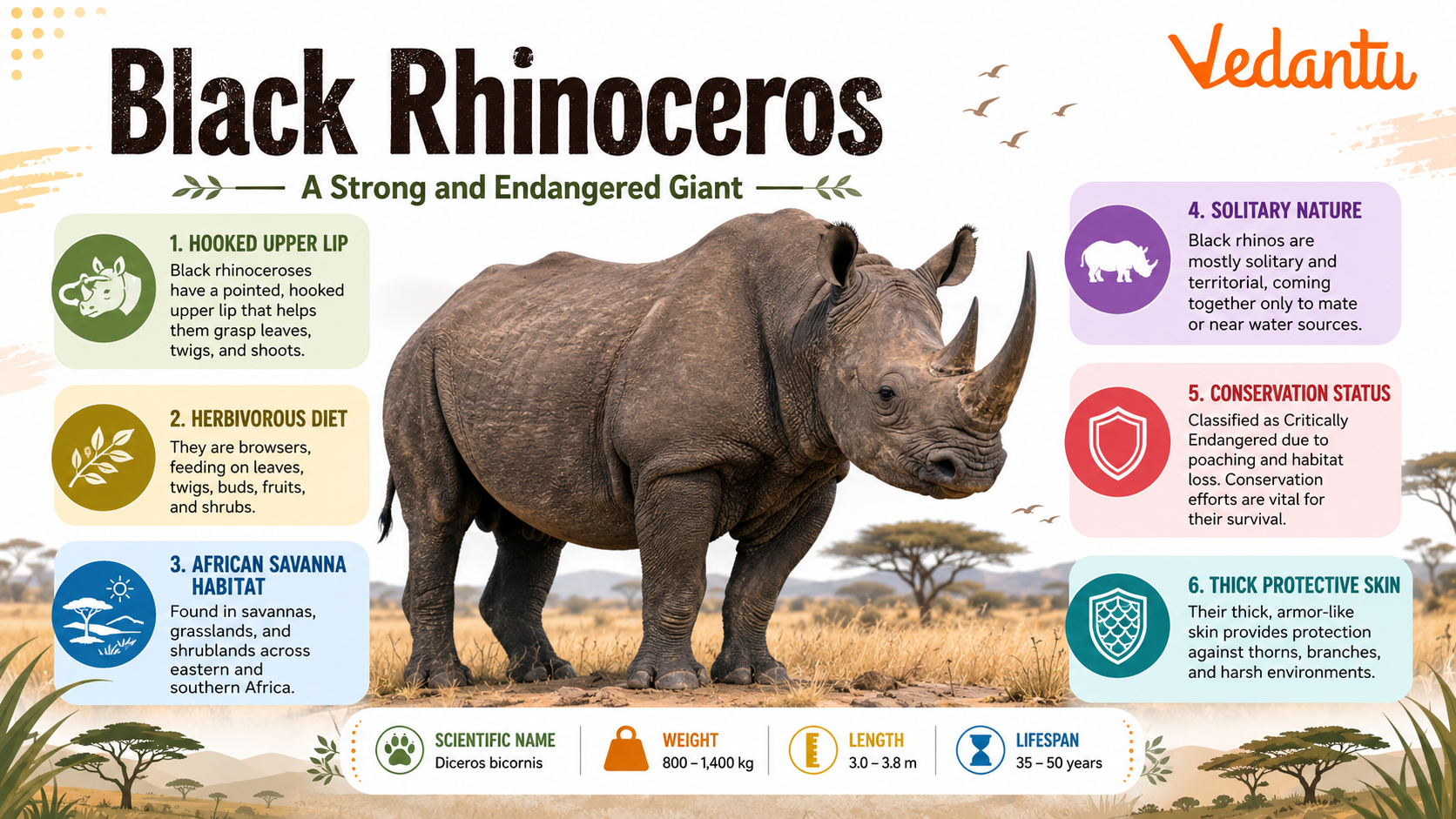
Quick Facts About Black Rhinoceros
| Feature | Details |
|---|---|
| Common Name | Black Rhinoceros |
| Scientific Name | Diceros bicornis |
| Animal Group | Mammal |
| Average Weight | 800–1,400 kg |
| Length | 3–3.8 metres |
| Lifespan | 35–45 years |
| Habitat | Savannas, grasslands, shrublands |
| Diet | Leaves, branches, shrubs |
| Conservation Status | Critically Endangered |
| Found In | Eastern and Southern Africa |
Appearance and Physical Characteristics
- Large, heavy body with thick grey skin.
- Two horns on the nose made of keratin (same material as human nails).
- Pointed upper lip, perfect for plucking leaves.
- Small eyes but strong sense of smell and hearing.
- Strong legs built for running and charging.
Habitat and Distribution
The Black Rhinoceros habitat mainly includes dry grasslands, savannas, and bushy areas where shrubs and small trees grow.
- Found mainly in Kenya, Namibia, Tanzania, Zimbabwe, and South Africa.
- Prefers areas with plenty of shrubs for feeding.
- Often stays near water sources.
- Uses thick bushes for shade and protection.
Diet and Feeding Habits
The Black Rhinoceros diet mainly consists of plants. It is a strict herbivore.
- Feeds on leaves, twigs, shoots, and branches.
- Uses its pointed lip to grab and pull leaves.
- Can eat up to 50 kg of vegetation in a day.
- Plays a role in controlling shrub growth.
Behaviour and Lifestyle
- Mostly solitary animals.
- Active during early morning and evening.
- Can be aggressive if they feel threatened.
- Communicate using snorts, growls, and scent marking.
- Have poor eyesight but excellent smell and hearing.
Life Cycle of Black Rhinoceros
- Birth: A mother gives birth to one calf after a pregnancy of about 15–16 months.
- Calf Stage: The baby stays close to its mother for protection and feeding.
- Juvenile: Learns to find food and survive independently.
- Adult: Becomes fully grown by 6–7 years of age.
What Makes the Black Rhinoceros Special?
Importance and Role in Nature
Amazing Facts About Black Rhinoceros
- It has two horns, and the front horn is usually longer.
- Its horn can grow up to 1.5 metres long.
- Black Rhinos are critically endangered due to poaching.
- They love mud baths to cool down and protect their skin.
- They have lived on Earth for millions of years.
- Each rhino has a unique horn shape.
Fun Facts for Kids
FAQs on Black Rhinoceros: Powerful Yet Critically Endangered Giant
1. What is a Black Rhinoceros?
The Black Rhinoceros is a large, plant‑eating mammal native to Africa and known for its hooked lip and two horns.
- Scientific name: Diceros bicornis
- Belongs to the rhinoceros family
- Has a pointed upper lip for eating bushes
- Also called the hook‑lipped rhino
- One of the five species of rhinoceros in the world
2. Where do Black Rhinos live?
The Black Rhino lives mainly in eastern and southern parts of Africa.
- Found in countries like Kenya, Namibia, Tanzania, and South Africa
- Prefers savannas, grasslands, and shrublands
- Lives in areas with thick bushes for food and protection
- Needs access to water sources
3. Why is it called a Black Rhinoceros?
The Black Rhinoceros is not actually black; its name helps distinguish it from the White Rhinoceros.
- Both species are usually gray in color
- The name may come from early English misunderstandings
- Main difference is the lip shape, not the color
- Black rhinos have a pointed lip, white rhinos have a square lip
4. What do Black Rhinos eat?
The Black Rhinoceros is a herbivore that feeds mainly on plants and shrubs.
- Eats leaves, branches, and twigs
- Uses its hooked upper lip to grab food
- Browses on bushes instead of grazing on grass
- Can eat thorny plants without getting hurt
5. How big can a Black Rhino grow?
An adult Black Rhinoceros is very large and powerful.
- Weighs between 800 to 1,400 kg
- Can grow up to 1.6 meters tall at the shoulder
- Has two horns made of keratin
- Can live up to 35–40 years in the wild
6. Are Black Rhinos endangered?
Yes, the Black Rhino is listed as Critically Endangered due to heavy poaching and habitat loss.
- Hunted for their horns
- Population dropped sharply in the 20th century
- Protected by wildlife conservation programs
- Numbers are slowly increasing due to conservation efforts
7. Why are Black Rhinos hunted?
Black Rhinos are hunted mainly for their valuable horns.
- Rhino horn is used in traditional medicine in some countries
- Sold illegally on the black market
- Made of keratin, the same material as human nails
- Poaching is the biggest threat to their survival
8. How are Black Rhinos different from White Rhinos?
The main difference between Black Rhinos and White Rhinos is their lip shape and feeding habits.
- Black rhinos have a pointed lip for browsing
- White rhinos have a wide, square lip for grazing grass
- Black rhinos are usually more solitary and aggressive
- White rhinos are generally larger in size
9. How fast can a Black Rhinoceros run?
Despite their size, Black Rhinos can run surprisingly fast.
- Can reach speeds of up to 55 km/h (34 mph)
- Run fast to escape danger
- Have strong legs and heavy bodies
- Use speed as a defense against predators
10. How can we help protect Black Rhinos?
We can help protect the Black Rhinoceros by supporting wildlife conservation and stopping illegal trade.
- Support anti-poaching programs
- Donate to wildlife conservation organizations
- Spread awareness about endangered animals
- Avoid buying products made from rhino horn
