




How do you find the angle of the resultant vector?
Answer
 Verified
570.9k+ views
Hint: Let us first know about vectors. Vectors are useful in physics because they can represent location, displacement, velocity, and acceleration visually. When drawing vectors, you often don't have enough room to draw them to the scale they represent, therefore it's crucial to specify what scale you're working with.
Complete step by step solution:
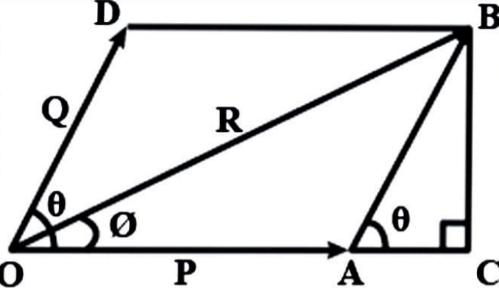
Let P and Q be two vectors acting at the same time at a location, represented in magnitude and direction by two adjacent sides OA and OD of a parallelogram OABD, as shown in figure.
Let R be the resultant vector and be the angle between P and Q. The consequent of P and Q is therefore represented by diagonal OB, according to the parallelogram law of vector addition.
So,
$R = P + Q$
Expand A to C and draw BC perpendicular to OC at this point.
From triangle OCB
$O{B^2} = {C^2} + B{C^2}$
$ \Rightarrow $ $O{B^2} = {(OA + AC)^2} + B{C^2}$ ….$(1)$
In triangle ABC
$\cos \theta = \dfrac{{AC}}{{AB}}$
$ \Rightarrow $$AC = AB\,\cos \theta $
$ \Rightarrow $$AC = OD\,\cos \theta $
$AC = Q\cos \theta \,\,\,\,\,\,\,\,[AB = OD = Q]$
Also,
$\cos \theta = \dfrac{{BC}}{{AB}}$
$ \Rightarrow $\[\;BC{\text{ }} = {\text{ }}AB{\text{ }}sin\theta \]
$ \Rightarrow $\[BC{\text{ }} = {\text{ }}OD{\text{ }}sin\theta \]
$BC = Q{\text{ }}sin\theta \;{\text{ }}\;{\text{ }}\;{\text{ }}\;{\text{ }}\;{\text{ }}\;{\text{ }}\;{\text{ }}\;{\text{ }}\;{\text{ }}[{\text{ }}AB{\text{ }} = {\text{ }}OD{\text{ }} = {\text{ }}Q\;]$
Magnitude of resultant we will be:
Substituting value of AC and BC in $(1)$ we get
\[{R^2} = {(P + Qcos\theta )^2} + {(Qsin\theta )^2}\]
$ \Rightarrow $\[{R^2} = {P^2} + 2PQcos\theta + {Q^2}co{s^2}\theta + {Q^2}si{n^2}\theta \]
$ \Rightarrow $\[{R^2} = {P^2} + 2PQcos\theta + {Q^2}\]
$ \Rightarrow $\[R{\text{ }} = \;\sqrt {{P^2} + 2PQcos\theta + {Q^2}} \]
Now let us see the direction of Resultant:
Let $\phi $ be the angle made by the resultant R with P.
From triangle OBC,
\[tan\phi = \dfrac{{BC}}{{OC}} = \dfrac{{BC}}{{OA + AC}}\]
$ \Rightarrow $\[\;tan\phi = \dfrac{{Q\,\sin \theta }}{{P + Q\cos \theta }}\]
\[\phi = {\tan ^{ - 1}}\left( {\dfrac{{Q\sin \theta }}{{P + Q\cos \theta }}} \right)\]
This is the angle of the resultant vector.
Note:
We use vector values like displacement, acceleration, and force to launch satellites into the sky, target foes on the battlefield, do sophisticated calculations within computers, and even identify our location using GPS or a map. As a result, vectors play a crucial part in our lives.
Complete step by step solution:
Let P and Q be two vectors acting at the same time at a location, represented in magnitude and direction by two adjacent sides OA and OD of a parallelogram OABD, as shown in figure.
Let R be the resultant vector and be the angle between P and Q. The consequent of P and Q is therefore represented by diagonal OB, according to the parallelogram law of vector addition.
So,
$R = P + Q$
Expand A to C and draw BC perpendicular to OC at this point.
From triangle OCB
$O{B^2} = {C^2} + B{C^2}$
$ \Rightarrow $ $O{B^2} = {(OA + AC)^2} + B{C^2}$ ….$(1)$
In triangle ABC
$\cos \theta = \dfrac{{AC}}{{AB}}$
$ \Rightarrow $$AC = AB\,\cos \theta $
$ \Rightarrow $$AC = OD\,\cos \theta $
$AC = Q\cos \theta \,\,\,\,\,\,\,\,[AB = OD = Q]$
Also,
$\cos \theta = \dfrac{{BC}}{{AB}}$
$ \Rightarrow $\[\;BC{\text{ }} = {\text{ }}AB{\text{ }}sin\theta \]
$ \Rightarrow $\[BC{\text{ }} = {\text{ }}OD{\text{ }}sin\theta \]
$BC = Q{\text{ }}sin\theta \;{\text{ }}\;{\text{ }}\;{\text{ }}\;{\text{ }}\;{\text{ }}\;{\text{ }}\;{\text{ }}\;{\text{ }}\;{\text{ }}[{\text{ }}AB{\text{ }} = {\text{ }}OD{\text{ }} = {\text{ }}Q\;]$
Magnitude of resultant we will be:
Substituting value of AC and BC in $(1)$ we get
\[{R^2} = {(P + Qcos\theta )^2} + {(Qsin\theta )^2}\]
$ \Rightarrow $\[{R^2} = {P^2} + 2PQcos\theta + {Q^2}co{s^2}\theta + {Q^2}si{n^2}\theta \]
$ \Rightarrow $\[{R^2} = {P^2} + 2PQcos\theta + {Q^2}\]
$ \Rightarrow $\[R{\text{ }} = \;\sqrt {{P^2} + 2PQcos\theta + {Q^2}} \]
Now let us see the direction of Resultant:
Let $\phi $ be the angle made by the resultant R with P.
From triangle OBC,
\[tan\phi = \dfrac{{BC}}{{OC}} = \dfrac{{BC}}{{OA + AC}}\]
$ \Rightarrow $\[\;tan\phi = \dfrac{{Q\,\sin \theta }}{{P + Q\cos \theta }}\]
\[\phi = {\tan ^{ - 1}}\left( {\dfrac{{Q\sin \theta }}{{P + Q\cos \theta }}} \right)\]
This is the angle of the resultant vector.
Note:
We use vector values like displacement, acceleration, and force to launch satellites into the sky, target foes on the battlefield, do sophisticated calculations within computers, and even identify our location using GPS or a map. As a result, vectors play a crucial part in our lives.
Recently Updated Pages
Write structures of the following compounds i 2 Chloro3methylpentane class 11 chemistry CBSE

If x a + bt + ct2 where x is in meters and t is in class 11 physics CBSE
A car covers the first half distance between two places class 11 physics CBSE
The resultant of two vectors overrightarrow P and overrightarrow class 11 physics CBSE
Find the value of cos 135 class 11 maths CBSE
A mass M is held in place by an applied force F and class 11 physics CBSE
Trending doubts
Find the value of the expression given below sin 30circ class 11 maths CBSE
One Metric ton is equal to kg A 10000 B 1000 C 100 class 11 physics CBSE
Draw a diagram of nephron and explain its structur class 11 biology CBSE
10 examples of friction in our daily life
Draw a diagram of a plant cell and label at least eight class 11 biology CBSE
Difference Between Prokaryotic Cells and Eukaryotic Cells