



A mass $M$ is held in place by an applied force $F$ and a pulley system as shown in figure. The pulley are massless and frictionless.
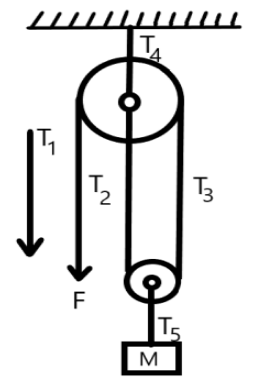
(a) Draw a free body diagram for each pulley
(b) Find tension in each section of rope ${T_1}$ , ${T_2}$ , ${T_3}$ , ${T_4}$
(c) Find the magnitude of $F$
Answer
 Verified
638.1k+ views
Hint: Here, a mass is attached by a string which rolls over the pulley. Here, different tensions will occur in each rope. All, the tensions will act downwards except ${T_4}$ as it is acting in the upward direction. As shown in the figure, the force $F$ will be equal to the tension ${T_1}$.
Complete step by step answer:
Consider a mass which is held by a pulley with a massless string which is shown below
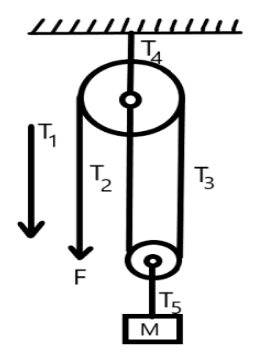
(a) Now, the free diagram of the system shown above is given below
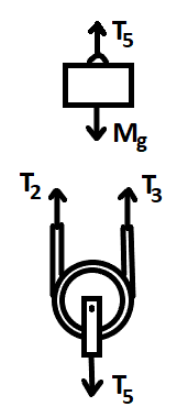
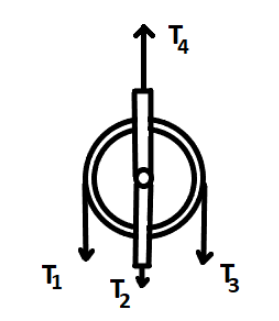
Here all the forces are working in the vertical direction. Now, as the pulleys are massless and frictionless, therefore, the tension in the strings will be the same along the full rope. Also, the downward will be equal to the three tensions that will put the mass. Therefore, $F - {T_1} = 0$
(b) Now, the rope will go through the pulley, therefore, the net force acting downward will be
${T_4} = {T_1} + {T_2} + {T_3}$
Now, the tensions ${T_1}$ , ${T_2}$ and ${T_3}$ are acting downward, therefore, all the tensions will be equal to the weight of the pulley and is given by
${T_1} = {T_2} = {T_3} = \dfrac{{Mg}}{2}$
Therefore the first equation will become
${T_4} = \dfrac{{Mg}}{2} + \dfrac{{Mg}}{2} + \dfrac{{Mg}}{2}$
$ \Rightarrow \,{T_4} = \dfrac{{3Mg}}{2}$
Therefore, the tension in each rope is ${T_1} = \dfrac{{Mg}}{2}$ , ${T_2} = \dfrac{{Mg}}{2}$ , ${T_3} = \dfrac{{Mg}}{2}$ and ${T_4} = \dfrac{{3Mg}}{2}$
(c) Now, from the option (a) we can say that the magnitude of force is given by
$F = {T_1}$
$ \therefore F = \dfrac{{Mg}}{2}$
Therefore the magnitude is $\dfrac{{Mg}}{2}$ .
Note:Here, we have not talked about the tension ${T_5}$ as it is in the same direction as that of the tension ${T_4}$. Also, it will be equal to the mass of the body that is hanged, that is, ${T_5} = Mg$ . Also, the above system is frictionless and is not rotating.
Complete step by step answer:
Consider a mass which is held by a pulley with a massless string which is shown below
(a) Now, the free diagram of the system shown above is given below
Here all the forces are working in the vertical direction. Now, as the pulleys are massless and frictionless, therefore, the tension in the strings will be the same along the full rope. Also, the downward will be equal to the three tensions that will put the mass. Therefore, $F - {T_1} = 0$
(b) Now, the rope will go through the pulley, therefore, the net force acting downward will be
${T_4} = {T_1} + {T_2} + {T_3}$
Now, the tensions ${T_1}$ , ${T_2}$ and ${T_3}$ are acting downward, therefore, all the tensions will be equal to the weight of the pulley and is given by
${T_1} = {T_2} = {T_3} = \dfrac{{Mg}}{2}$
Therefore the first equation will become
${T_4} = \dfrac{{Mg}}{2} + \dfrac{{Mg}}{2} + \dfrac{{Mg}}{2}$
$ \Rightarrow \,{T_4} = \dfrac{{3Mg}}{2}$
Therefore, the tension in each rope is ${T_1} = \dfrac{{Mg}}{2}$ , ${T_2} = \dfrac{{Mg}}{2}$ , ${T_3} = \dfrac{{Mg}}{2}$ and ${T_4} = \dfrac{{3Mg}}{2}$
(c) Now, from the option (a) we can say that the magnitude of force is given by
$F = {T_1}$
$ \therefore F = \dfrac{{Mg}}{2}$
Therefore the magnitude is $\dfrac{{Mg}}{2}$ .
Note:Here, we have not talked about the tension ${T_5}$ as it is in the same direction as that of the tension ${T_4}$. Also, it will be equal to the mass of the body that is hanged, that is, ${T_5} = Mg$ . Also, the above system is frictionless and is not rotating.
Recently Updated Pages
10 examples of friction in our daily life

Draw a diagram of nephron and explain its structur class 11 biology CBSE
Write structures of the following compounds i 2 Chloro3methylpentane class 11 chemistry CBSE
If x a + bt + ct2 where x is in meters and t is in class 11 physics CBSE
A car covers the first half distance between two places class 11 physics CBSE
The resultant of two vectors overrightarrow P and overrightarrow class 11 physics CBSE
Trending doubts
Difference between physical and chemical change class 11 chemistry CBSE
Draw a molecular orbital diagram of N2 or O2 with magnetic class 11 chemistry CBSE
State the laws of reflection of light
State and explain Newtons second law of motion Derive class 11 physics CBSE
Earth rotates in which direction A East to west B West class 11 physics CBSE
Show that total energy of a freely falling body remains class 11 physics CBSE