








Megasporogenesis Complete Guide: Definition and Overview
Megasporogenesis is a key concept in plant reproduction and is an important topic for NEET Biology preparation. It describes the process through which the female reproductive cell, or megaspore, is formed within the ovule of flowering plants. Understanding megasporogenesis is crucial because it forms the basis for topics like sexual reproduction in plants, embryo sac formation, and fertilization - all of which are frequently tested in NEET and build the foundation for advanced concepts in botany.
What is Megasporogenesis?
Megasporogenesis is the biological process in which a single diploid cell inside the ovule of a flowering plant undergoes meiosis to produce four haploid megaspores. Typically, only one of these megaspores survives and develops into the female gametophyte (embryo sac), which is essential for reproduction. In simple terms, megasporogenesis marks the transformation from a diploid mother cell to the formation of female reproductive cells.
Core Ideas and Fundamentals of Megasporogenesis
Location and Role in Plant Reproduction
Megasporogenesis occurs within the ovule, commonly found inside the ovary of a flower. The process initiates the development of the female gametophyte, which later takes part in fertilization to form seeds.
Process of Megasporogenesis: Key Steps
A single cell called the megaspore mother cell (MMC) forms within the nucellus of the ovule.
The MMC, which is diploid (2n), undergoes meiosis.
Meiosis results in four haploid (n) megaspores arranged in a linear tetrad.
Usually, only one megaspore (the chalazal-most) survives and functions, while the other three degenerate.
Structure of Megasporogenesis
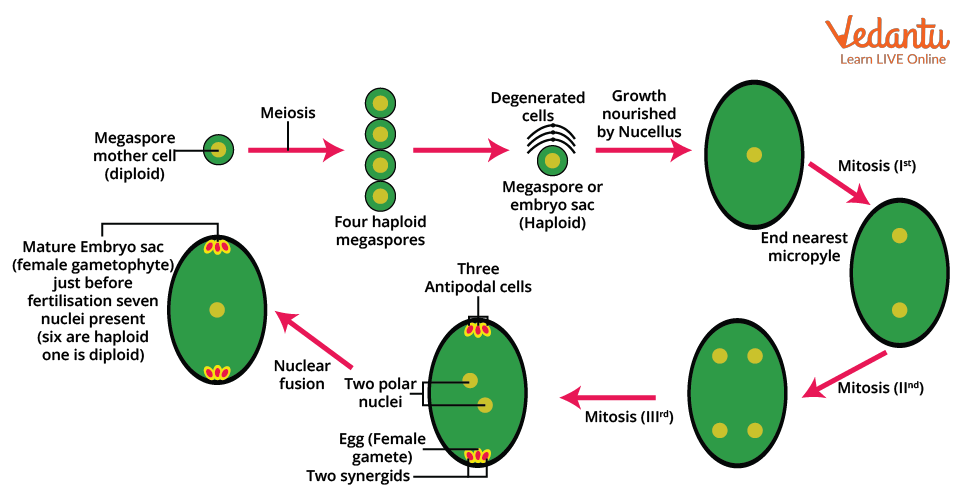
This diagram visually represents the sequential stages in megasporogenesis, helping you remember the steps for both understanding and answering NEET questions.
Important Sub-concepts Related to Megasporogenesis
Megaspore Mother Cell (MMC)
The MMC is a large diploid cell located in the nucellus of the ovule. It is the starting point of megasporogenesis and determines the potential for female gamete formation.
Types of Megasporogenesis Based on Functional Megaspore
Monosporic: Only one megaspore remains functional (most common, e.g., in most angiosperms).
Bisporic: Two megaspores fuse to form the embryo sac.
Tetrasporic: All four megaspore nuclei contribute to embryo sac formation.
Embryo Sac Formation (Megagametogenesis)
The single surviving megaspore undergoes a process called megagametogenesis, where it forms the mature female gametophyte (embryo sac) needed for fertilization. This is the direct outcome of megasporogenesis.
Principles and Relationships in Megasporogenesis
No complex formulas are directly associated with megasporogenesis. The key scientific principle is meiotic cell division, which ensures chromosome reduction (from diploid to haploid) - a fundamental requirement for sexual reproduction.
Key relationship: 1 MMC → Meiosis → 4 Megaspores (usually only 1 functional)
Steps of Megasporogenesis
Differentiation of the megaspore mother cell in the nucellus of the ovule
Meiotic division (meiosis I and II) of the MMC
Formation of four haploid megaspores in a linear tetrad
Degeneration of three megaspores; functional megaspore survives
Functional megaspore leads to development of the female gametophyte
Importance of Megasporogenesis for NEET
Megasporogenesis is commonly examined in NEET due to its central role in plant sexual reproduction. Questions may test your understanding of its definition, sequence, cell types involved, and the connection to embryo sac development. Mastering this topic not only helps with direct questions but also strengthens your foundation for related areas like double fertilization, alternation of generations, and overall plant reproductive biology.
It also connects with other key NEET topics such as microsporogenesis, pollination, and seed formation, making it an essential concept for scoring well.
Further Reading: Related Topics for NEET
FAQs on Megasporogenesis: Step-by-Step Process, Diagram and Explanation for NEET
1. Define Megasporogenesis from class 12 biology?
Megasporogenesis is the process of formation of megaspores from a diploid megaspore mother cell (MMC) through meiosis inside the ovule.
2. What is megaspore?
A megaspore is a haploid spore formed in the ovule. It later develops into the female gametophyte, also called the embryo sac.
3. Which plants produce megaspores?
Angiosperms and other heterosporous plants produce megaspores. In flowering plants, megaspores are formed inside the ovule.
4. What are the stages of megasporogenesis?
The main stages of megasporogenesis are:
Formation of the archesporial cell
Differentiation of the megaspore mother cell (MMC)
Meiotic division of MMC
Formation of four haploid megaspores
Usually, only one megaspore remains functional.
5. What is another name for megasporogenesis?
Megasporogenesis itself refers to formation of megaspores. The next process, where the functional megaspore develops into the embryo sac, is called megagametogenesis.
6. What is a female megaspore?
A female megaspore is the larger haploid spore that develops into the female gametophyte or embryo sac.
7. Why do 8 nucleates have 7 cells?
The embryo sac is 8-nucleate but 7-celled because two nuclei stay together in one central cell. So, there are 8 nuclei but only 7 cells.
8. What are the 4 types of gymnosperms?
The four main groups of gymnosperms are:
Conifers
Cycads
Ginkgo
Gnetales
9. What are the four megaspores?
The four megaspores are the four haploid cells formed after meiosis of one megaspore mother cell. In most plants, three degenerate and one remains functional.
10. What is the female gametophyte called?
The female gametophyte in angiosperms is called the embryo sac. It is also known as the megagametophyte.
11. What is the final product of megasporogenesis?
The final product of megasporogenesis is a tetrad of four haploid megaspores. In most angiosperms, only one functional megaspore remains.
12. What are the 4 layers of the microspore?
The four layers of the microsporangium are:
Epidermis
Endothecium
Middle layers
Tapetum
These layers surround the developing microspores.
