









Marchantia Complete Guide: From Classification, Characteristics to Alternation of Generations
Marchantia is a thalloid liverwort belonging to the division Bryophyta. It is a small, non-vascular land plant commonly found in moist, cool, and shady habitats, such as damp soil, wet rocks, stream banks, and forest floors. Since Marchantia lacks vascular tissues, it requires water for survival and reproduction, which explains its presence in humid environments.
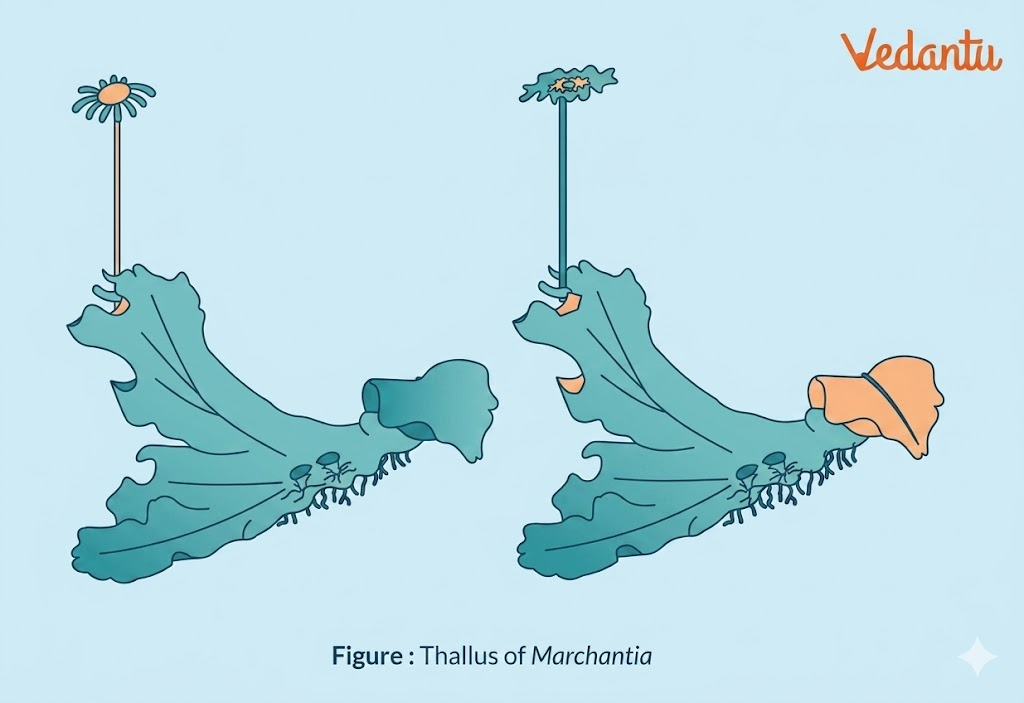
Marchantia shows a well-organised thalloid body with distinct dorsal and ventral surfaces. It reproduces by vegetative and sexual methods and exhibits a clear alternation between gametophyte and sporophyte generations. The sporophyte remains attached to the gametophyte and depends on it for nutrition.
The plant body of Marchantia is flat, green, dorsiventral, and ribbon-like, known as a thallus. This thallus represents the gametophyte stage, which is dominant in the life cycle.
Marchantia Classification
Marchantia belongs to liverworts under bryophytes. It is grouped based on its thalloid plant body and reproductive characteristics.
Marchantia includes several species. Some commonly studied ones include Marchantia polymorpha, Marchantia palmata, and Marchantia simlana. These species share similar morphological and reproductive features.
Marchantia Characteristics
Marchantia shows several typical bryophyte characteristics that help identify it. The plant body is gametophytic, flat, and dichotomously branched.
The thallus grows prostrate on the ground and shows a thick midrib running along the centre.
At the apex, an apical notch is present, which contains the growing point responsible for elongation.
Marchantia lacks true roots, stems, and leaves. Instead, it possesses rhizoids, which help in anchorage and absorption.
The plant body is dorsiventral, meaning the dorsal and ventral surfaces are structurally different.
The dorsal surface is photosynthetic, while the ventral surface is involved in absorption and attachment.
The plant is dioecious, meaning male and female reproductive organs occur on separate plants. Fertilisation requires water, and reproduction occurs through spores.
Marchantia also shows alternation of generations, with a dominant gametophyte and a short-lived sporophyte.
Structure of Marchantia
The structure of Marchantia consists of a flattened, green thallus that is usually 2–10 cm long. The thallus is dichotomously branched and prostrate. The central portion is thick and forms a midrib, while the margins are thinner.
At the apex of each branch, a depression called the apical notch is present. This region contains the growing point, from which new branches develop. The thallus is differentiated into a dorsal and a ventral surface, each performing specific functions.
The dorsal surface contains air pores and photosynthetic chambers, whereas the ventral surface bears rhizoids and scales. These structures help Marchantia survive in terrestrial habitats despite its lack of vascular tissue.
Marchantia Thallus Diagram
A labelled diagram of a Marchantia thallus includes both external and internal structures. Important labelled parts include:
apical notch
midrib
dichotomous branching
air pores
air chambers
dorsal surface
ventral surface
rhizoids
scales
gemma cups
This diagram helps understand both vegetative structure and reproduction.
Dorsal Surface of Marchantia
The dorsal surface of Marchantia is green and photosynthetic. It shows polygonal areas called areolae. Each areola represents an underlying air chamber. These chambers communicate with the atmosphere through pores in the air.
Air chambers contain chlorophyll-bearing cells arranged as photosynthetic filaments. These filaments carry out photosynthesis. The air pores help in gaseous exchange, but do not open and close like stomata.
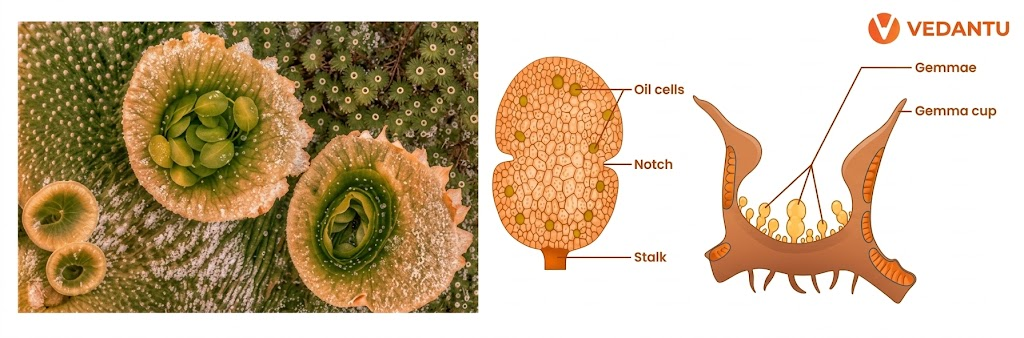
Gemma cups are also present on the dorsal surface. These cup-shaped structures contain gemmae, which are involved in vegetative reproduction.
Ventral Surface of Marchantia
The ventral surface contacts the substrate and provides anchorage and absorption. It bears rhizoids and scales arranged along the midrib.
Rhizoids help anchor the plant and absorb water. Two types of rhizoids are present:
smooth-walled rhizoids
tuberculate rhizoids
Scales are multicellular and arranged in rows. They protect the growing region and help retain moisture.
Anatomy of Marchantia
The anatomy of Marchantia in the vertical section shows three distinct regions.
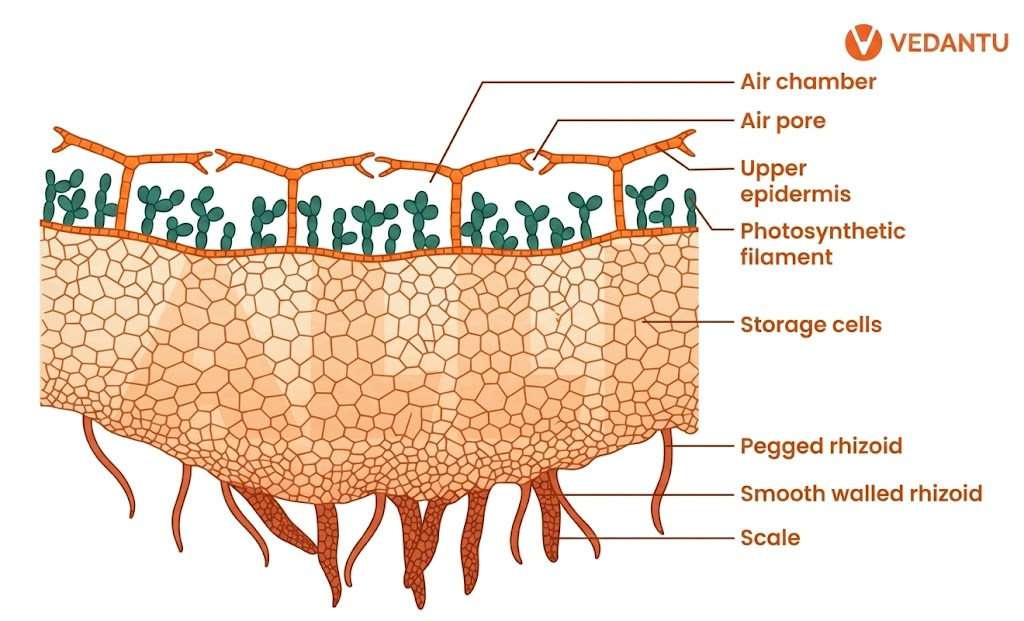
Epidermal Region
The epidermal region includes the upper and lower epidermis. The upper epidermis is protective and contains air pores. It reduces water loss and protects underlying tissues. The lower epidermis produces rhizoids and scales.
Photosynthetic Region
The photosynthetic region lies just below the upper epidermis. It contains air chambers arranged horizontally. Each chamber contains chlorophyll-bearing filaments. These filaments perform photosynthesis. This region is the main site of food production.
Storage Region
The storage region lies below the photosynthetic region. It consists of parenchymatous cells arranged compactly. These cells store starch, proteins, and oil bodies. This region provides nourishment to the plant.
Marchantia is Monoecious or Dioecious?
Marchantia is dioecious, meaning male and female reproductive organs occur on separate plants. This condition promotes cross-fertilisation.
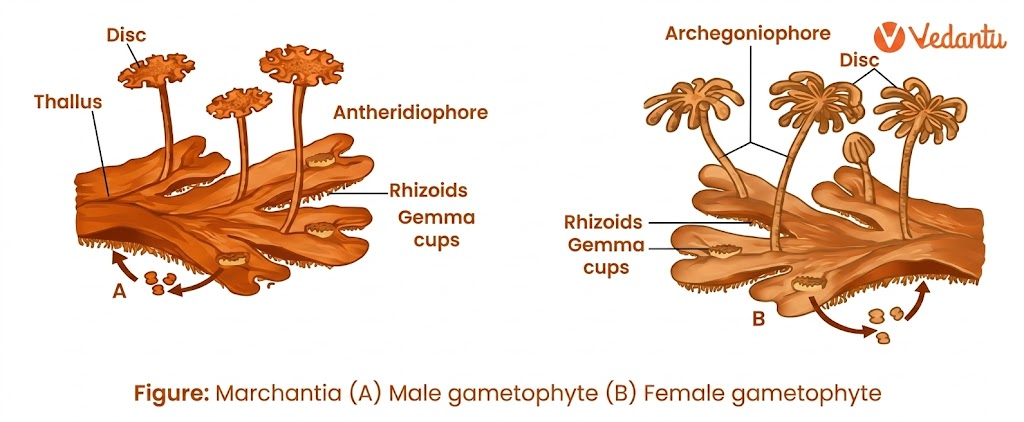
Male plants produce antheridiophores, while female plants produce archegoniophores. These specialised reproductive structures arise from the apical notch region of the thallus.
Reproduction in Marchantia
Reproduction in Marchantia occurs by vegetative reproduction and sexual reproduction.
Vegetative Reproduction in Marchantia
Vegetative reproduction occurs mainly by gemmae formation and fragmentation.
1. Gemmae Formation
Gemmae are multicellular structures produced inside gemma cups on the dorsal surface. A stalk attaches each gemma. When rainwater splashes the gemmae, they disperse and land on a suitable substrate. Each gemma germinates into a new plant.
This method allows rapid multiplication.
2. Fragmentation
Older parts of the thallus decay and separate. These detached fragments grow independently by apical growth. Each fragment develops into a new thallus.
Sexual Reproduction in Marchantia
Sexual reproduction in Marchantia is oogamous, meaning a large non-motile egg and small motile sperm are formed.
Male and female organs are located in specialised stalked structures.
1. Male Reproductive Structure — Antheridiophore
The antheridiophore is a stalked disc-like structure. Antheridia are present in chambers on its upper surface. Each antheridium produces biflagellate sperm.
2. Female Reproductive Structure — Archegoniophore
The archegoniophore is umbrella-shaped. Archegonia are present on the lower surface. Each archegonium contains an egg cell.
Fertilisation in Marchantia
Fertilisation depends on water. The male gametes swim to reach the egg.
Steps:
Antheridia release sperm
rainwater splashes sperm
sperm swim toward the archegonium
sperm enters the neck
fusion with the egg occurs
zygote formed
This mechanism is called the splash cup mechanism.
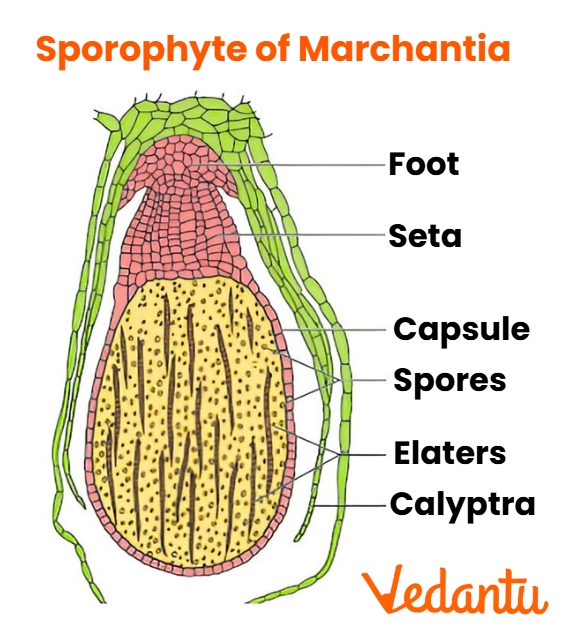
Sporophyte of Marchantia
After fertilisation, the zygote develops into a sporophyte. The sporophyte remains attached to the female gametophyte.
The sporophyte consists of:
foot
seta
capsule
Inside the capsule, spore mother cells undergo meiosis to form spores. These spores germinate into new gametophytes.
Life Cycle of Marchantia
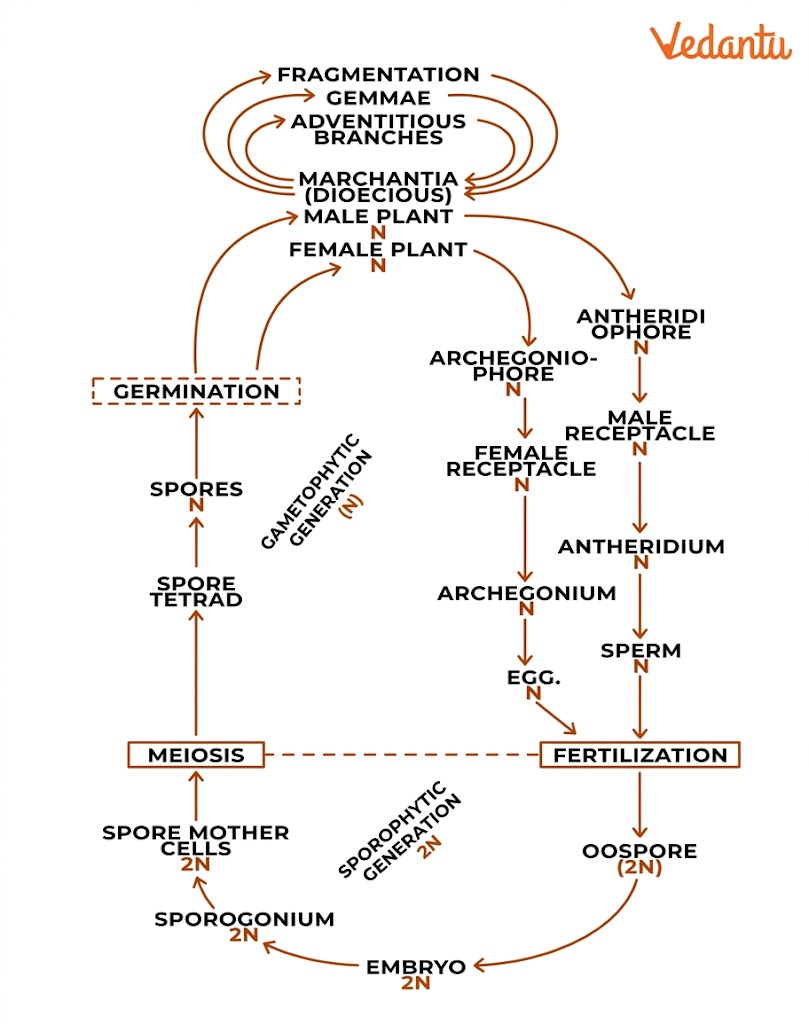
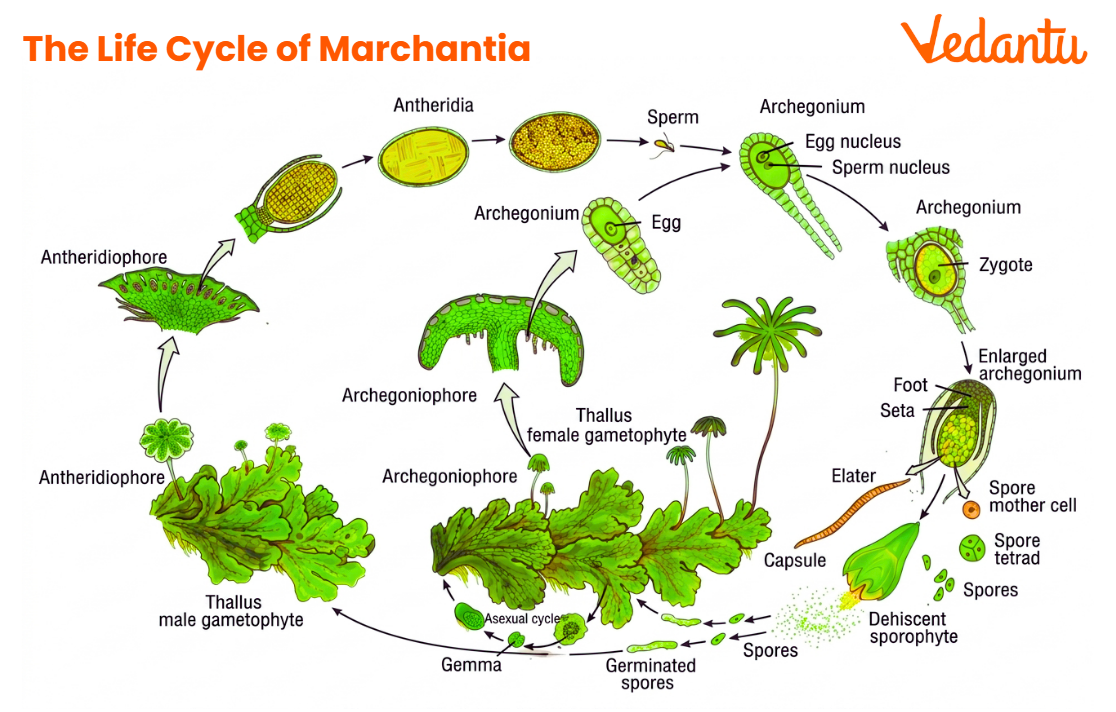
The life cycle of Marchantia shows alternation of generations. The haploid gametophyte is dominant, while the diploid sporophyte is short-lived.
Stages include:
gametophyte formation
gamete formation
fertilisation
zygote formation
sporophyte development
spore formation
spore germination
new gametophyte
Evolutionary Significance of Marchantia
Marchantia represents early land plants. It shows adaptation from aquatic to terrestrial life. Features like rhizoids, air chambers, and protective tissues helped early plants survive on land. Studying Marchantia helps understand plant evolution.
Summary of Marchantia
Marchantia is a thalloid liverwort in the class Bryophyta. It has a dorsiventral thallus with air chambers, rhizoids, and scales. It reproduces vegetatively by gemmae and sexually by antheridia and archegonia. Fertilisation requires water. The life cycle shows alternation of generations with a dominant gametophyte.
Also Read:
FAQs on Structure of Marchantia, Life Cycle, Reproduction, and Thallus Diagram Explained
1. What is Marchantia?
Marchantia is a thalloid liverwort and a simple non-vascular plant placed under bryophytes. Its plant body is flat, green, and ribbon-like, and it commonly grows in moist, shady places. Marchantia is often studied in botany because it clearly shows bryophyte structure, reproduction, and alternation of generations.
2. Where is Marchantia commonly found?
Marchantia is commonly found in moist, cool, and shady habitats. It usually grows on damp soil, wet rocks, stream banks, forest floors, and other humid places where water is easily available for growth and reproduction.
3. What are the distinguishing characteristics of Marchantia?
Marchantia has a flat, dorsiventral thallus instead of true roots, stems, and leaves. It contains rhizoids for anchorage, air chambers for gaseous exchange, and gemma cups for vegetative reproduction. It is a non-vascular bryophyte, usually dioecious, and depends on water for fertilisation.
4. Explain the life cycle of Marchantia.
The life cycle of Marchantia shows alternation of generations. The dominant stage is the haploid gametophyte, which produces male and female sex organs on separate plants. After fertilisation, a diploid sporophyte develops on the female plant. The sporophyte forms spores by meiosis, and these spores germinate to produce new gametophytes.
5. How many types of Rhizoids are seen in Marchantia?
There are two types of rhizoids in Marchantia:
Smooth-walled rhizoids
Tuberculate rhizoids
Both help in anchorage and absorption of water.
6. Are Marchantia bryophytes?
Yes, Marchantia is a bryophyte. More specifically, it is a liverwort. It is classified as a bryophyte because it is a non-vascular plant that lacks true roots, stems, or leaves.
7. What is Marchantia commonly known as?
Marchantia is commonly known as a liverwort. A common species, Marchantia polymorpha, is often called common liverwort.
8. Are elaters haploid or diploid?
Elaters in Marchantia are diploid. They are sterile cells present inside the capsule and help in spore dispersal.
9. Is Marchantia a moss or a fern?
Marchantia is neither a moss nor a fern. It is a liverwort, which is a type of bryophyte. It has a thalloid plant body and differs from both mosses and ferns in structure and reproduction.
10. What is Marchantia used for?
Marchantia is widely used as a model organism in plant biology and genetics.
Scientists study it to understand early land plant evolution, alternation of generations, and bryophyte reproduction.
Research on Marchantia has also contributed to the discovery of heterochromatin, plant sex chromosomes, and mechanisms of plant development, making it important to botanical and genetic studies.
