



Stepwise Answers, Key Diagrams & Important Questions for Class 7 Science Chapter 7
Question 1.
How does heat get transferred in these materials? (cooking utensils made of metals) (Page 90)
Answer:
In these materials, heat is transferred by a process known as conduction. During conduction, the heated particles transfer heat to the neighbouring particles one by one, while the particles themselves remain fixed in their positions.
Question 2.
Identify whether the given materials are good or poor conductors of heat. (Page 91)
Answer:
Question 3.
Why is the smoke going up? (Page 92)
Answer:
Smoke rises because hot air moves upward. When smoke is formed, it is usually warm. Through convection, the hot air carrying the smoke becomes lighter than the surrounding cooler air and therefore rises.
Question 4.
How does heat transfer take place in liquids? Do liquids also rise up when heated, like air? (Page 93)
Answer: When water is heated in a container, the water near the bottom warms up, expands, and becomes less dense, so it moves upward. As this warm water rises, the cooler and denser water above sinks down to replace it. This continuous movement is known as convection and goes on until the whole liquid is heated evenly. In this way, liquids rise on heating, similar to air.
Question 5.
I wonder how heat from the fire reaches us? (Page 96)
Answer: Heat from the fire reaches us by the process of radiation. In radiation, heat energy is transmitted directly to the surroundings in the form of waves. This method of heat transfer does not require any medium.
Question 6.
How does water seep through the surface of the Earth? (Page 99)
Answer: Water enters the ground through a process known as infiltration. From the Earth’s surface, it passes downward through layers of soil such as sand, gravel, or clay. After seeping through, the water collects in the tiny spaces between soil particles and in the cracks and openings of rocks, forming underground water reservoirs called aquifers.
Let Us Enhance Our Learning
Question 1.
Choose the correct option in each case.
(i) Your father bought a saucepan made of two different materials, A and B, as shown in Fig. 7.14. The materials A and B have the following properties
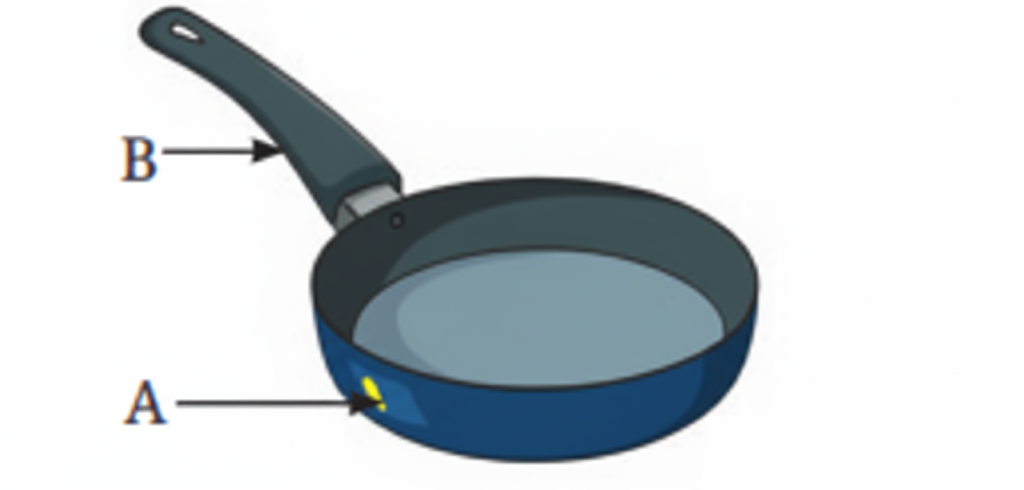
Fig. Saucepan
(a) Both A and B are good conductors of heat
(b) Both A and B are poor conductors of heat
(c) A is a good conductor and B is a poor conductor of heat
(d) A is a poor conductor and B is a good conductor of heat
(ii) Pins are stuck to a metal strip with wax and a burning candle is kept below the rod, as shown in Fig. 7.15. Which of the following will happen?
(a) All the pins will fall almost at the same time
(b) Pins I and II will fall earlier than pins III and IV
(c) Pins I and II will fall later than pins III and IV
(d) Pins II and III will fall almost at the same time
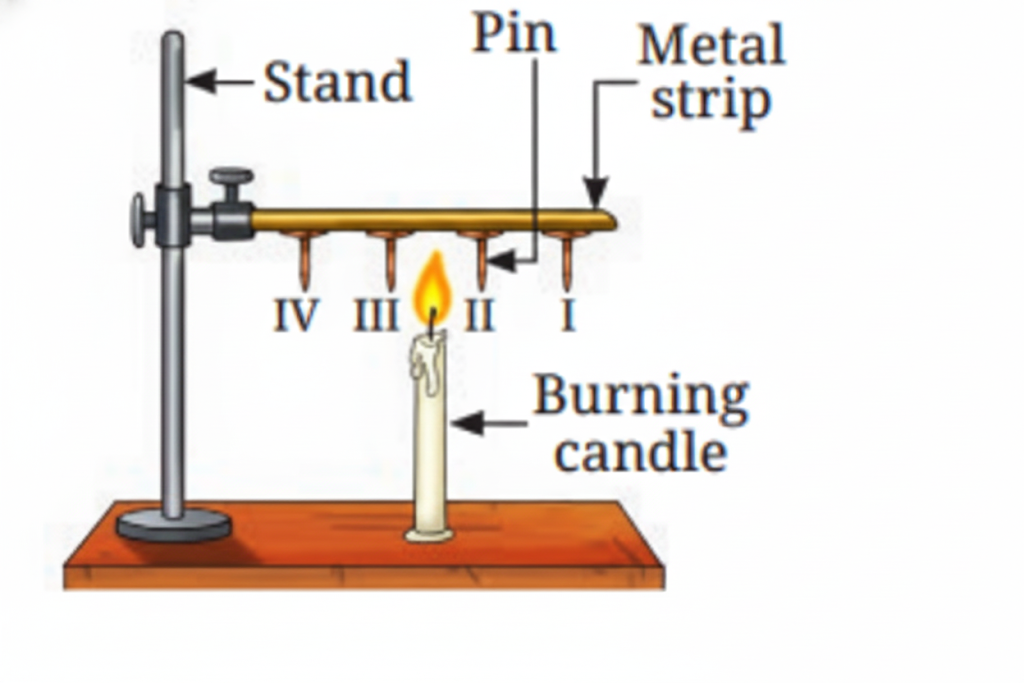
Fig. Transfer set-up
(iii) A smoke detector is a device that detects smoke and sounds an alarm. Suppose you are fitting a smoke detector in your room. The most suitable place for this device will be:
(a) Near the floor
(b) In the middle of a wall
(c) On the ceiling
(d) Anywhere in the room
Answer:
(i) (c) A is a good conductor and B is a poor conductor of heat
(ii) (d) Pins II and III will fall almost at the same time
(iii) (c) On the ceiling
Question 2.
A shopkeeper serves you cold lassi in a tumbler. By chance, the tumbler had a small leak. You were given another tumbler by the shopkeeper to put the leaky tumbler in it. Will this arrangement help to keep the lassi cold for a longer time? Explain.
Answer: Yes, this arrangement will help keep the lassi cold for a longer time. The layer of air trapped between the two tumblers acts as an insulator because air is a poor conductor of heat. This reduces the transfer of heat from the surroundings to the lassi, allowing it to remain cool for a longer duration.
Question 3.
State with reason(s) whether the following statements are True [T] or False [F],
(i) Heat transfer takes place in solids through convection.
Answer:
False, heat transfer takes place in solids through conduction.
ii) False, heat transfer takes place in solids through conduction. Heat transfer through convection takes place by the actual movement of particles.
Answer:
True
(iii) Areas with clay materials allow more seepage of water than those with sandy materials.
Answer:
False. Areas containing gravel allow more water to seep through because the spaces or pores between gravel particles are larger compared to those in sandy materials.
(iv) The movement of cooler air from land to sea is called land breeze.
Answer:
True
Question 4.
Some ice cubes placed in a dish melt into water after sometime. Where do the ice cubes get heat for this transformation?
Answer:
Ice cubes take in heat from their surroundings, such as the air and the surface they rest on. As they absorb this heat, the ice melts and changes from a solid into liquid water.
Question 5.
A burning incense stick is fixed, pointing downwards. In which direction would the smoke from the incense stick move? Show the movement of smoke with a diagram.
Answer: The smoke from an incense stick rises upward because it consists of warm gases mixed with tiny particles. As warm air becomes lighter and rises due to convection, the smoke is carried upward along with it.
Question 6.
Two test tubes with water are heated by a candle flame as shown in Fig. 7.16. Which thermometers (Fig. 7.16 a or Fig. 7.16 b) will record a higher temperature? Explain.
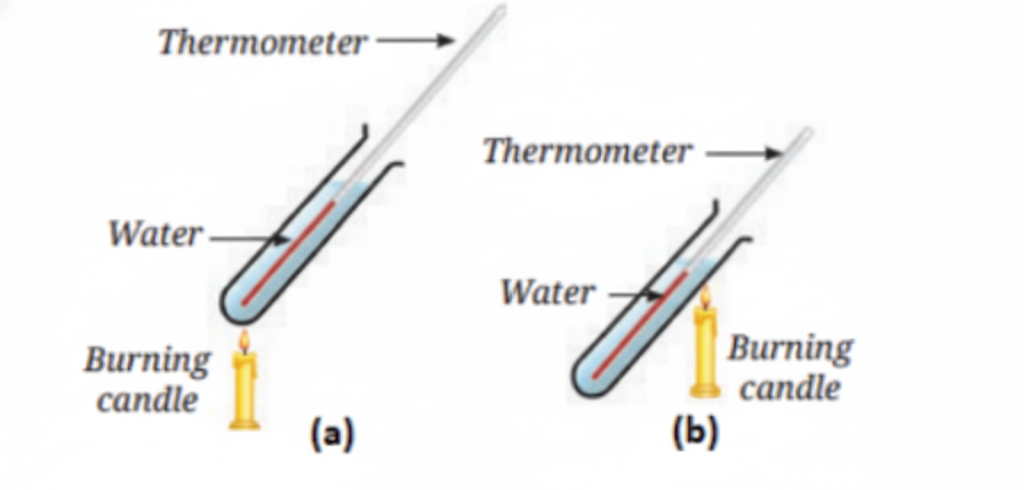
Fig. Two thermometers dipped in two test tubes
Answer:
In Fig. (a), the candle flame directly heats the lower part of the test tube, while the thermometer is positioned near the top. The water at the bottom warms first and, on heating, becomes lighter and moves upward. This upward movement transfers heat to the upper region, where the thermometer is placed, causing it to show a rapid increase in temperature.
In Fig. (b), the thermometer is positioned at the bottom of the test tube, while the candle flame heats the test tube from the side. This side heating does not efficiently transfer heat to the lower part where the thermometer is located. As a result, the thermometer in Fig. (a) records a higher temperature compared to Fig. (b).
Question 7.
Why are hollow bricks used to construct the outer walls of houses in hot regions?
Answer:
Air gets trapped inside the cavities of hollow bricks, and since air is a poor conductor of heat, it acts as an insulating layer. This trapped air reduces the transfer of heat into the house, helping to keep the interior cooler.
Question 8.
Explain how large water bodies prevent extreme temperature in areas around them.
Answer: Large water bodies such as seas and oceans help moderate the climate of nearby regions. During the daytime in coastal areas, land heats up more quickly than water, causing cool air from the sea to move towards the land as a sea breeze, which keeps temperatures comfortable. At night, the land cools faster than the water, so the air above the sea stays warmer while cooler air from the land flows towards the sea as a land breeze. This continuous movement of air helps prevent extreme temperature conditions in coastal regions.
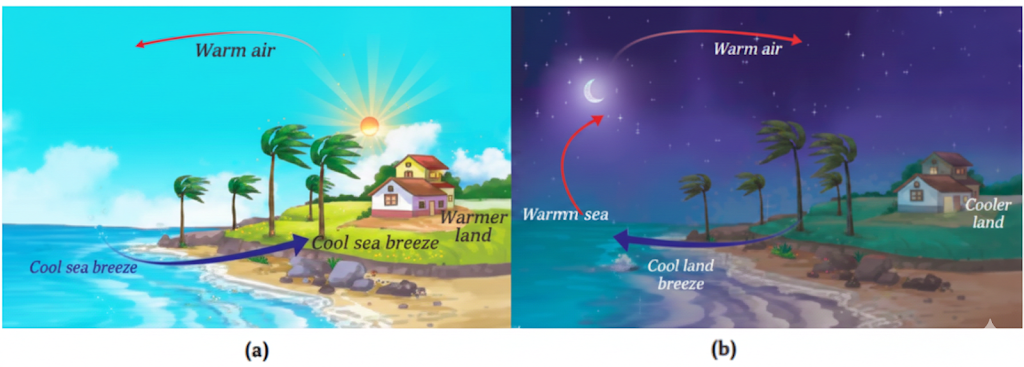
Fig. (a) Sea breeze (b) Land Breeza
Question 9.
Explain how water seeps through the surface of the Earth and gets stored as groundwater.
Answer:
Water enters the ground by slowly moving through soil and porous rocks, a process called infiltration. As it seeps downward, the water fills the tiny spaces and cracks in the soil and rocks, becoming stored underground as groundwater. The layers of sediments and rocks that hold this water in their pore spaces are known as aquifers.
Question 10.
The water cycle helps in the redistribution and replenishment of water on the Earth. Justify the statement.
Answer: The water cycle ensures the constant movement, redistribution, and renewal of water on Earth through different stages such as evaporation, condensation, and precipitation. Heat from the Sun causes water from oceans, rivers, and lakes to evaporate, which then cools and condenses to form clouds. This water returns to the Earth’s surface as rain or snow during precipitation. The rainfall replenishes rivers, lakes, and groundwater, maintaining a continuous supply of water on the planet.
Activity 7.1: Let Us Experiment (Page 90)
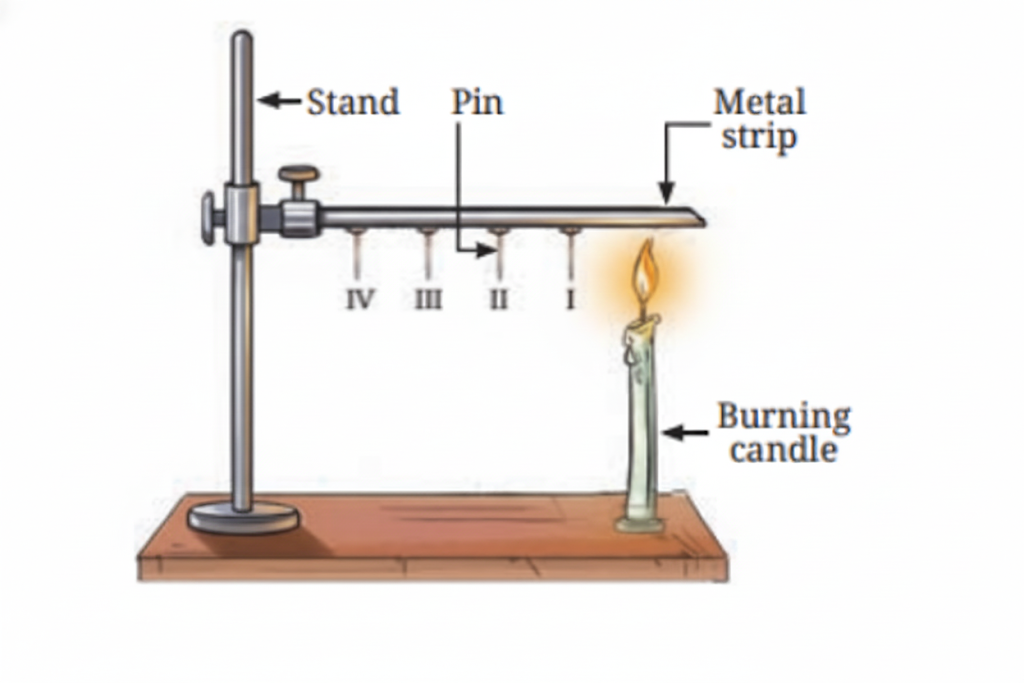
Table 7.1: Falling of pins
Conclusion: Transfer of heat takes place from the hot end of the strip to the colder end.
Activity 7.2: Let Us Investigate (Page 92)
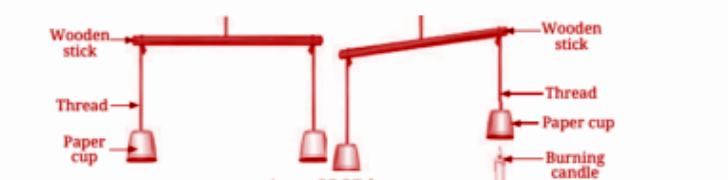
Fig. (a): Initial set-up (b): Hot air rising up
Activity 7.3: Let Us Find Out (Pages 93-94)
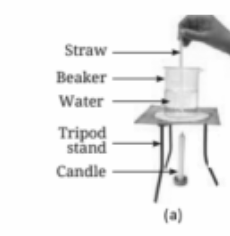
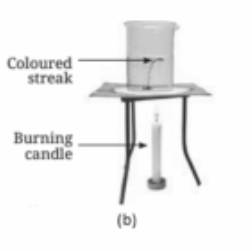
Fig. (a): Initial set-up for demonstration (b): Demonstration of convection in heated water
Observation: When heat is supplied, a streak of colour starts moving up and then coming down from the sides.
Conclusion:
• The streak of coloured water moves upward in the middle and then comes down along the sides. This happens because when the water at the bottom of the beaker gets heated, it expands, becomes lighter, and rises. Cooler water from the sides then moves down to take its place. This process of convection continues until the entire volume of the water becomes heated. Because of this convection, we see the movement of coloured streaks in the beaker.
• Water, like air, is heated through the process of convection.
Activity 7.4: Let Us Investigate (Pages 94-95)
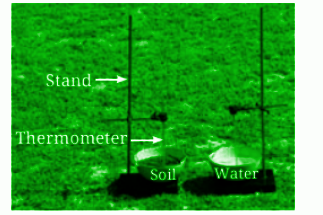
Fig. Measurement of the temperature of soil and water
Observation: When the temperature of the soil and water is measured by placing them in sunlight then the rise in the temperature of soil was more as compared to water after a particular period of time. Conclusion: Soil heats up faster than water.
Activity 7.5: Let Us Investigate (Page 99)
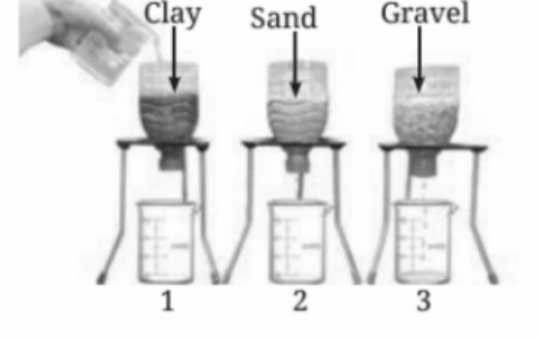
Fig. An activity to compare the flow of water through clay, sand and gravel
Table 7.5: Seepage of water
Conclusion: The spaces or pores between the particles of gravel are much larger than those in sand and clay. This allows water to pass through the gravel much faster. Clay has the smallest particles and smallest pores, so water seeps through it the slowest. Sand falls in between. Thus, the flow of water depends on the size of the soil particles and the space between them. Gravel, with its large gaps, allows the fastest seepage of water among the three materials.
Understanding Heat Transfer in Nature
Key terms like malleability, conductivity, and corrosion define how metals and non-metals behave in nature. Exploring real-life examples, as Yashwant and Anandi did in Rajasthan, makes the chapter engaging and boosts your understanding for quick exam revision.
Knowing how metals like iron corrode or how non-metals like sulfur react helps students relate science to daily life. Make notes on everyday uses of metals and non-metals for better recall during exams.
Practice questions about rust prevention and important properties like malleability to strengthen concepts. Consistent revision and real-life connections increase accuracy and confidence for CBSE Class 7 Science exams.
FAQs on NCERT Solutions For Class 7 Science Chapter 7 Heat Transfer in Nature - 2026-27 Free PDF Download (Sign-in Required)
1. What are the types of heat transfer in nature?
Heat transfer in nature occurs through three main processes: conduction, convection, and radiation. Conduction happens through direct contact, convection occurs in fluids (liquids and gases), and radiation transfers heat through electromagnetic waves.
2. How is heat transferred through solids?
Heat is transferred through solids by conduction. During conduction, heat is passed from one particle to the next in a solid material. The particles themselves remain in place, but the heat energy moves through them.
3. Why does smoke rise?
Smoke rises because hot air is lighter than cooler air. As the smoke consists of warm gases, it rises upward due to convection, where the warmer, lighter air rises and is replaced by cooler, denser air.
4. Why is water a better conductor of heat than air?
Water is a better conductor of heat than air because water molecules are closer together, allowing heat to transfer more efficiently between them. Air, on the other hand, has large spaces between its molecules, making it a poor conductor of heat.
5. How does heat transfer through liquids?
Heat in liquids is transferred through convection. As a liquid is heated, the warmer, less dense part rises, and the cooler, denser part sinks, creating a circular movement of the liquid known as convection currents.
6. How does heat from the Sun reach the Earth?
Heat from the Sun reaches the Earth through radiation. This process involves the transfer of energy in the form of electromagnetic waves, which can travel through the vacuum of space.
7. How do large water bodies affect the temperature of nearby regions?
Large water bodies like oceans and seas moderate the temperatures of nearby regions. During the day, water absorbs heat, keeping coastal areas cooler. At night, water releases heat, preventing drastic temperature drops in the surrounding areas.
8. Why do hollow bricks keep houses cooler in hot regions?
Hollow bricks trap air in their cavities. Since air is a poor conductor of heat, it acts as an insulator, preventing the transfer of heat from outside to inside, thus keeping the house cooler.
9. How does water seep through the Earth's surface?
Water seeps into the Earth through a process called infiltration. Water moves through the soil and porous rock layers and collects in underground reservoirs called aquifers.
10. What is the process of convection in liquids and gases?
Convection in liquids and gases occurs when warmer, less dense regions rise and cooler, denser regions sink, creating a continuous cycle of movement. This helps distribute heat evenly throughout the substance.
11. What are good and poor conductors of heat?
Good conductors of heat include metals like aluminum and steel. Poor conductors (insulators) include materials like wood, plastic, and bakelite. Good conductors allow heat to pass through them quickly, while poor conductors slow down heat transfer.
12. What is the difference between conduction, convection, and radiation?
Conduction transfers heat through direct contact between particles in solids. Convection transfers heat in fluids (liquids and gases) through the movement of the fluid. Radiation transfers heat through electromagnetic waves without requiring a medium (like in the case of heat from the Sun).
13. How do the size of particles in soil affect the flow of water?
The flow of water through soil depends on the size of the particles. Smaller particles like clay have tiny pores that allow water to seep slowly, while larger particles like gravel have bigger spaces between them, allowing water to pass through more quickly.
