




How to Write High-Scoring Answers for CBSE Class 5 EVS Chapter 4
Activity 1 (Page 56)
Question 1.
Walk around your school and create its map. Include the main building, playground, garden, water tanks and other key features. Do not forget the school gate and the pathways that connect the buildings.
Answer:
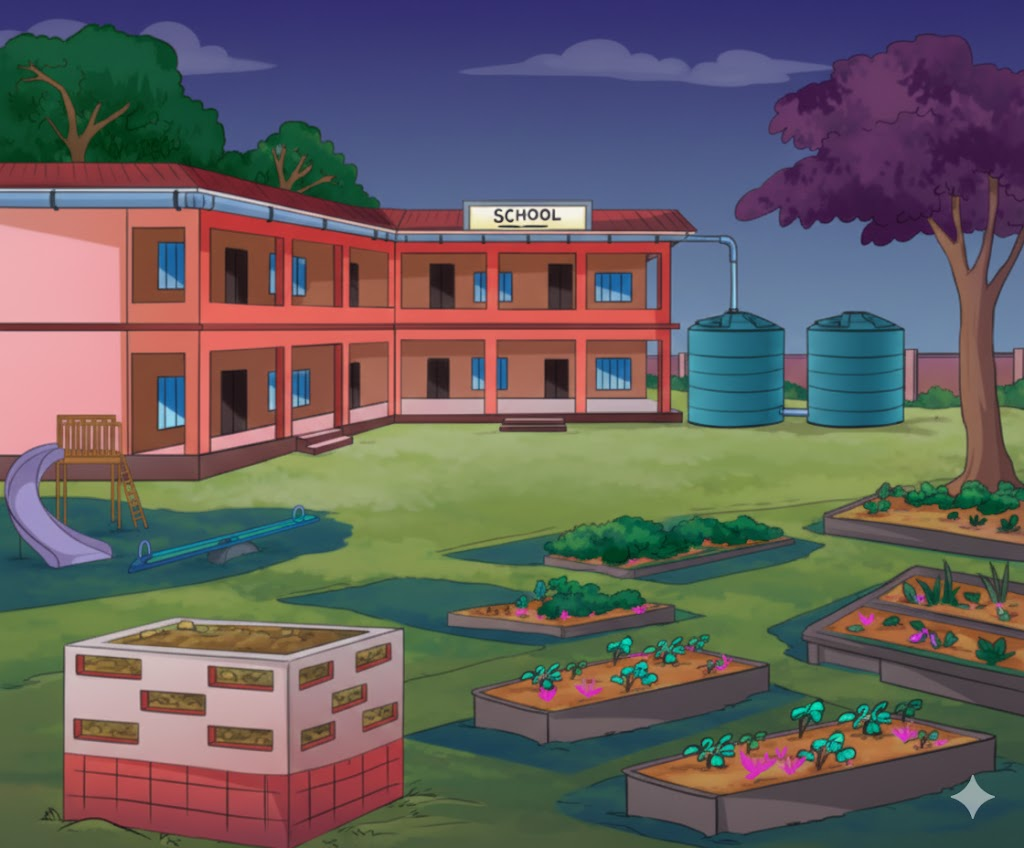
Write (Page 57)
Question 1.
What do I really like about my school?
Answer:
My school gives me the chance to see my teachers and classmates every day. I love discovering new things in class and spending time playing with my friends.
Question 2.
How can I make my school greener?
Answer: I can help make my school more eco-friendly by handling waste properly, conserving water, using electricity carefully, and planting trees and looking after them.
Question 3.
In case there is any difficulty at school, whom do I talk to or inform?
Answer: If I face any problem at school, I will first speak to my class teacher. If she is not available, I will inform another teacher or a caretaker.
Intext (Pages 57-59)
Question 1.
What did you find?
Answer:
I noticed that in a few classrooms, the fans were left running even after the students had left.
Yes, the school has separate dustbins for food waste and other kinds of waste.
All the drinking water taps were closed properly, and none of them were leaking.
Question 2.
Was there anything that made you feel concerned?
Answer: Yes, all lights and fans should be turned off when the class is over or when they are not needed.
The school should also have plenty of greenery, including plants and trees around the campus and in the backyard.
Question 3.
Did anything surprise you? What was it?
Answer: Yes, the surroundings are well-maintained, very clean, and everything is arranged neatly.
Question 4.
What made you feel proud?
Answer: I shared my concerns with my class teacher, and she promptly took steps to make the necessary improvements.
Write (Page 59)
Question 1.
Can you name the colour of the bin used for the following?
Dry waste: ………..
Wet waste: ………..
Answer:
Dry waste: Blue dustbin
Wet waste: Green dustbin
Intext (Page 59)
Question 1.
What are the various recyclers in your area called? Find out what each one collects.
Answer:
In Delhi, several groups help with recycling, such as 3R Recycler, which handles dry waste like paper and plastic, and E-Waste Recyclers India, which deals with old electronics and batteries. Dumpin Recyclers manage materials like paper, plastic, and metal, while Green-O-Tech focuses on office waste, including paper and wood. Various NGOs also collect items such as clothes, books, and plastics. In addition, local kabadiwalas play an important role by gathering recyclable household items directly from homes.
Write (Page 60)
Question 1.
What things does your school give to recyclers?
Answer:
My school gives old newspapers, used books and notebooks, magazines, cardboard boxes, and broken metal items to recyclers.
Question 2.
Ask your parents and find out if there are any items that they had set aside to give to the recyclers. What are they?
Answer: My parents have kept aside items such as plastic bottles, old newspapers, empty jars, a broken plastic chair, and electronic waste like an old radio to hand over to the recycler.
Find Out (Page 60)
Question 1.
With the help of your teacher, ask a recycler to visit your class and share what they do at work. It will be interesting to find out where these items go and how they can be reused or recycled.
Answer:
The recycler explained that they gather old papers, damaged plastic items, electronic waste, and other discarded materials. These are then sent to factories where they are processed and turned into new products such as bottles and cans. Sometimes, the recycler keeps certain items and uses them again, like reusing old jars for storage. This process helps reduce waste and keeps the environment cleaner.
Activity 2 (Page 61)
Segregation Game
Make small paper chits (30-40) with the names or drawings of the different items shown below. Add more items to the list based on what you see around your school or home.
Take three empty boxes, and label them-green for wet waste, blue for dry waste, and the third can be labelled as ‘Ttems for recycler’. One by one, pick a chit and put it in the box that is correct. After all the chits have been put in the boxes, take one box at a time and discuss whether it has been put correctly.
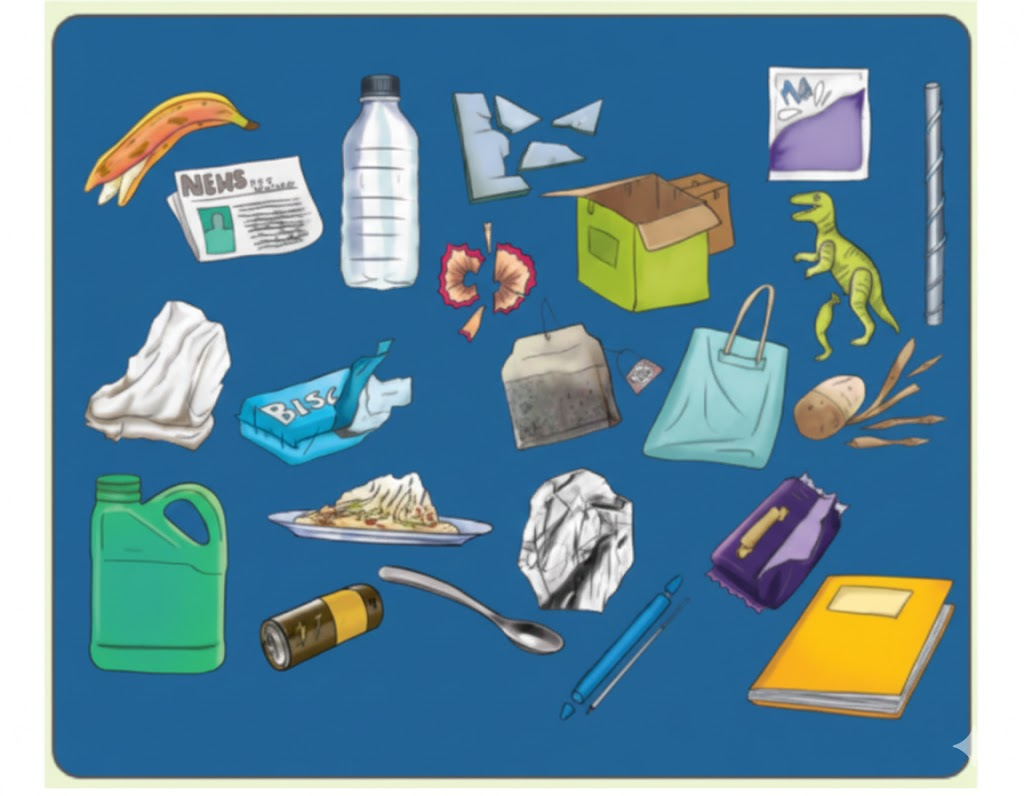
Answer:
Intext (Page 62)
Question 1.
How is wet waste managed?
1. In your school
2. In your home
Answer:
In our school, wet waste such as fruit peels and leftover food is thrown into green bins. This waste is either sent for composting or collected by garbage workers for proper disposal.
At home, we keep wet waste—like vegetable scraps, fruit peels, leftover food, and used tea leaves—in a separate covered container. We make sure it is not mixed with dry waste. This waste is then used for composting in our garden or handed over to the garbage collectors for correct disposal.
Discuss (Page 62)
Question 1.
What happens if we do not separate our waste?
Answer:
When wet and dry waste are mixed together, clean materials like paper, plastic, and metal become soiled, making them difficult to recycle.
Question 2.
What can we do to make the work of sanitation workers easier and safer? Ask your teacher to invite a member of the sanitation workers to your classroom. Ask them to share what they do, the challenges they face, and how we can play a better role in waste management.
Answer: To support sanitation workers, we must place wet waste in green bins and dry waste in blue bins. Any sharp objects should be wrapped before being thrown away. A sanitation worker visited our class and explained that his duty is to collect waste from homes, schools, and public areas. He mentioned that when waste is mixed, their job becomes harder and unsafe because they have to sort it by hand. Sometimes sharp items can hurt them. By giving waste separately, we help make their work simpler and much safer.
Activity 3 (Page 62)
Question 1.
Take two tiles or stones, paint one black and the other white. Keep them under the Sun. After a while, touch each of them and feel the difference in their temperature. Which one felt cooler?
Answer:
After leaving both tiles in the Sun and touching them, the black tile feels much hotter than the white one. This is because black surfaces absorb more heat, while white surfaces reflect most of the sunlight. As a result, the white tile remains cooler, whereas the black tile becomes warmer.
Write (Page 63)
Question 1.
If you have to paint the roof of your school or home white, what would happen?
Answer:
If the roof of our school or home is painted white, it will reflect most of the Sun’s heat instead of absorbing it. This helps keep the rooms inside cooler. As a result, we feel more comfortable and can also save electricity by using fans, coolers, and air conditioners less often.
Discuss (Page 63)
Question 2.
If your area is getting warmer, what actions can be taken to keep it cool?
Answer:
To keep our surroundings cool, we can take several steps:
Plant more trees in our neighbourhood.
Paint our rooftops white to help maintain cooler indoor temperatures.
Ensure good ventilation so fresh air can flow into the rooms.
Encourage neighbours and friends to grow more trees and maintain greenery in the area.
Activity 4 (Page 64)
Question 3.
Look out for a dripping tap or poke a small hole in a used water bottle filled with water. Now, let the water drip. Collect the dripping water in a glass and carefully measure the time it took for the glass to fill up.
Time taken to fill one glass: …………….
How many glasses would become full in one day?
You will be surprised at how quickly water adds up and how much is wasted without anyone noticing.
Answer:
(i) It takes 1 hour for one glass to fill.
(ii) In 24 hours, nearly 24 glasses of water would be wasted. This shows how even a small leak can lead to a large amount of water being lost.
Discuss (Pages 64)
Question 1.
What are some easy things we can do in our school to prevent the wastage of water?
Answer:
Some simple ways to stop water wastage in our school include:
Making sure taps are closed tightly after use to prevent dripping.
Informing a teacher or the responsible staff if any tap or pipe is leaking.
Using water carefully while washing hands or drinking.
Displaying posters with messages like “Save Water” on the notice board to spread awareness among students.
Question 2.
How can you collect and use rainwater at home or in school?
Answer: We can gather and use rainwater at home or in school in several ways:
Keep buckets or containers on rooftops or balconies to store rainwater.
Use the collected rainwater for watering plants or for other household tasks.
Create awareness in the neighbourhood and work together to set up rainwater harvesting systems in the area to collect and store rainwater.
Write (Page 65)
Question 1.
Name the trees on your campus or near your school.
Answer:
Examples include the peepal tree, neem tree, mango tree, and many others.
Question 2.
Which birds and insects have you seen near the plants or trees on your school campus?
Answer: Birds: Crow, peacock, sparrow, and many others.
Insects: Honeybees, butterflies, ants, and similar creatures.
Activity 5 (Page 66)
Question 1.
Take two glasses of water. Measure the temperature using a thermometer under the guidance of your teacher. Record your readings.
Answer: Students should do it by themselves.
Question 2.
Keep one glass under a tree and the other under the Sun. After one hour, measure the temperature again. Record your readings.
What do these readings tell us?
Answer:
The glass of water under the tree is cooler as compared to glass of water kept directly under the sun which means that the shade given by the tree keeps the water cool.
Question 3.
With the help of your teacher, try to find out the names of the trees and plants that attract birds, and butterflies. Try to create a butterfly garden in your school.
Answer:
Plants and trees such as hibiscus, sunflower, mango, and marigold help attract birds and butterflies.
You can even design your own butterfly garden.
Hint: Include plants like hibiscus, sunflower, and jasmine to make the garden bright and appealing.
Write (Page 67)
Question 1.
Find out and write at least three traffic rules.
Answer:
Always use the footpath for walking and avoid stepping onto the road.
Never run or play on the road, and remember to look both ways before crossing.
Follow traffic signals—go on green, stop on red, and wait on yellow.
Question 2.
Think and write about what you saw at the school gate.
Answer:
At the school entrance, I noticed some students arriving on bicycles, while several parents came in their vehicles to drop off their children. A few vehicles were parked very close to the gate. A security guard was seated at the gate, managing the entry of students, teachers, and parents into the school campus. I also observed that some vehicles on the nearby road were moving at high speed.
Intext (Page 68)
Question 1.
Make your traffic signboard here.
Answer:

Discuss (Page 68)
Question 1.
Besides making signboards, what else can we do to improve traffic near the school?
Answer:
To make the traffic near the school safer and more organised, we can take the following steps:
Request the authorities to build a speed breaker in front of the school gate.
Educate students and parents about traffic safety.
Ask the school to appoint an additional guard to help children cross the road safely.
Restrict vehicle parking near the school gate to avoid congestion.
Write (Pages 68-69)
Question 1.
Where is the fire extinguisher kept in your school?
Answer: In my school, fire extinguishers are placed at the main entrance, outside the staff room, in the science lab, and near the staircase.
Question 2.
In case of a fire, where is the assembly point in your school?
Answer: If a fire occurs, the designated assembly area in my school is the playground, where all students can gather safely.
Question 3.
What should you do if there is a fire or if you smell smoke?
Answer: During a fire emergency, we should follow these steps:
Stay calm and avoid panicking.
Immediately inform a teacher or any nearby adult.
Leave the building quickly using the nearest exit.
Activity 6 (Page 70)
In small groups, discuss the situations given below. Each group will discuss one situation. One student from each group will then share their ideas with the class.
1. Two students are pushing and skipping the line at the water tap while others are waiting.
2. A student is scribbling on a classroom bench with a marker. Another child watches but says nothing.
3. Someone throws a wrapper in the playground. A younger student copies the same act.
4. One student keeps teasing and making fun of another student.
5. A group of students are making noise in a public park and disturbing a small group doing yoga nearby.
Each group would discuss:
If you see such a situation unfold before you, what would you do?
What steps can we take to prevent such incidents?
Answer:
Situation 1:
Ask them politely to wait for their turn and explain that jumping the queue is unfair to others.
Put up a poster near the water tap reminding students to stand in line.
Situation 2:
Gently request the student to stop and report the damage to the teacher. Encourage the quiet child to speak up in the future.
Spread awareness among classmates about respecting and taking care of school property.
Situation 3:
Pick up the wrapper and throw it into the dustbin. Explain to the younger child why littering is not good.
Ask the teacher to provide more dustbins around the school and encourage students to use them responsibly.
Situation 4:
Tell the student who is teasing to stop because it hurts others and is not a joke. If needed, inform a teacher or another adult.
Have classroom conversations about kindness, friendship, and understanding others’ feelings.
Situation 5:
Request them to speak more softly and remind them that others are also using the park.
Teach children how to behave in public places by keeping their volume low and respecting shared spaces.
Let Us Reflect (Pages 71-72)
Question 1.
Out of all the classrooms in your school, which one do you think is the nicest and why?
Answer:
Classrooms that have windows and a white roof are the most comfortable because the windows let fresh air enter, and the white roof reflects sunlight, helping the room stay cool.
Question 2.
Create a happiness tree. On a wall or chart paper, draw a large tree with many branches. Each student should add a ‘leaf’ with one small action written on it that makes the school a happier place (for example, greeting someone, turning off lights, sharing space, etc.).
Answer:
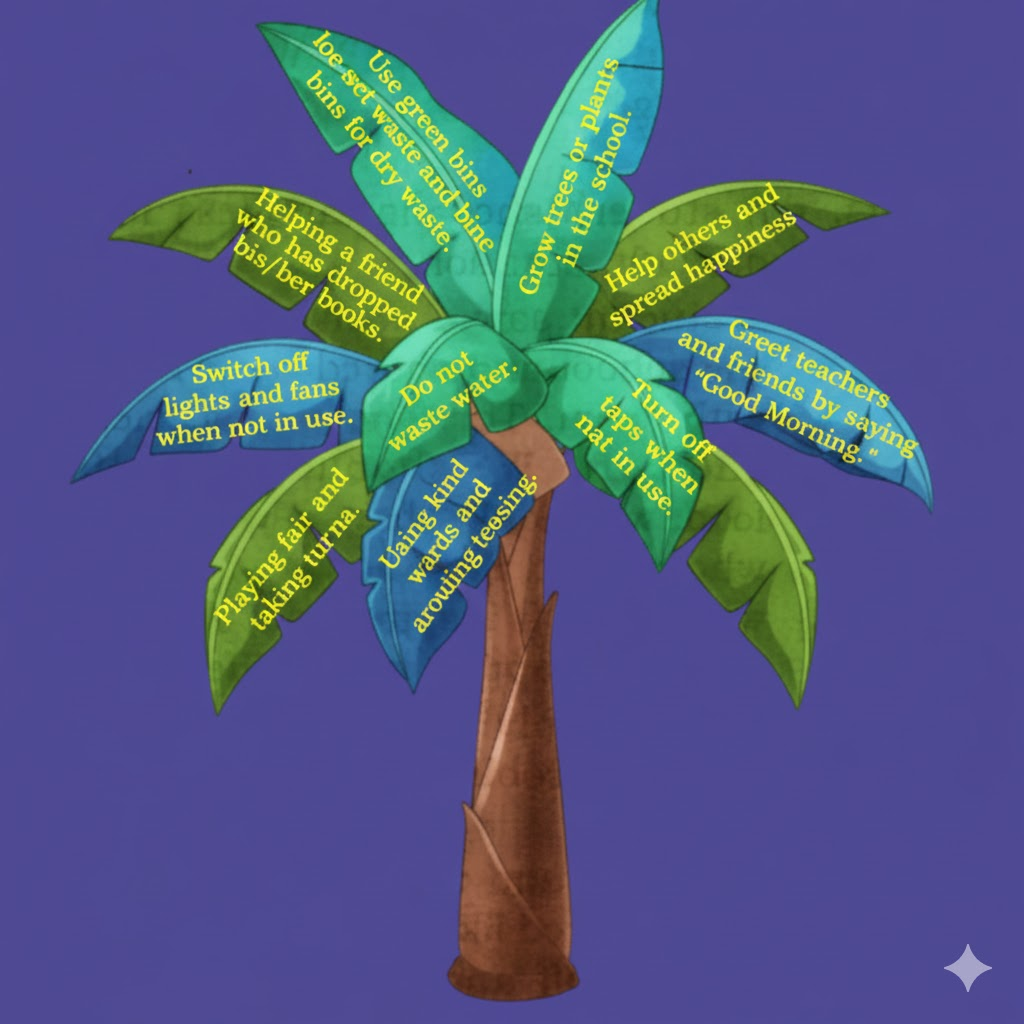
Question 3.
Sharing one’s feelings is exciting. Write a letter to your teacher on ‘My School – My Happy Place’.
Answer:
Dear Ma’am,
I am glad to share my thoughts with you. My school is a place that brings me joy. I look forward to coming every day because I get to meet my friends, play, and learn new things. It is a space where I feel protected, valued, and cared for.
At school, I have learned the importance of looking after plants, trees, and animals. We are taught to keep our surroundings clean and green. Our teachers also remind us to save water, dispose of waste properly, and use electricity wisely.
Greeting my teachers and friends with a “Good Morning” always brightens my day. I enjoy sharing things with my classmates because it makes everyone happy. Thank you for teaching us that even small actions can help make our school a cheerful and eco-friendly place.
Your student,
Aanya
Question 4.
Which actions would you extend to your home, neighbourhood and communities to make it a happy place for all? Describe any one of them in detail.
Answer: Planting trees, managing waste, saving water, and using electricity carefully are some actions that I would like to extend to make my home, community, and neighbourhood to make it a happy place.
For example, I will start by planting trees and taking care of them. Trees make the surroundings clean and cool. They provide shade and food to birds and insects. Trees are also home to many living beings. By planting and protecting trees, I can help make my surroundings green, beautiful, and healthy for everyone.
Question 5.
Imagine a day in school from someone else’s perspective. Choose any one of the following:
A student who navigates school using a wheelchair.
A student who speaks a different mother tongue.
A sanitation worker at school.
Write a diary entry from their point of view. What they felt? What was easy or hard? What made them smile or worry?
Answer:
From the perspective of a sanitation worker
19/07/20XX
Dear diary,
Today was a long and tiring day at school. I began my duties early in the morning, cleaning the classrooms, corridors, playground, and toilets. Some students threw their waste into the dustbins correctly, but many still dropped wrappers and scraps of paper on the floor, which I had to clean up. A few students also forgot to flush, making my work more difficult. While I was cleaning the toilets, I noticed a tap leaking. Seeing water being wasted always upsets me.
However, there were also moments that made me smile. A few children greeted me politely and even said “Thank you.” It felt nice to be appreciated and to know that they value the work I do.
I hope that someday all students will take responsibility for keeping the school clean. It would make my job easier and brighten my day.
X Y Z
Question 6.
As principal for a day, what three changes would you make to enhance happiness, safety and greenery in your school?
Answer: As a principal, I would introduce three key changes to improve happiness, safety, and greenery in my school:
Begin every day with a morning assembly where everyone warmly greets one another.
Create a zebra crossing and install safety signboards outside the school gate to reduce the risk of accidents.
Grow more trees and plants to make the school environment greener and more pleasant.
Question 7.
In groups of 4-5, act out the following:
A student showing kindness in a difficult situation.
A team solving a school water wastage problem.
A student helping a shy classmate feel included.
After each role-play, ask the class:
What did you see? What was inspiring? Could this happen in reallife?
Answer:
A student demonstrated kindness in a challenging situation when they noticed a poor person near the school and offered them some extra lunch. This act showed compassion and generosity. It reminds us not to waste food and to share it with those who are in need. Seeing such kindness was inspiring, and yes, such situations can happen in real life.
A team solving the problem of water wastage at school:
A student noticed that a tap at school was overflowing and immediately informed his friends. Together, they turned off the tap and decided to spread awareness about the issue. They spoke to their teacher and suggested ideas like making posters and reminding others to close taps properly. Their teamwork to solve the problem inspired me. Small actions like these can help us save water in real life.
A student helping a shy classmate feel included:
One day, a shy student was sitting alone during lunch and remained quiet during a group activity. Another classmate observed this and gently invited them to join in. They also encouraged the shy student to participate and share their thoughts in class. Gradually, the student felt more confident and happy to be included.
A simple act of kindness can make someone feel valued, and that is truly inspiring.
Yes, we can do the same in real life by being kind, friendly, and supportive.
Question 8.
Write a one minute speech for your morning assembly on ‘My Dream School’. Mention what makes it special, who helps it stay that way and what every student can do.
Answer:
Good morning everyone,
Today, I would like to talk about “My Dream School.”
I imagine a school that is bright, clean, green, and filled with joy. It has large gardens with trees and colourful flowers, tidy classrooms with plenty of fresh air, and a calm, friendly atmosphere where everyone feels comfortable and safe. Teachers, gardeners, sanitation workers, and all staff members work together to maintain a clean, green, and secure campus. As students, we should also plant trees, conserve water, use dustbins, and do our part to keep the school beautiful and cheerful.
Question 9.
Take a quick survey, ask five students and one teacher:
(a) What is the one thing that makes them feel happy in school?
(b) What is the one thing that could be improved?
(c) What is the one kind thing that they saw today?
Record and present your findings to the class. What did you learn from others?
Answer:
(a) Things that make students and teachers feel happy
(b) What is the one thing that could be improved?
(c) What is the one kind thing that they saw today?
Our School—A Happy Place: NCERT Class 5 EVS Chapter 4 Solutions
Explore the key concepts from NCERT Solutions Class 5 Our Wondrous World Chapter 4 Our School—A Happy Place (2026-27). This chapter builds awareness about cleanliness, greenery, waste management, and safety, guiding students to create a safe and happy learning environment at school.
Mastering the exercises in this chapter helps children understand the importance of teamwork, respect, and conscious actions. Regular practice of these solutions strengthens concepts and encourages holistic development for every learner.
Reviewing chapter-wise NCERT solutions boosts exam confidence. Remember, simple actions like planting trees, saving water, and helping peers not only earn marks but also make your school truly a happy place!
FAQs on NCERT Solutions For Class 5 Our Wonderous World Chapter 4 Our School-A Happy Place - 2026-27 Free PDF Download (Login Required)
1. How can I score full marks in Class 5 EVS Chapter 4?
To score full marks in Class 5 EVS Chapter 4 – Our School—A Happy Place, follow a stepwise answer format and include important points.
- Write clear, structured answers using keywords from the NCERT textbook.
- Incorporate definitions, short and long answers as per the question’s demand.
- Draw neat diagrams or maps if asked, with correct labelling.
- Revise important topics regularly and practice exercise-wise solutions.
- Use the provided solutions PDF for last-minute revision.
2. Are diagrams needed in answers for Class 5 EVS Chapter 4?
Including diagrams in Class 5 EVS Chapter 4 answers is highly recommended when asked.
- Diagrams help you score step marks as per the CBSE marking scheme.
- Label all parts neatly using pencil.
- Practice drawing school building layouts, playgrounds, or activity areas as given in your NCERT book.
3. Which questions are likely from this chapter in school exams?
School exams often ask a mix of short, long, and diagram-based questions from Chapter 4.
- Important themes: features of a happy school, student responsibilities, school facilities, and importance of cleanliness.
- Expect questions to define key terms, explain the importance of a happy school, or draw and label parts of a school.
- Refer to the Chapter 4 important topics for targeted revision.
4. How do I structure long answers for better marks?
For long answers in Class 5 EVS Chapter 4, use a stepwise structure:
- Start with an introduction sentence mentioning the topic.
- Include bullet points for main ideas (e.g., school atmosphere, safety, activities).
- Write a brief conclusion summing up the main point.
- Highlight important words, definitions, and examples.
5. Where can I download the chapter’s solutions PDF?
You can download the Class 5 Our Wondrous World Chapter 4 NCERT Solutions PDF from trusted educational sites.
- Look for the Free PDF Download button at the top or bottom of the solutions page.
- Use this PDF for offline study and quick revision.
6. What are the most important topics from Chapter 4 – Our School—A Happy Place?
The most essential topics for CBSE exams from Chapter 4 are:
- Features of a happy and safe school
- Role of students and teachers
- Importance of cleanliness and teamwork
- School facilities (playground, classrooms, library)
- Diagram/map of the school layout
7. Are NCERT Solutions enough for Class 5 EVS exams?
NCERT Solutions are sufficient for most questions in Class 5 EVS exams.
- Covers the full CBSE syllabus and matches exam format.
- Practice with solutions, revision notes, and important questions for best results.
8. How to present long answers to match CBSE marking?
Present long answers using clear steps to match the CBSE marking scheme.
- Use subheadings or points for each idea.
- Underline or highlight keywords.
- Add relevant diagrams or definitions if needed.
- Keep your answer concise and well-organized.
9. How to learn diagrams and maps for this chapter?
To learn and score in school diagrams or maps:
- Practice drawing each diagram given in the NCERT book.
- Label all parts neatly with a pencil.
- Use simple headings like Classroom, Playground, Library, etc.
- Revise labelled diagrams right before exams using flash notes or solution PDFs.
10. Do examiners award partial marks for correct steps even if the final answer is wrong?
Yes, in the CBSE marking scheme, partial marks are given for correct steps.
- Always write all your working and steps clearly.
- Even if your final answer is incorrect, correct methods or steps can earn you marks.
11. Are references to textbook page numbers useful during revision?
Referencing textbook page numbers during revision can help you find answers faster.
- Mark important pages for quick lookup during last-minute study.
- Use these references along with NCERT Solutions and revision notes for effective preparation.
