




How to Write High-Scoring Answers for Class 5 Our Wondrous World Chapter 2?
Intext (Page 22)
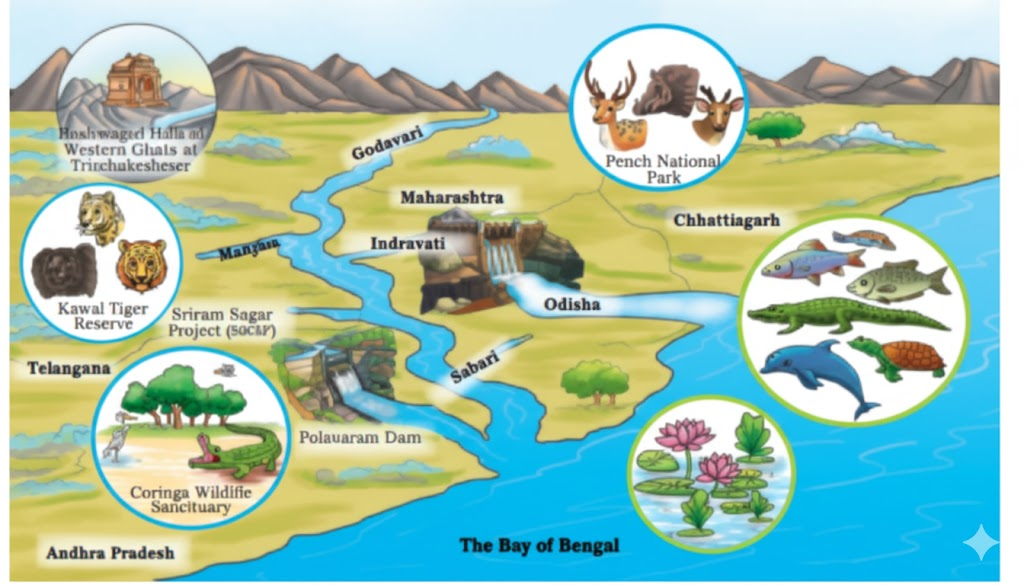
Look at the image given below and answer the following.
1. Name the states that Godavari flows through.
……………………………………..
2. Name a dam and a wildlife sanctuary along the length of Godavari.
……………………………………..
3. Which other small rivers join Godavari in its journey?
……………………………………..
Answer:
1. The Godavari River passes through Maharashtra, Telangana, Chhattisgarh, Andhra Pradesh, and Odisha.
2. Important places along its course include the Polavaram Dam in Andhra Pradesh, the Sriram Sagar Project (SRSP) Dam in Telangana, and the Coringa Wildlife Sanctuary.
3. Based on the given diagram, the smaller rivers that merge with the Godavari during its course are:
Manjira
Sabari
Indravati
Intext (Page 24)
Since ancient times, people have always built their homes near rivers or water bodies. Can you guess why?
Answer:
People have chosen to build their homes near rivers or other water bodies for many important reasons, such as:
Rivers supply a reliable source of freshwater for drinking, cooking, bathing, washing, and cleaning.
The land around water bodies is usually very fertile, which makes it suitable for farming.
Many industries require water to produce everyday goods.
Rivers offer fish and other aquatic life that serve as food.
Since animals also need water, living near a river made it easier to care for livestock.
Rivers act as natural routes for transportation, allowing boats to move people and goods from place to place.
Intext (Pages 25-26)
Question 1.
List three ways in which people are dependent on the river Godavari.
Answer:
Three ways in which people depend on the Godavari River include:
The river supplies water for everyday activities such as drinking, cooking, bathing, washing, and cleaning.
Its water helps farmers raise crops like rice, sugarcane, and cotton.
Many communities—fishermen, boatmen, and factory workers near the river—earn their income through jobs and activities linked to the river.
Question 2.
In which occupations are people engaged near the river Godavari?
Answer: People who live close to the Godavari engage in many river-based occupations. These include:
Farming: Farmers rely on the river’s water to grow their crops.
Fishing: Fishermen catch fish from the river for selling or for their own consumption.
Boating and Transport: Boats are used to move people and goods across the river.
Factory Work: Industries located near the river use its water to manufacture different products, providing jobs to workers.
Selling Goods and Services: Shopkeepers and vendors offer food and other items to pilgrims and tourists who visit the sacred riverbanks.
Question 3.
Which crops do you see growing near the Godavari?
Answer: Crops such as paddy, sugarcane, cotton, pulses, and fruits like mango and banana are cultivated near the Godavari. These crops flourish because the river supplies abundant irrigation water and the surrounding soil is rich and fertile.
Question 4.
Which crops grow in your region? Where does the water for irrigation come from?
Answer:
(Answers will differ.)
I live in Delhi close to the Yamuna River. The major crops grown in the surrounding regions include wheat, rice, radish, spinach, mustard, carrots, and coriander.
Activity 1 (Page 26)
Make a poster in your classroom showing all the ways rivers help people. Include drawings of homes, farms, boats, fishermen and more.
Answer:
Students should do it by themselves.
Write (Page 27)
What problems can arise after a dam is built? How can they be solved?
Answer:
After a dam is constructed, several issues may occur, such as:
Large areas of land, including forests, farmlands, and villages, may get submerged, destroying vegetation and natural habitats.
People and animals living in those regions are forced to relocate, which disrupts their routines, homes, and livelihoods.
The dam stops the river’s natural flow, preventing it from carrying nutrients downstream as it normally would.
Fish are unable to move freely along the river, leading to a decline in their numbers.
These challenges can be reduced with proper planning before building a dam:
The location of the dam should be selected carefully to avoid harming important ecological areas and human settlements.
Safe and protected zones should be created for relocating wildlife.
New trees should be planted around the dam to prevent soil erosion.
Fishways, which are special structures with steps or small pools, should be built to help fish move past the dam by swimming or jumping through them.
Write (Page 28)
Question 1.
Where do the plastic wrappers and bags that we litter end up?
Answer:
Plastic bags and wrappers that are thrown away carelessly often get carried into drains, lakes, and rivers. Once they enter these water bodies, they contaminate the water and endanger aquatic life such as fish, turtles, and other organisms. Because plastic does not decompose, it remains in the environment for many years, causing long-term harm.
Question 2.
What kinds of soaps, shampoos or floor cleaners (natural or readymade) are used in your home? Where does the unclean water mixed with these cleaners go?
Answer: (Responses may differ.)
At home, we use products like soaps, shampoos, and floor cleaners. The wastewater containing these substances flows through the bathroom or kitchen drains into underground sewage pipes. From there, it often reaches rivers, lakes, or other water bodies without adequate treatment. This polluted water harms plants, animals, and even people who rely on these water sources.
Discuss (Page 28)
Ask your parents or elders, about the condition of water bodies near your home when they were your age. What is the status of those water bodies today?
Answer:
(Answers will vary.)
When I asked my parents what the water bodies near our home were like when they were my age, they told me that the rivers, ponds, and lakes were clean. People would bathe, wash clothes, and even drink the water. There were plenty of fish and many birds living around them.
Today, things are very different. Many water bodies have become polluted and dirty. People throw garbage and plastic into them, and some ponds have dried up or are filled with waste. The water is no longer safe to use, and many birds and animals that once lived there have disappeared.
Activity 2 (Page 29)
Make a list of things that we throw into the waste bin at home or school. If these things were thrown into a river or a pond, how would each of these items harm the animals, plants and people who live nearby, and use this water?
Answer:
Activity 3 (Page 29)
Take two clear glasses of water. Add a spoonful of sugar in one and a spoonful of cooking oil in the other. Stir both well and observe. What do you observe? Which one appears clear?
Answer:
Observation: When a spoonful of sugar was added to one glass of water and stirred, it dissolved completely. The water looked clear and see-through.
In the second glass, when cooking oil was added and mixed, it remained floating on the surface and did not blend with the water. The water appeared cloudy and unclear.
Conclusion: The glass containing sugar mixed with water stays transparent.
This activity demonstrates that sugar dissolves in water, whereas cooking oil does not.
Intext (Pages 29-30)
Can you list a few things that: Dissolve in water
……………………………………………….
……………………………………………….
Do not dissolve in water
……………………………………………….
……………………………………………….
Answer:
Substances like salt, sugar, lemon juice, and honey can dissolve in water. Items such as oil, sand, chalk, ghee, and plastic do not dissolve in water.
Activity 4 (Page 30)
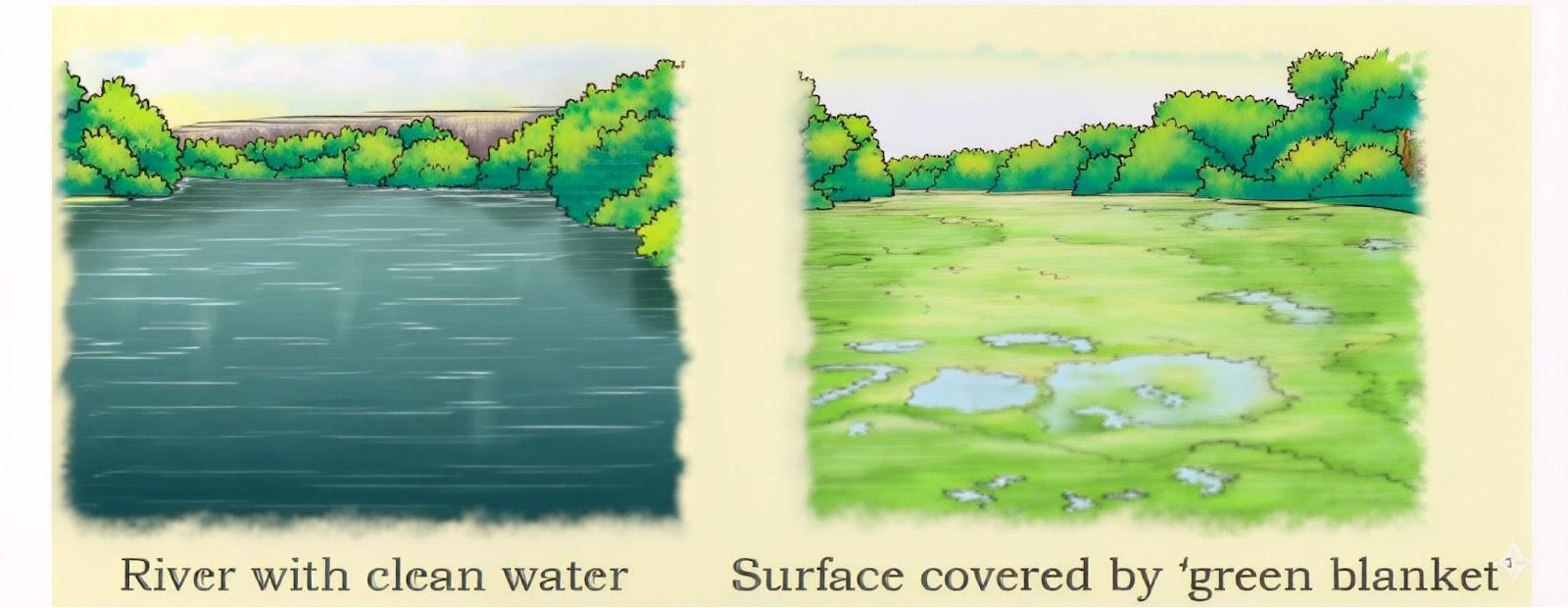
Look at the two images given below. Which river looks healthy and why? How do so many plants grow in water? What do you think happens when too many plants grow in a river?
Answer:
The first river on the left appears clean and healthy because its water is clear and there is little or no visible waste. Such a river provides a safe environment for both plants and animals.
In the second river, the surface is covered with a thick layer of green plants. This happens when fertilisers used in farming are washed into the river. These fertilisers cause rapid growth of plants and other organisms, forming a green layer on the water.
When plant growth becomes excessive, it blocks sunlight and oxygen, slowly suffocating the life inside the river. The water also becomes unsafe for people to use or drink.
Write (Page 31)
Can you list three things you can do to protect the water bodies near you?
1. ………..
2. ………..
3. ………..
Answer:
Waste should be disposed of in proper bins rather than being thrown into drains or rivers, as this helps keep water bodies clean and safe for both humans and animals.
It is important to use environmentally friendly soaps, shampoos, and cleaning products to prevent harmful chemicals from contaminating the river.
Excessive use of fertilisers should be avoided because these chemicals can damage the life forms living in water bodies.
Activity 5 (Page 32)
Match the Columns.
Note: One problem could affect more than one things.
Answer:
(i)-(f); (ii)-(d), (g); (iii)-(g); (iv)-(c), (e); (v)-(f), (vi)-(a), (f); (vii)-(c)
Activity 6 (Page 33)
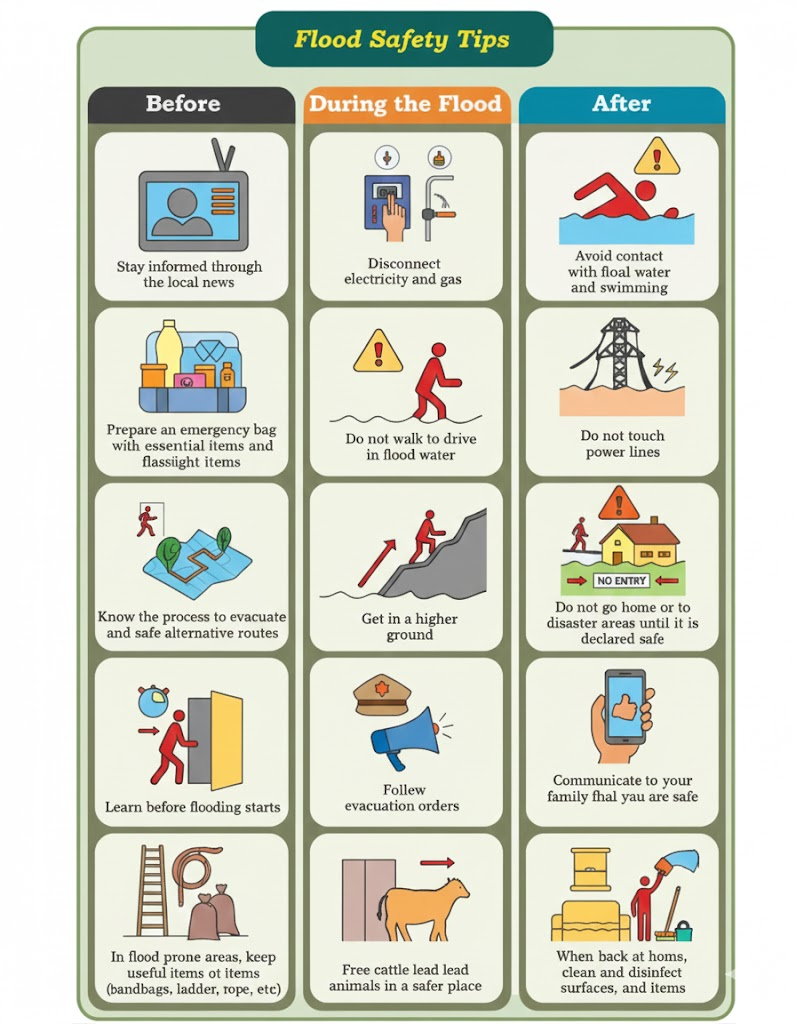
Flood Safety Tips
Read the flood safety tips carefully.
Activity 7 (Page 34)
Read the flood safety tips given in Activity 6 and organise a role-play where you are the Sarpanch or Municipal Corporator of your village or city.
Discuss what actions you will take to –
prevent flooding
prevent damage caused by flooding
keep elderly people and people with disability safe
keep animals safe
Answer:
Students should do it by themselves.
Intext (Page 35)
Question 1.
What would you do if you had no water in your home for an entire day?
Answer:
If my home had no water for an entire day, managing daily activities would become difficult. I would:
Use whatever stored water is available very carefully for essential needs like drinking, cooking, and bathing.
Try to get water from other places, such as neighbours, a community tap, or a water tanker if one arrives.
Reuse water whenever possible—for example, the water used to wash vegetables could be used for watering plants.
Delay tasks that require a large amount of water, such as washing clothes or cleaning the house.
Question 2.
What if there was no water for a week? How would you bath, drink, cook or clean? Where would you go to find water?
Answer:
Going a full week without water would be extremely challenging. It would make me realise just how valuable water is and why it is important to save, store, and share it responsibly. During such a situation, I would:
Take sponge baths or wipe myself with wet towels to reduce water use.
Use the stored drinking water very carefully and ensure none of it is wasted.
Prepare simple foods that require minimal water, such as chapatis instead of rice.
Drink only the amount of water necessary and avoid throwing any away.
Reuse water from washing fruits or vegetables to water the plants.
To get additional water, I would look for:
Nearby wells or hand pumps that provide safe water.
Public taps or water tanks if they are functioning.
Community buildings or schools that might be distributing water.
Neighbours who have bore wells or extra stored water.
Bottled water from shops for immediate needs.
Water ATMs that supply purified drinking water.
Question 1.
Find out which river(s) flow through your state.
(a) What are they used for?
(b) Are there any dams on them?
Answer: (Responses may differ.)
The Yamuna River is the major river that passes through Delhi.
(a) People use this river for drinking water, irrigation, farming, producing electricity, performing religious rituals, recreational activities, and for replenishing groundwater.
(b) No, there is no dam constructed on the Yamuna River within Delhi.
Question 2.
Ask your grandparents or parents to share any story or festival related to rivers in your region and present it in the class.
Answer:
(Answers may vary.)
I live in Delhi with my parents and grandparents, and the Yamuna is the major river flowing through our city. My grandparents often talk about the vibrant festivals celebrated on its banks, such as Yamuna Aarti, Ganga Dussehra, and Chhath Puja. On Ganga Dussehra, people gather at the river to take a sacred dip, believing it purifies them of their sins. Many families also travel to places like Hathni Kund, where the Yamuna flows clean and fast. During these festivals, devotees place diyas on the water, offer flowers, and perform aarti while singing praises to the river.
Chhath Puja, though originally a festival of Bihar and eastern Uttar Pradesh, is now widely observed in Delhi too, especially by families who have moved here from those states. For this festival, devotees stand in the river and offer arghya—prayerful offerings of water—to the setting sun and again the next morning to the rising sun. My grandmother remembers the riverbank lit up with hundreds of diyas and filled with devotional songs, creating a calm, spiritual atmosphere.
Question 3.
Ask an elder in your family:
(a) What was the condition of rivers when you were a child?
(b) What has changed since then?
Answer:
(a)
When I asked my grandfather what the Yamuna in Delhi was like during his childhood, he told me that the river used to be much cleaner and had plenty of flowing water. People regularly bathed in it, washed their clothes, and even drank the river water. Children played along the banks, and many adults visited the river for morning walks or religious activities.
(b)
He explained that the condition of the Yamuna today is very different. The river has become polluted because drains and factories release waste into it, and people throw garbage and plastic into the water. In many areas, the river appears dark and has a foul smell. He said that the river once supported life, and now it is our responsibility to protect and restore it so that future generations can enjoy clean water.
Question 4.
Why do you think people built houses and cities near rivers in the past? Are rivers still important today in the same way?
Answer:
People in earlier times built their towns and houses near rivers for several important reasons:
Rivers supplied them with a steady source of freshwater.
The water from rivers supported farming and helped raise animals.
Boats could move easily along rivers, allowing trade and travel to flourish.
Rivers provided food in the form of fish and other aquatic creatures.
People depended on river water for daily tasks such as washing, bathing, and cleaning.
Even today, rivers remain extremely valuable, although the way we use them has evolved. We still rely on rivers for drinking water, irrigation in farming, producing electricity, sustaining wildlife, and supporting industries. Rivers also serve as habitats for fish and many other aquatic species that are important sources of food. It is essential to protect and care for our rivers for the well-being of future generations.
Question 5.
If you could create one new rule to protect rivers in your city or village, what would it be?
Answer: If I were allowed to introduce one new rule to safeguard the rivers in my town or village, it would be this: No drainage system or factory should release wastewater into the river unless it has first been treated in a proper purification plant. Such a rule would greatly reduce pollution and help keep the river clean and healthy for humans, animals, and plants.
Question 6.
Think about a time when you wasted water. What could you have done differently?
Answer: There was a time when I accidentally kept the tap running while brushing my teeth and didn’t notice how much water was being wasted. I should have turned the tap off and used water only when required. Using a mug to rinse my mouth would have saved a lot more water. This experience taught me to be more mindful whenever I use water, because every drop matters. Even small habits can make a big difference in conserving water.
Question 7.
Can you design a simple water filter using everyday materials? What would you include and why?
Answer: Yes, it is possible to create a basic water filter using common household materials.
Hint: A plastic bottle, layers of sand, gravel, charcoal, and a piece of cotton cloth can be used to make it.
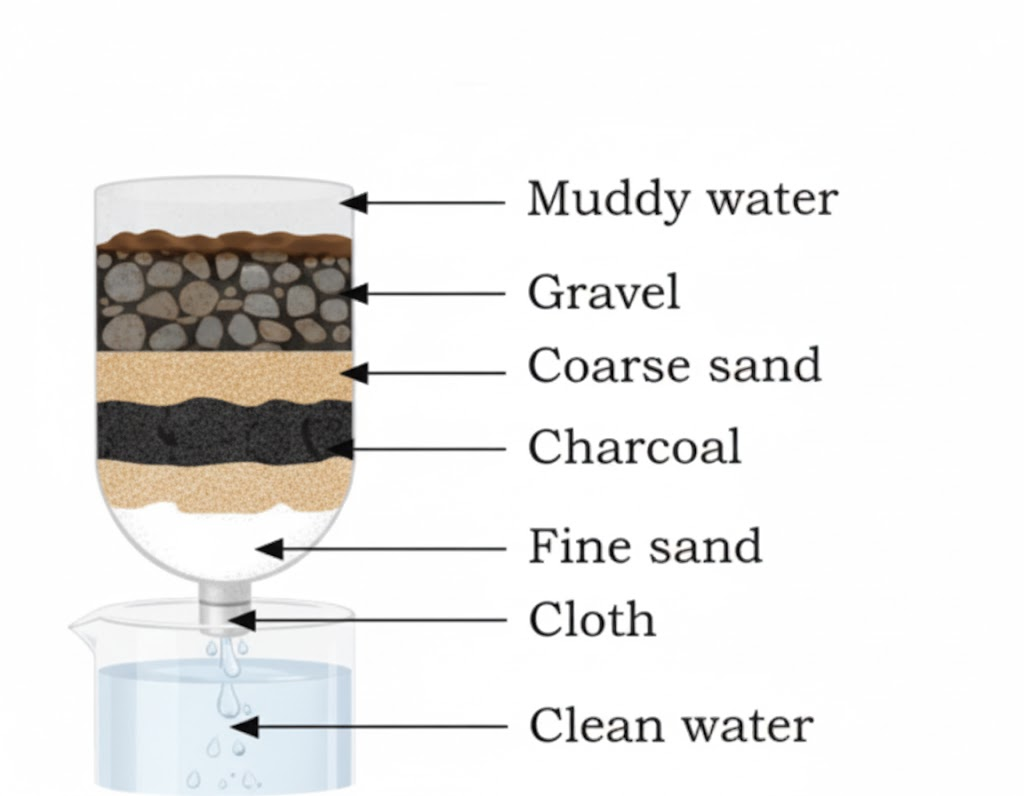
First, we cut a plastic bottle into two parts and turned the upper half upside down so it worked like a funnel. A piece of cloth was tied over the bottle’s opening. Inside this funnel, we arranged the filtering materials in layers: fine sand at the bottom, then a layer of charcoal, followed by coarse sand, and gravel at the top. The entire setup was placed on a container to collect the cleaned water.
When muddy water was poured into it, the gravel stopped the big particles, the sand removed smaller bits of dirt, the charcoal absorbed harmful substances, and the cloth held back very fine impurities. The water that came out looked much clearer, although it still needs to be boiled before drinking to make it completely safe.
Question 8.
Imagine you are planning a new city near a river. What steps would you take to:
(a) keep the river clean.
(b) prevent floods during heavy rains.
(c) ensure there is always enough water for everyone, even during summers.
Answer: If I were designing a new city beside a river, I would take the following measures:
(a) To keep the river unpolluted, I would ensure that all wastewater is cleaned in sewage treatment plants before entering the river. Dumping garbage or industrial waste into the river would be strictly prohibited. I would also organise awareness programmes so that citizens understand the importance of protecting the river.
(b) To reduce the risk of flooding during heavy rains, I would construct strong embankments along the river and develop an efficient drainage system to carry away excess rainwater. Wetlands would be preserved so they can naturally absorb extra water. Houses would not be built in low-lying or flood-prone zones to ensure people’s safety. In areas prone to floods, I would encourage residents to keep essential items like sandbags, ladders, and ropes ready for emergencies.
(c) To maintain an adequate water supply during the summer months, I would construct dams and reservoirs to store rainwater and promote rainwater harvesting in every household. Repairing leaks, encouraging people to use water carefully, and reusing water for tasks like gardening and cleaning would help minimise wastage and ensure a reliable supply.
NCERT Solutions for Class 5 EVS Chapter 2 Journey of a River: Key Concepts
Understanding the Journey of a River is essential in Class 5 EVS. This chapter explains how rivers like the Godavari support life, boost agriculture, and provide water for daily needs. Learning with NCERT Solutions makes these important ideas easy to grasp.
By practicing these solutions, students get a clear understanding of river systems, pollution prevention, and the importance of water conservation. Both exam confidence and real-life awareness improve with regular learning and revision.
Keep revising these topics to strengthen your knowledge. NCERT Solutions for Class 5 Our Wondrous World Chapter 2 (2026-27) help you master exam-focused content while developing responsible habits to protect water and nature.
FAQs on NCERT Solutions for Class 5 Our Wondrous World Chapter 2 Journey of a River - 2026-27 Free PDF Download (Sign-In Required)
1. What are the important questions in Journey of a River?
Important questions in Class 5 EVS Chapter 2 – Journey of a River often include key concepts and textbook exercises for exams.
- Definitions: Source of a river, tributary, river basin, delta
- Short answer: Describe the journey or stages of a river
- Diagram: Label the parts of a river or show its journey on a map
- Long answer: Explain why rivers are important for living beings
- Intext and back exercise questions from NCERT Solutions for Class 5 EVS Chapter 2
2. Are diagrams needed in class 5 EVS Chapter 2?
Including neat diagrams and map labelling in your answers for Class 5 EVS Chapter 2 can help you score extra marks.
- Draw basic diagrams of a river, its source, and flow path
- Label parts like source, tributary, meander, and mouth clearly
- Follow standard conventions for neatness
- Use diagrams when the question asks or when explaining processes
3. How to download Class 5 NCERT EVS solutions?
You can download free PDF NCERT Solutions for Class 5 Our Wondrous World Chapter 2 from trusted educational sites.
- Look for the 'Free PDF Download' button or link on the solution page
- Check for teacher-reviewed, syllabus-aligned PDFs for the 2026–27 academic year
- Ensure the solutions cover intext, back exercises, diagrams, and key definitions
4. How to write stepwise NCERT answers to score full marks?
To score full marks in Class 5 EVS Chapter 2, write stepwise NCERT answers as per CBSE marking scheme:
- Start with a direct answer or definition
- Use bullet points, numbering, or short paragraphs for each step
- Explain concepts in simple language with examples from the chapter
- Add relevant keywords and neat diagrams when needed
- End with a summary sentence if it is a long answer
5. What are the most important topics from Journey of a River class 5?
The most important topics in Journey of a River (Class 5 EVS Chapter 2) include:
- Stages of a river's journey: source, middle course, meanders, delta, mouth
- Key definitions: tributary, river basin, delta, erosion, deposition
- Importance of rivers for plants, animals, and humans
- Map/diagram labelling of a river's parts
6. How do I structure long answers for better marks in Class 5 EVS Chapter 2?
Structure long answers using NCERT Solutions for Class 5 Our Wondrous World Chapter 2 strategies:
- Start with an introductory line stating the main point
- Divide the answer into clear paragraphs or bullet points for each stage/concept
- Use keywords like river journey, source, tributary, delta, etc.
- Add neat diagrams or labelled maps if relevant
- Conclude with the importance or summary of your answer
7. Where can I get chapterwise NCERT Solutions for Class 5 EVS?
You can access chapterwise NCERT Solutions for Class 5 EVS from official educational websites offering:
- Class 5 Our Wondrous World Chapter 2 Journey of a River solutions
- Free PDF downloads for offline access
- Exercise-wise and exam-centric answers
8. Do examiners award partial marks for correct steps even if the final answer is wrong?
Yes, CBSE examiners award partial marks for correct steps in Class 5 EVS, even if the final answer is incorrect.
- Follow a logical, stepwise approach using NCERT Solutions
- Each correct step (definition, diagram, explanation) earns marks
- Always attempt every part to maximise your score
9. Are NCERT Solutions enough for Class 5 EVS exams?
NCERT Solutions for Class 5 EVS Chapter 2 are generally sufficient for CBSE exams.
- Covers the full syllabus and textbook exercises
- Includes stepwise, teacher-reviewed answers
- Provides definitions, diagrams, and key keywords
- Helps in thorough revision and scoring better marks
10. How to learn diagrams and maps for Journey of a River?
To master diagrams and map labelling for Class 5 EVS Chapter 2:
- Practice drawing simple diagrams of the river’s journey step by step
- Label the source, tributary, meander, delta, and mouth clearly
- Use colour pencils for neatness and clarity (if allowed)
- Review sample diagrams from NCERT Solutions and textbooks
