



How to Write Scoring Answers for Maps and Locations in Class 5 Maths?
NCERT Textbook Page 171
Finding Directions
Manu is facing the rising Sun.
That direction is east.
His left hand is pointing in the north direction.
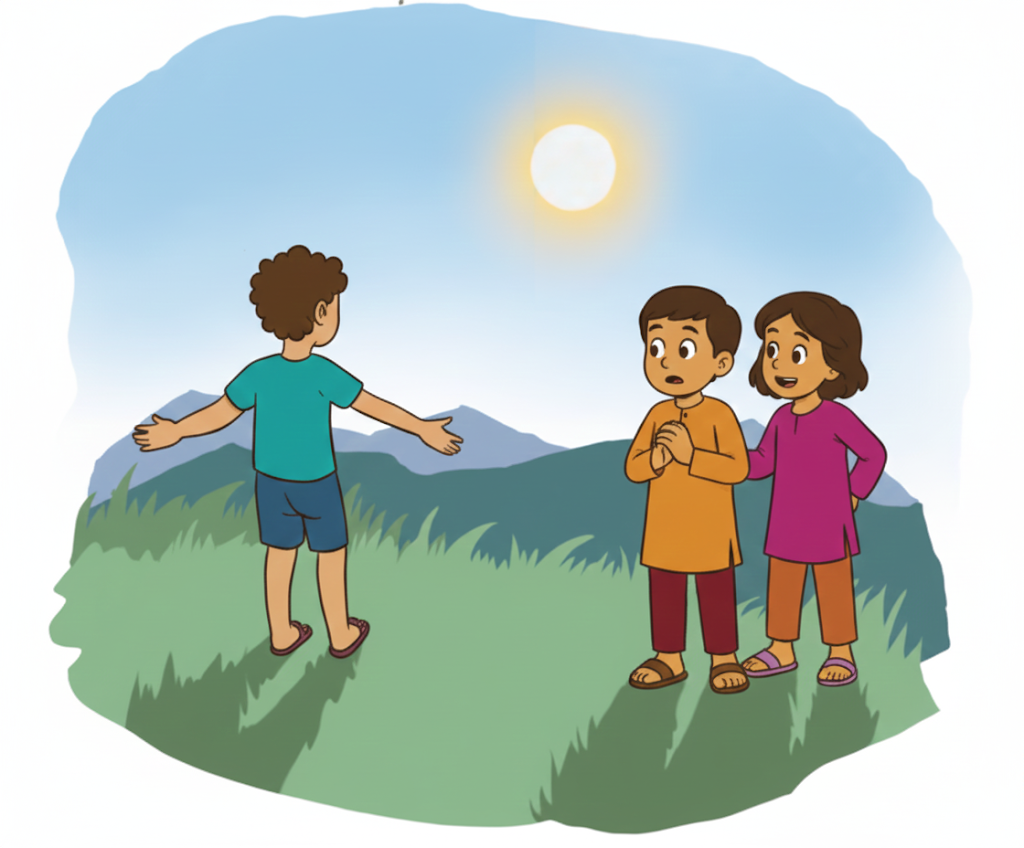
His right hand is pointing in the south direction.
Q. Which way is west?
Solution: Behind Manu
NCERT Textbook Page 172
Bird Watching
Children are at a bird-watching camp. Read the clues and colour the tents in the camp accordingly.
The tent to the west of the road is blue.
The tent closest to the lake is green.
The tent north of the green tent is purple.
The tent south of the lake is yellow.
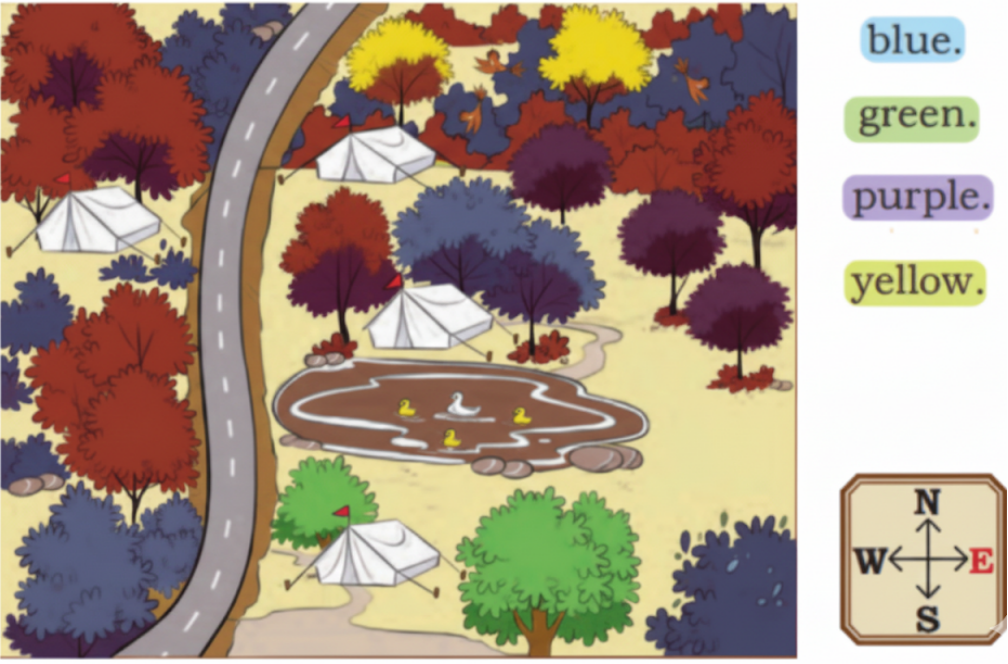
Now, draw a tent to the east of the lake
Solution: Students should do it by themselves.
NCERT Textbook Pages 172-173
Map of a Room
Write the directions of the following in relation to the girl.
Window _____________
Bed _________________
Cupboard ___________
Bedside table ________
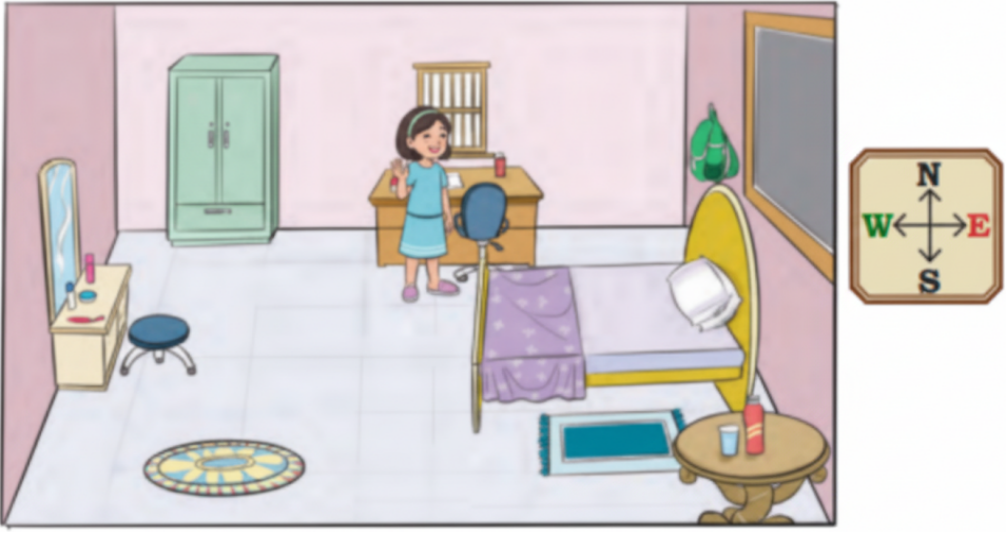
Solution: Students should do it by themselves.
Make a drawing of your room and locate the direction in which different things have been placed in relation to you standing at the centre of the room. Make the direction arrow for your room.

Solution: Students should do it by themselves.
Write the names of the things that are placed in the following directions.
East_____________________________________________________
West_____________________________________________________
North_____________________________________________________
South _____________________________________________________
Solution: Students should do it by themselves.
NCERT Textbook Pages 173-174
Zoo Trip
Bus Route
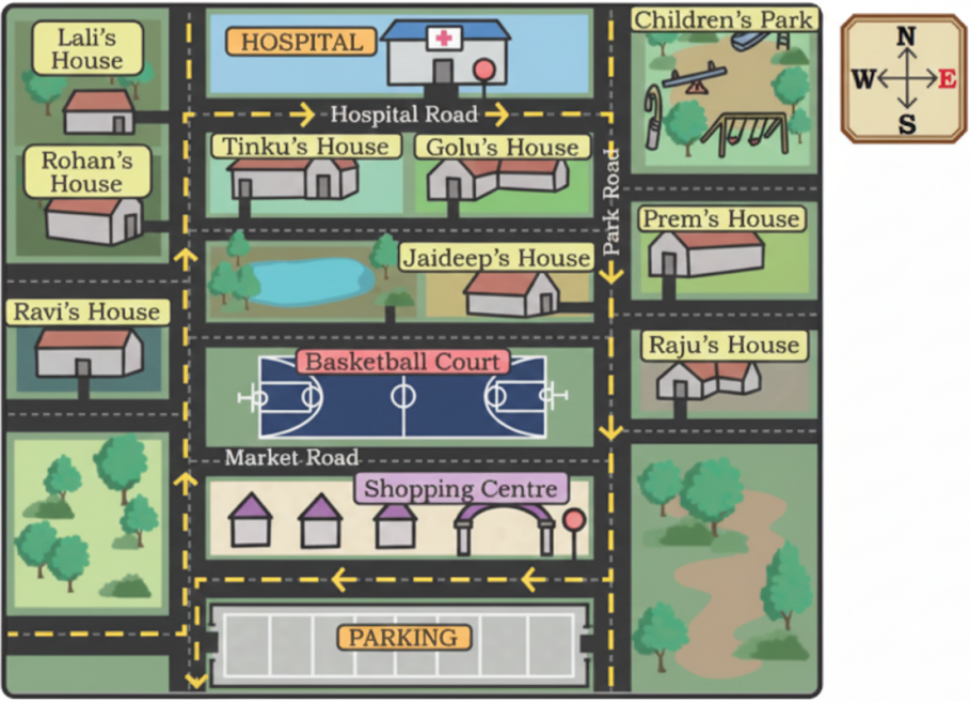
The bus will start from the parking area. It will go north and then it will take a right turn onto ___________ Road driving in the ___________ direction to reach Stop 1(S1).
To reach Stop 2(S2), it will turn _______ (right/left) onto ___________ Road driving in the ___________ direction.
Solution:
The bus begins its journey from the parking area and moves north. It then takes a right turn onto Hospital Road and travels east to reach Stop 1 (S1).
To reach Stop 2 (S2), the bus turns right onto Park Road and continues in the south direction.
(a) Whose houses are situated to the east of Jaideep’s house?
Solution:
Raju’s house and Prem’s house are located to the east of Jaideep’s house.
(b) Mark the route from Ravi’s house to the children’s park.
Solution:
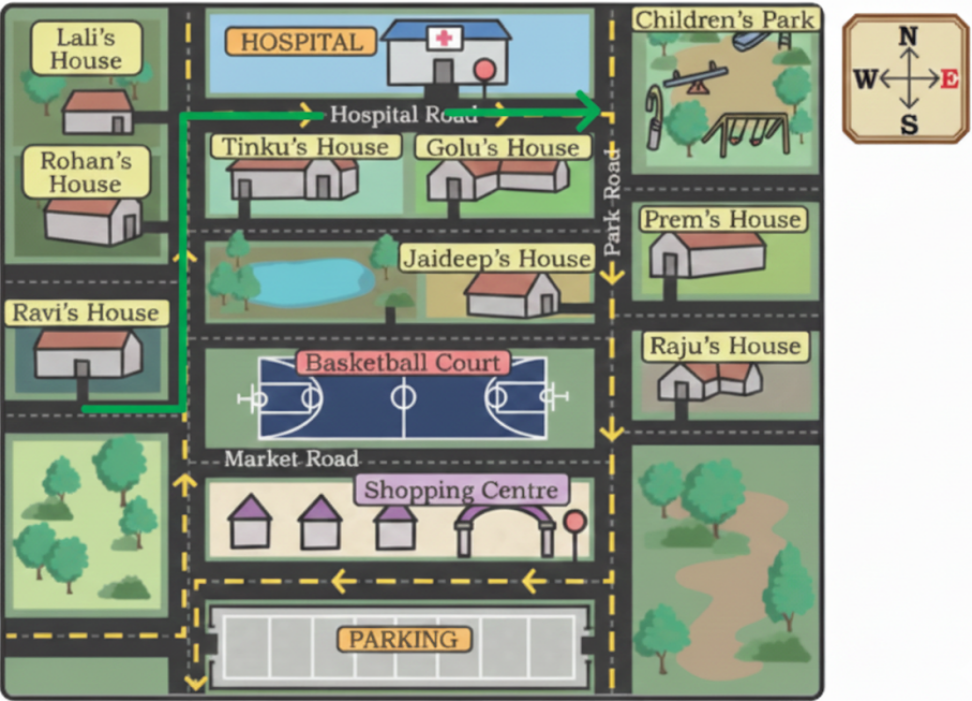
(c) Which stop is closer to Lali’s house?
Solution:
Stop 1 (S1) is nearer to Lali’s house.
(d) Golu is running late. Trace the route to help him reach the nearest bus stop.
Solution:
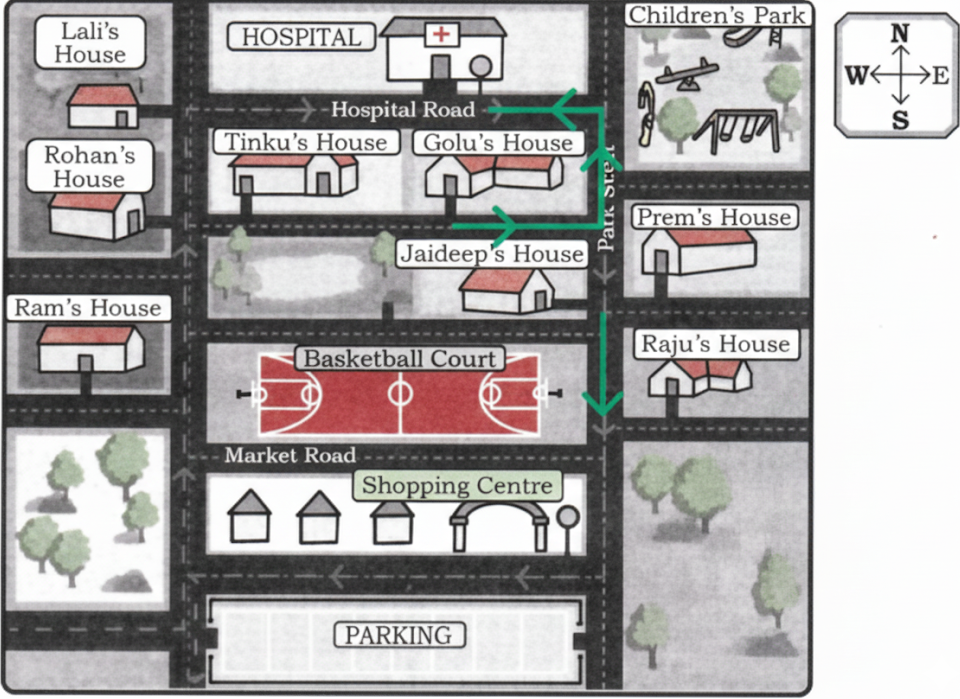
(e) In which direction would Prem have to move to reach Stop 2?
Solution: Prem would need to move southwards to reach Stop 2.
NCERT Textbook Pages 175-176
Delhi Metro Train Stations
Children will get off the bus at the Qutb Minar metro station. To reach the zoo, they need to get off the metro at the Supreme Court metro station. Here is the metro map for your reference.
Read the key to the symbols and identify them on the map.
What do the different coloured lines represent?
Solution: The coloured lines show different metro routes, with each colour representing a separate metro line such as the Red Line, Yellow Line, and Blue Line.
Mark the Qutb Minar station on the Yellow Line and the Supreme Court Station on the Blue Line.
Solution: Metro Map
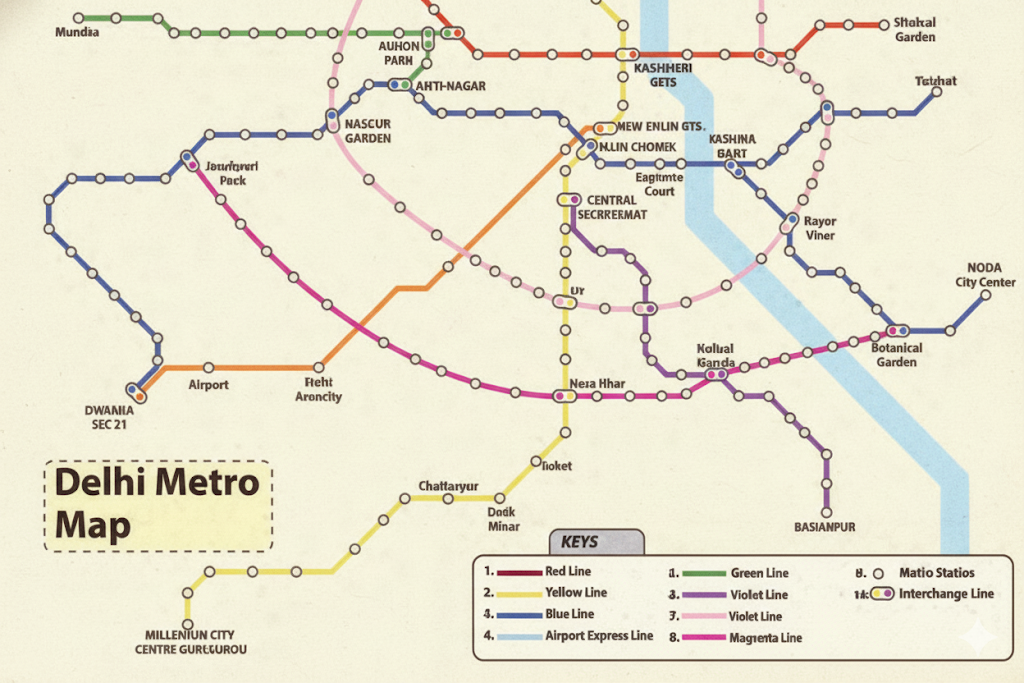
Study the map carefully and answer the questions that follow.
(a) Look at the metro map and trace different routes from the Qutb Minar metro station to the Supreme Court metro station.
Solution:
Route 1:
Start from Qutb Minar and travel on the Yellow Line to Rajiv Chowk. At Rajiv Chowk, change to the Blue Line and continue the journey to reach Supreme Court Metro Station.
Route 2:
Begin at Qutb Minar Metro Station on the Yellow Line and travel to Hauz Khas. Change to the Magenta Line at Hauz Khas and travel to Botanical Garden. From there, switch to the Blue Line to reach Supreme Court Metro Station.
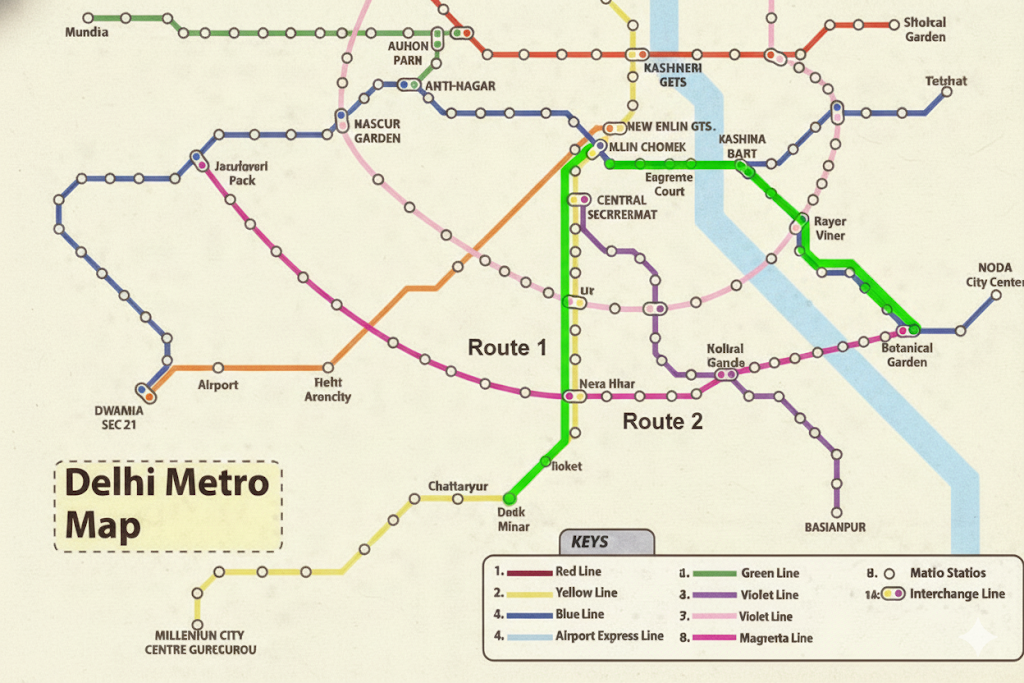
(b) Lali says, “We can take the Yellow Line and change the metro at Hauz Khas to take the Magenta Line.”
If the children follow Lali’s suggestion, at which station(s) do they nedcl to change the metro line again to reach the Supreme Court metro station?
Solution: If the children go by Lali’s suggestion, they will need to change the metro line once more at Botanical Garden, switching to the Blue Line to reach Supreme Court Metro Station.
(c) Which route has the least number of stations between Qutb Minar and Supreme Court?
Solution: There are 12 stations from Qutb Minar to Rajiv Chowk and 3 stations from Rajiv Chowk to Supreme Court.
So, the total number of stations between Qutb Minar and Supreme Court via Rajiv Chowk is 15.
Hence, the route through Rajiv Chowk has the fewest stations.
(d) Which metro route(s), do you think, is/are the best way to reach the zoo from Qutb Minar?
Solution:
Best Route:
Travel on the Yellow Line from Qutb Minar to Rajiv Chowk, then switch to the Blue Line to reach Supreme Court Metro Station (Zoo stop). This is the fastest route.
NCERT Textbook Page 176
Let Us Do
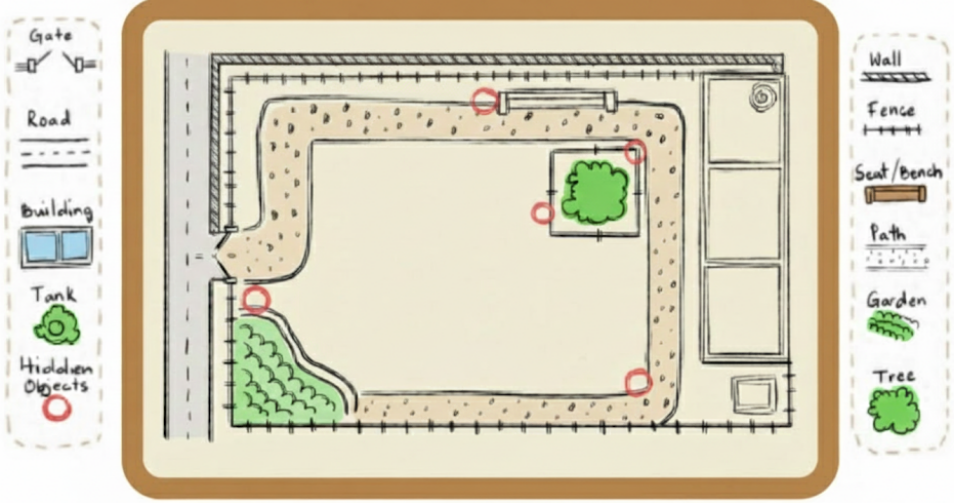
Make a map showing the different places in your school. Make a key for the symbols used in the map. Hide some objects in these places.
Mark the positions where things are hidden with red dots or flags. Now, challenge your friends to find the hidden things by reading the map.
A sample map and its key are given below.
Solution: Students should do it by themselves.
NCERT Textbook Page 177
Anthill in the Zoo
To collect food, the ant can only crawl along the dotted lines on the grid. The arrows show the direction in which the ant can move.
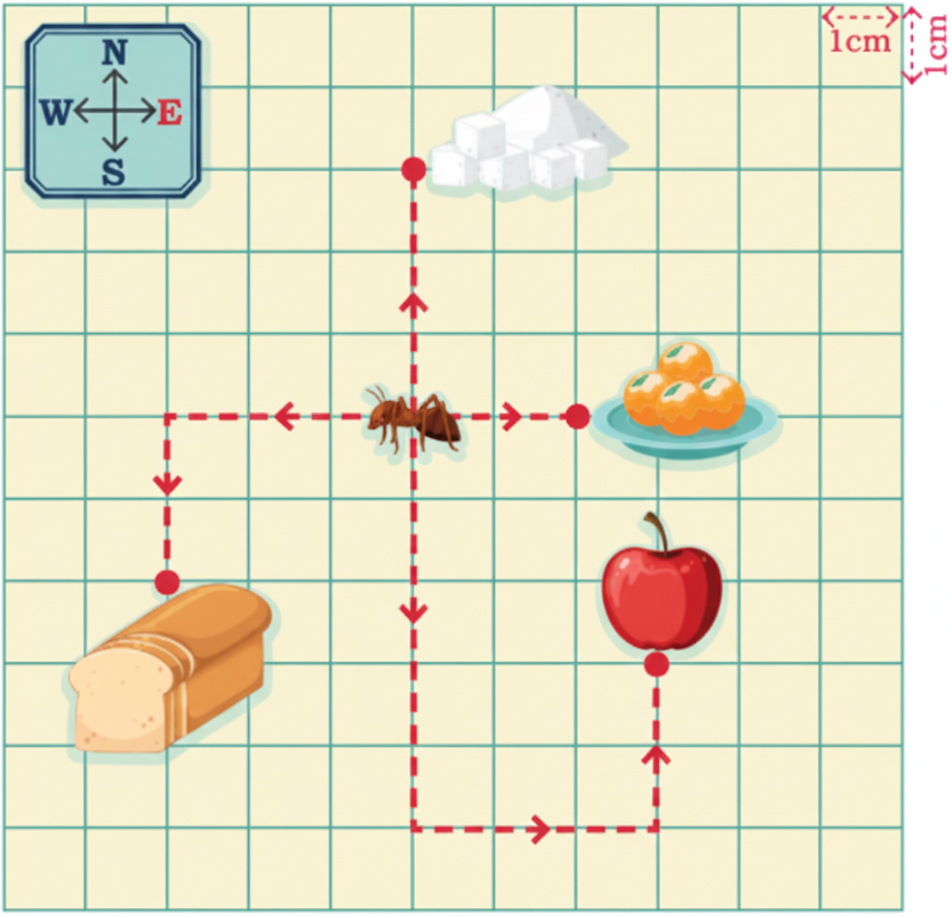
Fill in the blanks below with the distances and the directions in which the ant must move from its starting position.
(a) To get to the laddoos, the ant has to crawl 2 cm towards the east.
(b) To get to the sugar, the ant has to crawl ____cm in the _______direction.
(c) To get to the bread, the ant has to crawl ____cm in the _______ direction; then ____cm in the _______direction.
(d) To get to the apple, the ant needs to crawl ______cm towards _________, and then ____cm towards _________, and finally ___cm towards______.
Solution:
(a) To reach the laddoos, the ant must crawl 2 cm towards the east.
(b) To reach the sugar, the ant needs to move 3 cm northwards.
(c) To reach the bread, the ant has to crawl 3 cm towards the west and then 2 cm towards the south.
(d) To reach the apple, the ant must crawl 5 cm south, then 3 cm east, and finally 2 cm north.
Identify other routes to reach the point where the apple is located. Which one is the shortest?
Solution:
To reach the apple, the ant can crawl 3 cm east and then 3 cm south.
Alternatively, it can move 1 cm east and 1 cm south repeatedly until it reaches the apple.
Both routes cover a total distance of 6 cm, making them the shortest possible paths.
In the same way, there are several other shortest routes the ant can take to reach the apple.
NCERT Textbook Page 178
Locating the Animals in the Zoological Park (Zoo)
Children observe a map of the zoo drawn on a grid. Each vertical line (column) and horizontal line (row) is marked with a number. To reach the Panda, we will start from zero. Move one step horizontally east and reach the first column.
Move up (vertically) one step north and reach the first row.
The panda is where the first row and the first column meet
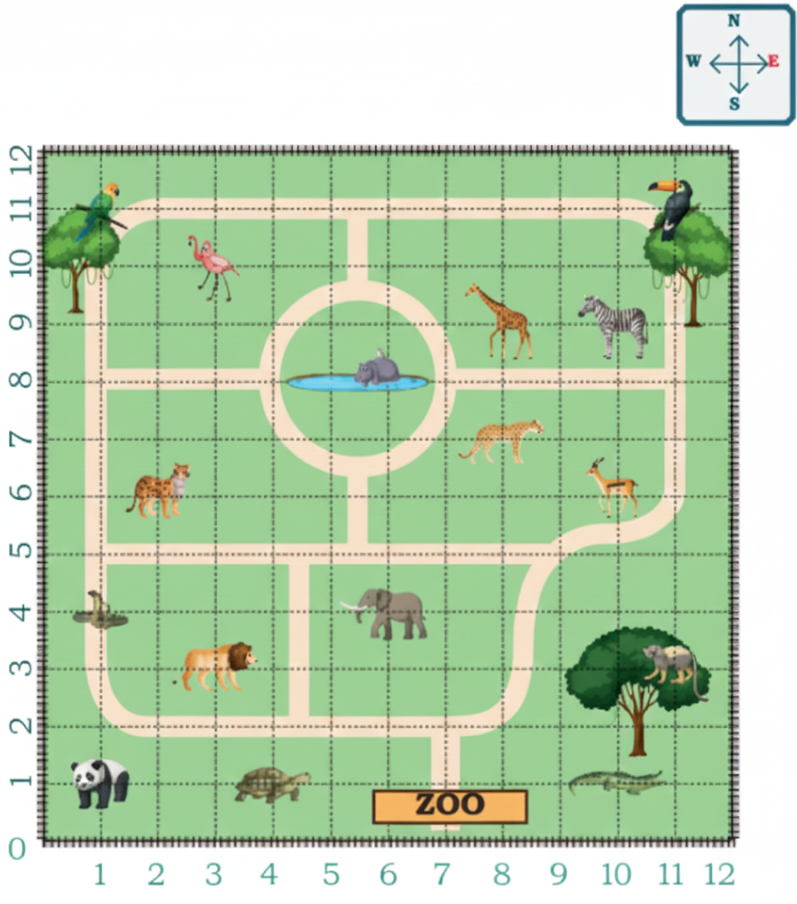
First move horizontally from 0 and then vertically.
We write the meeting point of the first row and the first column as (1, 1).
To reach the tortoise, move ________ steps towards east and reach the _________ column.
Then move _______ step(s) _______ and reach the first _______.
Solution:
To reach the tortoise, move 4 steps towards east and reach the 4th column.
Then move 1 step(s) north and reach the first row.
The location of the tortoise is (4, 1). What is at (1,4)?
Solution: At (1, 4), there is a snake.
Answer the following questions now:
Question 1. Locate the animal at the following positions on the map.
(a) (11,11) ________
(b) (2,6) ________
(c) (6,4) ________
(d) (3,10) ________
(e) (11,3) ________
(f) (10,9) ________
Solution:
(a) (11,’11) Hornbill
(b) (2, 6) Tiger
(c) (6, 4) Elephant
(d) (3, 10) Flamingo
(e) (11, 3) Monkey
(f) (10, 9) Zebra
Question 2. Write the position of the following animals on the map.
(a) Lion _________
(b) Elephant ____
(c) Tortoise ________
(d) Deer _________
(e) Panda _________
(f) Crocodile ______
Solution:
(a) Lion (3, 3)
(b) Elephant (6, 4)
(c) Tortoise (4, 1)
(d) Deer (10, 6)
(e) Panda (1, 1)
(f) Crocodile (10, 1)
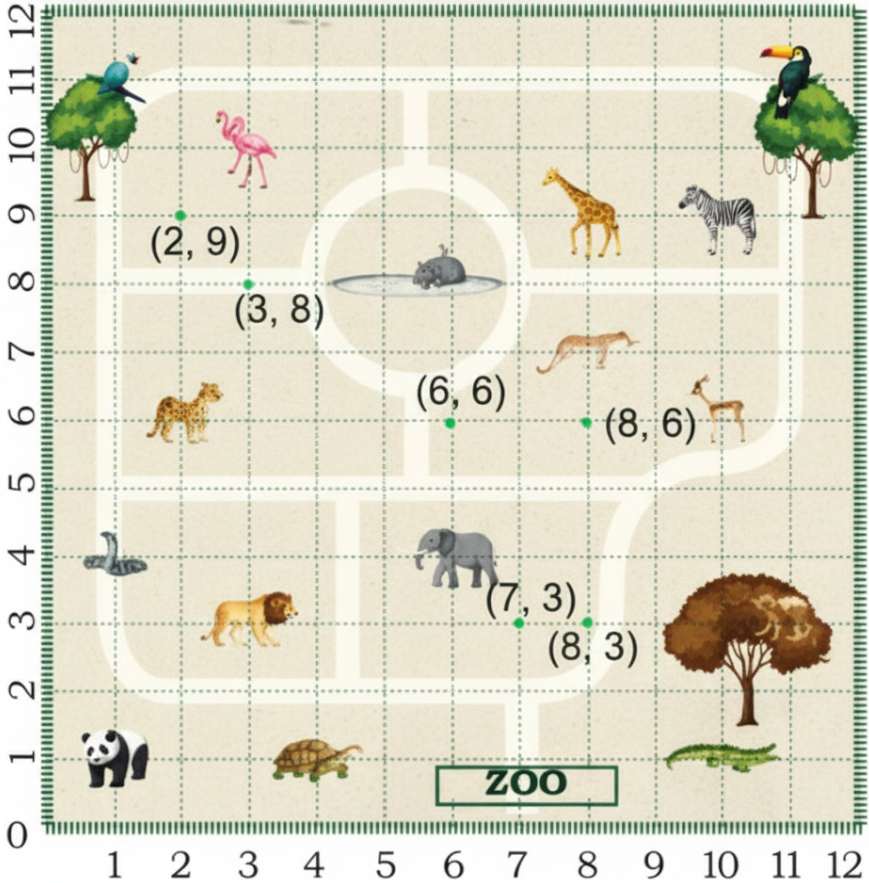
Question 3. Place dots of different colours on the following positions.
(a) (8, 3) (Red)
(b) (2, 9) (Green)
(c) (7, 3) (Blue)
(d) (3, 8) (Orange)
(e) (8, 6) (Black)
(f) (6, 6) (Pink)
Solution:
Master Class 5 Maths Maps and Locations Concepts with NCERT Solutions (2026-27)
The NCERT Solutions for Class 5 Maths Mela Chapter 14 Maps and Locations help you understand important concepts about directions, maps, and coordinates. Clear and stepwise solutions make your preparation for 2026-27 exams easy and enjoyable.
Focus on map reading skills, understanding locations, and using directions like north, south, east, and west. These chapters build strong fundamentals for future studies. Use visuals and practice questions to strengthen your grasp of key concepts quickly.
Practice regularly with exercise-based maps and locations questions. Revising these questions will boost your speed and confidence for school exams. Keep revising the NCERT concepts to improve your marks and develop excellent spatial sense.
FAQs on NCERT Solutions For Class 5 Maths Chapter 14 Maps And Locations - 2026-27
1. What is the best way to solve NCERT Class 5 Maths Chapter 14 “Maps and Locations”?
The best way to solve NCERT Class 5 Maths Chapter 14: Maps and Locations is to follow stepwise solutions and understand map concepts clearly.
- Start with reading all definitions and terms related to maps.
- Practice each question using step-by-step methods as provided in the NCERT solutions.
- Draw neat diagrams and label maps where required.
- Use revision notes and attempt all back and intext exercises.
- Download the solutions PDF for regular practice and offline study.
2. What are the important questions in Class 5 Maths Chapter 14?
Important questions in Class 5 Maths Chapter 14 Maps and Locations often include:
- Labelling maps or diagrams provided in the textbook.
- Defining key terms such as map, scale, direction, symbol.
- Solved questions from back exercises and intext activities.
- Application-based queries (like tracing a route on a map).
- Drawing or interpreting simple maps and identifying locations.
3. How to label maps in maths class 5?
To label maps in Class 5 Maths effectively, always:
- Use clear and neat handwriting.
- Place labels close to the correct location on the map.
- Utilize arrows if necessary for clarity.
- Follow map conventions (like North at the top).
- Include all required symbols and legends as instructed in the question.
4. How to get full marks in Chapter 14 Maths?
To score full marks in Class 5 Maths Chapter 14:
- Write stepwise solutions for every answer.
- Include correct diagrams/maps with proper labelling.
- Use the exact terms and definitions from the NCERT textbook.
- Practice with CBSE marking schemes and sample questions.
- Revise using the provided quick notes and follow expert answer structures.
5. Are diagrams or definitions mandatory in answers?
Yes, diagrams and definitions are usually mandatory in answers for Class 5 Maths Chapter 14 when asked.
- Always draw diagrams/maps when instructed for full marks.
- Write crisp and exam-ready definitions for all key terms.
- Refer to NCERT solutions for standard answer formatting.
6. Where can I download the chapter’s solutions PDF?
You can download the NCERT Solutions PDF for Class 5 Maths Chapter 14 Maps and Locations for free from trusted educational platforms like Vedantu.
- Look for the dedicated download button at the top of the solutions page.
- Ensure the PDF is updated for the latest CBSE syllabus 2026–27.
7. Do examiners award partial marks for correct steps even if the final answer is wrong?
Yes, according to the CBSE marking scheme, examiners give partial marks for correct steps even if the final answer has mistakes.
- Always show all calculation and reasoning steps.
- Mistakes in the last step may reduce only partial marks, not all.
8. How do I structure long answers for better marks in Maths Chapter 14?
To structure long answers for maximum marks:
- Start with a clear introduction or definition if applicable.
- Break the answer into logical steps or paragraphs.
- Include all relevant diagrams with labels.
- Use headings or bullets if needed for clarity.
- Conclude with the final answer and box it when possible.
9. What are the most important topics from Class 5 Maths Maps and Locations chapter?
The most important topics from Class 5 Maths Chapter 14 Maps and Locations include:
- Understanding and reading maps.
- Directions (North, South, East, West).
- Symbols and legend in maps.
- Drawing simple maps and routes.
- Scales and distances on a map.
10. Are NCERT Solutions enough for Class 5 Maths exams?
NCERT Solutions for Class 5 Maths Chapter 14 are sufficient for exam preparation if you:
- Practice all exercise-wise, step-by-step answers provided.
- Revise definitions, diagrams, and example problems.
- Supplement with important questions and previous year papers for best results.
