



How to write full marks answers for Class 5 Maths Racing Seconds?
NCERT Textbook Pages 155-156
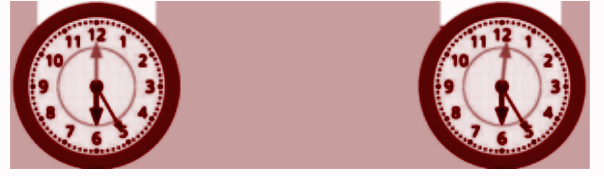
Raghav practices yoga in the morning.

Let us find out
Question 1.
At what time did Raghav start practising Yoga?
Solution:
Raghav began practicing yoga at 5:35 a.m.
Question 2.
At what time did he finish?
Solution:
Raghav completed his practice at 5:55 a.m.
Question 3.
How much time did he spend practising Yoga?
Solution:
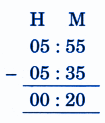
He began at 5:35 a.m. and finished at 5:55 a.m.
Since 55 − 35 = 20, he spent 20 minutes practicing yoga.
Question 4.
Find the time elapsed between the given time periods. Share your strategies.
(a) 01:15 p.m. to 01:42 p.m.?
Solution:
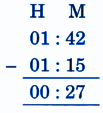
The time interval from 1:15 p.m. to 1:42 p.m. is 27 minutes.
(b) 03:18 p.m. to 08:18 p.m.?
Solution:
The time interval from 1:15 p.m. to 1:42 p.m. is 27 minutes.
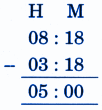
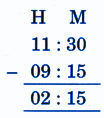
(c) 09:15 a.m. to 11:30 a.m.?
Solution:
The time interval from 9:15 a.m. to 11:30 a.m. is 2 hours and 15 minutes.
Question 5.
The table below shows the time taken by 3 children to paint a picture.
(a) Who took the longest time?
(b) Who took the least time?
Solution:
(a) Since 2 hours 10 minutes is greater than 1 hour 35 minutes, which in turn is greater than 1 hour 20 minutes, Rani took the longest time.
(b) Raghav took the shortest time.
Question 6.
Fill in the blanks by writing the time in the appropriate format.
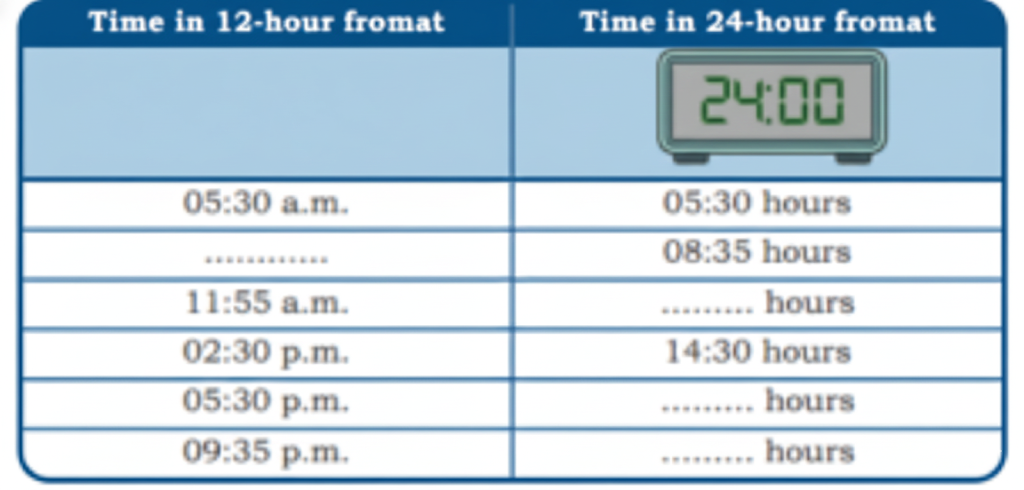
Solution:
Question 7.
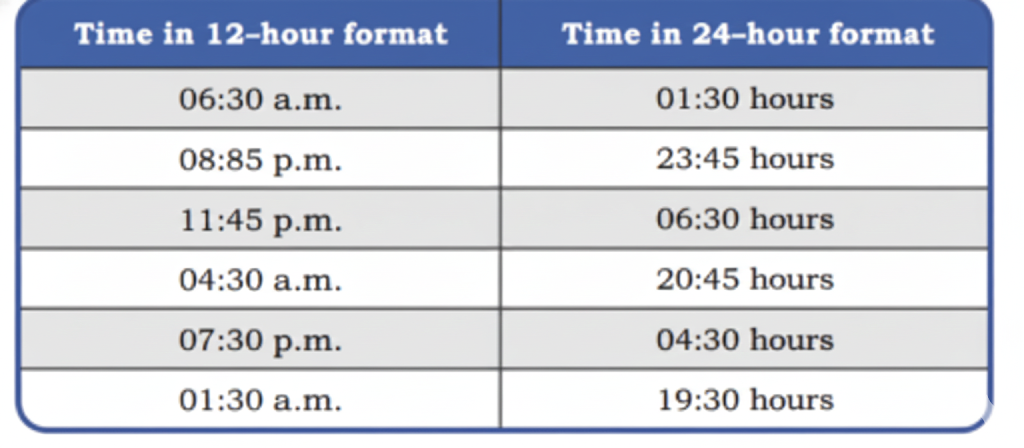
Solution:
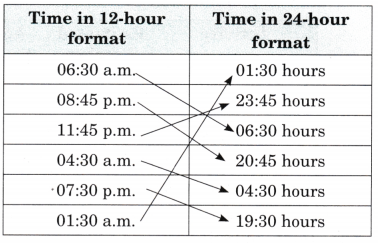
NCERT Textbook Pages 156-157
School Race
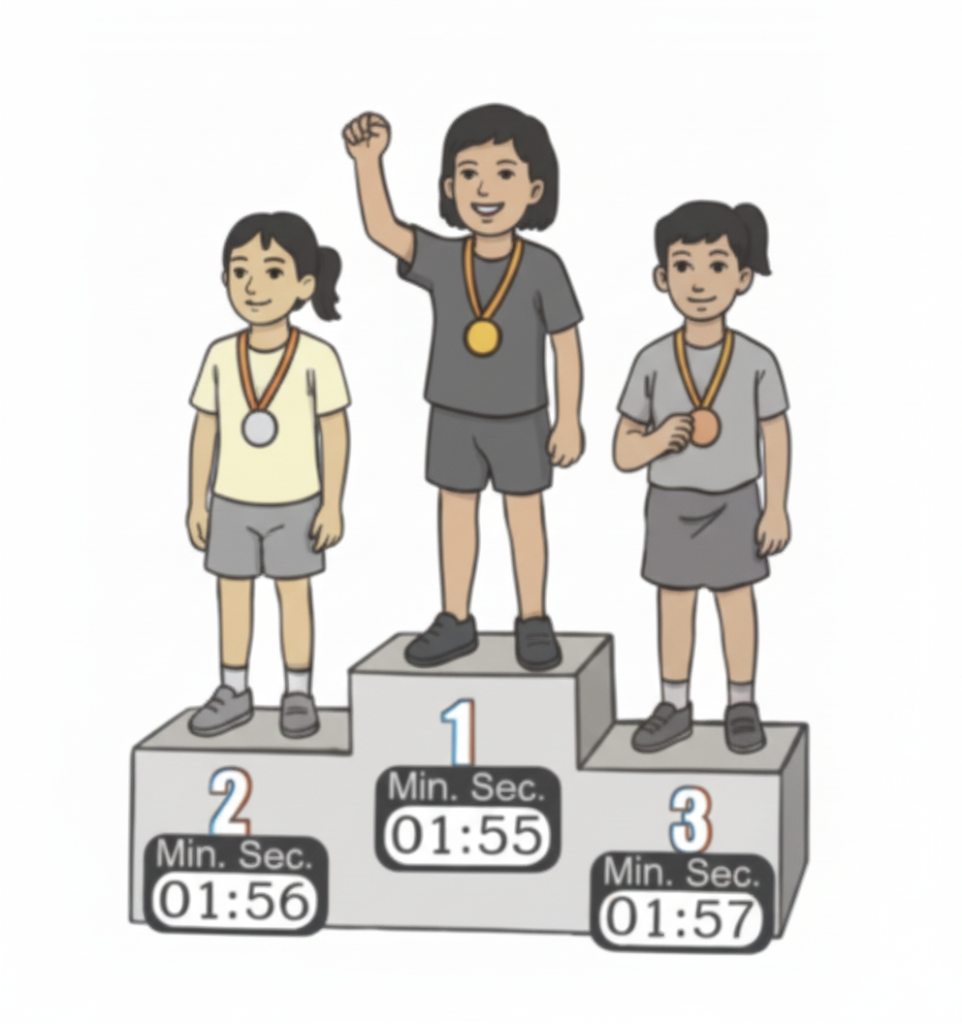
Akira, Sunita, and Mary are participating in a 200 m-walking race.
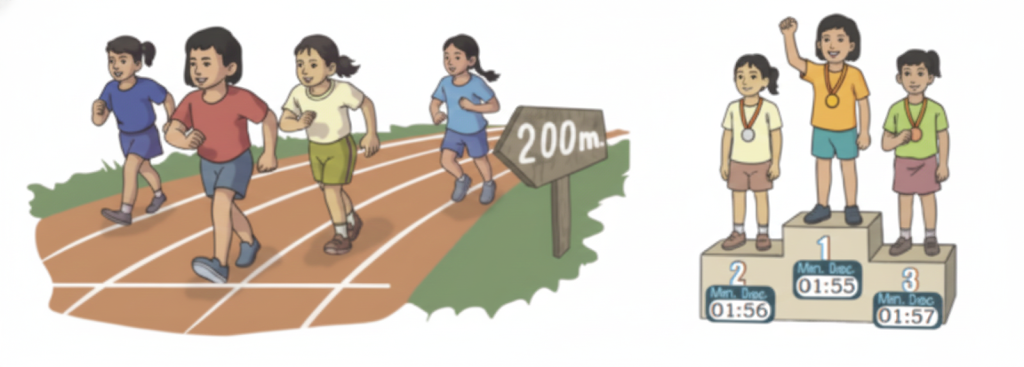
Do you notice the use of a new unit ‘seconds’ in the picture?
1 min = 60 seconds
In situations like a race, ‘seconds’ help us observe small differences in time taken by participants. Each participant took 1 minute but how much more?
Identify the child who won the race. How much time did the child take?
Solution:
The child who won the race is shown inside the circle.
She completed the race in 1 minute 55 seconds.
NCERT Textbook Page 157 – 158
Let us Do
Estimate whether you would take seconds or minutes to complete the following activities. Tick the appropriate cell.
Solution:
List events other than the ones listed above that you can do or that can happen in less than a minute or in a few seconds.
……………………………………………………………………………
……………………………………………………………………………
……………………………………………………………………………
……………………………………………………………………………
……………………………………………………………………………
……………………………………………………………………………
……………………………………………………………………………
……………………………………………………………………………
……………………………………………………………………………
……………………………………………………………………………
……………………………………………………………………………
……………………………………………………………………………
Solution:
Students should do it by themselves.
Estimate and verify how many of these you can do in a minute.
Solution:
Students should do it by themselves.
NCERT Textbook Page 158
Let Us Find
Question 1.
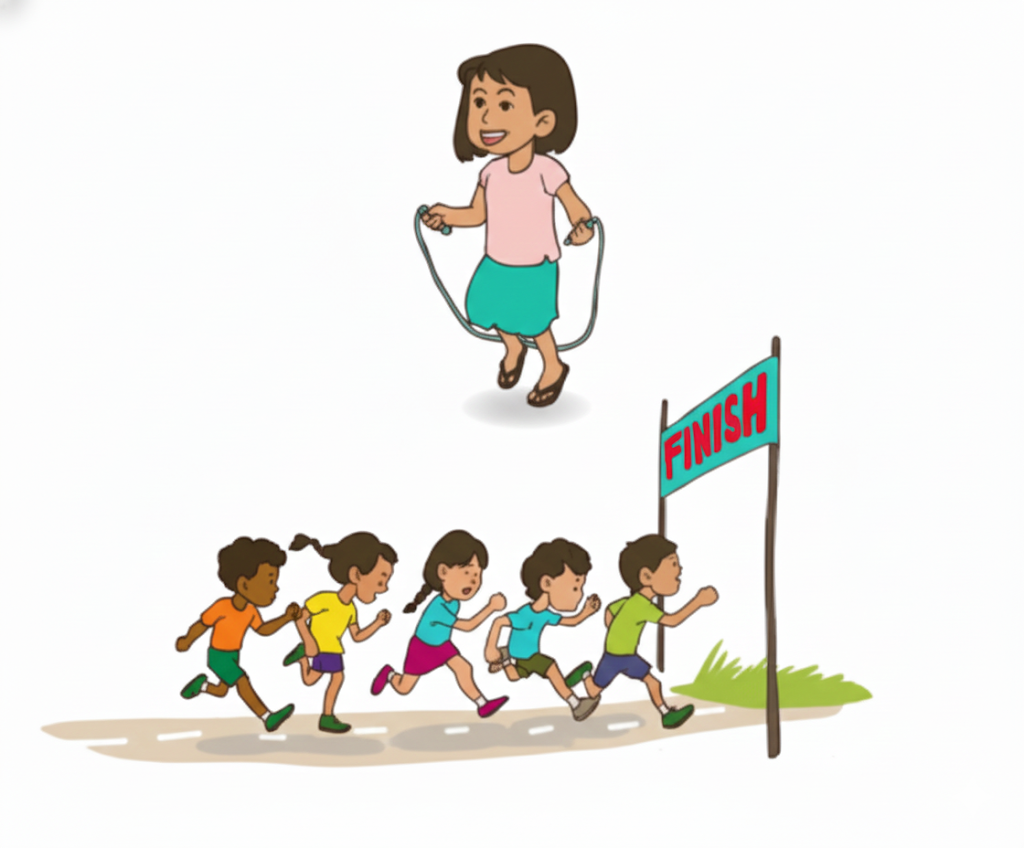
Find out the number of times you can skip the rope in 10 seconds.
Solution:
Students should do it by themselves..
Question 2.
How long does it take you to write the word FRIEND?
Solution:
Students should do it by themselves.
Question 3.
How long does it take you to run 100m?
Solution:
Students should do it by themselves.
NCERT Textbook Pages 159 -160
Let Us Do
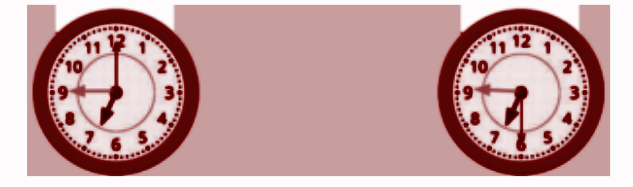
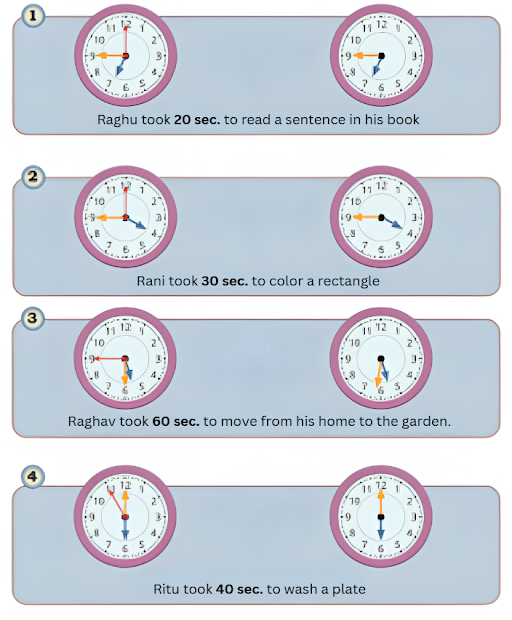
Observe the clocks and fill in the blanks.
Question 1.
Rani took __________ sec. to get out of her bed.
Solution:
Rani took 30 seconds to get out of bed.
Question 2.
Raghav took ________ sec. to move from his room to the kitchen.

Solution:
Raghav took 35 seconds to move from his room to the kitchen.
Question 3.
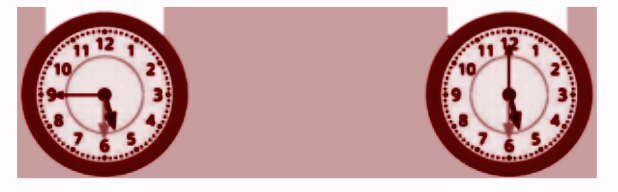
Ritu took ________ sec. to pick up a piece of paper from the floor.
Solution:
Ritu took 15 seconds to pick up a piece of paper from the floor.
Question 4.
Raghu took ________ sec. to wash his spoon and plate.
Solution:
Raghu took 60 seconds to wash his spoon and plate.
Draw the missing seconds hand on the clocks on the right side.
Solution:
Students should do it by themselves.
NCERT Textbook Pages 161 -163
Let Us Do
Question 1.
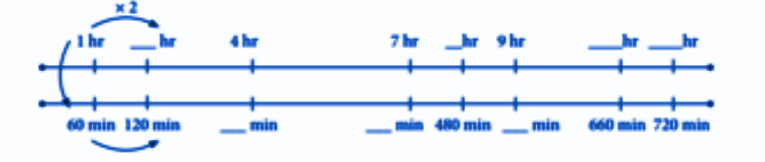
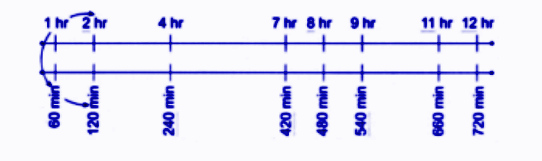
Use the double number line below to complete the conversions.
Solution:
(a) 1 hr = 60 min
2 hr = 2 × 60 = 120 min
4 hr = 4 × 60 = 240 min
7 hr = 7 × 60 = 420 min
480 min = 8 hr
As, 8 hr = 8 × 60 = 480 min
9 hr = 9 × 60 = 540 min
660 min = 11 hr
As, 11 hr = 11 × 60 = 660 min
720 min = 12 hr
As, 12 hr = 12 × 60 = 720 m
(b) Do as instructed. You can use the above double number line for the following conversions.
Solution:
(i) 1 hr 10 min = 60 min + 10 min = 70 min
So, 1 hour 10 minutes = 70 minutes.
(ii) 2 hr 45 min = 120 min + 45 min = 165 min
So, 2 hours 45 minutes = 165 minutes,
(iii) 3 hr 15 min = 3 times 60 + 15 min – 180 min + 15 min = 195 min
So, 3 hours 15 minutes = 195 minutes.
(iv) 4 hr 20 min = 4 times 60 + 20 min
= 240 min + 20 min = 260 min
So, 4 hours 20 minutes = 260 minutes.
(v) 75 min = 60 min + 15 min = 1 hr 15 min
So, 75 minutes = 1 hour 15 minutes.
(vi) 150 min = 120 min + 30 min = 2 hr 30 min
So, 150 minutes = 2 hours 30 minutes.
(vii) 220 min = 120 min + 60 min + 40 min = 2 hr + 1 hr + 40 min = 3 hr 40 min
So, 220 minutes = 3 hours 40 minutes.
(viii) 390 min = 240 min + 120 min + 30 Mn = 4 hr + 2 hr + 30 min = 6 hr + 30 min
So, 390 minutes = 6 hours 30 minutes
(c) Fill in the blanks in the double number line to complete the conversions.
Solution:
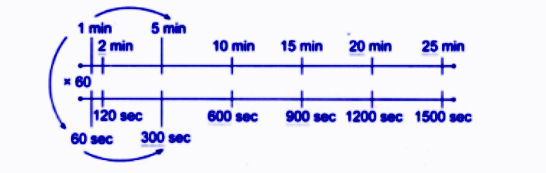
120 seconds equals 2 minutes, since
2 minutes = 2 × 60 = 120 seconds.
When we multiply a minute marking by 5, we obtain the next marking on the minutes number line.
To find the matching value on the seconds number line, the number of minutes must be multiplied by 60.
(i) 320 sec = 300 sec + 20 sec = 5 min + 20 sec
So, 320 sec = 5 min 20 sec
(ii) 225 sec = 120 sec + 60 sec + 45 sec
= 2 min + 1 min + 45 sec
So, 225 sec = 3 min 45 sec
(iii) 700 sec = 600 sec + 60 sec + 40 sec
= 10 min + 1 min + 40 sec
So, 700 sec = 11 min 40 sec
(iv) 1000 sec = 900 sec + 60 sec + 40 sec
= 15 min + 1 min + 40 sec
So, 1000 sec = 16 min 40 sec
(v) 10 min 13 sec = 600 sec + 13 sec
= 613 sec
So, 10 sec 13 sec = 613 sec
(vi) 4 min 8 sec = 2 min + 2 min + 8 sec
= 120 sec + 120 sec + 8 sec = 248 sec
So, 4 min 8 sec = 248 sec
(vii) 15 min 40 sec = 900 sec + 40 sec
= 940 sec
So, 15 min 40 sec = 940 sec
Question 2.
Raghav studies Mathematics, English, Hindi, and the World Around Us subjects. He took 50 minutes to study each of the subjects. Find the total time taken in hours and minutes. Share your strategies with your class.
Solution:
Raghav studies 4 subjects, spending 50 minutes on each one.
So, the total time he spends studying is:
50 × 4 = 200 minutes.
Now, convert 200 minutes into hours and minutes:
200 minutes = 180 minutes + 20 minutes
= 3 × 60 minutes + 20 minutes
= 3 hours 20 minutes.
Therefore, the total time taken is 3 hours and 20 minute
Question 4.
Jyoti went to play at 06:15 PM. She came back after I hour 45 minutes. At what time did she reach home?
Solution:
One hour after 6:15 p.m. is 7:15 p.m., and adding another 45 minutes brings the time to 8:00 p.m.
So, 1 hour and 45 minutes after 6:15 p.m. is 8:00 p.m.
Therefore, Jyoti reached home at 8:00 p.m.
Question 5.
Ragini took 1 hour 10 minutes to do her homework. She finished it at 09:40 PM. What time did she start?
Solution:
One hour before 9:40 p.m. is 8:40 p.m., and 10 minutes before 8:40 p.m. is 8:30 p.m.
So, 1 hour and 10 minutes before 9:40 p.m. is 8:30 p.m.
Therefore, Ragini began her homework at 8:30 p.m.
Question 6.
A group of children left for a picnic at 08:30 AM. They returned after 4 hours and 10 minutes. At what time did they return?
Solution:
Four hours after 8:30 a.m. is 12:30 p.m., and adding another 10 minutes gives 12:40 p.m.
So, 4 hours and 10 minutes after 8:30 a.m. is 12:40 p.m.
Therefore, the children returned at 12:40 p.m..
Question 7.
Raji started her homework at 06:00 PM. She finished her homework in 1 hour 30 minutes. At what time did she finish?
Solution:
1 hour and 30 minutes after 6:00 p.m. is 7:30 p.m.
So, Raji completed her homework at 7:30 p.m.
Question 8.
Alya goes out to play at 05:30 PM and comes back after 1 hour 10 minutes. At what time does she come back?
Solution:
One hour after 5:30 p.m. is 6:30 p.m., and adding another 10 minutes gives 6:40 p.m.
So, Alya returned at 6:40 p.m.
Question 9.
If the lunch break of a school starts at 12:30 PM and ends in 35 minutes, what time will lunch end?
Solution:
35 minutes after 12:30 p.m. is 1:05 p.m., since 65 minutes equals 1 hour and 5 minutes.
Therefore, the lunch will finish at 1:05 p.m..
Question 10.
It is 08:35 PM right now. What time will it be after 8 hours and 25 minutes?
Solution:
Four hours after 8:35 p.m. is 12:35 a.m., and another 4 hours after that is 4:35 a.m..
Adding 25 minutes to 4:35 a.m. gives 5:00 a.m. Thus, 8 hours and 25 minutes after 8:35 p.m. is 5:00 a.m..
Mastering Time Calculations in NCERT Class 5 Maths
The Racing Seconds chapter in NCERT Class 5 Maths enhances your understanding of seconds and minutes through real-life activities and time calculations. Developing these skills is essential for accuracy and speed in exam problem-solving.
With Vedantu's NCERT Solutions Class 5 Maths Mela Chapter 12, students can systematically practice elapsed time, conversions, and reading clocks in both 12-hour and 24-hour formats. Regular practice builds strong mental math and time management abilities for day-to-day and exam use.
Focus on practicing exercise-based questions and daily time estimation to enhance your confidence. Reviewing these solutions will help you master time word problems and boost your score in the NCERT Class 5 Maths final exams.
FAQs on NCERT Solutions For Class 5 Maths Chapter 12 Racing Seconds - 2026-27
1. What is covered in NCERT Solutions Class 5 Maths Mela Chapter 12 Racing Seconds?
NCERT Solutions Class 5 Maths Mela Chapter 12 Racing Seconds provides comprehensive, step-by-step answers for all textbook exercises and intext questions.
- Covers every question type: objective, short, and long-form
- Includes key definitions, formulae, and important diagrams if applicable
- Follows latest CBSE 2026–27 syllabus and marking scheme
- Provides revision tips and exam-oriented model answers
- PDF download available for offline revision
2. How should I write stepwise NCERT answers for full marks in Class 5 Maths Chapter 12?
To score full marks in Maths Class 5 Chapter 12, present answers clearly and stepwise:
- Start with the formula, definition, or observation (if required)
- Show each calculation step neatly
- Box the final answer
- Include diagrams where needed
- Use correct units and keywords from NCERT Class 5 Maths Chapter 12 Racing Seconds
3. Where can I download the NCERT Solutions PDF for Class 5 Maths Mela Chapter 12 Racing Seconds?
You can easily download the free PDF of NCERT Solutions for Class 5 Maths Chapter 12 Racing Seconds from educational websites offering CBSE resources.
- Look for the download button on the chapter solution page
- PDFs are exam-ready and printable
- Useful for offline study and quick revision
4. Are diagrams or definitions mandatory in Class 5 Maths Chapter 12 answers?
Diagrams and definitions are often required in Class 5 Maths Chapter 12 Racing Seconds for full marks:
- Include neat diagrams where questions ask for them (e.g., time measurement tools)
- Write key definitions in your own words for answer clarity
- Label all parts of diagrams clearly
5. What are the important topics and concepts in NCERT Class 5 Maths Mela Chapter 12 Racing Seconds?
The most important topics from NCERT Class 5 Maths Chapter 12 Racing Seconds include:
- Understanding and measuring time in seconds, minutes, and hours
- Comparing time durations
- Status-based questions (who finishes first, etc.)
- Real-life application through simple problems
- Reading and interpreting clocks and stopwatches
6. Are NCERT Solutions enough for Class 5 Maths exams?
NCERT Solutions for Class 5 Maths Chapter 12 provide complete coverage for school exams as they follow the prescribed syllabus and pattern:
- All NCERT exercise and intext questions are fully solved
- They build a strong foundation for every Maths concept
- For higher scores, also practice sample papers and important questions
7. How to present long answers to match CBSE marking?
To match the CBSE marking scheme for long answers in Class 5 Maths Chapter 12:
- Break your answer into logical steps
- Mention each calculation and reasoning
- Add diagrams or tables if relevant
- Use key terms like 'seconds', 'minutes', 'difference', etc.
- Summarise your answer at the end, boxing the final value
8. How to revise Class 5 Maths Chapter 12 Racing Seconds quickly before exams?
For quick revision of Class 5 Maths Chapter 12 Racing Seconds:
- Go through summary notes and key formulas
- Practice solved examples and stepwise solutions
- Attempt important and exemplar questions
- Revisit diagrams and definitions
- Use 1-day and 3-day planners for fast coverage
9. Do examiners award partial marks for correct steps even if the final answer is wrong?
Yes, examiners often give partial marks if correct steps are shown, even if the final answer is incorrect:
- Write all steps clearly as per CBSE guidelines
- Box the final (even if incorrect) answer separately
- Partial marks are crucial for maximizing your score
10. Where to find chapterwise solutions PDF for offline study?
Chapterwise NCERT solutions PDFs for Class 5 Maths including Chapter 12 are available on various educational platforms:
- Look for subject-wise and chapter-wise download sections
- PDFs are formatted for easy revision and print use
- Ensure you select the latest CBSE academic year (2026–27)
