



Step-by-step Answers & Marking Tips for Animal Jumps (Class 5 Maths)
NCERT Textbook Page 165
Do you see why 12 is a multiple of 1, 2, 3, 4, 6, and 12?
Solution:
2 × 6 = 12, 3 × 4 = 12, 12 × 1 = 12, 1 × 12 = 12
Let Us Do
Question 1.
Make different arrays for the following numbers. Identify the factors in each case.
(a) 10
Solution:

Factors = 1, 2, 5, and 10.
(b) 14
Solution:

Factors = 1, 2, 7, and 14.
(c) 13
Solution:

Factors of 13 are 1 and 13 only. So, 13 is a prime number.
(d) 20
Solution:

Factors = 1, 2, 4, 5, 10, and 20.
(e) 25
Solution:

Factors of 25 are 1, 5, and 25.
(f) 32
Solution:

Factors = 1, 2, 4, 8, 16, and 32.
(g) 37
Solution:

Factors of 37 are 1 and 37 only. So, 37 is a prime number.
(h) 46
Solution:

Factors of 46 are 1 , 2, 23 and 46.
(i) 54
Solution:

Factors of 54 are 1, 2, 3, 6, 9, 18, 27 and 54.
NCERT Textbook Pages 166-170
Let Us Do
Question 1.
Find 5 common multiples of the following pairs of numbers.
(a) 2 and 3
Solution:
2 and 3
Multiples of 2:
2, 4, 6, 8, 10, 14, 16, 18, 20, 22, 24, 26, 28, 30, …
Multiples of 3:
3, 6, 9, 12, 15, 18, 21, 24, 27, 30, 33, …
First 5 common multiples of 2 and 3 are: 6, 12, 18, 24, and 30.
(b) 5 and 8
Solution:
5 and 8
Multiples of 5:
5, 10, 15, 20, 25, 30, 35, 40, 45, 50, 55, 60, 65, 70, 75, 80, 85, 90, 95, 100, 105, 110, 115, 120, 125, 130, 135, 140, 145, 150, 155, 160, 165, 170, 175, 180, 185, 190, 195, 200, …
Multiples of 8:
8, 16, 24, 32, 40, 48, 56, 64, 72, 80, 88, 96, 104, 112, 120, 128, 136, 144, 152, 160, 168, 176, 184, 192, 200, …
First 5 common multiples of 5 and 8 are: 40, 80, 120, 160, and 200.
(c) 2 and 4
Solution:
Multiples of 2:
2, 4, 6, 8, 10, 12, 14, 16, 18, 20, …
Multiples of 4:
4, 8, 12, 16, 20, 24, 28, 32, …
First 5 common multiples of 2 and 4 are:
4, 8, 12, 16, and 20.
(d) 3 and 9
Solution:
Multiples of 3:
3, 6, 9, 12, 15, 18, 21, 24, 27, 30, 33, 36, 39, 42, 45, …….
Multiples of 9:
9, 18, 27, 36, 45, 54 …
First 5 common multiples of 3 and 9 are:
9, 18, 27, 36, and 45.
(e) 5 and 10
Solution:
Multiples of 5:
5, 10, 15, 20, 25, 30, 35, 40, 45, 50, …
Multiples of 10:
10, 20, 30, 40, 50, 60, 70, 80, 90, 100, …
First 5 common multiples of 5 and 10 are:
10, 20, 30, 40, and 50.
(f) 9 and 12
Solution:
Multiples of 9:
9, 18, 27, 36, 45, 54, 63, 72, 81, 90, 99, 108, 117, 126, 135, 144, 153, 162, 171, 180, 189, …
Multiples of 12:
12, 24, 36, 48, 60, 72, 84, 96, 108, 120, 132, 144, 156, 168, 180, 192, …
First 5 common multiples of 9 and 12 are: 36, 72, 108, 144, and 180.
(g) 8 and 12
Solution:
Multiples of 8:
8, 16, 24, 32, 40, 48, 56, 64, 72, 80, 88, 96, 104, 112, 120, 128, …
Multiples of 12:
12, 24, 36, 48, 60, 72, 84, 96, 108, 120, ………..
First 5 common multiples of 8 and 12 are:
24, 48, 72, 96, and 120.
(h) 6 and 8
Solution:
Multiples of 6:
6, 12, 18, 24, 30, 36, 42, 48, 54, 60, 66, 72, 78, 84, 90, 96, 102, 108, 114, 120, 126, …
Multiples of 8:
8,16, 24, 32, 40, 48, 56, 64, 72, 80, 88, 96, 104, 112, 120, 128, …
First 5 common multiples of 6 and 8 are: 24, 48, 72, 96 and 120.
(i) 6 and 9
Solution:
Multiples of 6:
6, 12, 18, 24, 30, 42, 48, 54, 60, 66, 72, 78, 84, 90, 96, …
Multiples of 9:
9, 18, 27, 36, 45, 54, 63, 72, 81, 90, 99, …
First 5 common multiples of 6 and 9 are: 18, 36, 54, 72 and 90.
What do you notice about the common multiples of different pairs of numbers? Discuss in class.
Solution:
Students should do it by themselves.
Question 2.
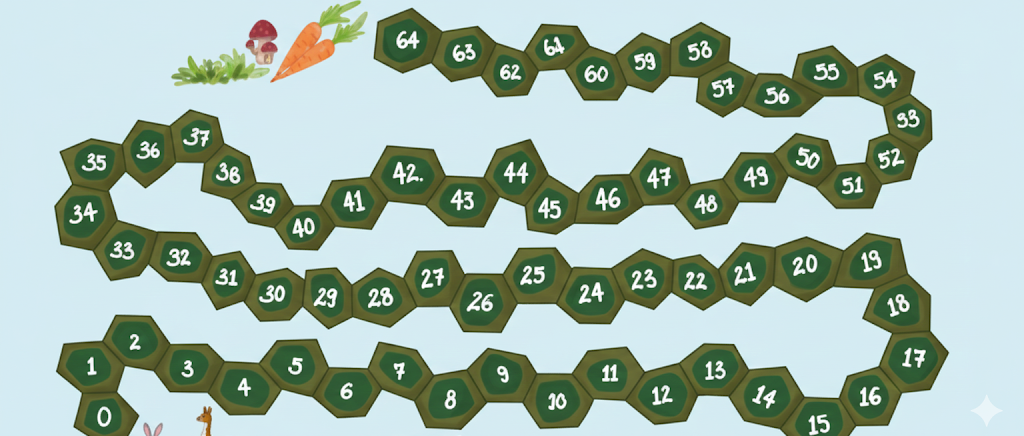
Food is available at the end of a cobbled road. Robby, the rabbit, takes a jump of 4 each time. Deeku, the deer, takes a jump of 6 each time. They both start at 0. Will both Robby and Deeku reach the food? Who will reach first? How do you know? Explain your answer.
Solution:
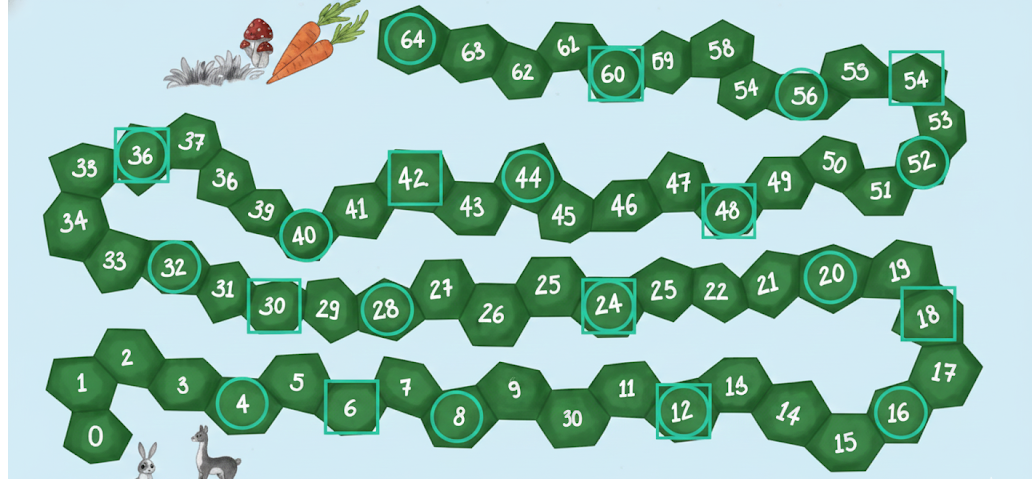
Robby the rabbit jumps 4 steps at a time, so he lands on multiples of 4 such as 0, 4, 8, 12, …, 64. Since 64 = 4 × 16, Robby will land exactly on 64.
Deeku the deer jumps 6 steps at a time, so he lands on multiples of 6 like 0, 6, 12, 18, …, 60. As 64 is not a multiple of 6 (it lies between 60 and 66), Deeku will not land on 64.
Therefore, Robby will reach the food, as only he can land exactly on step 64.
Question 3.
Mowgli’s friends live along the trail on the marked places below. Which of his friends will he be able to visit, if he jumps by 2 steps starting from 0?
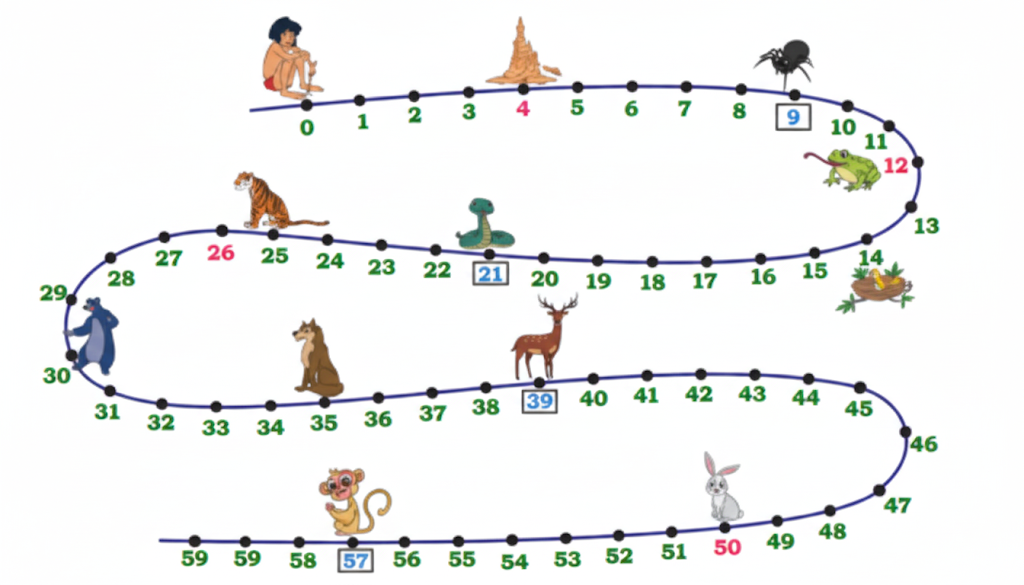
Which of his friends will he be able to meet if he jumps by 3 steps?
Solution:
If Mowgli jumps 3 steps at a time, he meets the spider at 9, the frog at 12, the snake at 21, the bear at 30, the deer at 39, and the monkey at 57.
Which numbers will he touch if he jumps by 5 steps?
Solution:
5, 10, 15, 20, 25, 30, 35, 40, 45, 50, 55.
5 is a common factor of the numbers .
Which numbers will he touch if he jumps by 10 steps?
Solution:
10, 20, 30, 40,50.
10 is a common factor of the numbers .
10 is a common factor of the numbers: 10, 20, 30, 40, 50, 60, …
Question 4.
Let us find some common factors of the numbers 24 and 36. Note that all jumps in the following questions start from 0.
(a) Can we jump by 2 steps at a time to reach both 24 and 36? Yes/No. 2 is/is not a common factor of 24 and 36. ,
(b) Can we jump by 3 steps at a time to reach both 24 and 36? Yes/No. 3 is/is not a common factor of 24 and 36.
(c) Can we jump by 4 steps at a time to reach both 24 and 36? Yes/No. 4 is/is not a common factor of 24 and 36.
(d) What other jumps can we take to reach both 24 and 36?
(e) How many common factors can you find for 24 and 36? List them.
(f) What about jumping by 1 step each time to reach both 24 and 36?
Solution:
(a) Yes, 2 divides both 24 and 36, so it is a common factor.
(b) Yes, 3 divides both 24 and 36, making it a common factor.
(c) Yes, 4 is also a factor of both numbers, so it is common to 24 and 36.
(d) Apart from 2, 3, and 4, the other jumps that reach both 24 and 36 are 6 and 12, as both numbers are divisible by them.
(e) The common factors of 24 and 36 are 1, 2, 3, 4, 6, and 12.
(f) 1 is a factor of every whole number, so it is common to all numbers.
Question 5.
What are the common factors of 12 and 13?
Solution:
Common factors of 12 and 13 are only 1.
Question 6.
Find which of the following numbers can be reached by jumps of 4 steps?

4 is the common factor of the numbers _____________________________.
Solution:

The number 4 divides 16, 36, and 48, so it is a common factor of all three numbers.
Question 7.
Find the common factors of the following pairs of numbers.
(a) 12 and 16
Solution:
Factors of 12: (1), (2), 3, (4), 6, and 12.
Factors of 16: (1), (2), (4), 8, and 16.
Common factors of 12 and 16 are: 1, 2 and 4.
(b) 8 and 12
Solution:
Factors of 8: (1), (2), (4), and 8.
Factors of 12: (T), (2), 3, (4), and 12.
Common factors of 8 and 12 are: 1, 2, and 4
(c) 4 and 16
Solution:
Factors of 4: (1), (2), and (4).
Factors of 16: (1), (2), (4), 8, and 16. Common factors of 4 and 16 are: 1, 2 and 4
(d) 2 and 9
Solution:
Factors of 2: (1), and 2 Factors of 9: (1), 3 and 9
Common factor of 2 and 9 is only 1.
(e) 3 and 5
Solution:
Factors of 3: (1) and 3.
Factors of 5: (1) and 5.
Common factor of 3 and 5 is only 1.
(f ) 12 and 15
Solution:
Factors of 12: (1), (2), 3, 4, 6 and 12.
Factors of 15: (1), (3), 5 and 15.
Common factors of 12 and 15 are: 1 and 3.
(f) 20 and 5
Solution:
Factors of 20: (1) 2, 4, (5) 10 and 20.
Factors of 5: (1) and (5).
Common factors of 20 and 5 are: 1 and 5.
(g) 9 and 21
Solution:
Factors of 9: (1), (3) and 9.
Factors of 21: (1), (3), 7 and 21.
Common factors of 9 and 21 are: 1 and 3.
(h) 6 and 27
Solution:
Factors of 6: (1), 2, (3) and 6.
Factors of 27: (1), (3), 9 and 27.
Common factors of 6 and 27 are: 1 and 3.
What do you notice about the common factors of different pairs of numbers? Discuss in class.
Solution:
Students should do it by themselves.
Question 8.
State whether the following statements are true (T) or false (F). .
(a) Factors of even numbers must be even.
Solution:
False
(b) Multiples of odd numbers cannot be even.
Solution:
False
(c) Factors of odd numbers cannot be even.
Solution:
True
(d) One of the common multiples of two consecutive numbers is their product.
Solution:
True
(e) The only common factor of any two consecutive numbers is 1.
Solution:
True
(f) 0 cannot be a factor of any number.
Solution:
True
Question 9.
Sher Khan, the tiger, goes hunting every 3rd day. Bagheera, the panther, goes hunting every 5th day. If both of them start on the same day, on which days will they be hunting together?
Solution:
They will hunt together on days that are common multiples of 3 and 5.
Multiples of 3 are 3, 6, 9, 12, 15, 18, 21, 24, 27, …, and multiples of 5 are 5, 10, 15, 20, 25, 30, ….
The first common day is the 15th day, when both conditions are met. After that, they will hunt together again on the 30th day, 45th day, and so on—these are all multiples of 15.
Question 10.
(a) In the trail shown earlier, Sher Khan’s house is on number 25 and that of Baloo the bear is on number 30. Mowgli wants to meet his friend Baloo the bear but wants to avoid Sher Khan’s house. How long (in steps) could each jump be?
(b) What number of jumps (in steps) he could choose so that he can meet both Kaa, the snake, at 21 and Akela, the wolf, at 35?
Solution:
(a) Mowgli should pick a jump length that divides 30 but does not divide 25.
The factors of 25 are 1, 5, and 25, while the factors of 30 are 1, 2, 3, 5, 6, 10, 15, and 30.
So, the jump lengths that work are 2, 3, 6, 10, 15, and 30.
(b) Mowgli must choose a jump length that is a common factor of both 21 and 35.
The factors of 21 are 1, 3, 7, and 21, and the factors of 35 are 1, 5, 7, and 35.
Hence, the possible jump lengths Mowgli can choose are 1 and 7.
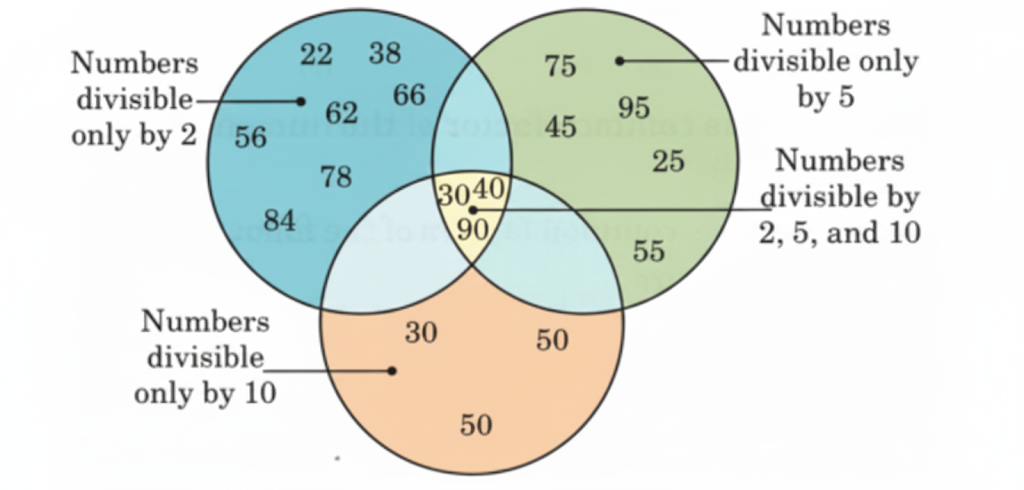
Question 11.
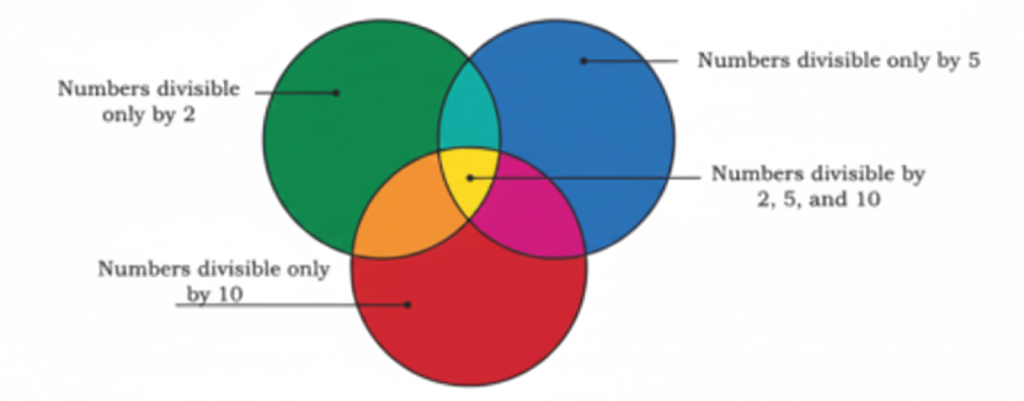
Sort the following numbers into those that are
(a) divisible by 2 only
(b) divisible by 5 only
(c) divisible by 10 only
(d) divisible by 2, 5, and 10.

Solution:
(a) 22, 30, 38, 40, 56, 62, 66, 78, 84, 90.
(b) 25, 30, 40, 45, 55, 75, 90, 95.
(c) 30, 40, 90.
(d) 30, 40, 90.
Mastering Multiples and Factors in Class 5 Maths Mela Chapter 13
Dive into NCERT Solutions Class 5 Maths Mela Chapter 13 Animal Jumps (2026-27) to strengthen your grasp of factors and multiples. The chapter’s engaging animal jump scenarios make it fun to learn mathematical relationships for exam success.
By exploring common multiples, factors, and arrays, students develop a strong conceptual base. Regular practice with these concepts aids in solving all types of questions quickly and boosts problem-solving confidence in maths exams.
Revise key examples and practice the chapter-wise NCERT solutions to ace your Maths Mela syllabus. Focus on understanding prime numbers and divisibility rules to secure more marks in your school exams.
FAQs on NCERT Solutions For Class 5 Maths Chapter 13 Animal Jumps - 2026-27
1. What does NCERT Solutions Class 5 Maths Chapter 13 Animal Jumps include?
NCERT Solutions for Class 5 Maths Chapter 13 Animal Jumps give complete, stepwise answers for all textbook exercises and questions as per the latest CBSE 2026–27 syllabus.
- Detailed, step-by-step solutions to all intext and back exercises
- Key definitions, diagrams, and formulae included
- Marking-scheme guidance for each type of question
- Downloadable PDF for easy offline revision
- Helps students score full marks and build solid exam confidence
2. How can I download the NCERT Solutions for Class 5 Maths Chapter 13 Animal Jumps in PDF format?
You can download the Class 5 Maths Chapter 13 Animal Jumps NCERT Solutions PDF for free from trusted educational sites.
- Look for the 'Download PDF' button on the solutions page
- Ensure it is for Chapter 13 Animal Jumps and updated for the 2026–27 syllabus
- PDFs are handy for offline learning and quick revision sessions
3. Are diagrams or definitions mandatory in NCERT Class 5 Maths Chapter 13 Animal Jumps answers?
Including neat diagrams and accurate definitions in your Animal Jumps answers is highly recommended for full marks.
- Many questions require labelled diagrams or sketches
- Proper definitions show conceptual clarity
- According to the CBSE marking scheme, these carry step marks
- Always label diagrams clearly and write definitions in simple language
4. How do stepwise NCERT solutions help in scoring full marks for Animal Jumps?
Stepwise NCERT solutions for Animal Jumps ensure you write answers as expected by examiners and gain maximum marks.
- Each step earns partial marks, even for long calculations
- Neatly structured steps show your understanding to the examiner
- Helps avoid skipping important reasoning or method marks
- Aligns with the CBSE step marking pattern
5. What types of questions can come from Class 5 Maths Chapter 13 Animal Jumps in exams?
Exams often ask various types of questions from Animal Jumps:
- Short answer sums: Direct calculations or single-step problems
- Long answer sums: Situational questions with multiple steps
- Diagram labelling: Drawing and naming animal jumps or paths
- Definitions/explanations: Key terms from the chapter
- Application questions: Real-life situations using jump patterns
6. How should I present long answers from Animal Jumps to match the CBSE marking scheme?
For long answers from Animal Jumps, follow a clear structure:
- Start with what is asked (given/required/solution steps)
- Show all calculations step-by-step
- Use proper headers for each part (e.g., Step 1: finding distance, Step 2: calculating jumps)
- Add diagrams or tables, if relevant
- End with the final answer in a box for clarity
7. What are the key definitions and formulae to remember in Animal Jumps?
Important definitions and formulae for Animal Jumps include:
- Jump: The distance covered by an animal in one leap
- Number of jumps = Total distance ÷ Length of one jump
- Patterns in jumps: Spotting sequences or repetitions
- Shortcut methods for addition and multiplication related to jumps
Review these before your exam for quick recall and time saving.
8. What are common mistakes to avoid in Class 5 Maths Animal Jumps questions?
To avoid losing marks in Animal Jumps questions, remember:
- Don’t skip calculation steps – write every important step
- Always label diagrams clearly and neatly
- Check units (e.g., metre vs. centimetre)
- Don’t mix up number of jumps with jump length
- Recheck final answers for accuracy before submission
9. Where can I find revision notes and important questions for Animal Jumps?
You can find revision notes and important questions for Animal Jumps on the same educational platform that provides NCERT Solutions.
- Look for the dedicated 'Revision Notes' and 'Important Questions' section
- Notes include quick summaries, formulae, and diagrams
- Important Questions target likely exam topics from Chapter 13
- These resources help with last-minute preparation and understanding trends
10. Are NCERT solutions enough for Class 5 Maths Chapter 13 exam preparation?
NCERT solutions for Animal Jumps are usually sufficient for CBSE Class 5 exam preparation, but extra practice helps:
- All CBSE exam questions are based on the NCERT Animal Jumps chapter
- Try exemplar and previous year questions for extra confidence
- Practice diagrams and long answers for complete preparation
- Use the NCERT Solutions as your main guide for accurate answers
