Raksha Bandhan - Exercise-wise Questions and Answers for Class 3 Maths PDF Download
1. Tomorrow is Gopal’s favourite festival. Gopal and Dhara are very excited. Their beloved Atya (father’s sister) is visiting them today. They have cleaned and decorated their house. Carefully observe Gopal’s house. What do you find interesting here?
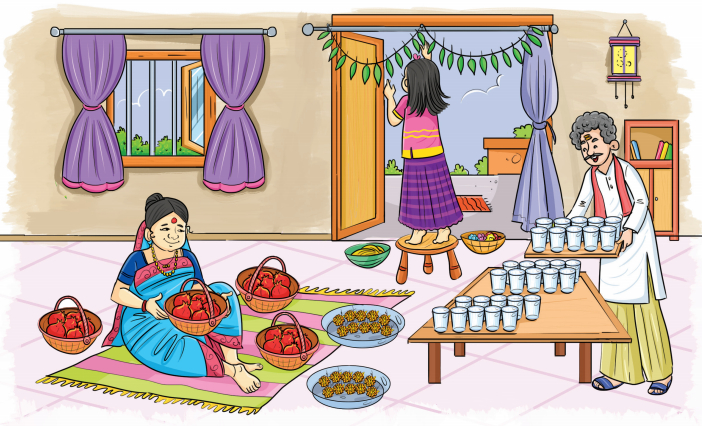
Ans: Here, there are a tonne of leaves, glasses, flowers, and pomegranates.
2. Find and count the number of each of these objects and write.

Ans:

Leaves 24
Glasses 30
Pomegranate 24
Flowers 20
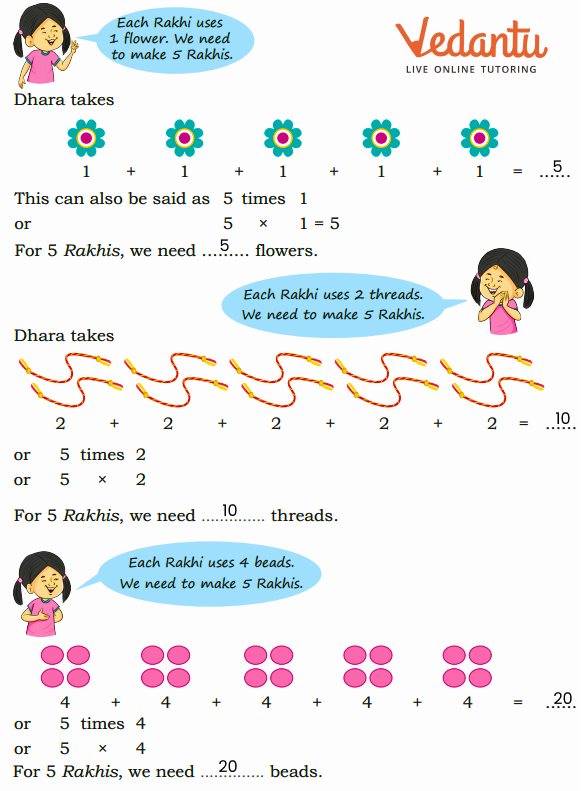
3. How many threads, flowers and beads do they need?
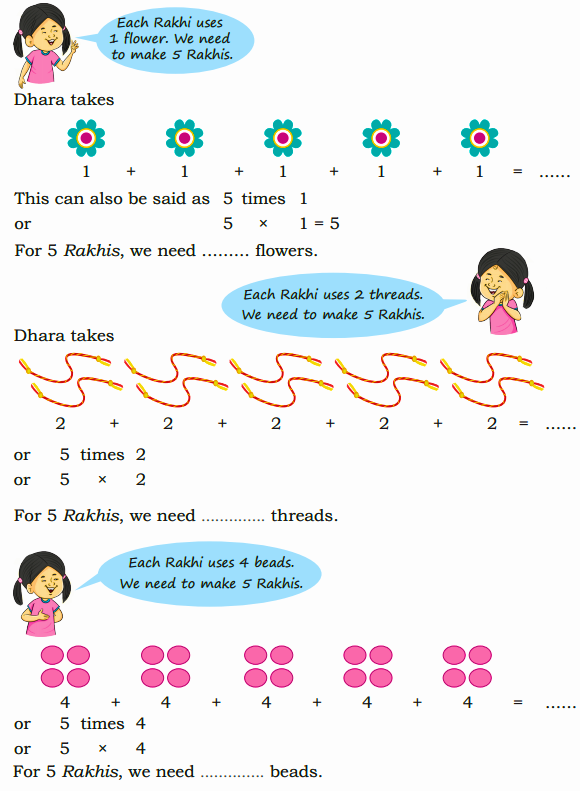
Ans:
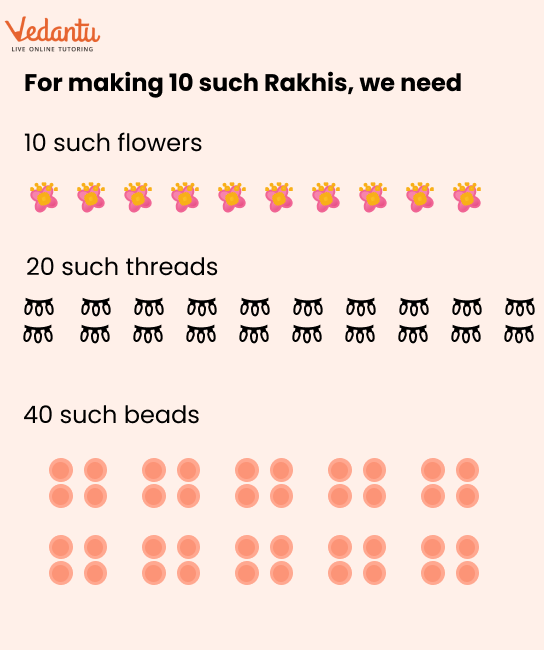
4. For making 10 such Rakhis, we need ......... flowers, ......... threads and ......... beads. There are 30 flowers, 30 threads and 30 beads. How many Rakhis can you make with this material? Use drawings if needed to find out the answer.
Ans:
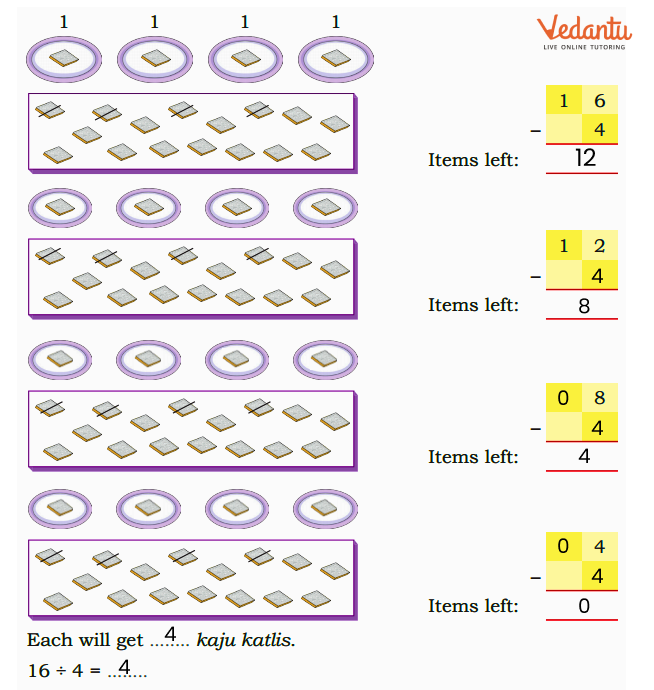
5. Distribute all the kaju katlis equally among 4 people. How many kaju katlis will each get? Let us do this in the picture given below. Strike out the kaju katas from the tray and draw them on the plates.
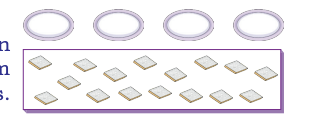
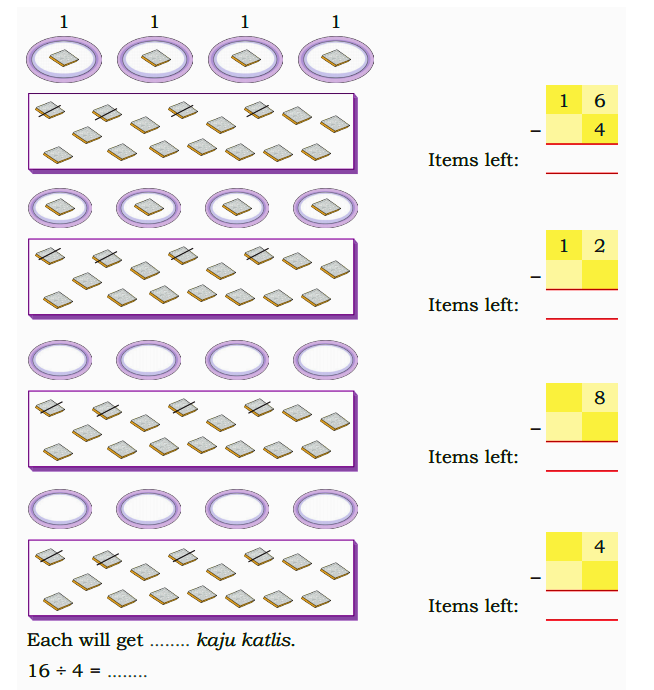
Each will get ........ kaju katlis.
16 ÷ 4 = ........
Ans: Each will get 4 kaju katlis.
16 ÷ 4 =4
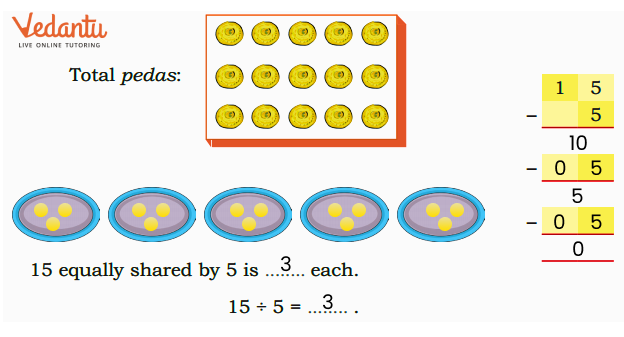
6. Distribute all the 15 pedals in plates equally among 5 people. How many pedals will each get?
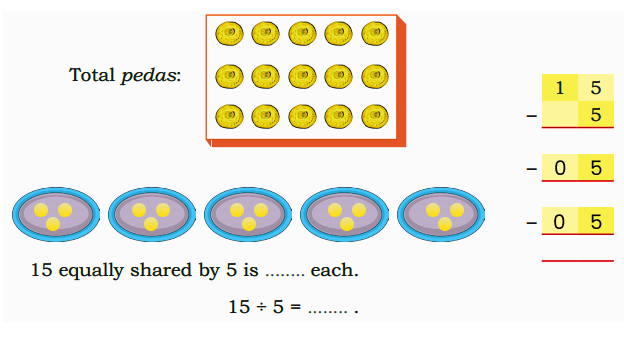
15 equally shared by 5 is ........ each.
15 ÷ 5 = ........ .
Ans:
15 equally shared by 5 is 3 each.
15 ÷ 5 = 3.
7. Each cycle needs 2 wheels. How many cycles can be fitted with 12 wheels?
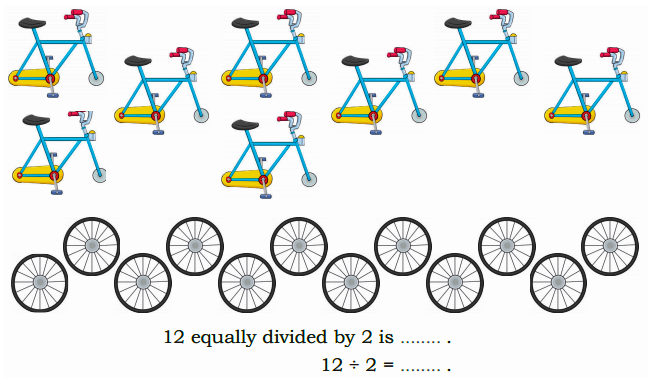
12 equally divided by 2 is .........
Let us Think Let Us Think 12 ÷ 2 = .........
Ans: 12 equally divided by 2 is 6
Let us Think Let Us Think 12 ÷ 2 = 6
8. Look at the picture carefully. Count the number of jalebis

There are ........ jalebis
How did you count? Discuss with your friends. Counting in groups, we see there are six groups of four jalebis each,
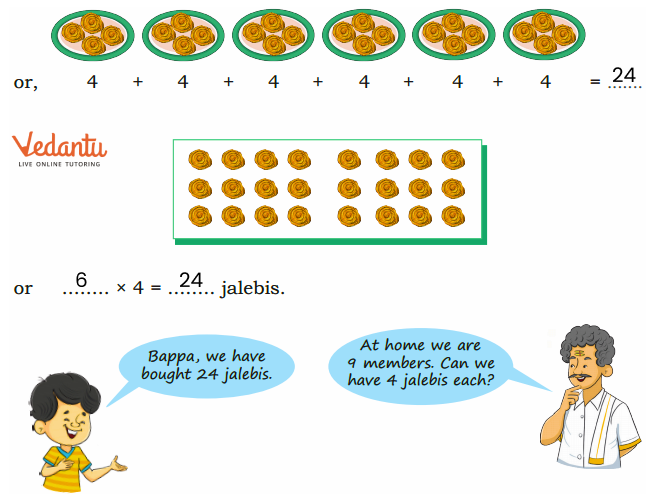
Are there enough jalebis for everyone in Dhara’s family to have four each? Share your thoughts in the class. How many jalebis should Dhara buy so that everyone can get four each?
Ans:
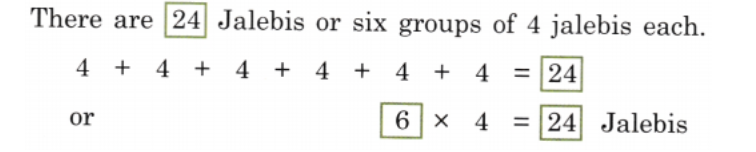
No 24 jalebis are not enough for everyone in Dhara’s family to have four each.
Total members of Dhara’s family = 9
So we need 3 more groups of 4 jalebis.
4 + 4 + 4 + 4 + 4 + 4 + 4 + 4 + 4 = 36
Dhara should buy 36 jalebis so that everyone gets four each.
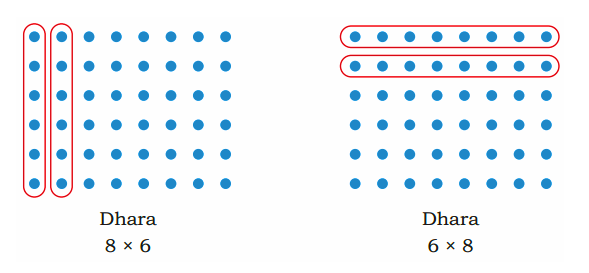
9. Plants in the garden Dhara and Gopal see a flower bed on their way home. Dhara: The number of plants is 6 + 6 + 6 + 6 + 6 + 6 + 6 + 6 = ..... 8 times 6 =
= 8 × 6 =
Gopal: No, it is 8 + 8 + 8 + 8 + 8 + 8 = 6 × 8 Who do you think is correct?
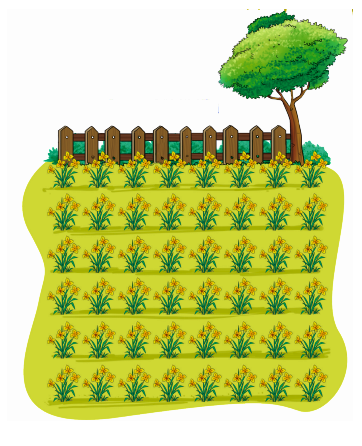
Ans:
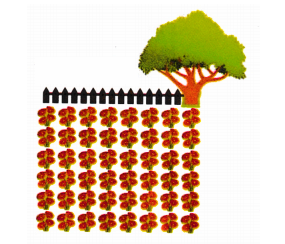
Dhara: The number of plants is
6 + 6 + 6 + 6 + 6 + 6 + 6 + 6 = 48
8 times 6 = 8 × 6 = 48
Gopal: No, it is 8 + 8 + 8 + 8 + 8 + 8
6 × 8 = 48
Dhara and Gopal both are correct.
10. Can you complete this equal grouping and write it as multiplication? Can you find more equal groups of different sizes? Draw them and write them as multiplication.
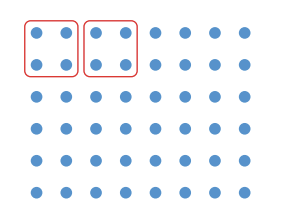
Ans:
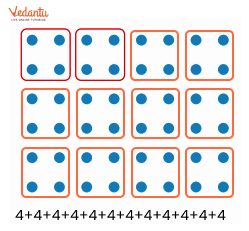
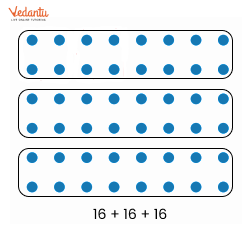
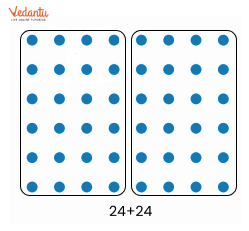
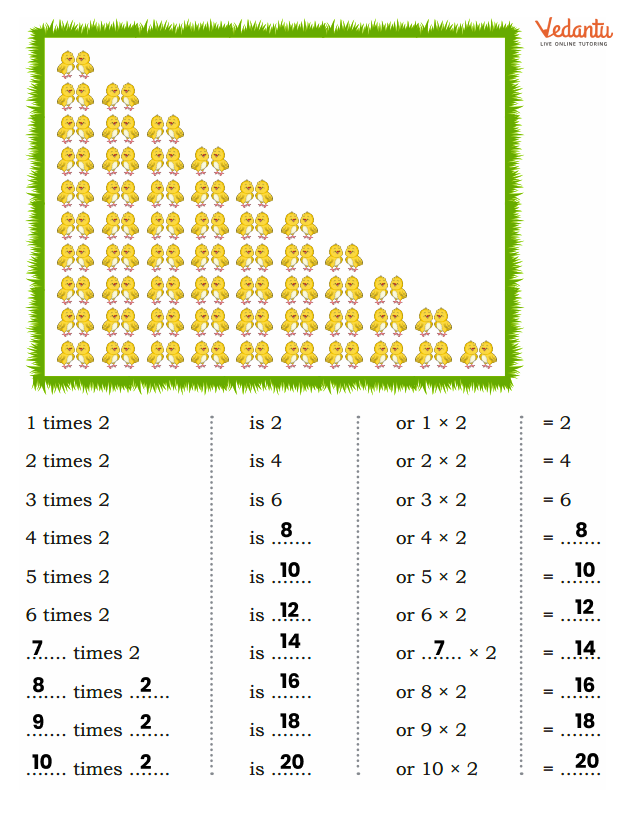
11. The next day the children take their Appa and cousins to the farm. They see a lot of chickens there. Let us count chickens on the farm!
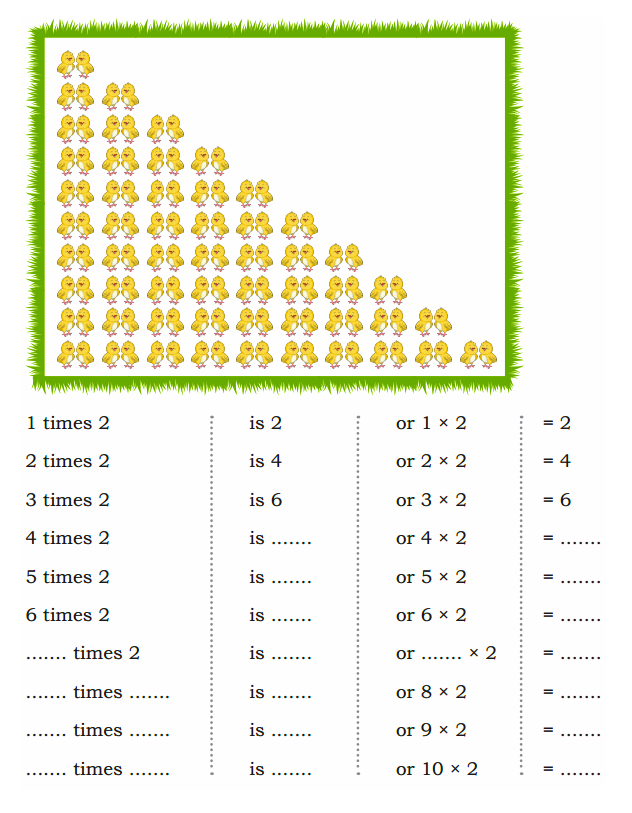
Ans:
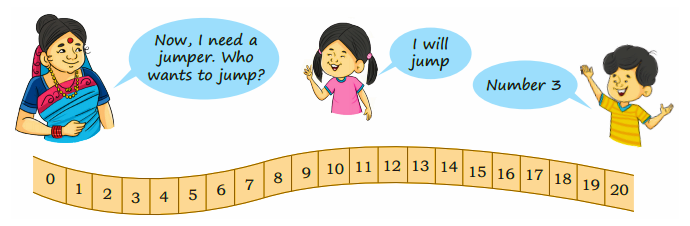
12. In the evening, the family goes to the playing field. Atya draws a curvy number track on the ground with a stick. She asks Dhara to write numbers starting from 0.
Starting from 0, Dhara jumps to 3. From 3 she goes to 6. From 6 she goes to 9. Now continue to see how Dhara jumps after 9.
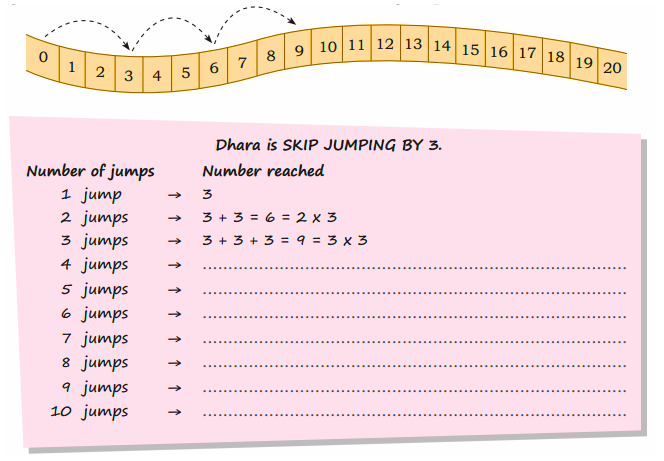
Ans:
Dhara is skipping the jumping by 3
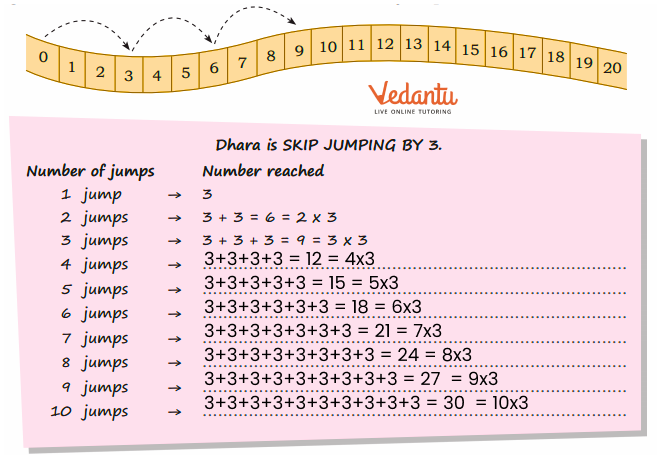
13.
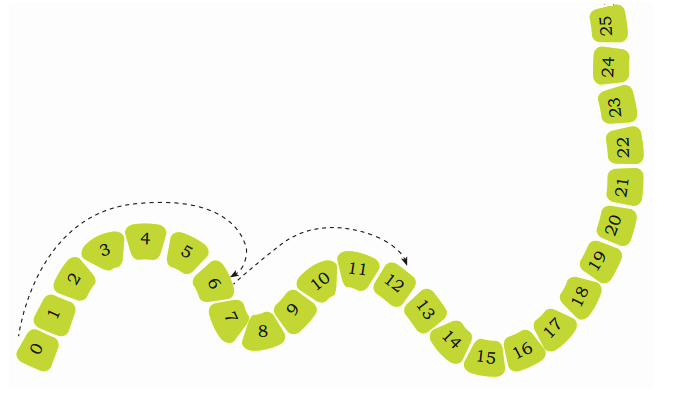
1. Guess and write the next number she will jump onto.
Ans:

2. Is there a pattern in these numbers: 3, 6, 9, ...?
Ans: Indeed, there is a pattern to the numbers 3, 6, 9,... Three more than the previous number is the next one.
3. How many steps forward is Dhara jumping each time?
Ans: Every time, Dhara leaps forward 3 paces.
4. Continue skip jumping by 6 by drawing the jumps on the number track.
Ans:
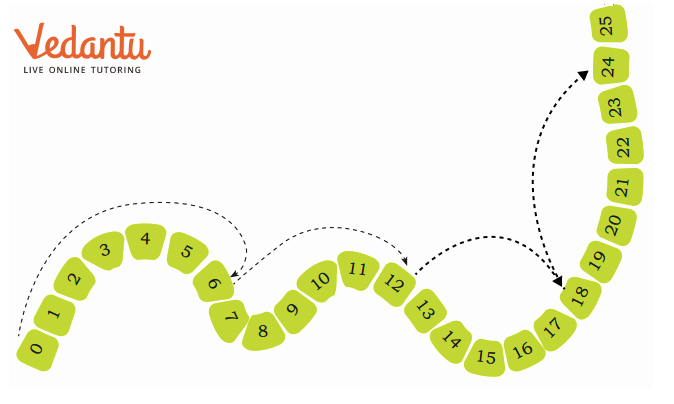
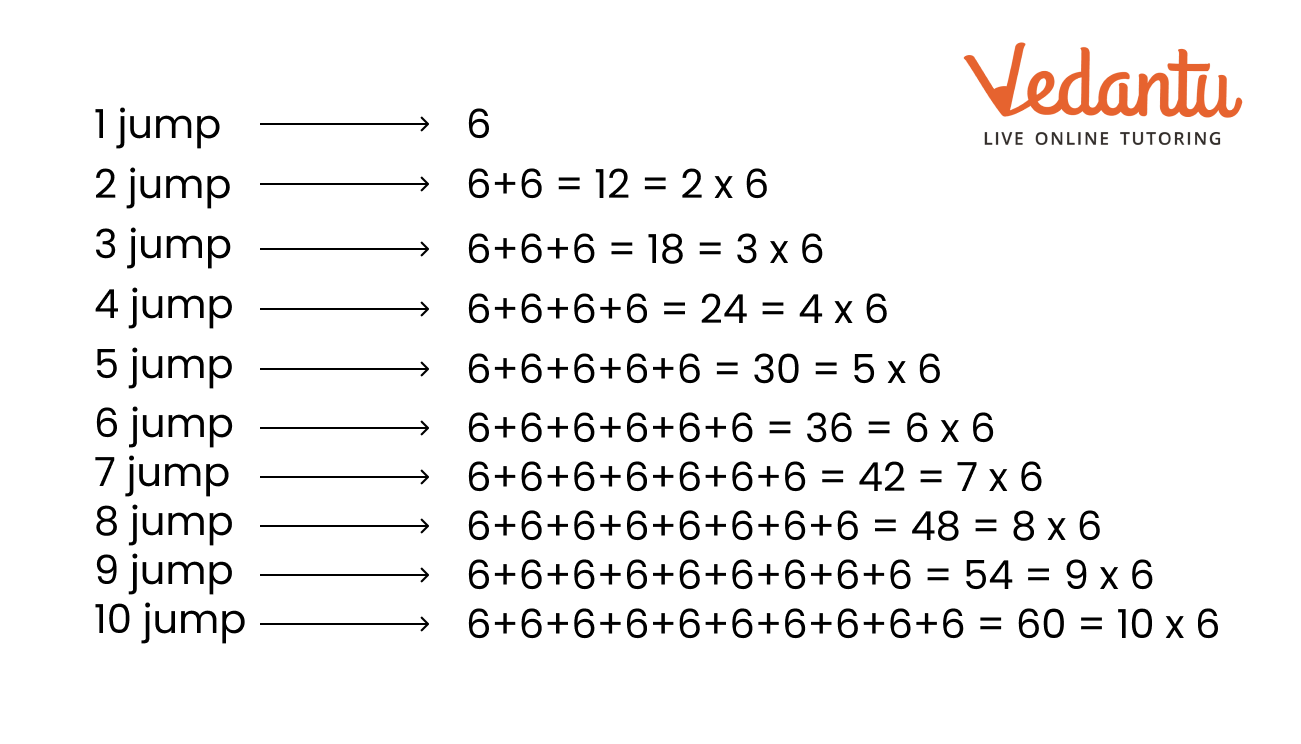
5. Can this skip jumping be used to form the times-6 table? Write the times-6 table in your notebook.
Ans:
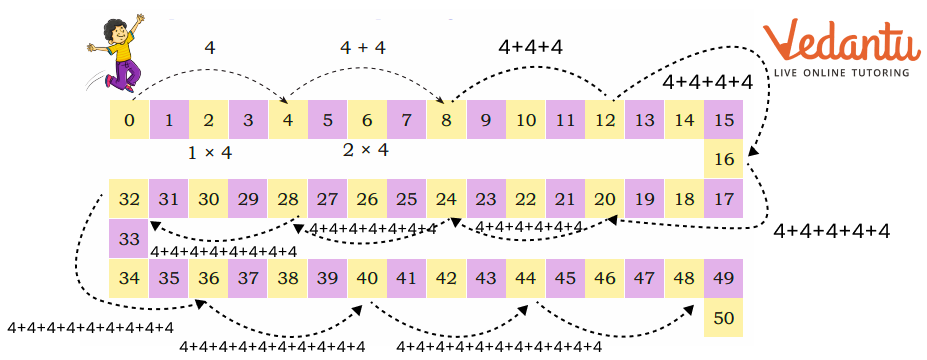
6. Is there repeated addition happening? Make a times-4 table using repeated addition in the picture given below.
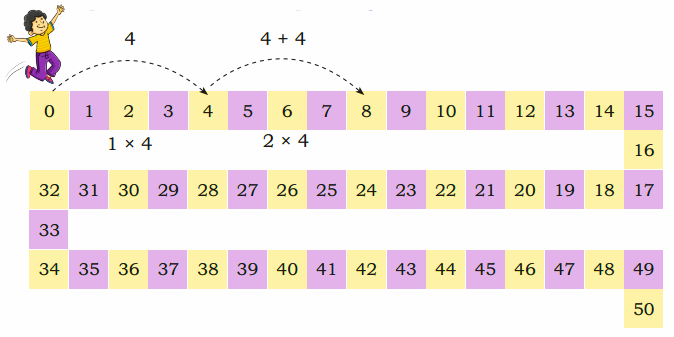
Ans:
7.

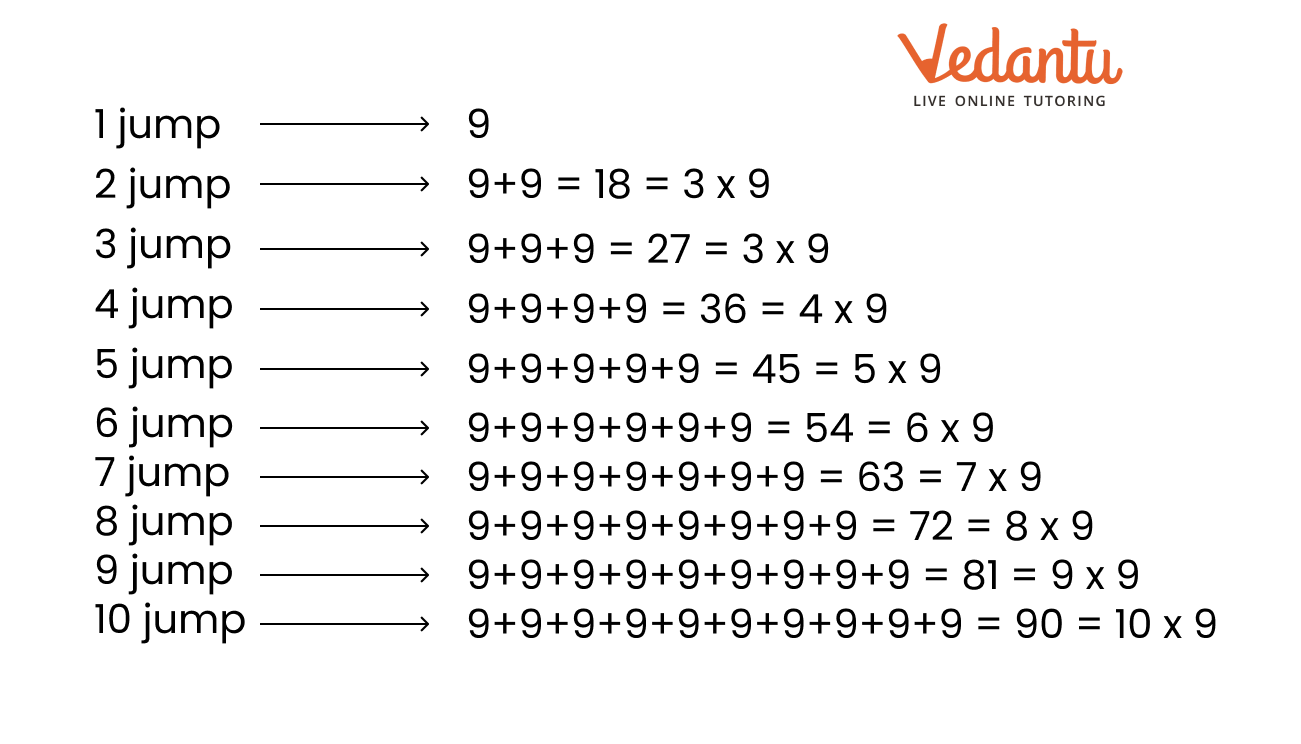
Gopal is skipping the ............. steps.
After 27 he will jump on ............., ..............
Ans: Gopal is skipping 9 steps.
After 27 he will jump on 36, 45.
8. What times table can you construct from Gopal’s jumps? Make it in your notebook.
Ans:
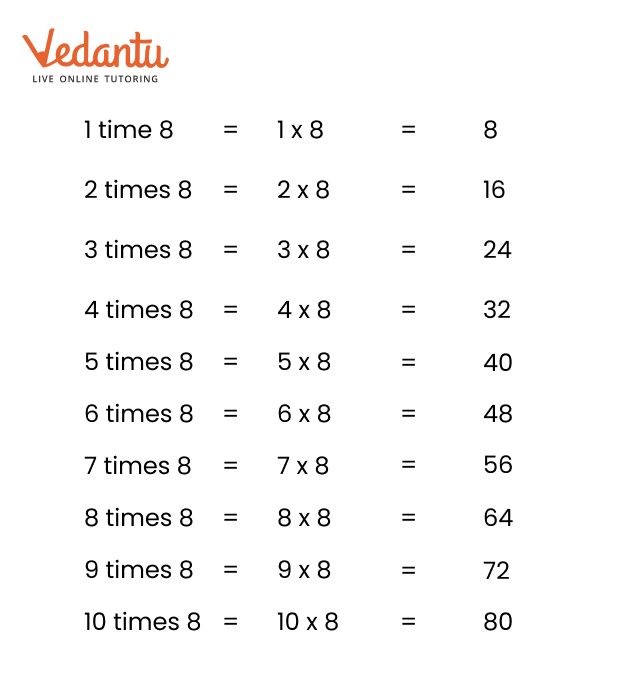
9. Dhara also skips and jumps. Gopal notes down the jumps but he misses the first few numbers.

By what numbers was Dhara skip jumping? Construct the times table of this number in your notebook.
Ans: Dhara was skip jumping by 8
14. Atya places a flower on 12. Skip jumps with equal steps to reach the flower. No direct jumping to the flower is allowed. The one who reaches the flower in the smallest number of jumps wins. What skip-jumping number will you choose? ..........
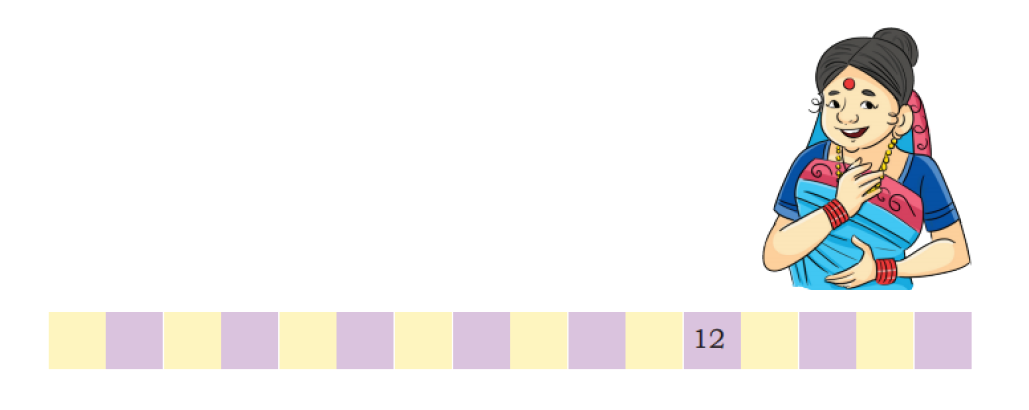
Play this game with your friends by putting the flower in different numbers on the track. See who can reach the minimum number of jumps. Are there numbers that can be reached only through skip jumping by 1? Find 3 such numbers.
Ans:

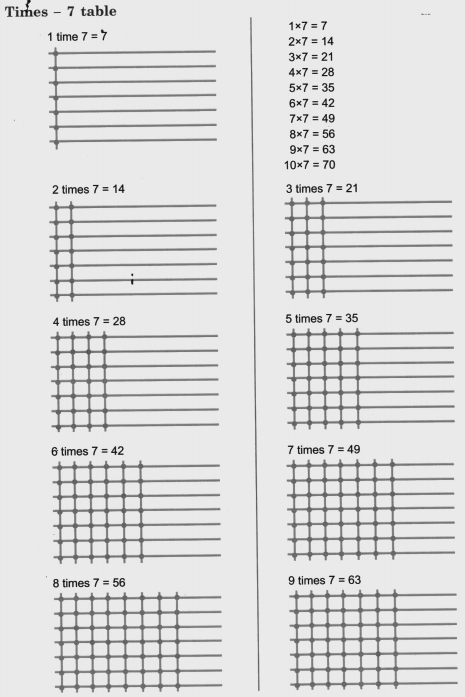
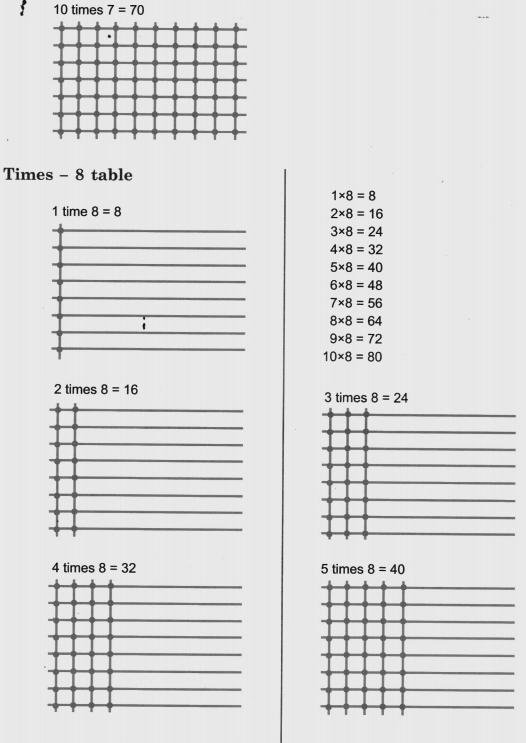
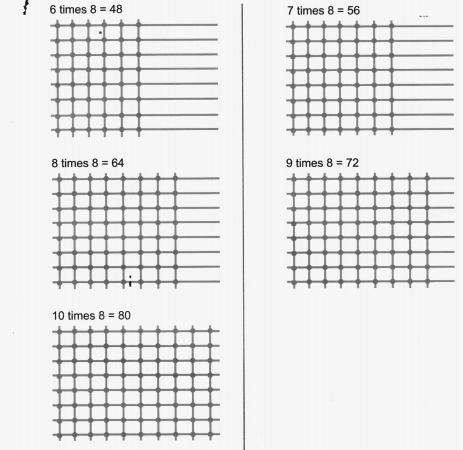
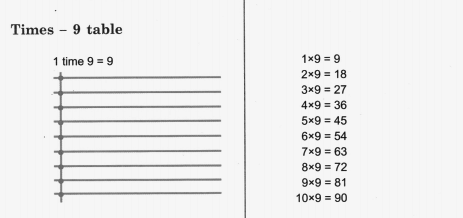
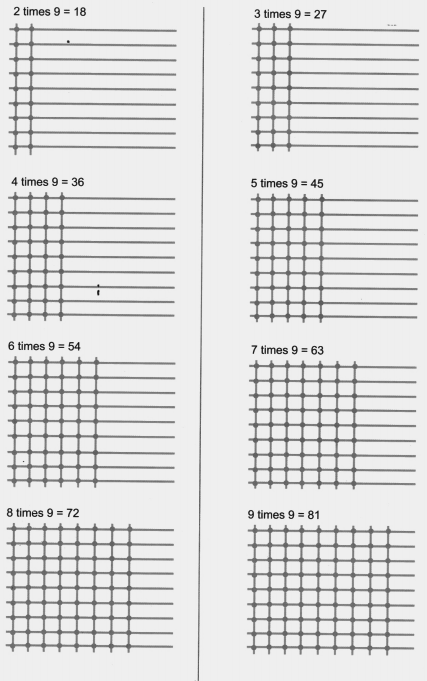
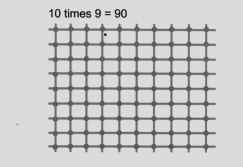
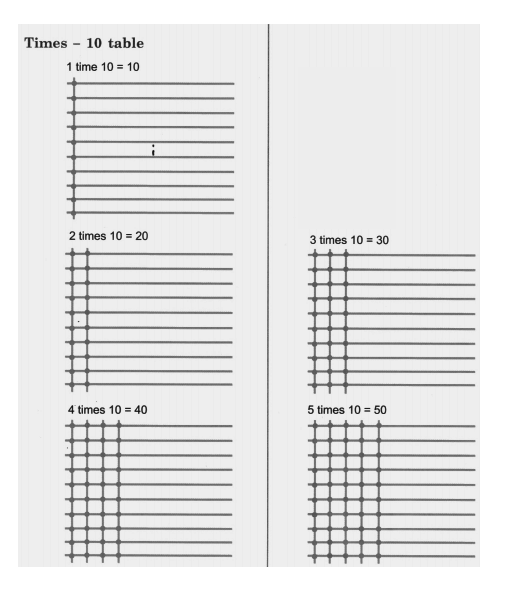
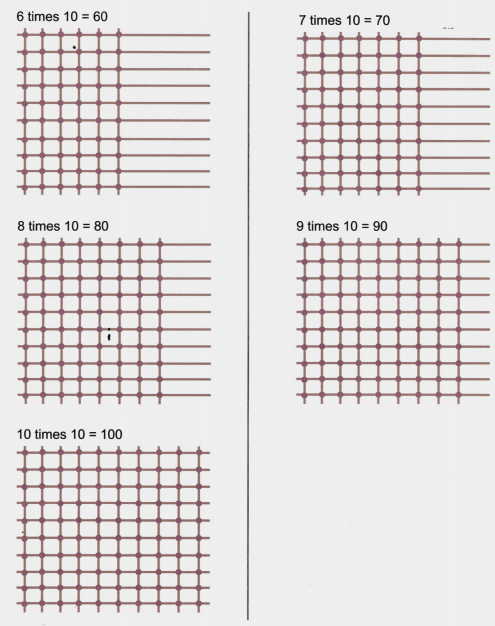
15. Mithu figures out another way of writing multiplication tables by drawing sticks! Do you see repeated additions in this?
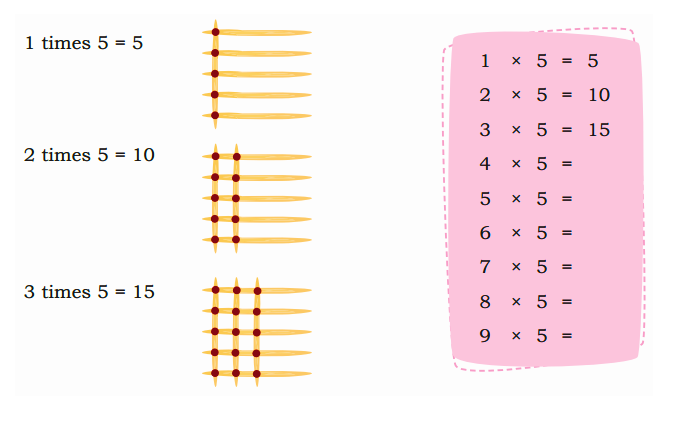
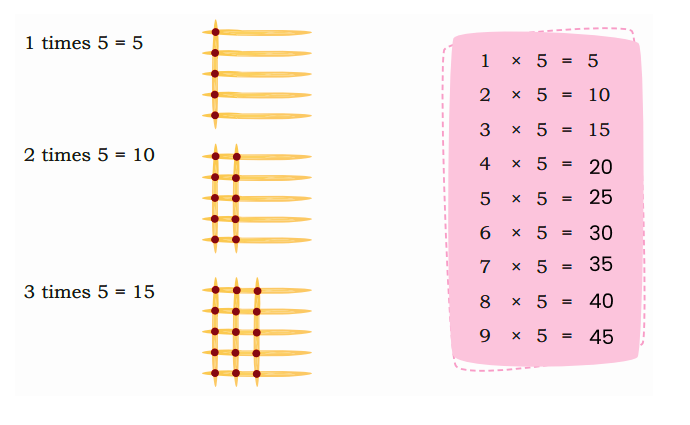
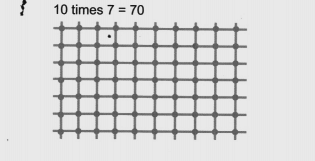
Complete the times-5 table using sticks Make times-6 to times-10 tables using the sticks method shown above.
Ans: Times-5 table using sticks
Make times-6 to times-10 tables using the sticks method shown above
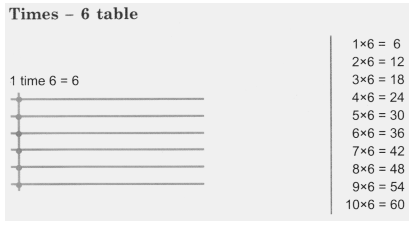
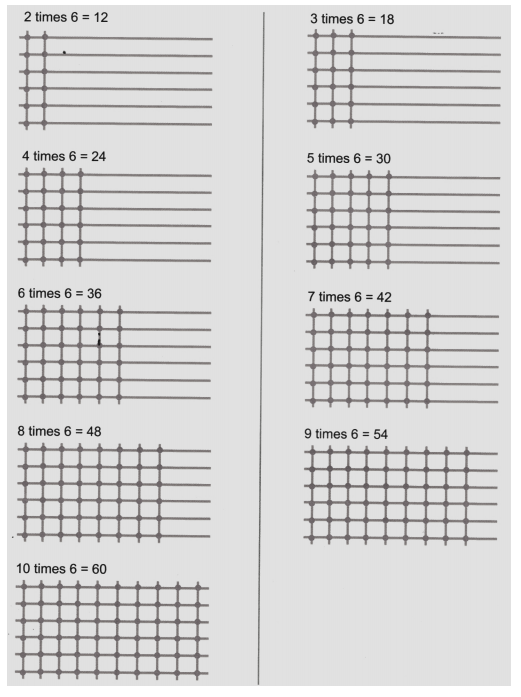
16. Multiplication Table
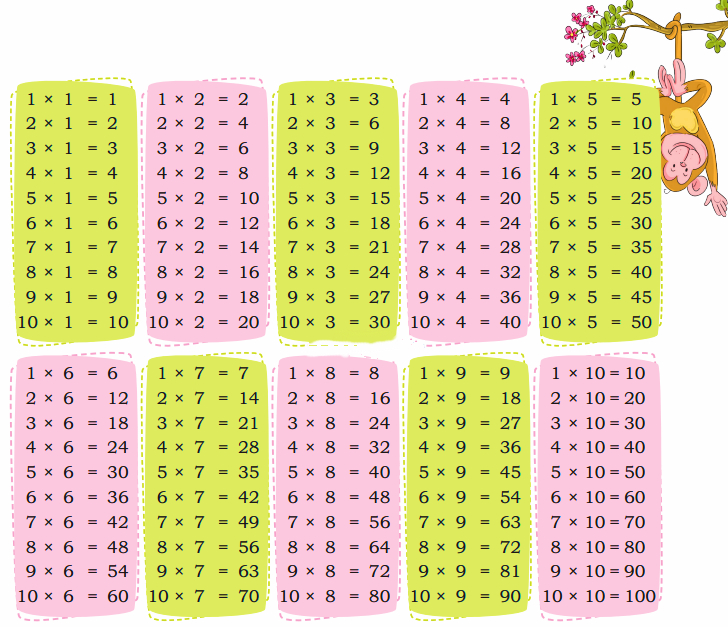
Look at the times-5 table. What patterns do you see? Guess what will be the last digits of 11 × 5 and 12 × 5. Give 3 examples of numbers that when taken 5 times give an answer ending with
(i) 0 ....... ....... .......
(ii) 5 ....... ....... .......
Without finding the answer, can you tell the last digits of 18 × 5, 23 × 5, 32 × 5, 50 × 5. Look at the times tables of 2, 3, 5. They have a relation between them. Can you see it?
Ans:
(i) 0 4, 6, 8
(ii) 5 3, 5, 7
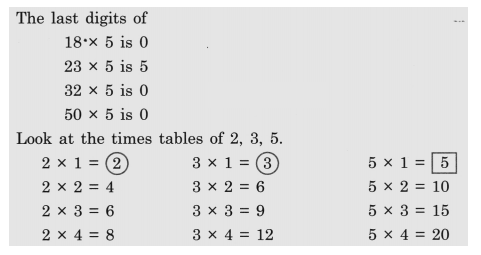
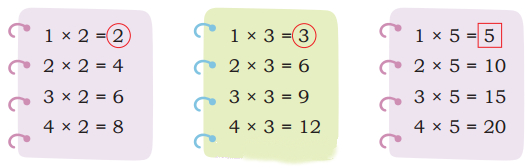
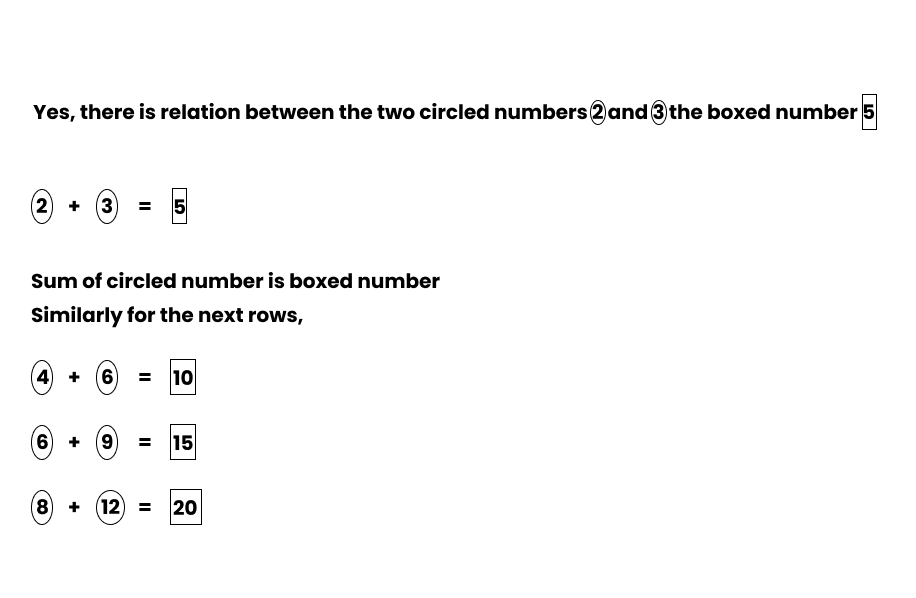
17. Is there a relation between the two circled numbers and the boxed number? Does this happen for the next rows also? Can you find other examples of two tables adding up to a third table?
Ans:
18. Draw pictures for each of the following problems in your notebook. Use counting, number line jumps or any other method to solve the problems.
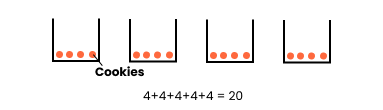
a. There are 5 jars with 4 cookies in each jar. How many cookies are there?
Ans:
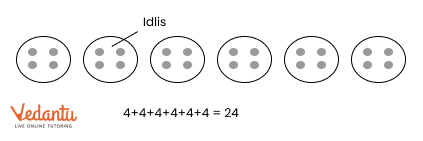
b. An idli vessel contains 6 idli plates. In each plate, we can make 4 idlis. How many idlis can be cooked in one go?
Ans:
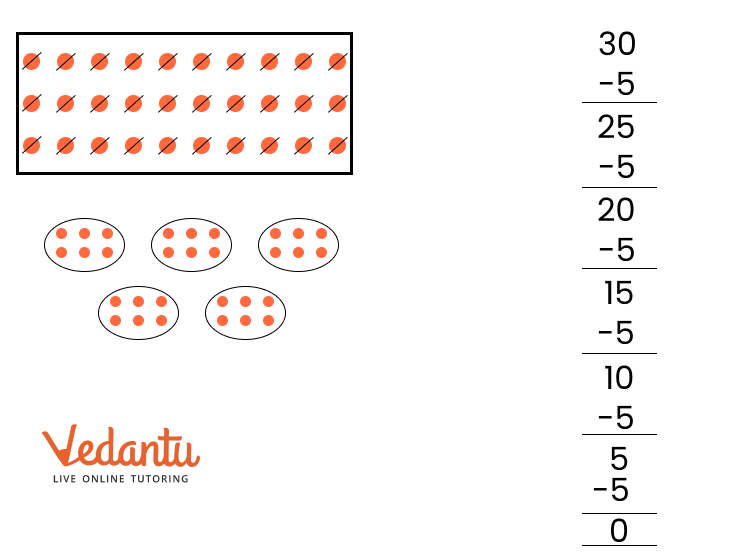
c. 30 cookies are to be distributed among 5 children equally. How many cookies will each child get?
Ans:
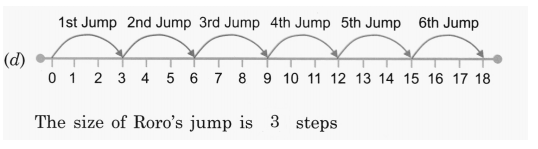
d. Roro starts from 0 and takes 6 jumps to reach 18. All his jumps are of the same size. What is the size of Roro’s jump?
Ans:
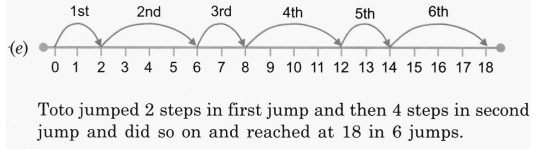
e. Toto does not take jumps of the same size and still reaches 18 in 6 jumps. How did Toto jump?
Ans:
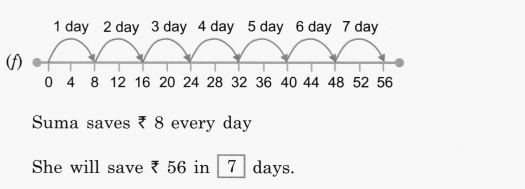
f. Suma saves ` 8 every day. After how many days will she have ` 56?
Ans:
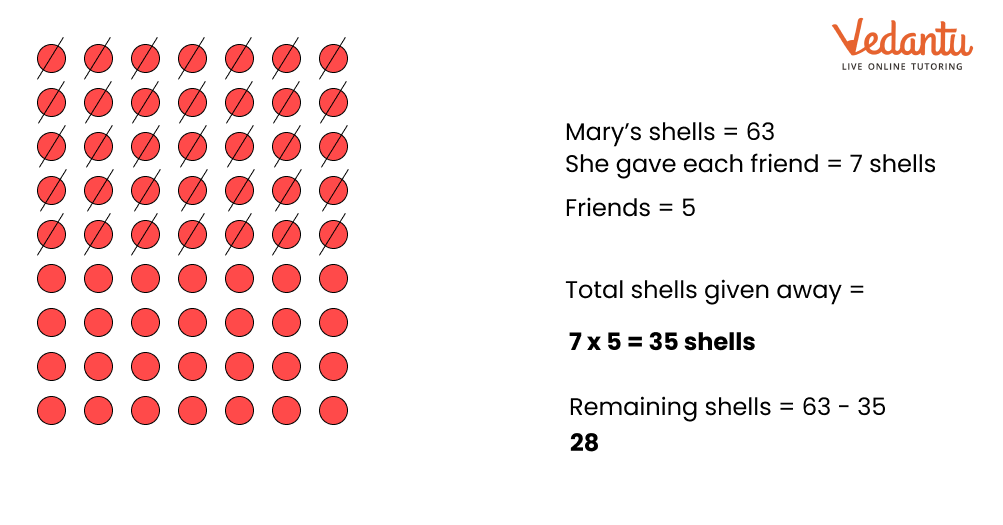
g. Mary has 63 sea shells. She gives 7 sea shells to each of her 5 friends. How many does she have left?
Ans:
19. Solve the following problems. Try constructing a word problem.
a. 4 × 9
b. 32 ÷ 8
c. 6 × 7
d. 45 ÷ 5
Ans:
(a) 4 × 9 = 36
(b) 32 ÷ 8 = 4
(c) 6 × 7 = 42
(d) 45 ÷ 5 = 9
20. Help Bhim! Bhim will need ........ spokes. Think and share with your friends how you found the answer. Let us see how Bhim did it. 10 wheels will need:
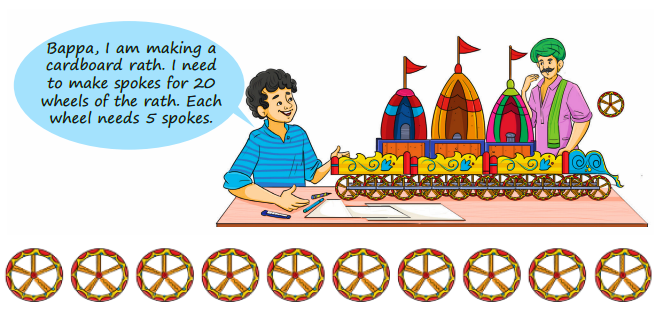
5 + 5 + 5 + 5 + 5 + 5 + 5 + 5 + 5 + 5 = 10 × 5 = ........ spokes.
Another 10 wheels will be needed ........ × ........ = ........ spokes.
So, the total number of spokes needed is ........ + ........ = ........ spokes.
Ans:
5 + 5 + 5 + 5 + 5 + 5 + 5 + 5 + 5 + 5 = 10 × 5 = 50 spokes
Another 10 wheels will need 10 × 5 = 50 spokes.
So, the total number of spokes needed is 50 + 50 = 100 spokes.
21.
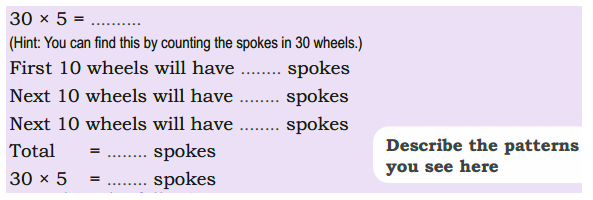
Ans:
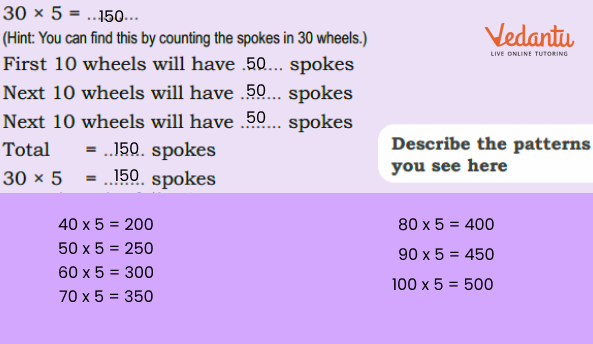
22.
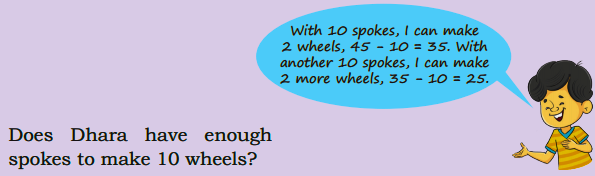
Ans: She made 2 wheels out of 10 spokes. that She can produce 9 wheels.
No, Dhara does not have 10 wheels' worth of spokes.
23. How many wheels can you make with 60 spokes?
Ans:
For 2 wheels spoke used = 10
For 10 wheels spoke used = 50
50 from 60 spoke, we can make 10 + 2 = 12 wheels
24. A spider has 8 legs.
5 spiders will have ........ legs.
10 spiders will have ........ legs.
15 spiders will have ........ legs.
Ans:
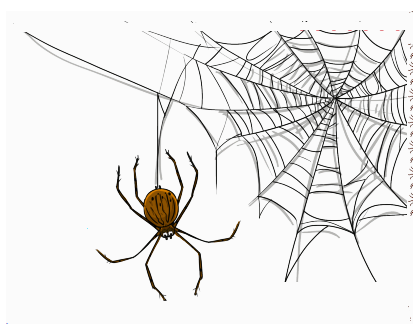
Spider Leg Calculation
Legs per Spider: 8
For 5 Spiders:
Total legs: 8 × 5 = 40 legs
For 10 Spiders:
Total legs: 8 × 10 = 80 legs
For 15 Spiders:
Total legs: 40 (from 5 spiders) + 80 (from 10 spiders) = 120 legs
Summary:
5 spiders will have 40 legs.
10 spiders will have 80 legs.
15 spiders will have 120 legs.
25. How many legs will 23 spiders have?
Ans: Spider Leg Calculation
Legs per Spider: 8
For 10 Spiders:
Total legs: 10 × 8 = 80 legs
For the Next 10 Spiders:
Total legs: 10 × 8 = 80 legs
For 3 Spiders:
Total legs: 3 × 8 = 24 legs
Total Legs for 23 Spiders:
Combined legs: 80 (from first 10 spiders) + 80 (from next 10 spiders) + 24 (from 3 spiders) = 184 legs
26. A group of spiders have 32 legs. How many spiders are there in the group?
Ans:
1 spider have = 8 legs
2 spiders have = 2 × 8 = 16 legs
3 spiders have = 3 × 8 = 24 legs
4 spiders have = 4 × 8 = 32 legs
So, 4 spiders are in the group.
27. Here is a 3-wheeled auto rickshaw. How many wheels are there in
a. 18 auto rickshaws?
b. 34 auto rickshaws?
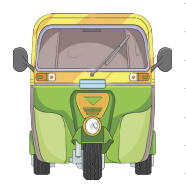
Ans:
(a) Calculation for 18 Auto Rickshaws:
Wheels per Auto Rickshaw: 3
For 10 Auto Rickshaws:
Total wheels: 3 × 10 = 30 wheels
For 8 Auto Rickshaws:
Total wheels: 3 × 8 = 24 wheels
Total Wheels for 18 Auto Rickshaws:
Combined wheels: 30 (from 10 auto rickshaws) + 24 (from 8 auto rickshaws) = 54 wheels
(b) Calculation for 34 Auto Rickshaws:
For 10 Auto Rickshaws:
Total wheels: 3 × 10 = 30 wheels
For the Next 10 Auto Rickshaws:
Total wheels: 3 × 10 = 30 wheels
For the Next 10 Auto Rickshaws:
Total wheels: 3 × 10 = 30 wheels
For 4 Auto Rickshaws:
Total wheels: 3 × 4 = 12 wheels
Total Wheels for 34 Auto Rickshaws:
Combined wheels: 30 + 30 + 30 + 12 = 102 wheels
28. Auto rickshaws in a garage have a total of 36 wheels. How many auto rickshaws are there in the garage?
Ans:
10 auto rickshaws have = 30 wheels
2 more auto rickshaws have = 2 × 3 = 6 wheels
So 12 auto rickshaws have 36 wheels
29. There is a line of 55 ants (one ant has 6 legs). What is the total number of legs in the line?
Ans:
Ant Leg Calculation
Legs per Ant: 6
For 5 Ants:
Total legs: 5 × 6 = 30 legs
For 10 Ants:
Total legs: 10 × 6 = 60 legs
For 40 Ants (10 ants each in four groups):
Total legs: 60 × 4 = 240 legs
For 50 Ants:
Total legs: 240 (from 40 ants) + 60 (from 10 ants) = 300 legs
For 55 Ants:
Total legs: 300 (from 50 ants) + 30 (from 5 ants) = 330 legs
Total Legs:
There are 330 legs in total for 55 ants.
30. Micky, the mouse, can see 48 legs of cows in the shed. How many cows are there in the shed?
Ans:
Cow Leg Calculation
Legs per Cow: 4
For 10 Cows:
Total legs: 10 × 4 = 40 legs
For 2 Cows:
Total legs: 2 × 4 = 8 legs
Total Number of Cows:
Number of cows = 10 (from the first group) + 2 (from the second group) = 12 cows
Conclusion:
There are 12 cows in the shed.
31. Karry, the crow, can see 24 horns of cows in the shed. What is the total number of legs in the shed?
Ans:
1 cow has = 2 horns
So 10 cows have = 2 × 10 = 20 horns
and 2 cows have = 2 × 2 = 4 horns
So, 10 + 2 = 12 cow has 24 horns
1 cows have = 4 legs
10 cows have = 10 × 4 = 40 legs
2 more cows have = 2 × 4 = 8 legs
So 12 cows have = 40 + 8 = 48 legs
The total number of legs in the shed is 48.
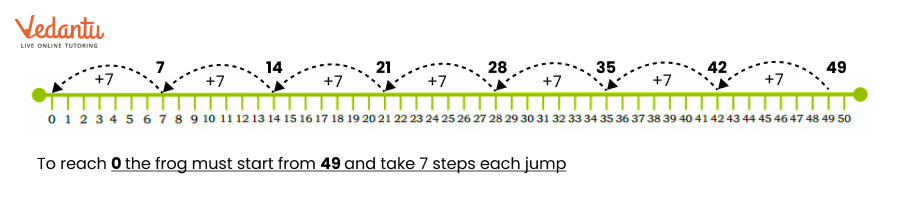
32. A frog is at 0. It takes jumps of only 7. What would be the largest number that the frog will reach before crossing 50?

Ans:
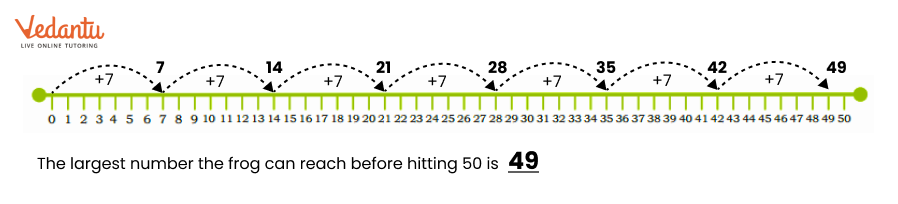
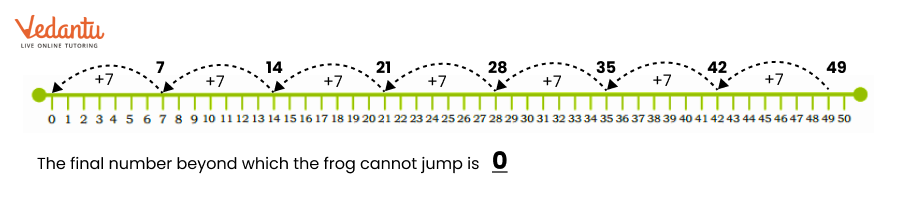
33. A frog wants to jump backward from 50. It continues to take jumps of 7. What is the number after which the frog can't make a jump of 7?

Ans:
34. What numbers should the frog start from to reach 0, taking jumps of 7 each time? What do you observe?

Ans:
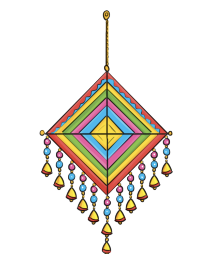
35. One wall hanging costs 42. How much do two wall hangings cost? Two wall hangings cost ` 42 + ` 42 = 2 × ` 42 The cost of the two wall hangings: ..........
Ans:
Two wall-hangings cost ₹ 42 + ₹ 42 = 2 × 42
The cost of the two wall hangings = ₹ 84.
36. One Rabdi cup costs ` 75. Preeti buys 5 cups of Rabdi. She has her mother’s purse which has only 100 notes. How many ` 100 notes should she give the shopkeeper? How much will the shopkeeper then return to Preeti? What is the total cost of 5 cups of Rabdi?

Ans:
37. Dhruv lives near the sea. He thought of making a necklace for each of his three friends. He looked for sea shells the whole day. He collected 112 seashells by the evening. Now, he has many different coloured and shiny shells.
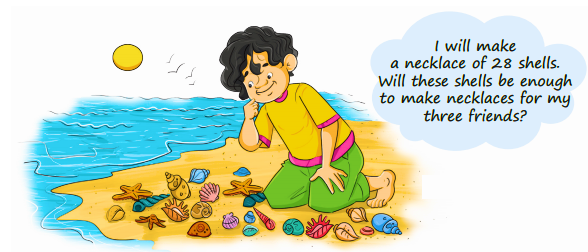
He took 28 shells for one necklace. 112 – 28 = 84 Now he was left with 84 shells. Again he took 28 more shells for the second necklace.
• How many shells are left now?
• Then he took shells for the third necklace.
• So he was left with ........... shells.
• Are the shells enough for making necklaces for all his friends? ...........
• How many necklaces can Dhruv make from 112 shells? ...........
Ans: He took 28 shells for one necklace 112 – 28 = 84
Again he took 28 more shells for the second necklace.
• How many shells are left now?
84 – 28 = 56
Ans: 56 shells
• Then he took shells for the third necklace.
• So he was left with 56 – 28 = 28 shells.
Ans: 28 shells
• Are the shells enough for making necklaces for all his friends?
Ans: Yes
How many necklaces can Dhruv make from 112 shells?
Ans: 4
38. Kannu makes a necklace of 17 sea-shells. How many such necklaces can be made using 100 sea shells?
Ans:
Sea-Shell Distribution for Necklaces
Total Sea-Shells: 100
First Necklace:
Kannu takes 17 sea shells.
Sea shells remaining: 100 - 17 = 83
Second Necklace:
Kannu takes another 17 sea shells.
Sea shells remaining: 83 - 17 = 66
Third Necklace:
Kannu takes another 17 sea shells.
Sea shells remaining: 66 - 17 = 49
Fourth Necklace:
Kannu takes another 17 sea shells.
Sea shells remaining: 49 - 17 = 32
Fifth Necklace:
Kannu takes another 17 sea shells.
Sea shells remaining: 32 - 17 = 15
Total Necklaces:
Kannu can make 5 necklaces with 17 sea shells each and still have 15 sea shells left.
39. While searching for seashells, Dhruv also finds 127 shiny pebbles. He distributes them equally to his 3 friends. How many will each get?
Ans:
Marble Distribution
Total Marbles: 127
First Turn:
Dhruv gives 10 marbles to each of his three friends.
Total marbles given: 10 + 10 + 10 = 30
Marbles remaining: 127 - 30 = 97
Second Turn:
Dhruv gives 10 marbles to each of his three friends again.
Total marbles given: 10 + 10 + 10 = 30
Marbles remaining: 97 - 30 = 67
Third Turn:
Dhruv gives 10 marbles to each of his three friends again.
Total marbles given: 10 + 10 + 10 = 30
Marbles remaining: 67 - 30 = 37
Fourth Turn:
Dhruv gives 10 marbles to each of his three friends again.
Total marbles given: 10 + 10 + 10 = 30
Marbles remaining: 37 - 30 = 7
Total Marbles Given to Each Friend:
Marbles given in all turns: 10 + 10 + 10 + 10 = 40
Distribution of Remaining Marbles:
Dhruv distributes the remaining 7 marbles, giving 1 marble to each friend:
First distribution: 7 - 3 = 4 marbles left
Second distribution: 4 - 3 = 1 marble left
Final Count:
Each friend receives 40 marbles from the initial distributions.
Plus 1 marble from each of the two additional distributions.
Total marbles each friend gets: 40 + 1 + 1 = 42 marbles.
40. Preeti has a ` 500 note and wants to exchange it for lower denomination notes. How many notes will she get if she wants—
(i) All 50 rupees notes?
(ii) All 20 rupees notes?
(iii) All 10 rupees notes
Ans:
(i) Using ₹50 Notes
For ₹500, the breakdown with ₹50 notes is as follows:
After receiving the first ₹50 note, ₹500 - ₹50 leaves ₹450.
After the second ₹50 note, ₹450 - ₹50 leaves ₹400.
After the third ₹50 note, ₹400 - ₹50 leaves ₹350.
After the fourth ₹50 note, ₹350 - ₹50 leaves ₹300.
After the fifth ₹50 note, ₹300 - ₹50 leaves ₹250.
After the sixth ₹50 note, ₹250 - ₹50 leaves ₹200.
After the seventh ₹50 note, ₹200 - ₹50 leaves ₹150.
After the eighth ₹50 note, ₹150 - ₹50 leaves ₹100.
After the ninth ₹50 note, ₹100 - ₹50 leaves ₹50.
After the tenth ₹50 note, ₹50 - ₹50 leaves ₹0.
Thus, she will receive 10 ₹50 notes for ₹500.
(ii) Using ₹20 Notes
For ₹100, the breakdown with ₹20 notes is:
After receiving the first ₹20 note, ₹100 - ₹20 leaves ₹80.
After the second ₹20 note, ₹80 - ₹20 leaves ₹60.
After the third ₹20 note, ₹60 - ₹20 leaves ₹40.
After the fourth ₹20 note, ₹40 - ₹20 leaves ₹20.
After the fifth ₹20 note, ₹20 - ₹20 leaves ₹0.
So, for ₹100, she will receive 5 ₹20 notes. For ₹500, the calculation is:
5 notes per ₹100, so for ₹500: 5 + 5 + 5 + 5 + 5 = 25 ₹20 notes.
(iii) Using ₹10 Notes
For ₹50, the breakdown with ₹10 notes is:
After receiving the first ₹10 note, ₹50 - ₹10 leaves ₹40.
After the second ₹10 note, ₹40 - ₹10 leaves ₹30.
After the third ₹10 note, ₹30 - ₹10 leaves ₹20.
After the fourth ₹10 note, ₹20 - ₹10 leaves ₹10.
After the fifth ₹10 note, ₹10 - ₹10 leaves ₹0.
Thus, for ₹50, she will receive 5 ₹10 notes. For ₹100, she will need:
5 notes for each ₹50, so 5 + 5 = 10 ₹10 notes. For ₹500, she will receive:
10 notes per ₹100, so for ₹500: 10 + 10 + 10 + 10 + 10 = 50 ₹10 notes.
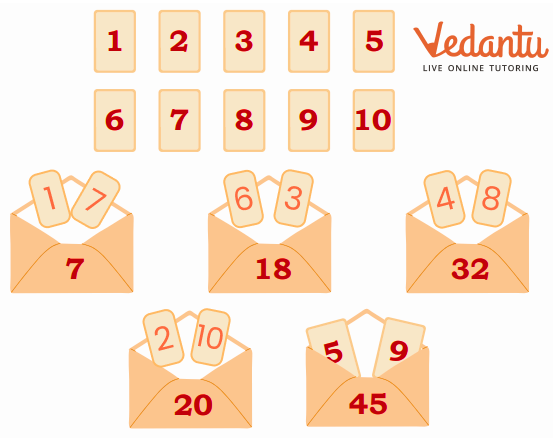
41. There are ten number cards from 1–10. There are five sealed envelopes. Each has two cards On the top of each envelope the multiplication of the numbers contained in it is written. The 5th envelope contains the cards 5 and 9. The number 5 × 9 = 45 is written on the envelope.
Identify the number of cards inside each of the envelopes.
Ans:
Benefits of NCERT Solutions for Class 3 Maths Chapter 7 Raksha Bandhan
Helps students understand numbers and arithmetic by relating them to the Raksha Bandhan festival, making the learning experience more engaging and relevant.
Provides practice problems that involve real-life scenarios, such as gifts and sweets, helping students see how maths is used in everyday situations.
Offers step-by-step solutions and explanations that clarify basic arithmetic concepts like addition and subtraction, reinforcing students’ comprehension.
Includes fun activities and examples tied to the festival, making maths more enjoyable and memorable for young learners.
Builds a strong foundation in basic arithmetic that is essential for more advanced maths concepts in later grades.
Important Study Material Links for Maths Chapter 7 Class 3 - Raksha Bandhan
Conclusion
The NCERT Solutions for Class 3 Maths Chapter 7: Raksha Bandhan provides a vibrant and engaging approach to learning basic arithmetic. By incorporating the festive context of Raksha Bandhan, these solutions make mathematical concepts like addition and subtraction more relatable and enjoyable. Students benefit from practical problem-solving exercises and culturally relevant examples that enhance their understanding and application of numbers in everyday life.
Chapter-wise NCERT Solutions Class 3 Maths
After familiarising yourself with the Class 3 Maths Chapter 7 Question Answers, you can access comprehensive NCERT Solutions for all Chapters in Class 3 Maths.
Related Important Links for Maths Class 3
Along with this, students can also download additional study materials provided by Vedantu for Maths Class 3.

FAQs on NCERT Solutions for Class 3 Maths Chapter 7 Raksha Bandhan - 2026-27 PDF Download
1. What is the focus of Chapter 7 Raksha Bandhan in Class 3 Maths?
Class 3 Maths Chapter 7 Raksha Bandhan focuses on multiplication, division, skip counting, and equal grouping. Students learn these concepts through simple activities involving rakhis, sweets, and other festival-related examples. The chapter helps children understand how to multiply, divide, and arrange numbers into equal groups.
2. How does Chapter 7 use Raksha Bandhan to teach maths?
The chapter uses familiar Raksha Bandhan activities to explain mathematical concepts. For example, students may count rakhis arranged in equal groups, calculate the total number of sweets in several boxes, or share items equally among family members. These examples make multiplication and division easier to understand.
3. What types of problems are included in Class 3 Maths Chapter 7?
Class 3 Maths Chapter 7 includes questions on repeated addition, multiplication, division, skip counting, and equal sharing. Students practise making equal groups, finding totals, and solving simple word problems using everyday situations.
4. How do NCERT Solutions for Class 3 Maths Chapter 7 help students learn?
NCERT Solutions provide clear, step-by-step explanations for textbook questions. They help students understand multiplication and division, learn different problem-solving methods, and check their answers. Students can also use these solutions to complete homework and revise important concepts.
5. Why is it beneficial to use real-life contexts like Raksha Bandhan in maths problems?
Real-life examples help children connect mathematical concepts with familiar activities. Counting rakhis, arranging gifts, and sharing sweets show how multiplication and division are used in everyday life. This approach makes learning more interesting and helps students understand the practical use of Maths.
6. What are the key arithmetic concepts covered in Class 3 Maths Chapter 7 Raksha Bandhan?
The important arithmetic concepts include multiplication as repeated addition, division as equal sharing, skip counting, and making equal groups. For example, 4 groups of 5 rakhis make 20 rakhis (4 × 5 = 20). Similarly, sharing 20 sweets equally among 4 children gives each child 5 sweets.
7. How can parents help their children with Class 3 Maths Chapter 7?
Parents can help children practise multiplication and division using everyday objects such as pencils, beads, sweets, or toys. They can encourage children to make equal groups, count objects, and solve simple sharing problems. NCERT Solutions can also help parents explain difficult textbook questions.
8. Are there any interactive activities included in Class 3 Maths Chapter 7?
Yes, Chapter 7 includes activity-based learning that encourages students to practise counting, grouping, and sharing. Children can use objects, drawings, and number patterns to understand multiplication and division. These activities help students remember mathematical concepts more easily.
9. How does learning through a festival context improve student engagement in Chapter 7?
Using a familiar festival like Raksha Bandhan makes Maths more relatable and enjoyable for young learners. Students can connect questions about sweets, rakhis, and gifts with their own experiences. This helps them understand mathematical operations and encourages active participation in learning.
10. Can NCERT Solutions for Class 3 Maths Chapter 7 Raksha Bandhan be used for revision and self-assessment?
Yes, students can use NCERT Solutions for Class 3 Maths Chapter 7 to revise multiplication, division, and equal grouping. They should first attempt the textbook questions independently and then compare their answers with the solutions. This helps them identify mistakes, improve calculation skills, and prepare for school assessments.