








Proof Formula and Solved Examples of Opposite Angles Theorem in Cyclic Quadrilateral
In this article, we will prove the theorem and the converse of the theorem on the sum of opposite angles of a cyclic quadrilateral. The Cyclic Quadrilateral Theorem is a fundamental tool of Euclidean Geometry that connects the quadrilateral with the circles and tells us about the properties of cyclic quadrilaterals. In this article, some of the solved examples related to the application of the theorem and the converse of the theorem will also be discussed along with the applications of the theorem in the real world for a crystal clear understanding of the topic.
History of Euclid

Euclid
Name: Euclid
Born: 325 BC
Died: 265 BC
Field: Mathematics
Nationality: Egypt
Statement of the Theorem on the Sum of Opposite Angles of a Cyclic Quadrilateral
According to the Cyclic Quadrilateral Theorem, the sum of either pair of opposite angles in a cyclic quadrilateral is supplementary, i.e., 180 degrees.
Proof of Theorem on Sum of Opposite Angles of Cyclic Quadrilateral

Cyclic quadrilateral ABCD with centre O
Given: Consider a cyclic quadrilateral $A B C D$ in a circle with a centre at $O$.
To prove: $\angle B A D+ \angle B C D=180^{\circ}$
$\angle A B C+ \angle A D C=180^{\circ}$
$A B$ is the chord of the circle.
$\Rightarrow \angle 5=\angle 8$ .. (1) (Angles in the same segment are equal)
$B C$ is the chord of the circle.
$\Rightarrow \angle 1=\angle 6$...(2) (Angles in the same segment are equal)
$C D$ is the chord of the circle.
$\Rightarrow \angle 2=\angle 4 \ldots$... (3) (Angles in the same segment are equal)
$A D$ is the chord of the circle.
$\Rightarrow \angle 7=\angle 3 \quad \ldots$ (4) (Angles in the same segment are equal)
By angle sum property of a quadrilateral,
$\angle A+\angle B+\angle C+\angle D=360^{\circ}$
$\Rightarrow \angle 1+\angle 2+\angle 3+\angle 4+\angle 7+\angle 8+\angle 5+\angle 6=360^{\circ}$
$\Rightarrow(\angle 1+\angle 2+\angle 7+\angle 8)+(3+\angle 4+\angle 5+\angle 6)=360^{\circ}$
$\Rightarrow(\angle 1+\angle 2+7+\angle 8)+(-7+\angle 2+\angle 8+\angle 1)=360^{\circ}$
From equations (1), (2), (3), and (4),
$2(\angle 1+\angle 2+\angle 7+\angle 8)=360^{\circ}$
$\Rightarrow(\angle 1+\angle 2+\angle 7+\angle 8)=180$
$\Rightarrow(\angle 1+\angle 2)+(\angle 7+\angle 8)=180^{\circ}$
$\Rightarrow \angle B A D+\angle B C D=180^{\circ}$
Similarly, $\angle A B C+\angle A D C=180^{\circ}$
Hence proved.
The Converse of Cyclic Quadrilateral
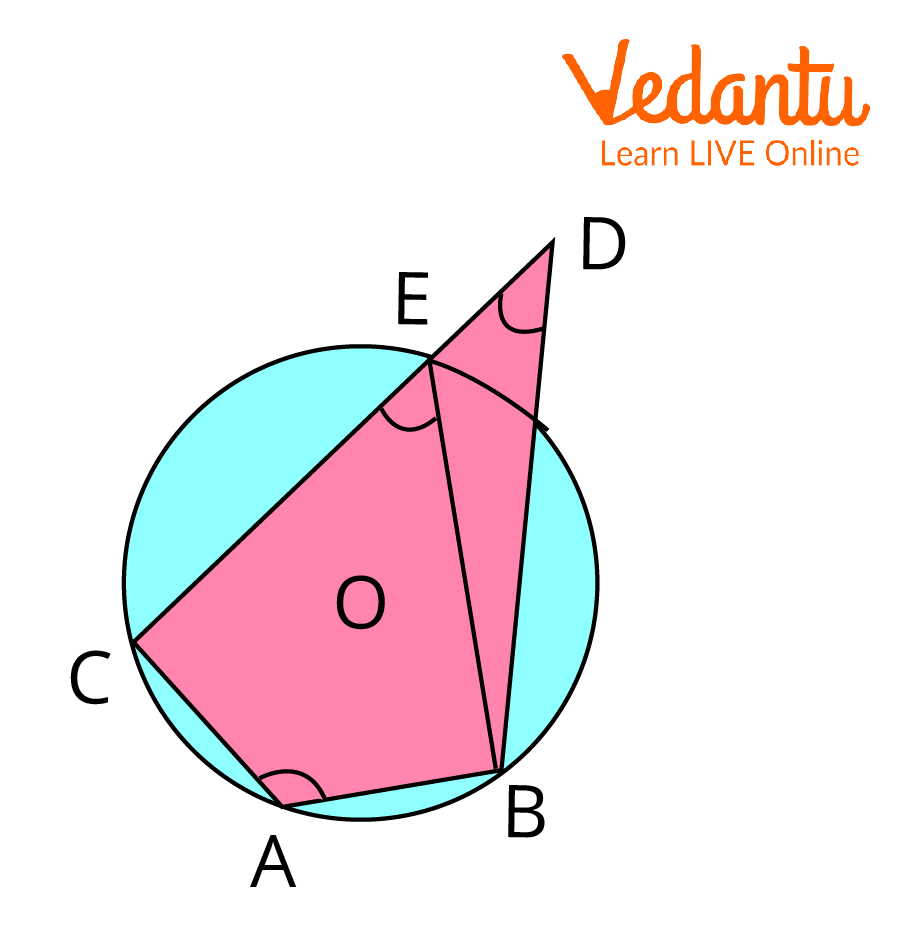
Converse of Cyclic Quadrilateral Theorem
Given: ABCD is a quadrilateral with:
$\angle B A C+\angle B D C=180^{\circ}$
$\angle A B D+\angle D C A=180^{\circ}$
To Prove: $A B C D$ is a cyclic quadrilateral.
Proof: Since A, B, C are non-collinear, the circle passes through three collinear points.
Let us draw a circle $C_{1}$ with the centre at $O$.
Let us suppose $D$ does not lie on $C_{1}$. Now,
$\therefore A B C E$ is a cyclic quadrilateral.
But given
$\Rightarrow \angle B A C=\angle B E C=180^{\circ}$
Thus,
$\Rightarrow \angle B E C=\angle B D C$
Now, $\ln \Delta \mathrm{BDE}$,
$\Rightarrow \angle B E C=\angle B D E+\angle D B E$ (Exterior angle Property)
$\Rightarrow \angle B E C=\angle B D C+\angle D B E$
$\Rightarrow \angle B D C-\angle B D C=\angle D B E$
$\Rightarrow \angle D B E=0$
$\therefore$ $E$ and $D$ Coincides
Thus, our assumption was wrong.
$\Rightarrow$ Point $D$ lies on circle $C_{1}$
$\Rightarrow A B C D$ is a cyclic quadrilateral.
Hence proved.
Limitations of the Theorem on the Sum of Opposite Angles of a Cyclic Quadrilateral
The Cyclic Quadrilateral theorem only tells us about the opposite pair of angles and doesn't tell anything about the corresponding pairs of angles.
The cyclic quadrilateral is not applicable if any quadrilateral is formed with only three points on the circumference and a fourth point inside the circle.
Applications of the Theorem on the Sum of Opposite Angles of a Cyclic Quadrilateral
The cyclic Quadrilateral Theorem is used in computer programming.
It is used in graphic arts, logos, and packaging.
It is used in making paintings, sculptures, etc.
Solved Examples
1. Find the value of angle D of a cyclic quadrilateral, if angle B is $80^{\circ}$.
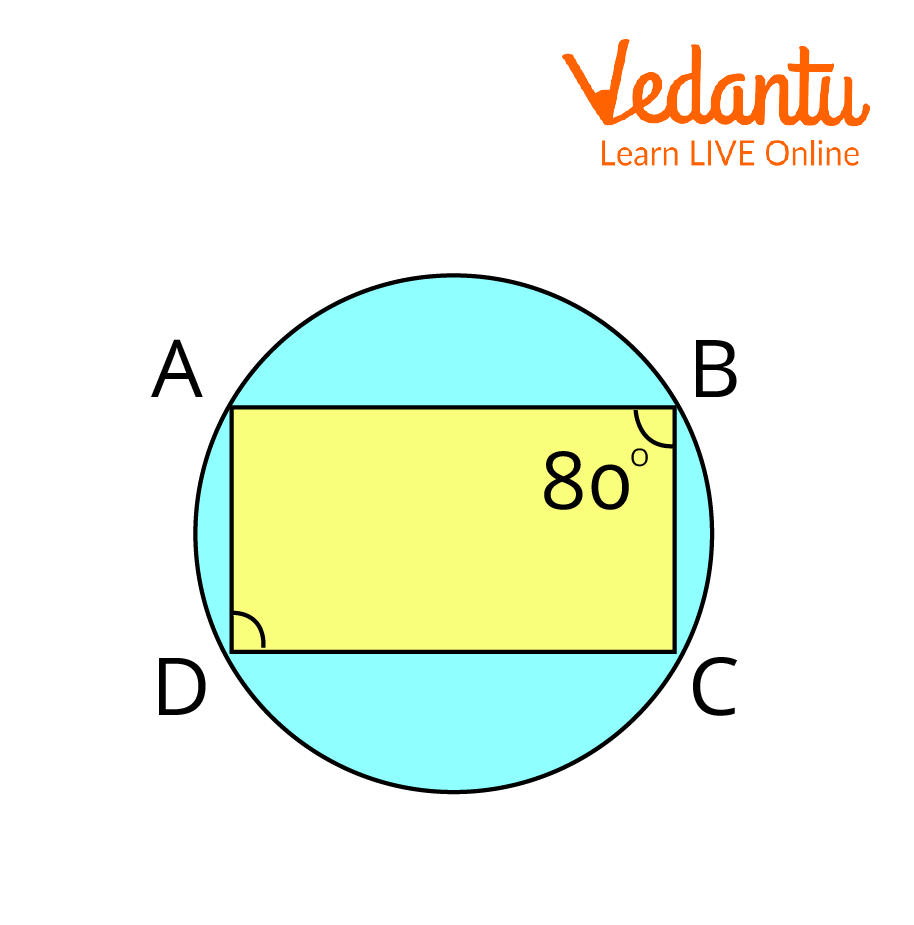
ABCD is a cyclic quadrilateral with angle B is 80 degrees.
Ans: Since $A B C D$ is a cyclic quadrilateral,
Hence, the sum of a pair of two opposite angles $=180^{\circ}$.
$\Rightarrow \angle B+\angle D=180$
$\Rightarrow 80^{\circ}+\angle D=180^{\circ}$
$\Rightarrow \angle D=180^{\circ}-80^{\circ}$
$\Rightarrow \angle D=100^{\circ}$
The value of angle $D$ is $100^{\circ}$.
2. Find the value of angle $D$ of a cyclic quadrilateral, if angle $B$ is $120^{\circ}$.
Ans:
As ABCD is a cyclic quadrilateral, hence the sum of a pair of two opposite angles $=180^{\circ}$.
$\Rightarrow \angle B+\angle D=180^{\circ} \\$
$\Rightarrow 120^{\circ}+\angle D=180^{\circ} \\$
$\Rightarrow \angle D=180^{\circ}-120^{\circ} \\$
$\Rightarrow \angle D=60^{\circ}$
The value of angle D is $60^{\circ}$.
3. In the figure given below, $A B C D$ is a cyclic quadrilateral in which
$\angle B A D=100^{\circ}$ and $\angle C D B=50^{\circ}$. find $\angle D B C$ ?
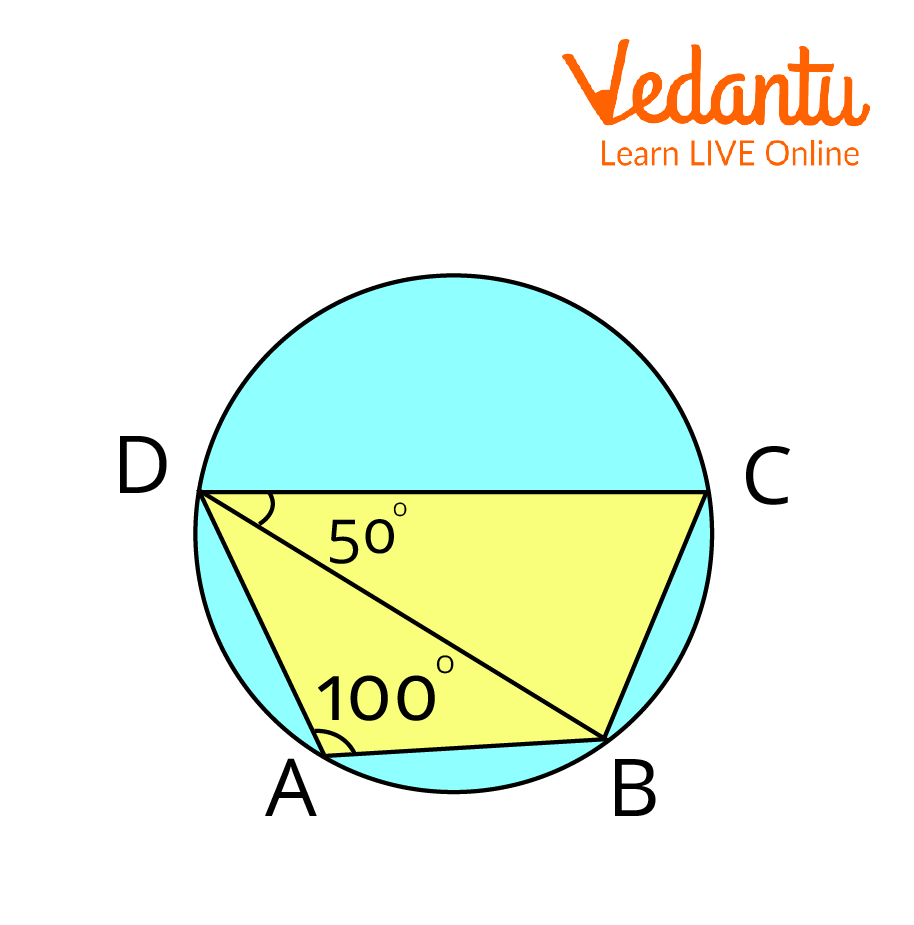
To find angle DBC in a cyclic quadrilateral
Ans:
Given,
$\angle B A D=100^{\circ}$ and $\angle C D B=50^{\circ}$
$\angle B A D+\angle B C D=180^{\circ}$ as these both angles are opposite angles of a cyclic quadrilateral.
$\Rightarrow \angle B C D=180^{\circ}-100^{\circ}=80^{\circ}$
In $\triangle B C D$,
$\angle B C D+\angle C D B+\angle D B C=180^{\circ}$
$\Rightarrow 80^{\circ}+50^{\circ}+\angle D B C=180^{\circ}$
$\Rightarrow \angle D B C=180^{\circ}-130^{\circ}$
$\Rightarrow \angle D B C=50^{\circ}$
Therefore,
$\Rightarrow \angle D B C=50^{\circ}$
Important Points to Remember
The sum of pairs of opposite angles of a cyclic quadrilateral is always supplementary.
If the sum of a pair of opposite angles of a Quadrilateral is supplementary, then the quadrilateral is a cyclic quadrilateral.
Important Formulas to Remember
If $ABCD$ is a cyclic quadrilateral in a circle with centre O, then $\angle B A D+ \angle B C D=180^{\circ}$.
If in a quadrilateral $ABCD$, $\angle B A D+ \angle B C D=180^{\circ}$, then $ABCD$ must be a cyclic quadrilateral.
Conclusion
In the article, we have discussed the proof of the Cyclic Quadrilateral Theorem and its converse. Applications of Cyclic Quadrilaterals are also discussed in this article. Cyclic Quadrilaterals are connecting links between polygons and circles. In all, we can say that the Cyclic Quadrilaterals are very important component of Geometry and connects the fundamental tools of geometry, i.e., Polygons and circles.


FAQs on Theorem on Sum of Opposite Angles in a Cyclic Quadrilateral
1. What is the theorem on the sum of opposite angles of a cyclic quadrilateral?
The theorem on the sum of opposite angles of a cyclic quadrilateral states that the opposite angles of a cyclic quadrilateral add up to 180°.
- If ABCD is a cyclic quadrilateral, then ∠A + ∠C = 180°
- Similarly, ∠B + ∠D = 180°
2. What is a cyclic quadrilateral in geometry?
A cyclic quadrilateral is a quadrilateral whose four vertices lie on the circumference of a circle.
- All vertices lie on the same circle.
- It is also called an inscribed quadrilateral.
- Its key property is that opposite angles are supplementary.
3. Why do opposite angles of a cyclic quadrilateral add up to 180°?
Opposite angles of a cyclic quadrilateral add up to 180° because each pair of opposite angles subtends arcs that together form a full semicircle.
- An inscribed angle equals half the measure of its intercepted arc.
- The arcs corresponding to opposite angles together measure 360°.
- Half of 360° is 180°, so the angles are supplementary.
4. How do you prove the opposite angles of a cyclic quadrilateral are supplementary?
To prove opposite angles of a cyclic quadrilateral are supplementary, use the inscribed angle theorem.
- Let ABCD be a cyclic quadrilateral.
- ∠A intercepts arc BCD, and ∠C intercepts arc BAD.
- The sum of these arcs is 360°.
- Each inscribed angle equals half its intercepted arc.
- Therefore, ∠A + ∠C = 180°.
5. What is the formula for opposite angles in a cyclic quadrilateral?
The formula for opposite angles in a cyclic quadrilateral is ∠A + ∠C = 180° and ∠B + ∠D = 180°.
- These pairs of angles are called supplementary angles.
- The formula applies only when all four vertices lie on a circle.
6. How do you find a missing angle in a cyclic quadrilateral?
To find a missing angle in a cyclic quadrilateral, subtract the known opposite angle from 180°.
- Use the formula Opposite angle = 180° − given angle.
- Example: If ∠A = 110°, then ∠C = 180° − 110° = 70°.
7. Can a quadrilateral be cyclic if opposite angles are supplementary?
Yes, a quadrilateral is cyclic if a pair of opposite angles are supplementary, meaning their sum is 180°.
- If ∠A + ∠C = 180°, the quadrilateral can be inscribed in a circle.
- This is the converse of the cyclic quadrilateral theorem.
8. What is the converse of the cyclic quadrilateral angle theorem?
The converse states that if the opposite angles of a quadrilateral add up to 180°, then the quadrilateral is cyclic.
- If ∠A + ∠C = 180°, the four points lie on a circle.
- This helps prove that a given quadrilateral is inscribed in a circle.
9. What is an example of the opposite angles theorem in a cyclic quadrilateral?
An example of the opposite angles theorem is when one angle of a cyclic quadrilateral is 95°, the opposite angle must be 85°.
- Use the formula ∠A + ∠C = 180°.
- Compute: 180° − 95° = 85°.
10. What are common mistakes when applying the cyclic quadrilateral angle theorem?
A common mistake is applying the 180° opposite angle rule to quadrilaterals that are not cyclic.
- Forgetting to confirm that all vertices lie on a circle.
- Adding adjacent angles instead of opposite angles.
- Confusing cyclic quadrilateral properties with parallelogram angle properties.
