








Progressive Pattern Formula Properties and Solved Examples
A pattern is something that repeats itself. It can be a man-made object or something occurring naturally in nature, like the petals of sunflowers. You can see patterns in the way things are arranged in your kitchen; you can see patterns in how streetlights are placed. Therefore, patterns are everywhere. Some patterns repeat while others grow or develop. There are various types of patterns in math as well. However, today we will learn about the progressive pattern. The pattern created by either increasing or decreasing is known as a progressive pattern.
What is a Progressive Pattern?
Progressive patterns are those that either increase or decrease in two or more different ways. They are a combination of more than one change. If you have ever been to the doctor who checks your eyes, you must have seen some patterns on the screen. Have a look at the image below. The chart you see is the one the doctors use to check your eyes. These are called log MAR charts.
You can see how it continuously decreases in size. This decreasing pattern is the best example of a progressive pattern. Examples of progressive patterns in math include geometric progressions, arithmetic progressions, etc., which you will learn in higher classes.
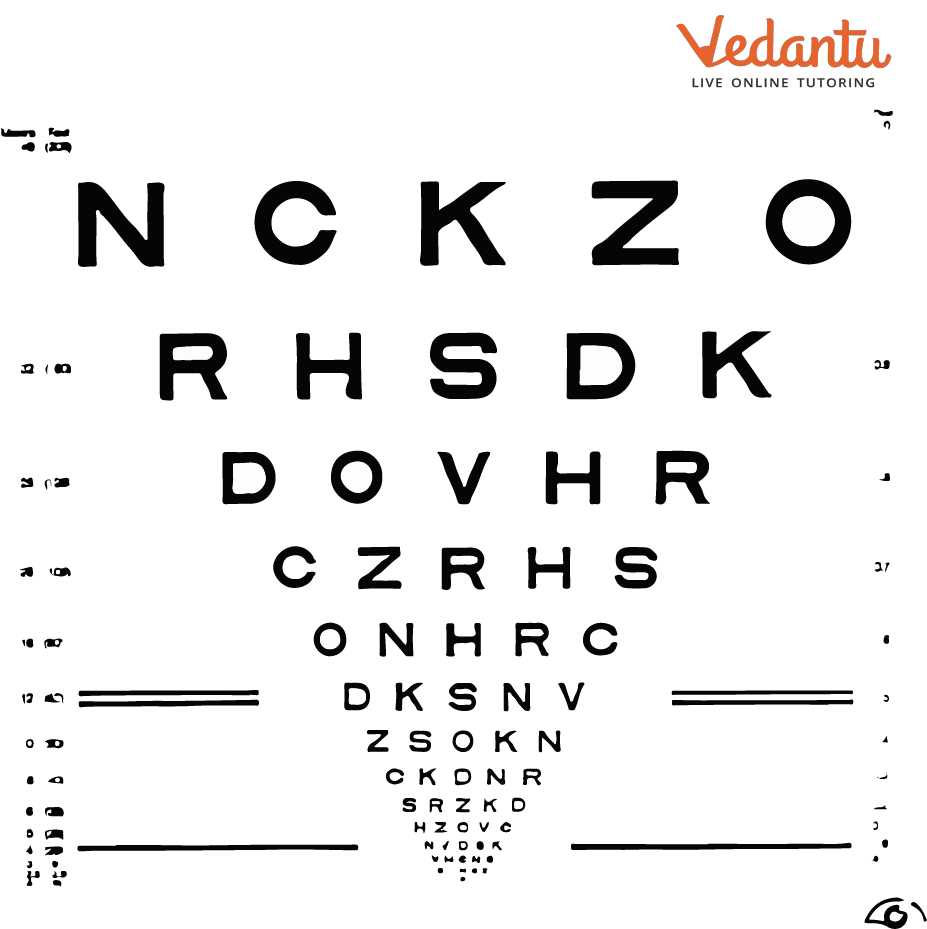
Log MAR charts used by Ophthalmologists
How to Identify the Pattern Type?
You now understand what a progressive pattern is. You can do this by marking the difference between the first two numbers/pictures and between the second and third numbers/pictures. It will form a progressive pattern when comparing whether the difference increases or decreases. Notice how the difference keeps increasing by 1.
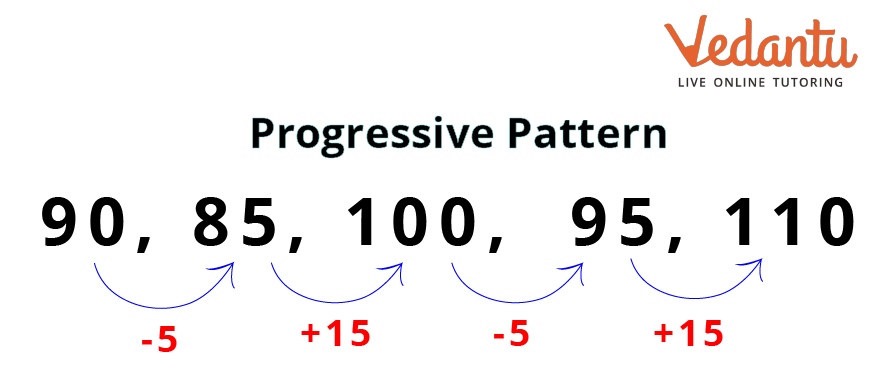
Progressive pattern
Questions Related to the Number Pattern
1. Fill in the blanks with the correct numbers
i. 90, 85, 100, 95, 110, _, _
In this question, observe the difference between the first two numbers.
$90-85=5$
The difference is 15.
Take the second and third numbers now.
$85 + 15 = 100$
The difference between 85 and 100 is 15.
Let us take 100 and 95 now.
$100 - 95 = 5$
The difference is 5.
The difference was at first 5, then increased to 15, then again decreased to 5.
Let’s take 95 and 110 now.
$95 + 15 = 110$
The pattern the numbers follow is -5, +15, -5 and +15.
So, if the pattern is followed, the next number will be $110-5=105$.
The next number will again follow the pattern, which is +15.
Hence, $105 + 15 = 120$.
The answers are 105 and 120.
ii. 160, 110, 70, ___, ___
Observe the difference between 160 and 110.
$160 - 110 = 50$
The difference is 50.
Let's observe the second and third numbers now.
$110 - 70 = 40$
You can see that the difference keeps decreasing by 10.
So, this way, the following number will be $70 - 30 = 40$ .
The number next to 40 will be $40 - 20 = 20$.
Hence, the numbers are 40 and 20.
2. Identify the pattern type.

Progressive pattern question
Answer: Progressive pattern
You can see that the circles keep getting larger as you move down the pattern. This is purely a progressive pattern, as the difference between each row keeps growing by 1.
Conclusion
Today, you have learnt about patterns, specifically progressive patterns, along with some real-life examples. Apart from that, you have also learnt to identify progressive patterns by observing the difference between two consecutive numbers or images. You have also practised a few questions related to the progressive pattern.
FAQs on Progressive Pattern in Maths Explained Clearly
1. What is a progressive pattern in Maths?
A progressive pattern is a sequence of numbers or shapes that change in a consistent and predictable way according to a specific rule. In mathematics, this usually means the numbers either increase or decrease regularly.
- Each term follows a fixed rule.
- The change can be addition, subtraction, multiplication, or another operation.
- Example: 2, 4, 6, 8, ... (add 2 each time).
2. How do you identify a progressive number pattern?
To identify a progressive number pattern, find the rule that connects consecutive terms. Follow these steps:
- Check the difference between terms (subtraction).
- If not constant, check multiplication or division.
- Look for repeating operations.
3. What is the formula for a progressive pattern?
The formula for a progressive pattern with constant difference is an = a + (n − 1)d. Here:
- a = first term
- d = common difference
- n = term number
4. What is the difference between a progressive pattern and a sequence?
A progressive pattern is a type of sequence that follows a clear, consistent rule of change. While a sequence is any ordered list of numbers, a progressive pattern specifically shows regular growth or decrease.
- Sequence: Any ordered numbers (e.g., 2, 7, 1, 9).
- Progressive pattern: Follows a rule (e.g., +3 each time).
5. Can you give an example of a progressive pattern with a solution?
Yes, an example of a progressive pattern is 4, 9, 14, 19, ... where the common difference is +5. To find the 6th term:
- First term (a) = 4
- Common difference (d) = 5
- Use formula: an = a + (n − 1)d
6. What are the types of progressive patterns?
The main types of progressive patterns are arithmetic and geometric patterns.
- Arithmetic pattern: Adds or subtracts a constant number (e.g., +3).
- Geometric pattern: Multiplies or divides by a constant number (e.g., ×2).
7. How do you find the next term in a progressive pattern?
To find the next term in a progressive pattern, apply the same rule used between previous terms.
- Find the common difference or ratio.
- Apply it to the last given term.
8. What is a progressive pattern in shapes or figures?
A progressive pattern in shapes is a visual sequence where figures change according to a consistent rule. The pattern may increase in size, number of sides, or number of objects.
- Example: 1 square, 2 squares, 3 squares arranged in order.
- The rule could be “add one square each step.”
9. Why are progressive patterns important in Maths?
Progressive patterns are important because they form the foundation of algebra, sequences, and series. They help students:
- Develop logical reasoning.
- Predict future values using formulas.
- Understand arithmetic and geometric progressions.
10. What are common mistakes when solving progressive patterns?
A common mistake in solving progressive patterns is assuming the wrong rule without checking consistency. Typical errors include:
- Not verifying the common difference or ratio.
- Confusing arithmetic and geometric patterns.
- Incorrectly substituting values in the formula an = a + (n − 1)d.
