








How to Convert Improper Fractions into Mixed Fractions with Steps and Examples
In Mathematics, fraction is used to show or represent a part of the entire thing. It can represent things as equal parts of the whole. In the representation of fractions, there are two parts namely numerator and denominator.
The number written on the top is known as the numerator. The number written on the bottom part is known as the denominator. The number of equal parts of a thing written on top is called the numerator. The denominator is the whole number in a fraction.
If $\dfrac{5}{10}$ is a fraction.
The number $5$ is a numerator, and $10$ is a denominator.

Visual Representation of a Fraction
Improper Fraction
The fractions in which the numerator value is larger than the denominator are known as improper fractions.
E.g. $\dfrac{7}{3}, \dfrac{9}{5}, \dfrac{7}{2}$
Mixed Fraction
It can be defined as the fraction made up of a combination of whole numbers and fractions.
e.g. $3 \dfrac{1}{2}, 5 \dfrac{1}{2}$
How to Convert an Improper Fraction into a Mixed Fraction?
There are certain steps to convert an improper fraction into a mixed fraction. These are discussed below.
First Step: We need to identify the improper fraction.
Second Step: Then, we need to divide the numerator by the denominator and thereby obtain the quotient and remainder.
Third Step: Now, the mixed fraction can be written as:
Quotient (Remainder/Denominator).
Simple Way to Convert Improper Fraction to Mixed Fraction
To convert an improper fraction to a mixed fraction, divide the numerator (upper portion) by the denominator in order to write an improper fraction as a mixed fraction (bottom part). The numerator is the remainder, and the quotient is the entire number.
Solved Examples
Example 1. Let us convert $\dfrac{7}{5}$ into a mixed fraction.
Ans: If in a fraction the numerator and denominator have the same number, it will make a whole.
In the case of $\dfrac{7}{5}, \dfrac{5}{5}$ can be extracted and that can be made a whole.
Therefore, the remaining fraction is $2 / 5$.
So, now we can write $\dfrac{7}{5}$ as the mixed fraction, and that is $1 \dfrac{2}{5}$
The fraction $\dfrac{7}{5}$ means that $7 \div 5$. Now we divide $7$ by $5$ and get $1$ as the quotient making $2$ as the remainder.
In order to convert an improper fraction into a mixed fraction, we need to use the quotient $1$ as the whole number and the remainder $2$ as the numerator whereas the divisor $5$ is used as the denominator of the proper fraction.
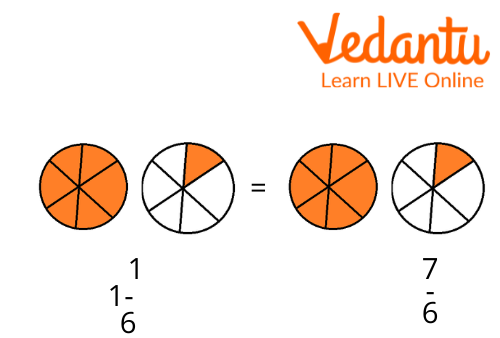
Mixed and Improper Fraction.
Example 2. Convert the improper fractions into mixed fractions:
(i) $\dfrac{17}{4}$
Ans: According to the question, the numerator is $17$, and the denominator is $4$
In order to convert the improper fraction into a mixed fraction, we divide the numerator with the denominator.
When we divide $17$ by $4$
Quotient = $4$, Remainder = $1$, Denominator = $4$.
Hence, $\dfrac{17}{4}=4 \dfrac{1}{4}$
(ii) $\dfrac{13}{5}$
Ans: According to the question, the numerator is $13$, and the denominator is $5$
In order to convert the improper fraction into a mixed fraction.
We divide the numerator with the denominator.
When we divide $13$ by $5$
Quotient = $2$, Remainder = $3$, Denominator = $5$.
Hence, $\dfrac{13}{5}=2 \dfrac{3}{5}$
(iii) $\dfrac{28}{5}$
Ans: According to the question, the numerator is $28$, and the denominator is $5$
In order to convert the improper fraction into a mixed fraction.
We divide the numerator with the denominator.
When we divide $28$ by $5$
Therefore, Quotient = $5$, Remainder = $3$, Denominator = $5$
Hence, $\dfrac{28}{5}=5 \dfrac{3}{5}$
(iv) $\dfrac{28}{9}$
Ans: According to the question, the numerator is $28$ and the denominator is $9$
In order to convert the improper fraction into a mixed fraction.
We divide the numerator with the denominator.
When we divide $28$ by $9$
The Quotient = $3$, Remainder = $1$, Denominator = $9$.
Hence, $\dfrac{28}{9}=3 \dfrac{1}{9}$
Practice Questions
Convert the following improper fractions into mixed fractions.
Q 1. Convert into mixed fractions:
(a) $\dfrac{7}{3}$
(b) $\dfrac{11}{7}$
(c) $\dfrac{13}{6}$
Ans: (a) $2^\dfrac{1}{3}$
(b) $\dfrac{14}{7}$
(c) $2^\dfrac{1}{6}$
Q 2. Write improper fraction of $\dfrac{3}{9}$
Ans: $\dfrac{1}{3}$
Summary
Fractions are representations of a single part out of many parts, and they can be in different forms either mixed or improper. Fractions can be converted into either form following a few steps. The steps include identifying an improper fraction, dividing the numerator by the denominator to get a quotient and remainder, and finally, the mixed fraction is written as Quotient (Remainder/Denominator).
Fractions are very useful in expressing a lot of things such as time, i.e. every minute is a part of an hour and every hour is a part of a day.
FAQs on Conversion of Improper Fractions into Mixed Fractions Explained
1. What is an improper fraction?
An improper fraction is a fraction in which the numerator is greater than or equal to the denominator. This means the value of the fraction is equal to or more than 1.
- Example: 7/4 is improper because 7 > 4.
- Example: 5/5 is also improper because 5 = 5.
- Improper fractions can always be converted into mixed fractions.
2. What is a mixed fraction?
A mixed fraction (or mixed number) is a number made up of a whole number and a proper fraction. It represents a value greater than 1 in a simplified form.
- Example: 1 3/4 means 1 whole and 3/4.
- The fractional part must be a proper fraction (numerator less than denominator).
- Mixed fractions are commonly used in real-life measurements.
3. How do you convert an improper fraction into a mixed fraction?
To convert an improper fraction into a mixed fraction, divide the numerator by the denominator and write the quotient and remainder properly. Follow these steps:
- Divide the numerator by the denominator.
- The quotient becomes the whole number.
- The remainder becomes the new numerator.
- Keep the denominator the same.
4. What is the formula for converting an improper fraction to a mixed number?
The formula for converting an improper fraction to a mixed number is: Improper Fraction = (Quotient × Denominator + Remainder) / Denominator. In reverse form:
- Whole number = numerator ÷ denominator
- Remainder = numerator mod denominator
- Mixed number = Quotient Remainder/Denominator
5. Can you give an example of converting 9/4 into a mixed fraction?
Yes, 9/4 as a mixed fraction is 2 1/4. Step-by-step solution:
- Divide 9 by 4 → 9 ÷ 4 = 2 remainder 1.
- Quotient = 2 (whole number).
- Remainder = 1 (new numerator).
- Denominator stays 4.
6. Why do we convert improper fractions into mixed fractions?
We convert improper fractions into mixed fractions to make them easier to understand and use in real-life situations. Mixed numbers clearly show the number of whole units and the remaining fraction.
- They are easier to visualize.
- They are commonly used in measurements like length and cooking.
- They simplify comparison between quantities.
7. What is the difference between a proper fraction and an improper fraction?
The main difference is that a proper fraction has a numerator smaller than the denominator, while an improper fraction has a numerator greater than or equal to the denominator.
- Proper fraction example: 3/5
- Improper fraction example: 8/5
- Improper fractions can be written as mixed fractions, but proper fractions cannot.
8. How do you convert a mixed fraction back into an improper fraction?
To convert a mixed fraction into an improper fraction, multiply the whole number by the denominator and add the numerator. The steps are:
- Multiply whole number × denominator.
- Add the numerator.
- Keep the same denominator.
9. What are common mistakes when converting improper fractions to mixed fractions?
A common mistake when converting improper fractions to mixed fractions is placing the quotient or remainder incorrectly. Avoid these errors:
- Do not change the denominator.
- Do not write the remainder as the denominator.
- Always check that the fractional part is a proper fraction.
10. Is every improper fraction convertible into a mixed fraction?
Yes, every improper fraction can be converted into a mixed fraction or a whole number. When the numerator is exactly divisible by the denominator, the result is a whole number.
- Example: 12/4 = 3 (no remainder).
- Example: 13/4 = 3 1/4 (with remainder).
