








Step by Step Method To Construct A Parallelogram With Compass And Ruler
If you're struggling with geometry, don't worry. With this step-by-step guide, you'll be able to know how to make a parallelogram or construct it in no time! Just remember the basic definition of a parallelogram - It is a special kind of quadrilateral that is formed by parallel lines. The angle between the adjacent sides of a parallelogram may vary, but the opposite sides need to be parallel for it to be a parallelogram.
So, it can also be said that a parallelogram is a quadrilateral. A parallelogram has two pairs of parallel lines, called the bases, while the other pair is a set of diagonals that intersect at their midpoints. In this article, we will look at parallelograms and how to draw a parallelogram.
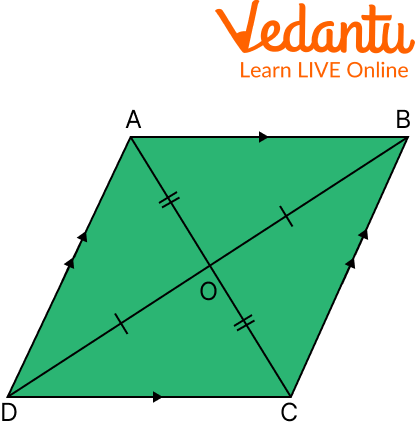
Parallelogram
Properties of a Parallelogram
Following are the Properties of a Parallelogram:
A parallelogram can be identified using certain simple properties. Examine the following parallelogram PQTR in relation to the properties listed below.
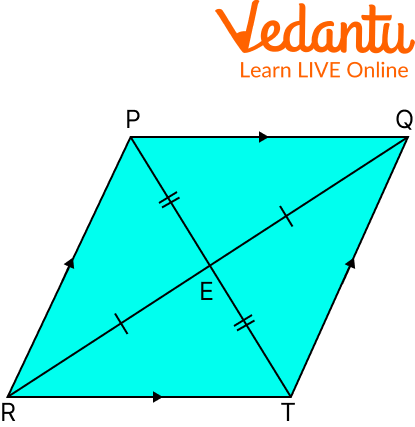
Parallelogram PQTR
The following properties can help us identify and differentiate a parallelogram:
The opposite sides of a parallelogram are parallel. Here, $PQ \| RT$ and $PR \| Q T$.
The opposite sides of a parallelogram are equal. Here, $P Q=R T$ and $P R=QT$
The opposite angles of a parallelogram are equal. Here, $\angle P=\angle T$ and $\angle Q=\angle R$
The diagonals of a parallelogram bisect each other. Here, RE = EQ and $P E=E T$
Same-side interior angles supplement each other. Here, $\angle P R T+$ $\angle R T Q=180^{\circ}, \angle R T Q+\angle T Q P=180^{\circ}, \angle T Q P+\angle Q P R=180^{\circ}, \angle Q P R+$ $\angle P R T=180^{\circ}$
The diagonals divide the parallelogram into two congruent triangles. Here, $\triangle \mathrm{RPQ}$ is congruent to $\triangle \mathrm{RTQ}$, and $\triangle \mathrm{RPT}$ is congruent to $\triangle Q T P$
Parallelogram is a Quadrilateral
A quadrilateral with two opposite pairs of parallel sides is known as a parallelogram. A parallelogram's opposite sides are equal in length, and its opposite angles are equal in size. Furthermore, the interior angles on the same transversal side are additional. And that is why we call a parallelogram a quadrilateral.
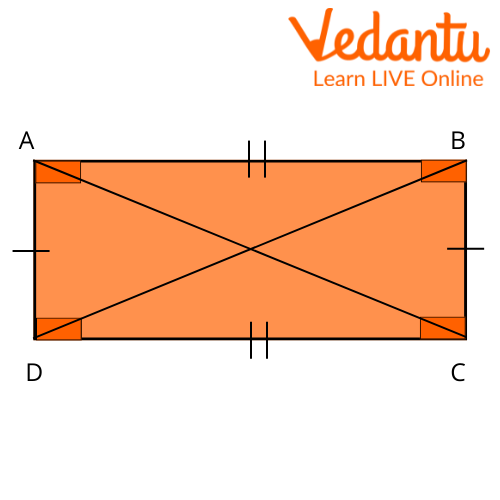
Quadrilateral ABCD
Can a Square be a Parallelogram?
A parallelogram having four equal sides and four right angles is called a square.
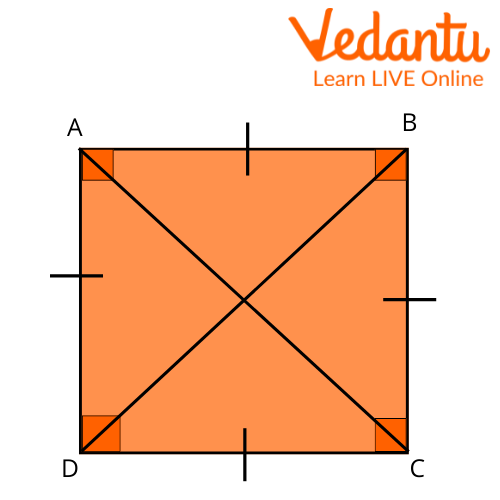
Square ABCD
Examine the square ABCD to see how it relates to the following qualities. A square contains:
Four equal sides. Here, $A B=B C=C D=D A$
Four right angles. Here, $\angle \mathrm{A}=\angle \mathrm{B}=\angle \mathrm{C}=\angle \mathrm{D}=90^{\circ}$
Two pairs of parallel sides. Here, $A B \| D C$ and $A D|| B C$
Two equal diagonals. Here, $A C=B D$
Diagonals that are perpendicular to each other. Here, $A C \perp B D$
Diagonals that bisect each other.
Therefore, from the above properties, it can be said that a square is a parallelogram.
Construct a Parallelogram
Construct a Parallelogram When Two Consecutive Sides and the Included Angle are given:
Step 1: Construct a line segment $A B=4 \mathrm{~cm}$.
Step 2: Construct a 60-degree angle at point $A$.
Step 3: Construct a line segment $A D=5 \mathrm{~cm}$ on the other arm of the angle.
Step 4: Then, place the sharp point of $5 \mathrm{~cm}$ above $B$
Step 5: Stretch your compasses to $4 \mathrm{~cm}$, place the sharp end at D and draw an arc to intersect the arc drawn in step 2.

Draw a Parallelogram
Step 6: Label the intersecting point $C$.
Step 7: Join $C$ to $D$ and $B$ to $C$ to form the parallelogram $A B C D$.
Practice Problems
Q 1. Construct a parallelogram whose diagonal is 5.4 cm and 6.2 and an angle between them is 70.
Q 2. Construct a parallelogram when one of its side is $4 \mathrm{~cm}$ and its two diagonal are $5.6 \mathrm{~cm}$ and $7 \mathrm{~cm}$. Measure the other side.
Summary
A parallelogram is a four-sided figure with two pairs of parallel sides. Then we saw the properties of a parallelogram, and we came to know that a square is a parallelogram. To construct a parallelogram, you will need a scale and a compass.
First, use the compass to draw two arcs that intersect at two points. Then, use the scale to connect the points of intersection. Finally, use the compass to draw two more arcs that intersect at two additional points. Connect these points as well, and you will have created a parallelogram. We have now seen how to construct a parallelogram given certain conditions.
FAQs on How To Construct A Parallelogram Using Geometric Steps
1. What is a parallelogram?
A parallelogram is a quadrilateral in which both pairs of opposite sides are parallel. It has the following key properties:
- Opposite sides are equal and parallel.
- Opposite angles are equal.
- Adjacent angles are supplementary (sum to 180°).
- Diagonals bisect each other.
2. How do you construct a parallelogram using a ruler and compass?
To construct a parallelogram using a ruler and compass, draw two pairs of equal and parallel opposite sides. Follow these steps:
- Draw a line segment AB of given length.
- At point A, construct the given angle.
- Mark point D on the angle arm with the given side length.
- With center B and radius equal to AD, draw an arc.
- With center D and radius equal to AB, draw another arc intersecting at C.
- Join BC and CD to complete parallelogram ABCD.
3. How do you construct a parallelogram when two adjacent sides and the included angle are given?
To construct a parallelogram when two adjacent sides and the included angle are given, use the side-angle-side method. Steps:
- Draw side AB equal to the first given length.
- At A, construct the given angle.
- Mark point D on the angle arm equal to the second given side.
- Draw a line through B parallel to AD.
- Draw a line through D parallel to AB to meet at C.
4. What is the formula for the area of a parallelogram?
The formula for the area of a parallelogram is Area = base × height. Here:
- Base (b) is any side of the parallelogram.
- Height (h) is the perpendicular distance from the base to the opposite side.
5. How do you find the perimeter of a parallelogram?
The perimeter of a parallelogram is calculated using Perimeter = 2(a + b), where a and b are adjacent sides. Since opposite sides are equal:
- Add the lengths of two adjacent sides.
- Multiply the sum by 2.
6. What are the properties used to construct a parallelogram?
The main properties used to construct a parallelogram are that opposite sides are parallel and equal, and diagonals bisect each other. Important properties include:
- Opposite sides are equal and parallel.
- Opposite angles are equal.
- Diagonals bisect each other.
7. Can you construct a parallelogram if only the diagonals are given?
Yes, a parallelogram can be constructed if both diagonals and the angle between them are given. Since diagonals bisect each other:
- Draw one diagonal and mark its midpoint.
- Construct the given angle at the midpoint.
- Draw the second diagonal so that it is bisected at the same midpoint.
- Join the endpoints of the diagonals.
8. What is the difference between a parallelogram and a rectangle?
The main difference is that a rectangle has four right angles, while a parallelogram does not necessarily have right angles. Specifically:
- A parallelogram has opposite sides parallel and equal.
- A rectangle is a special type of parallelogram with all angles equal to 90°.
9. How do you prove that a quadrilateral is a parallelogram?
A quadrilateral is a parallelogram if it satisfies at least one key parallelogram condition. You can prove it by showing:
- Both pairs of opposite sides are parallel, or
- Both pairs of opposite sides are equal, or
- Diagonals bisect each other, or
- One pair of opposite sides is both equal and parallel.
10. What are common mistakes when constructing a parallelogram?
Common mistakes when constructing a parallelogram include not ensuring opposite sides are parallel and equal. Frequent errors are:
- Incorrect angle construction.
- Not measuring side lengths accurately.
- Forgetting that diagonals must bisect each other.
- Drawing lines that are not truly parallel.
