








What Are Multiplication Facts With Tables and Solved Examples
As we all know what multiplication is and how we solve questions related to multiple class 2. But did you know that we also call the solution of any multiplication equation a fact? Some standard multiplication facts are needed to follow for multiplying numbers and there are several methods by which we can find out the multiplication facts. The repeated addition of one particular number is expressed by multiplication. Some maths sheets for class 2 are given below for practice.
Multiplication Fact
A multiplication fact is considered the answer to a multiplication calculation when a number is multiplied by a different set of numbers. It follows some patterns to multiply two numbers and write their products aside.
Here are some examples of multiplication facts:
2 × 3 = 6 (the multiplication fact is 6)
7 × 5 = 35 (the multiplication fact is 35)
10 × 2 = 20 (the multiplication fact is 20).
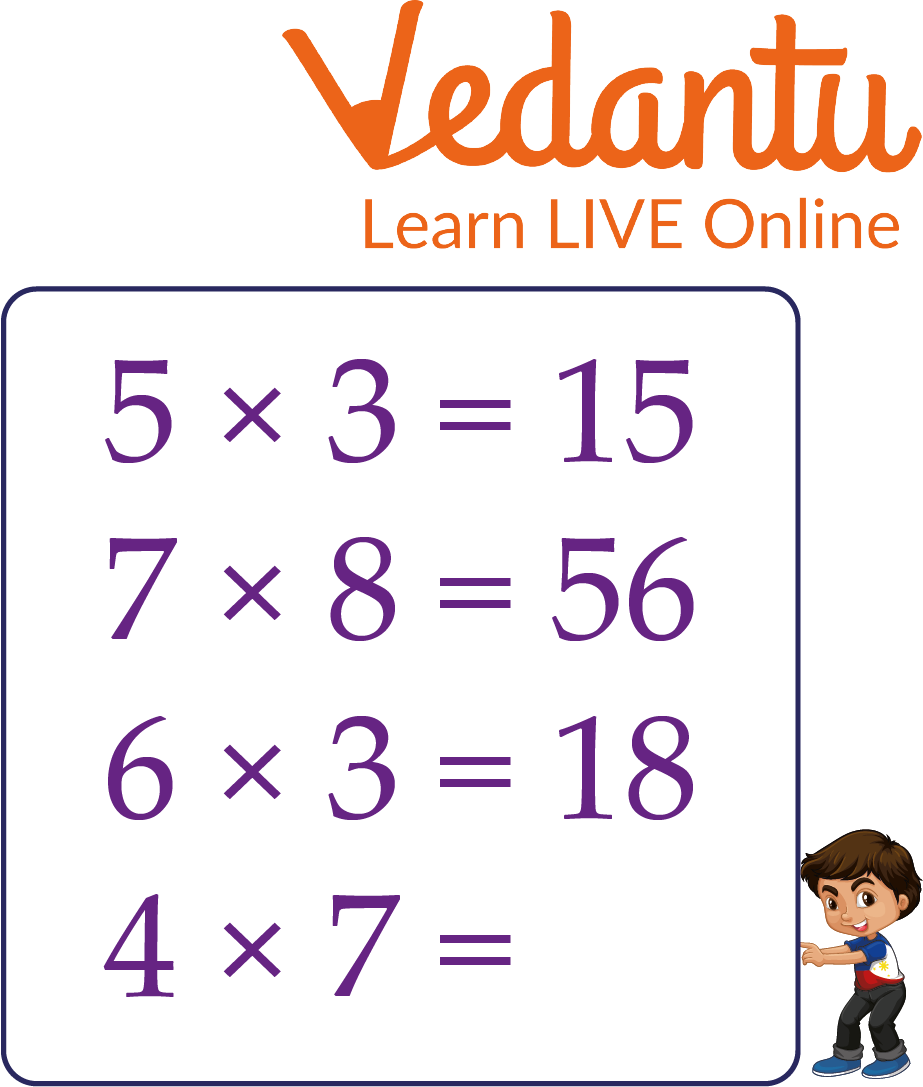
Multiplication Fact
How to Write Multiplication Facts for Class 2?
You can write multiplication facts by writing out multiplication calculations.
For example:
12 x 10 = 120
3 x 7 = 21
8 x 6 = 48
Multiplication facts can also be written by different methods of multiplication.
For example, repeated addition is a way of finding multiplication facts. One can repeatedly add a number to reach the answer. 2 × 4 is the same as 2 + 2 + 2 + 2 = 8. The multiplication fact, in this case, is 8.
How to Learn Multiplication Facts for Class 2?
One of the best ways to learn multiplication facts is through repetition since it helps children to form a good and strong memory of multiplication facts.
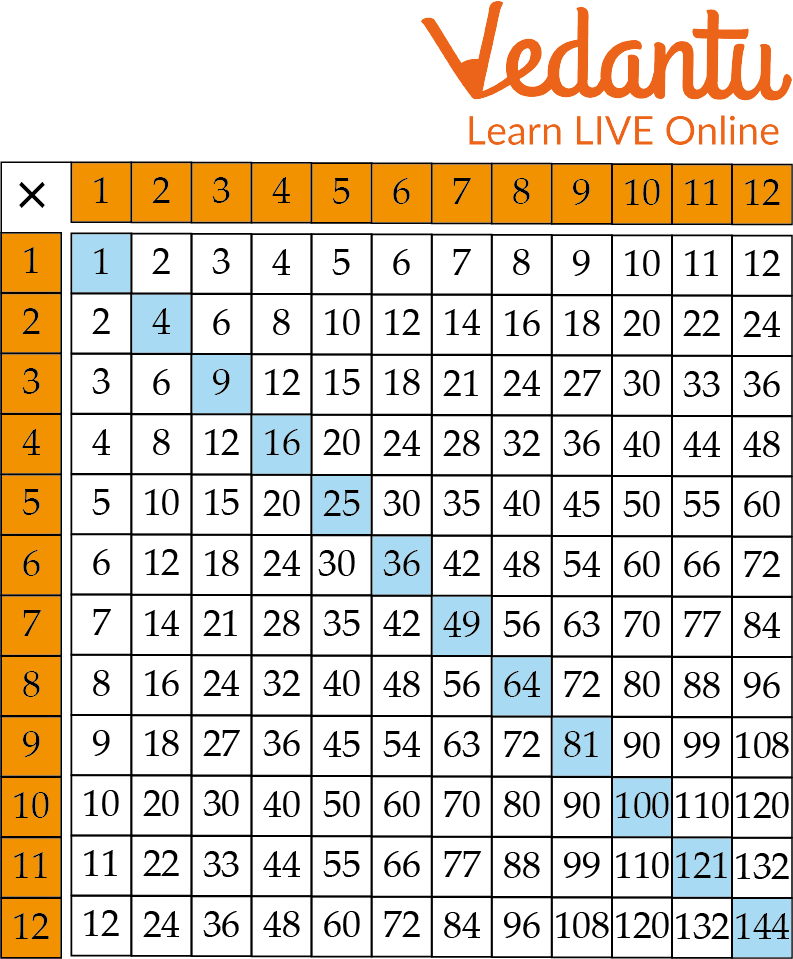
Learning Method
Given are some ways to learn multiplication facts and their multiplication tables:
Using a multiplication square that shows the multiplication facts for numbers in the times table. This provides a great visual aid for learning times tables and multiplication facts.
Reciting the multiplication table forwards and backwards. Reciting it out loud helps to reinforce one's memory of basic multiplication facts.
Practising skip counting. Skip counting is a type of multiplication by repeated addition. For eg, skip counting by 2 is the same as the table of 2: 2, 4, 6, 8, 10, etc.
Solved Examples of Multiples Class 2
Q 1. If a bowl contains 25 marbles, each group should have 5 marbles. Then how many such groups can be formed?
Ans. The total number of marbles in a bowl is = 25
5 marbles are used to make a group, i.e. the number of groups is calculated using the formula:
Number of groups = Total number of marbles in a bowl divided by the number of marbles required to make a group
= $\dfrac{25}{5}$
= 5
One can also do it by the process of repeated addition, i.e. add 5 to itself 5 times, it will result in 25, i.e. 5+5+5+5+5 = 25.
Thus, the required number of groups of marbles are 5.
Q 2. How many groups of bats are there?

Solved Example
Ans. The total number of bats in 3 groups is calculated by adding 3 to itself three times, i.e. 3 + 3 + 3 = 9. This can also be found by multiplying, three by three, i.e. 3 × 3.
Thus, the required number of bats in the group is 9.
Practice Problems
Q1. How many brinjals are there, if the number of groups of brinjals is 144 and there are 8 brinjals in each one?
Answer: 1152
Q2. How many groups of two apples each can be made using 166 apples?
Answer: 83
Q3. How many groups can be made of 240 carrots, if there should be 12 carrots in a group?
Answer: 20
Class 2 Maths Multiplication Worksheets
Below given is the worksheet maths for class 2, which helps the students to evaluate their learning of the multiplication facts.
(a) $7 \times 11$ (Ans: 77)
(b) $7 \times 2$ (Ans: 14)
(c) $8 \times 9$ (Ans: 72)
(d) $9 \times 5$ (Ans: 45)
(e) $7 \times 10$ (Ans: 70)
(f) $6 \times 12$ (Ans: 72)
(g) $10 \times 30$ (Ans: 300)
(h) $4 \times 11$ (Ans: 44)
(i) $2 \times 25$ (Ans: 50)
(j) $3 \times 15$ (Ans: 45)
Summary
In this article, we learned about multiplication facts and some basic facts that are needed for multiplying two numbers such as the repeated addition method where we make groups of the given number and then add them to get the fact. We also learned about how to write and learn multiplication facts. Some unsolved maths sheets for class 2 are also given. Worksheet maths for class 2 serves as a useful tool in evaluating the progress of students.
FAQs on Multiplication Facts and Times Tables Explained
1. What are multiplication facts?
Multiplication facts are basic number sentences that show the product of two whole numbers, such as 3 × 4 = 12. These facts are usually learned for numbers 0 through 12 and form the foundation of arithmetic.
- They are also called times tables.
- They help with division, fractions, and problem-solving.
- Example: 7 × 8 = 56 is a multiplication fact.
2. Why are multiplication facts important?
Multiplication facts are important because they build speed and accuracy in solving larger maths problems. Knowing them by heart helps students:
- Solve long multiplication and division quickly.
- Understand fractions and ratios.
- Improve mental maths skills.
3. How do you memorize multiplication facts easily?
You can memorize multiplication facts easily by practicing patterns, using repetition, and applying simple strategies. Effective methods include:
- Learning facts in groups (like the 2s, 5s, and 10s first).
- Using skip counting (e.g., 3, 6, 9, 12 for 3s).
- Practicing with flashcards and timed quizzes.
- Using patterns such as any number × 0 = 0.
4. What is the multiplication table?
A multiplication table is a chart that shows the products of numbers multiplied together, usually from 1 to 10 or 1 to 12. It lists results like:
- 4 × 5 = 20
- 6 × 7 = 42
5. What are the properties of multiplication?
The main properties of multiplication are the commutative, associative, identity, and zero properties. These include:
- Commutative Property: a × b = b × a (e.g., 3 × 4 = 4 × 3).
- Associative Property: (a × b) × c = a × (b × c).
- Identity Property: a × 1 = a.
- Zero Property: a × 0 = 0.
6. What is the trick for multiplying by 9?
A simple trick for multiplying by 9 is that the digits of the product add up to 9 for facts from 1 to 10. For example:
- 9 × 3 = 27 → 2 + 7 = 9
- 9 × 6 = 54 → 5 + 4 = 9
7. How are multiplication and division facts related?
Multiplication and division facts are related because they are inverse operations. If 4 × 6 = 24, then:
- 24 ÷ 6 = 4
- 24 ÷ 4 = 6
8. What is a fact family in multiplication?
A fact family is a group of related multiplication and division facts using the same three numbers. For example, using 5, 8, and 40:
- 5 × 8 = 40
- 8 × 5 = 40
- 40 ÷ 5 = 8
- 40 ÷ 8 = 5
9. What are common mistakes when learning multiplication facts?
Common mistakes in multiplication facts include confusing similar products and skipping practice. Frequent errors include:
- Mixing up facts like 6 × 7 = 42 and 7 × 8 = 56.
- Forgetting the zero property (any number × 0 = 0).
- Not recognizing commutative pairs like 3 × 5 and 5 × 3.
10. At what age should children know their multiplication facts?
Most children are expected to know basic multiplication facts up to 10 or 12 by ages 8 to 10 years. This typically happens in grades 3 or 4. By this stage, students should:
- Recall facts like 8 × 7 = 56 quickly.
- Understand times tables and fact families.
- Apply multiplication in word problems.
