









How to Convert Kilograms to Grams Using Formula and Solved Examples
The term “Measurement” describes the quantity of any object either in a solid or liquid state.
It helps to know the unit of every shape. There are basic units to measure the weight, length, and capacity of different shapes.
Measures of Mass: The quantity of matter or substance that makes up a thing is known as its mass. Mass is the measure of matter in an object. A unit of measurement is kilograms, abbreviated as kg.

Which is Heavier?
Can you tell us which one is heavier in the above image? Whose weight would be in Kg?
Yes, which one is heavy is depicted by the size of small and large but to know how much, we need to use a tool like a weighing machine to know the accurate weight.
Mass v/s Weight: It's crucial to keep in mind that mass differs from the weight. While weight varies with changes in gravity, mass never changes.
Weighing is how we determine the mass, yet weight and mass are not the same.
The most typical measurements are as follows:
Grams
Kilograms
Tonnes
Tonnes are the largest, while Grams are the smallest.
Here, the kilogram conversion is explained in detail. Few solved examples are shown below on how to convert kg into grams.
Grams
An average paper clip weighs one gram.

Paperclip
Let’s understand this through an activity.
Activity: One little paperclip should be held in your hand. Does that have much weight? No! Grams are quite light. This explains why items are frequently measured in hundreds of grams.
Since the abbreviation "g" for grams is frequently used, "300 g" stands for "300 grams."
The average loaf of bread weighs 700 g. (for a nice-sized loaf).
Kilograms
A kilogram is a unit used to measure mass.
Kilograms are excellent for weighing objects that people can lift, yet occasionally very powerful individuals are required.
1,000 grams make up 1 kilogram.
For example, an average dictionary weighs roughly one kilogram.

Dictionary
Another example is 1 kilogram of gold. The weight of this gold bar is similarly one kilogram.

Gold
Since kilograms are sometimes written as kg ("k" for "kilo" and "g" for "gramme"), "10 kg" refers to ten kilograms.
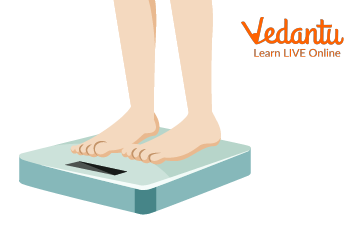
Weighing Machine
Our weight is measured on scales in kilograms. An adult typically weighs 70 kg.
But we must use the tonne when referring to extremely hefty items.
Kilogram Conversion
There are seven basic units used in kilogram conversion.
Milligrams
Centigrams
Decigrams
Gram
Decagrams
Hectograms
Kilograms
This is present in decreasing order means, a milligram is the smallest and a kilogram is the highest. To convert a smaller unit into a bigger unit we divide it by 10 and to convert a bigger into a smaller we multiply it by 10.
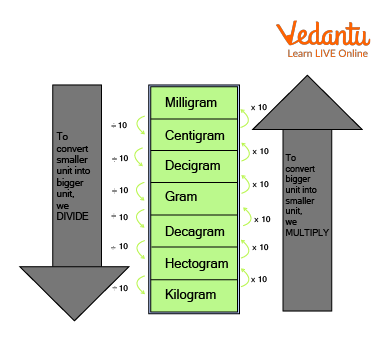
Conversion
Grams to Kilograms
The International System of Units also defines a gram as a unit of mass (SI). It weighs 0.001 kilograms. It is used to measure light things like pens and candy bars and is represented by the sign "g".
As a result, 1 kilogram (Kg) equals 1000 grams is the relationship between kilogram and grams (g).
Grams to Kilogram = 1g = 0.001 kg
Kilogram to Gram = 1 kg = 1000 g
Kilogram to Milligrams
As 1 gram (g) is equal to 1000 milligrams (mg), hence the relation between kilogram and milligrams is given as, 1 kilogram (kg) = 1000000 milligrams (mg).
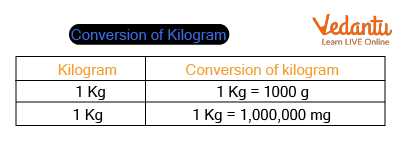
Conversion of Kilogram
Below are the few solved examples and practice problems on how to convert kg into gram.
Solved Example
Q1. Convert the following kilogram into grams.
(a) $2 \mathrm{~kg}$ into $\mathrm{g}$
Ans: $1 \mathrm{~kg}=1000 \mathrm{~g}$
$2 \mathrm{~kg}=2 \times 1000 \mathrm{~g}$
$=2000 \mathrm{~g}$
(b) $5 \mathrm{~g}$ into $\mathrm{kg}$
Ans: $1 \mathrm{~g}=\dfrac{1}{1000} \mathrm{~kg}$
$5 \mathrm{~g}=(\dfrac{5}{1000}) \mathrm{kg}$
$=0.005 \mathrm{~kg}$
(c) $1 \mathrm{~kg} 506 \mathrm{~g}$ into $\mathrm{g}$
Ans: $1 \mathrm{~kg}=1000 \mathrm{~g}$
$1 \mathrm{~kg} 506 \mathrm{~g}=1 \times 1000 \mathrm{~g}+506 \mathrm{~g}$
$=1000 \mathrm{~g}+506 \mathrm{~g}$
$=1506 \mathrm{~g}$
(d) $5 \mathrm{~kg} 124 \mathrm{~g}$ into $\mathrm{g}$
Ans: $1 \mathrm{~kg}=1000 \mathrm{~g}$
$5 \mathrm{~kg} 124 \mathrm{~g}=(5 \times 1000) \mathrm{g}+124 \mathrm{~g}$
$=5000 \mathrm{~g}+124 \mathrm{~g}$
$=5124 \mathrm{~g}$
(e) $15 \mathrm{~g}$ into $\mathrm{kg}$
Ans: $1 \mathrm{~kg}=1000 \mathrm{~g}$
$15 \mathrm{~g}=(15 \times 1000) \mathrm{g}$
$=15000 \mathrm{~g}$
Practice Problems
1. Convert the following:
(a) 5g into kg
(b) 5kg 64g into kg
(c) 6kg into g
Ans:
(a) 0.005kg
(b) 5.064kg
(c) 0.006g
Summary
The kilogram is employed to weigh things with a medium to high density. Body weight, vegetables, and fruits are all measured in kilograms, which are represented by the sign "kg," where "k" stands for kilo and "g" for gram. There are so many different-sized and-weighted items all around us. The same mass is being measured in different units. There are different units of measurement of mass. Like Kilogram, milligram, centigram, etc.
FAQs on Kilogram to Gram Conversion Explained with Formula
1. What is the formula to convert kilograms to grams?
The formula to convert kilograms to grams is grams = kilograms × 1000. This is because 1 kilogram (kg) = 1000 grams (g) in the metric system. To convert:
- Multiply the number of kilograms by 1000.
- The result is the equivalent weight in grams.
2. How many grams are there in 1 kilogram?
There are 1000 grams in 1 kilogram. The metric system is based on powers of 10, making conversions simple. Since “kilo” means 1000, 1 kg equals 1000 g. This relationship is essential for mass conversion in mathematics and everyday measurements.
3. How do you convert kilograms to grams step by step?
To convert kilograms to grams, multiply the number of kilograms by 1000. Follow these steps:
- Write the given value in kilograms.
- Multiply it by 1000.
- Add the unit grams (g) to the result.
- 5 × 1000 = 5000 g
4. How do you convert grams to kilograms?
To convert grams to kilograms, divide the number of grams by 1000. The formula is kilograms = grams ÷ 1000. For example:
- 2000 g ÷ 1000 = 2 kg
5. Why do we multiply by 1000 when converting kilograms to grams?
We multiply by 1000 because 1 kilogram equals 1000 grams in the metric system. The prefix “kilo-” means 1000, so converting from a larger unit (kg) to a smaller unit (g) requires multiplication. This place value shift makes metric conversions simple and consistent.
6. What is 0.5 kg in grams?
0.5 kilograms is equal to 500 grams. Using the formula grams = kilograms × 1000:
- 0.5 × 1000 = 500 g
7. What is the difference between kilograms and grams?
The difference between kilograms and grams is that a kilogram is a larger unit of mass, while a gram is a smaller unit. Specifically:
- 1 kilogram = 1000 grams
- Kilograms are used for heavier objects (e.g., body weight).
- Grams are used for lighter objects (e.g., food items).
8. Can you give an example of converting kilograms to grams?
Yes, to convert 2.75 kilograms to grams, multiply by 1000. Calculation:
- 2.75 × 1000 = 2750 g
9. What are common mistakes when converting kilograms to grams?
A common mistake when converting kilograms to grams is forgetting to multiply by 1000. Other errors include:
- Multiplying by 100 instead of 1000.
- Moving the decimal point the wrong way.
- Confusing grams to kilograms conversion (division) with kilograms to grams (multiplication).
10. How is kilogram to gram conversion used in real life?
Kilogram to gram conversion is used to measure and compare weights accurately in daily life. Common applications include:
- Buying groceries (e.g., 1.5 kg = 1500 g).
- Cooking and baking measurements.
- Science and maths calculations involving mass.
