









What Are Multiples Definition Rules and Solved Examples
Being one of the most exciting chapters of mathematics, Multiples and Factors enables students to get into the fundamentals of calculating and simplifying equations. The chapter establishes a base for students which they can make use of while understanding more difficult areas of this subject. The chapter mainly contains the definition of multiples, how these are important in Mathematics, activity based on common factors and common multiples, etc., along with some examples.
The chapter also contains a detailed description and usage of factors and the differences between common factors and common multiples. These two are vital concepts related to each other; therefore, students should go through both these topics simultaneously to better understand them.
Multiples are an easy way of saying ‘manifold’ or a result of adding something multiple times. It is important that kids learn the meaning and uses of multiples in Maths because this is a concept that will be used in life “multiple times”! So let us learn more about this term.
Definition of Multiple
The term multiple can be defined as the product of a number that is multiplied by another number. A number multiplied by different numbers will result in different multiples. Therefore, a multiple of a number can be reached by multiplying the number by a specific number or by adding the number to itself for a specific number of times.
Examples of Multiples
The number 56 is a multiple of 7. Here, adding 7 eight times will result in the number 56. In other words, multiplying the integer 7 by 8 will give 56. It must be noted here that 56 is also a multiple of 8 since 8 added seven times will give 56 or 8 multiplied by 7 will result in 56.
Here is a table to list a few multiples of 4:
4 x 1 = 4
4 x 2 = 8
4 x 3 = 12
4 x 4 = 16
4 x 5 = 20
4 x 6 = 24
Therefore, it can be said that 4, 8, 12, 16, 20, 24 are all multiples of 4.
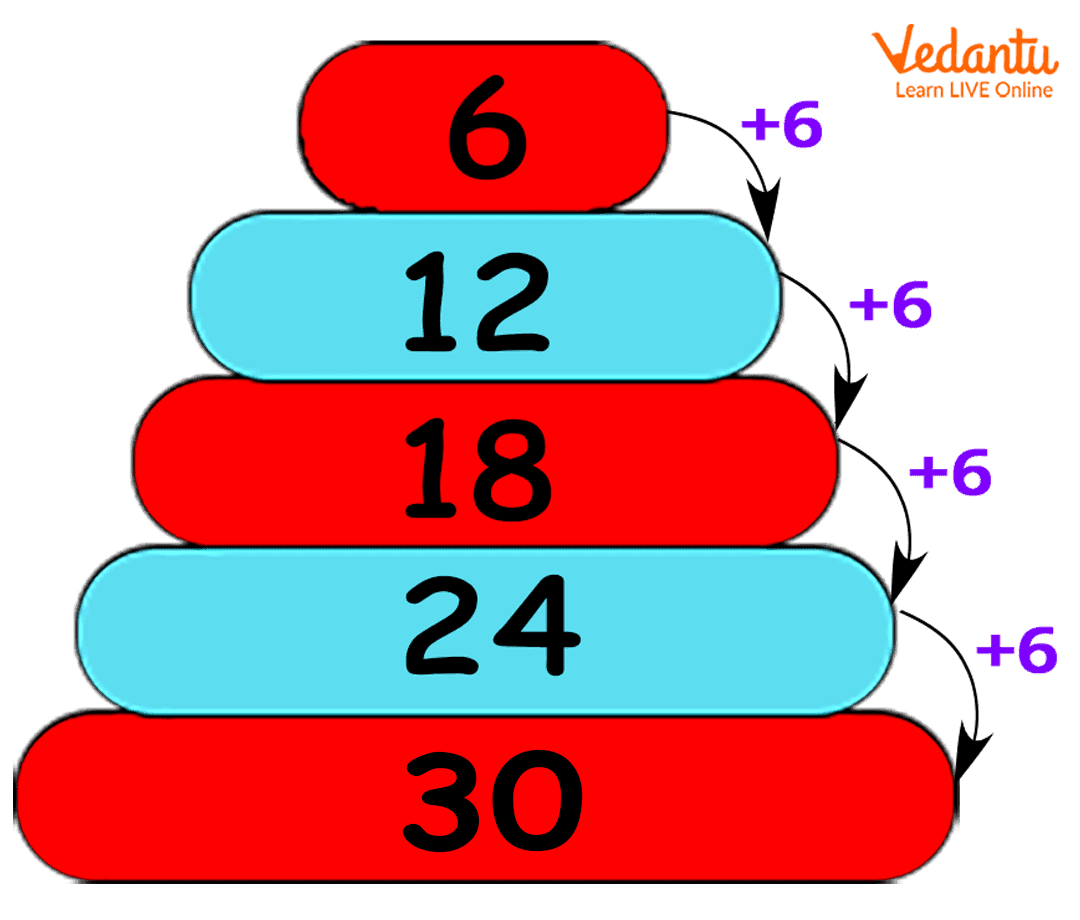
Multiples of 6 by adding 6
Games to Learn Multiples
There is an amazing game which you can play while travelling to school or some other place. This is called the Number plate Game, where you will need to call out the multiples of the first two numbers on the number plate of the vehicle ahead of you. It is a fun way to brush up on your counting skills and become a master of multiples.
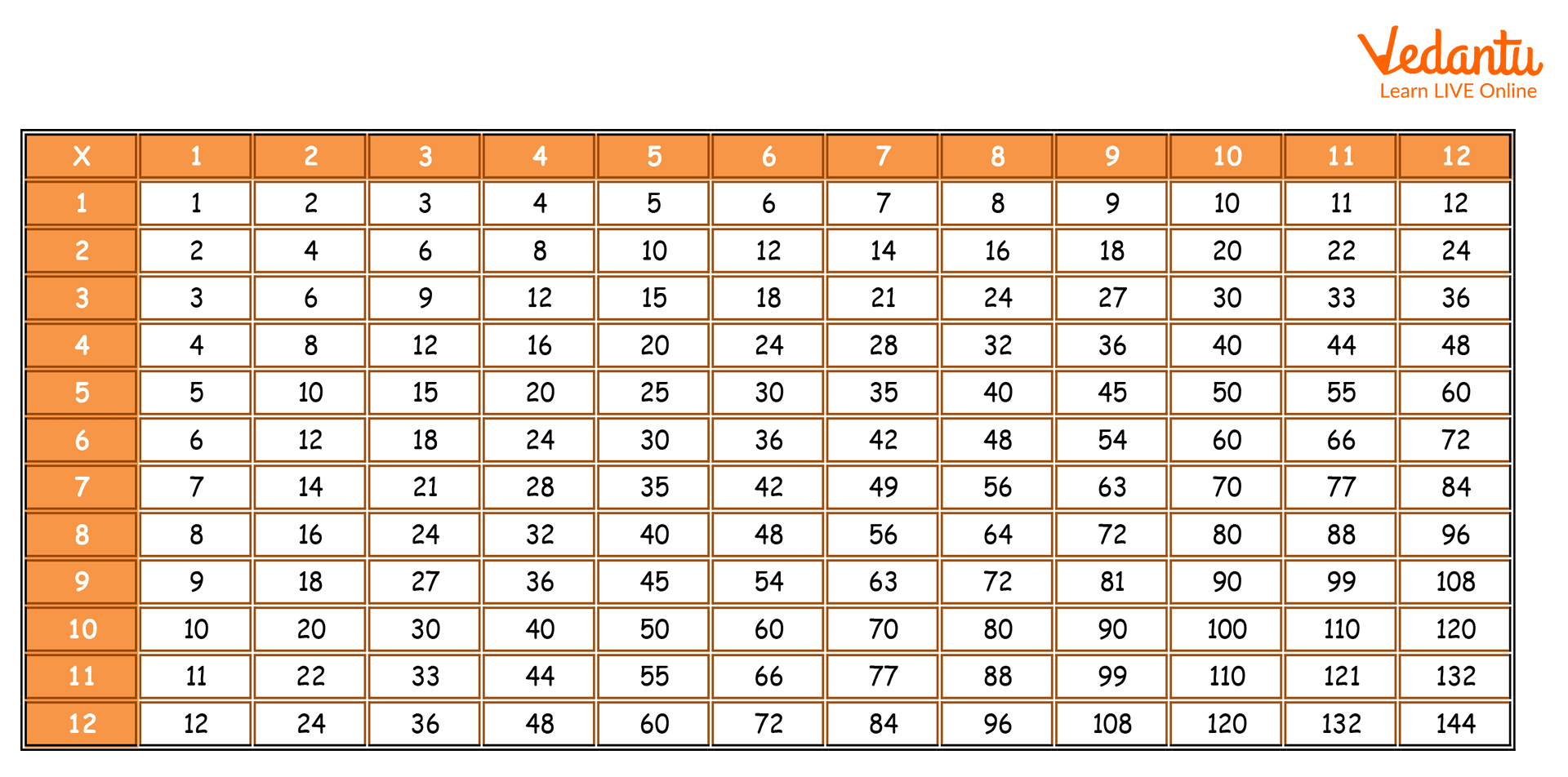
Multiplication table from 1 to 12
What is a Factor?
Factors can be specified as whole numbers that can evenly divide another number. Precisely, when a number is considered as a factor of another second number, the first one has to divide the second number completely without keeping any remainder behind.
In other words, if the dividend is evenly divisible by a number or also called as a divisor, that particular divisor will be known as a factor of that dividend. Every number is supposed to have a common factor, such as one (1) and also the number itself. The highest common factor and lowest common multiple TNPSC questions generally include questions related to these; therefore, students need to go through a few examples to comprehend them.
For instance,
4 is considered as a factor of 24, as it divides 24 evenly and leaves 6 as quotient and zero (0) as remainder. On the other hand, 6 is also considered as the factor of 24, which leaves 4 as quotient and zero (0) as remainder.
Consequently, it is apparent that 24 has multiple factors, such as 1, 24, 4, 6, and 2, 3, 8, including 12, since all these numbers can divide 24 evenly without leaving any remainder.
As discussed earlier, the factor is a number that generally keeps no remainder behind after dividing a particular number. On the other hand, multiple is a number obtained by multiplying a whole number by some other numbers. Following is a list of key differences between common factors and multiples class 4:
Difference Between Common Factors and Common Multiples
Along with these differences, students should also be aware of the process of common factors and common multiples to compare them. Mathematics mainly deals with numbers and different operations, and factors and multiples are one of those kinds. The concepts are pretty basic and should be grasped properly to understand higher-level mathematics in a better way.
Furthermore, with assistance from e-learning platforms like Vedantu, one can elevate their knowledge of multiples. The model exam question papers, expert notes, along with online classes, and doubt clearing sessions, students can better their final exam preparations.
Did You Know?
0 is a multiple of all numbers since any number multiplied by 0 will result in 0!
Conclusion
Multiples are an important part of Maths and the topic should not be avoided or kept for later. It is an integral part of learning counting and calculation, and it is advisable to memorise the multiplication tables at least till 12.
FAQs on Understanding Multiples in Mathematics
1. What are multiples in Maths?
A multiple of a number is the result you get when you multiply that number by any whole number. Multiples are found using repeated multiplication.
- Multiples of 4: 4 × 1 = 4, 4 × 2 = 8, 4 × 3 = 12, 4 × 4 = 16
- So, multiples of 4 are 4, 8, 12, 16, 20, …
- Every number has infinitely many multiples.
2. How do you find the multiples of a number?
To find the multiples of a number, multiply it by whole numbers like 1, 2, 3, and so on. This method works for all natural numbers.
- Step 1: Choose the number (e.g., 6).
- Step 2: Multiply by 1, 2, 3, 4…
- 6 × 1 = 6
- 6 × 2 = 12
- 6 × 3 = 18
- The multiples of 6 are 6, 12, 18, 24, …
3. What is the difference between factors and multiples?
The difference between factors and multiples is that factors divide a number exactly, while multiples are numbers obtained by multiplying.
- Factors of 12: 1, 2, 3, 4, 6, 12 (they divide 12 exactly)
- Multiples of 12: 12, 24, 36, 48… (12 × 1, 12 × 2, 12 × 3…)
- A number has finite factors but infinite multiples.
4. What are the first five multiples of a number?
The first five multiples of a number are found by multiplying it by 1, 2, 3, 4, and 5. For example:
- For 7: 7 × 1 = 7
- 7 × 2 = 14
- 7 × 3 = 21
- 7 × 4 = 28
- 7 × 5 = 35
5. What are common multiples?
A common multiple is a number that appears in the multiples list of two or more numbers. It is shared between them.
- Multiples of 3: 3, 6, 9, 12, 15…
- Multiples of 4: 4, 8, 12, 16…
- The common multiple is 12.
6. What is the least common multiple (LCM)?
The least common multiple (LCM) is the smallest number that is a multiple of two or more numbers. It is the smallest shared value in their multiples list.
- Multiples of 5: 5, 10, 15, 20…
- Multiples of 6: 6, 12, 18, 24, 30…
- The LCM of 5 and 6 is 30.
7. Are multiples always greater than the number?
Multiples are usually greater than the number, except when multiplied by 1.
- For 9: 9 × 1 = 9 (same number)
- 9 × 2 = 18
- 9 × 3 = 27
8. What are the multiples of 10?
The multiples of 10 are numbers obtained by multiplying 10 by whole numbers. They always end in 0.
- 10 × 1 = 10
- 10 × 2 = 20
- 10 × 3 = 30
- 10 × 4 = 40
9. Can a number be a multiple of itself?
Yes, every number is a multiple of itself because it can be multiplied by 1.
- Example: 8 × 1 = 8
- Example: 15 × 1 = 15
10. Why are multiples important in Maths?
Multiples are important in Maths because they help in solving problems involving LCM, fractions, division, and word problems.
- Used to find common denominators in fractions
- Help in solving real-life grouping and sharing problems
- Essential for understanding divisibility and number patterns
