




Question: A survey shows that 61%, 46% and 29% of the people watched 3 idiots, Raajneeti and Avatar respectively. 25% people watched exactly two of the three movies and 3% watches none. What percentage of people watched all the three movies?
A) \[39\% \]
B) \[11\% \]
C) \[14\% \]
D) \[7\% \]
Answer
 Verified
233.1k+ views
Hint: In this question, we have to find what percentage of people watched all three movie. In order to find this concept of Venn diagram is used. Draw intersection of Venn diagram and then by using diagram find solution.
Formula used: In this question we are going to use the Venn diagram. This diagram give the relation between various set and their subset.
Complete step by step solution:
Draw a Venn-diagram taking three intersecting sets 3 idiots, Rajneeti and Avatar. After intersection even regions will be developed.
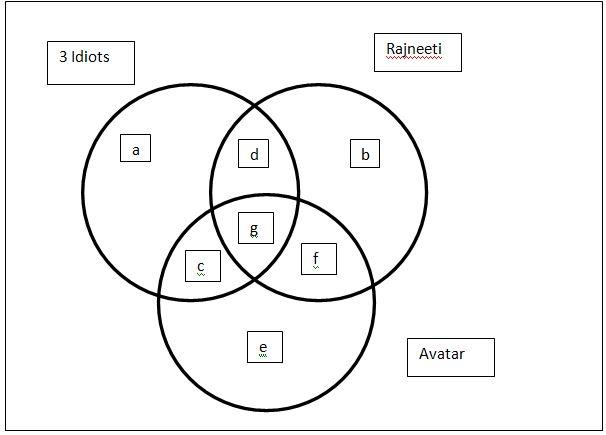
Now we know that
\[\{ (a + d + e + g) + (b + d + f + g) + (c + e + f + g)\} - (d + e + f) - 2g = a + b + c + d + e + f + g\]
\[61x + 46x + 29x - 25x - 2g = 97x\]
\[2g = 14x\]
\[g = 7x\]
Required value is \[7\% \]
Thus, Option (D) is correct.
Note: Here we must remember the algebra used in Venn diagram.
Some important properties of Sets are given below:
A. Idempotent Law is given as
(i) Union of two same sets \[A{\rm{ }} \cup {\rm{ }}A{\rm{ }} = {\rm{ }}A\]
(ii) Intersection of two same sets \[A{\rm{ }} \cap {\rm{ }}A{\rm{ }} = {\rm{ }}A\]
B. Associative Law is given as
(i) \[\left( {A{\rm{ }} \cup {\rm{ }}B} \right){\rm{ }} \cup {\rm{ }}C{\rm{ }} = {\rm{ }}A{\rm{ }} \cup {\rm{ }}\left( {B{\rm{ }} \cup {\rm{ }}C} \right)\]
(ii) \[\left( {A{\rm{ }} \cap {\rm{ }}B} \right){\rm{ }} \cap {\rm{ }}C{\rm{ }} = {\rm{ }}A{\rm{ }} \cap {\rm{ }}\left( {B{\rm{ }} \cap {\rm{ }}C} \right)\]
C. Commutative Law is given as
(i) \[A{\rm{ }} \cup {\rm{ }}B{\rm{ }} = {\rm{ }}B{\rm{ }} \cup {\rm{ }}A\]
(ii) \[A{\rm{ }} \cap {\rm{ }}B{\rm{ }} = {\rm{ }}B{\rm{ }} \cap {\rm{ }}A\]
D. Distributive law is given as
(i) \[A{\rm{ }} \cup {\rm{ }}\left( {B{\rm{ }} \cap {\rm{ }}C} \right){\rm{ }} = {\rm{ }}\left( {A{\rm{ }} \cup {\rm{ }}B} \right){\rm{ }} \cap {\rm{ }}\left( {A{\rm{ }} \cup {\rm{ }}C} \right)\]
(ii) \[A{\rm{ }} \cap {\rm{ }}\left( {B{\rm{ }} \cup {\rm{ }}C} \right){\rm{ }} = \left( {A{\rm{ }} \cap {\rm{ }}B} \right){\rm{ }} \cup {\rm{ }}\left( {A{\rm{ }} \cap {\rm{ }}C} \right)\]
Where A, B, C are set or subset of any universal set
E. De Morgan’s law is given as
(i) \[{\left( {A{\rm{ }} \cup B} \right)^c} = {A^c} \cap {\rm{ }}{B^c}\]
(ii) \[{\left( {A{\rm{ }} \cap B} \right)^c} = {A^c} \cup {\rm{ }}{B^c}\]
Where, \[{A^c},{B^c}\] is complement of set A and B respectively
Formula used: In this question we are going to use the Venn diagram. This diagram give the relation between various set and their subset.
Complete step by step solution:
Draw a Venn-diagram taking three intersecting sets 3 idiots, Rajneeti and Avatar. After intersection even regions will be developed.
Now we know that
\[\{ (a + d + e + g) + (b + d + f + g) + (c + e + f + g)\} - (d + e + f) - 2g = a + b + c + d + e + f + g\]
\[61x + 46x + 29x - 25x - 2g = 97x\]
\[2g = 14x\]
\[g = 7x\]
Required value is \[7\% \]
Thus, Option (D) is correct.
Note: Here we must remember the algebra used in Venn diagram.
Some important properties of Sets are given below:
A. Idempotent Law is given as
(i) Union of two same sets \[A{\rm{ }} \cup {\rm{ }}A{\rm{ }} = {\rm{ }}A\]
(ii) Intersection of two same sets \[A{\rm{ }} \cap {\rm{ }}A{\rm{ }} = {\rm{ }}A\]
B. Associative Law is given as
(i) \[\left( {A{\rm{ }} \cup {\rm{ }}B} \right){\rm{ }} \cup {\rm{ }}C{\rm{ }} = {\rm{ }}A{\rm{ }} \cup {\rm{ }}\left( {B{\rm{ }} \cup {\rm{ }}C} \right)\]
(ii) \[\left( {A{\rm{ }} \cap {\rm{ }}B} \right){\rm{ }} \cap {\rm{ }}C{\rm{ }} = {\rm{ }}A{\rm{ }} \cap {\rm{ }}\left( {B{\rm{ }} \cap {\rm{ }}C} \right)\]
C. Commutative Law is given as
(i) \[A{\rm{ }} \cup {\rm{ }}B{\rm{ }} = {\rm{ }}B{\rm{ }} \cup {\rm{ }}A\]
(ii) \[A{\rm{ }} \cap {\rm{ }}B{\rm{ }} = {\rm{ }}B{\rm{ }} \cap {\rm{ }}A\]
D. Distributive law is given as
(i) \[A{\rm{ }} \cup {\rm{ }}\left( {B{\rm{ }} \cap {\rm{ }}C} \right){\rm{ }} = {\rm{ }}\left( {A{\rm{ }} \cup {\rm{ }}B} \right){\rm{ }} \cap {\rm{ }}\left( {A{\rm{ }} \cup {\rm{ }}C} \right)\]
(ii) \[A{\rm{ }} \cap {\rm{ }}\left( {B{\rm{ }} \cup {\rm{ }}C} \right){\rm{ }} = \left( {A{\rm{ }} \cap {\rm{ }}B} \right){\rm{ }} \cup {\rm{ }}\left( {A{\rm{ }} \cap {\rm{ }}C} \right)\]
Where A, B, C are set or subset of any universal set
E. De Morgan’s law is given as
(i) \[{\left( {A{\rm{ }} \cup B} \right)^c} = {A^c} \cap {\rm{ }}{B^c}\]
(ii) \[{\left( {A{\rm{ }} \cap B} \right)^c} = {A^c} \cup {\rm{ }}{B^c}\]
Where, \[{A^c},{B^c}\] is complement of set A and B respectively
Recently Updated Pages
JEE Main 2023 April 6 Shift 1 Question Paper with Answer Key

JEE Main 2023 April 6 Shift 2 Question Paper with Answer Key
JEE Main 2023 (January 31 Evening Shift) Question Paper with Solutions [PDF]
JEE Main 2023 January 30 Shift 2 Question Paper with Answer Key
JEE Main 2023 January 25 Shift 1 Question Paper with Answer Key
JEE Main 2023 January 24 Shift 2 Question Paper with Answer Key
Trending doubts
JEE Main 2026: Session 2 Registration Open, City Intimation Slip, Exam Dates, Syllabus & Eligibility
JEE Main 2026 Application Login: Direct Link, Registration, Form Fill, and Steps
JEE Main Marking Scheme 2026- Paper-Wise Marks Distribution and Negative Marking Details
Understanding the Angle of Deviation in a Prism
Hybridisation in Chemistry – Concept, Types & Applications
How to Convert a Galvanometer into an Ammeter or Voltmeter
Other Pages
JEE Advanced Marks vs Ranks 2025: Understanding Category-wise Qualifying Marks and Previous Year Cut-offs
NCERT Solutions For Class 11 Maths Chapter 12 Limits and Derivatives (2025-26)
NCERT Solutions For Class 11 Maths Chapter 10 Conic Sections (2025-26)
Understanding Electromagnetic Waves and Their Importance
Understanding the Electric Field of a Uniformly Charged Ring
JEE Advanced Weightage 2025 Chapter-Wise for Physics, Maths and Chemistry