








How to Calculate Time of Flight with Step-by-Step Examples
Time of Flight is a fundamental concept in physics that describes the time an object, wave, or particle takes to travel between two points in space. This concept finds extensive application in measurement devices, particle physics, and daily physical observations. Understanding Time of Flight equips students for analyzing various dynamic phenomena, and the principle is directly tested in several JEE problem types.
Defining Time of Flight
At its core, Time of Flight refers to the time interval between the emission of a signal, particle, or object and its detection after traveling a certain path. It acts as a bridge to measure unknown distances when the speed of travel is known, or to measure velocities when the path is fixed. For example, when a light pulse is emitted and reflected from an object, the round-trip duration gives key information about the object's distance.
A common misconception is that Time of Flight only applies to moving objects, but it also governs the behavior of waves and particles in both classical and quantum regimes. JEE often requires distinguishing between these situations by interpreting the context of the problem.
Principle and Mechanism
The basic mechanism of Time of Flight is rooted in the relationship between distance, speed, and time. If a pulse of light or sound travels from a source to an object and returns, the total distance covered is twice the separation between the source and the object. The duration measured is the total time for the round trip, so dividing this by two yields the Time of Flight for a single leg of the journey.
Physically, this approach is valuable because it converts timing information into spatial measurement. For example, radar guns use the Time of Flight of radio pulses to determine the location or speed of vehicles. A similar physical intuition applies to the working of time of flight sensors and cameras in technology and research.
Mathematical Expression: Time of Flight Formula
The core mathematical relationship for Time of Flight, when a wave travels from source to object and back, is given by:
| Physical Quantity | Expression |
|---|---|
| Time of Flight (T) | T = 2D / S |
| Distance (D) | D = (S × T) / 2 |
Here, S denotes the speed of propagation (speed of light for electromagnetic waves, or speed of sound for acoustics), T is the total measured time, and D is the distance between the source and reflector. In JEE, time of flight formula is often used for quick computation in both conceptual and application-based questions. Dimensional analysis can immediately eliminate inconsistent solution options.
Time of Flight in Projectile Motion
In projectile motion, Time of Flight refers specifically to the total duration an object remains in the air after being projected, until it returns to its original vertical position. This scenario differs from the reflection-based applications but shares the same underlying principle: understanding how the initial velocity and gravitational acceleration influence the motion.
For instance, the standard equation for Time of Flight in projectile motion (with initial velocity u and angle θ, under acceleration due to gravity g) is:
| Scenario | Time of Flight |
|---|---|
| Projectile launched at angle θ | T = (2u sin θ)/g |
A common misconception is confusing the time of flight in projectile motion with the range or maximum height. In reality, each of these results from different aspects of the same kinematic equations. JEE frequently tests this by offering incomplete information; recognizing which variable is missing is key.
For a conceptual analogy, Time of Flight in projectile motion is like timing how long a ball stays airborne after being thrown upward. While this is intuitive, deeper calculation requires linking initial velocity's vertical component to the duration in the gravitational field.
Types of Time of Flight Applications
Time of Flight's versatility comes from its application across different physical domains and sensing technologies. Each setup leverages the same physics but adapts it to different contexts.
- Time of Flight sensors in range-finding and automation
- Time of Flight cameras to create 3D images
- ToF mass spectrometers in chemical analysis
- ToF in MRI (magnetic resonance imaging) and MRA (angiography)
- Acoustic ToF for fluid dynamics and material testing
- Indirect ToF systems using phase shift measurement
A practical micro-example is the use of a Time of Flight sensor in robotic vacuum cleaners to map and avoid obstacles. Likewise, ToF is critical in LiDAR for self-driving vehicles. JEE sometimes presents analogy-based questions requiring mapping these physical principles to new situations.
Working Principle of Time of Flight Sensors
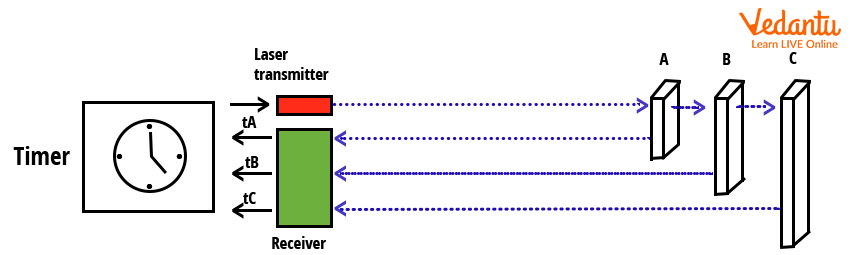
A Time of Flight sensor emits a light pulse (or acoustic pulse) toward an object and records the time until the reflected signal returns. This round-trip duration, multiplied by the known propagation speed, provides the object's distance. This mechanism is the backbone for devices measuring depth, position, and velocity in a wide range of industries, from automation to geology.
Schematic representation of timer pulsed time of flight sensor helps visualize that the emitter and receiver, often integrated, must handle time intervals as short as nanoseconds. Precision electronics are crucial, especially since small timing errors can lead to large spatial inaccuracies.
Alternate Method: Phase Shift in Amplitude Modulated Waves
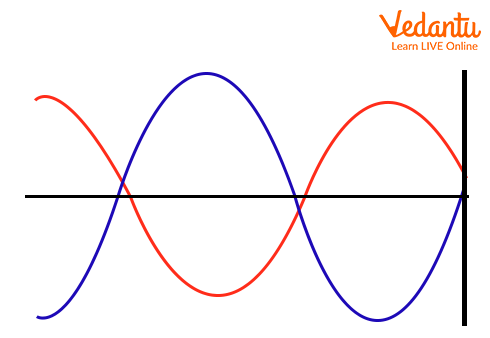
Another advanced method to determine distance is by analyzing the phase shift that occurs when an amplitude-modulated wave reflects off an object. The change in phase, relative to the emitted signal, depends on the travel distance and the wavelength of the modulating signal. This approach, popular in miniaturized sensors and ToF cameras, allows high precision even at short distances.
Schematic representation of phase shift of amplitude modulated wave in time of flight sensor provides further insight: as the phase difference increases, so does the calculated distance. The formula linking speed (c), wavelength (λ), and frequency (f) governs the conversion of measured phase shift into actual spatial distance.
A common misconception is believing phase-based methods are always more accurate than pulsed ToF. Actually, phase-based systems excel at short distances, but for long-range or highly reflective environments, pulsed ToF can outperform. JEE occasionally explores these subtle distinctions through matching or assertion-reason questions.
Time of Flight in Modern Sensing and Imaging
Time of Flight camera systems, especially in RGBD sensors, enable 3D mapping by measuring the distance to every point in the scene. Such devices are essential for autonomous vehicles, gesture recognition systems, and augmented reality applications. The operating logic, whether direct ToF (pulsed) or indirect ToF (phase-modulated), impacts the field of view, resolution, and depth accuracy.
Similarly, the time of flight mass spectrometer separates ions based on their velocities, relying on the concept that lighter ions reach the detector sooner. This principle also underpins advanced MRI techniques and medical imaging, where Time of Flight MRA (magnetic resonance angiography) visualizes blood flow non-invasively. In these situations, knowing how timing translates into physical geometry or composition is crucial.
A micro-example is the use of a Time of Flight mass spectrometry system to distinguish between molecules in a sample, solely based on their flight times.
JEE Interpretation and Problem-Solving Insights
Time of Flight is a standard context for testing vector resolution, dimensional consistency, and kinematic constraints in JEE problems. For example, in questions about projectile motion, students should quickly separate vertical and horizontal components and identify what "returns to the same height" means physically.
Dimensional analysis is regularly used to check the validity of formulae involving time, distance, and speed. Also, understanding semantic variants such as "time of flight equation projectile motion" or "time of flight calculator" helps interpret complex scenarios. Vedantu offers targeted practice to master these relationships.
Conclusion
Mastering the Time of Flight concept empowers students to describe, analyze, and predict the behavior of moving objects and waves across diverse physical systems. From basic kinematics to advanced sensing, this topic illustrates the deep unity between mathematics and physics. As JEE continues to integrate real-world and experimental questions, fluency in Time of Flight mechanisms will give candidates a strong problem-solving edge, bridging conceptual learning with practical understanding. For further exploration, students may refer to Projectile Motion Explained.


FAQs on Understanding Time of Flight in Physics
1. What is time of flight in projectile motion?
Time of flight is the total time a projectile remains in the air from launch to landing. It depends on the initial velocity and angle of projection.
- Time of flight (T) is given by the formula: T = (2u sinθ)/g, where u is initial velocity, θ is the angle of projection, and g is acceleration due to gravity.
- Applicable only when projectile lands at the same height from which it was launched.
- Key in understanding projectile motion for exams and physics problems.
2. How do you calculate the time of flight for a projectile?
The time of flight can be calculated using initial velocity, launch angle, and gravity.
- Use formula: T = (2u sinθ)/g
- For horizontal projection (θ = 0), adjusted formulas may apply based on vertical height
- For same-level projection, sinθ is critical for time duration in air
3. What factors affect the time of flight of a projectile?
The time of flight is mainly affected by three factors:
- Initial velocity (u) of the projectile
- Angle of projection (θ)
- Acceleration due to gravity (g)
4. What is the formula for time of flight when the projectile starts and ends at different heights?
When a projectile lands at a different height, the time of flight is calculated with:
- For initial height h: T = [u sinθ + sqrt((u sinθ)^2 + 2gh)]/g
- Accounts for differences in start and end altitude
- Commonly used in advanced problems and CBSE board exams
5. Why does the angle of projection affect the time of flight?
Angle of projection (θ) determines the vertical component of velocity, affecting how long the projectile remains airborne.
- Greater angle (up to 90°) means longer vertical journey, so more time.
- Time of flight is directly proportional to sinθ.
- At θ = 90°, time of flight is maximum for a given speed.
6. What are the units of time of flight?
The unit of time of flight is the same as the SI unit for time:
- Seconds (s)
- Time of flight = Seconds
7. How is time of flight experimentally measured?
To measure time of flight experimentally, you can:
- Use a stopwatch to record duration from launch to landing
- Use high-speed cameras or motion sensors for more accurate measurement
- Apply data to verify theoretical calculations using the T = (2u sinθ)/g formula
8. How does acceleration due to gravity affect the time of flight?
Acceleration due to gravity (g) inversely affects the time of flight of a projectile.
- Higher gravity = shorter time of flight
- Time of flight is inversely proportional to g in the formula (T = (2u sinθ)/g)
- Gravity on other planets results in different times of flight for the same launch velocity
9. What is the difference between time of flight, maximum height, and range in projectile motion?
In projectile motion, time of flight, maximum height, and range are unique parameters:
- Time of flight: Total time in air
- Maximum height: Peak vertical position reached by projectile
- Range: Horizontal distance traveled
10. Does air resistance affect the time of flight in projectile motion?
Yes, air resistance reduces the time of flight compared to the ideal (vacuum) case.
- Air resistance slows the projectile, causing it to land sooner
- CBSE exams generally ask to ignore air resistance for standard calculations
- Real-world conditions may yield slightly less time of flight than theoretical values
