








How to Calculate Terminal Voltage with Examples
Terminal voltage is a key concept in understanding how real-world batteries and electrical cells behave when delivering current to external circuits.
What is Terminal Voltage?
Terminal voltage refers to the potential difference measured across the terminals of any electrical source, such as a battery, when it is supplying current to a circuit. For example, a fresh battery may have a stated emf, but the real measured voltage at its terminals while powering a device may be less due to internal effects.
The terminal voltage meaning focuses on the actual usable voltage that external elements like bulbs or resistors experience. This concept matters because it helps explain why devices sometimes operate below their rated performance even if the source seems adequate. A common misconception is that terminal voltage always equals emf, but actually, it drops during current flow due to internal resistance.
Physical Basis and Internal Resistance
Every practical voltage source, such as a battery, consists of both an ideal voltage (or emf) source and an internal resistance in series. When no current is drawn, the voltage across the terminals equals the emf. Once current is drawn, the internal resistance causes a voltage drop that reduces the available voltage externally. This leads to the crucial difference between emf and terminal voltage, an aspect frequently examined in JEE through circuit manipulations and limiting cases.
An everyday analogy is to consider a water tank with a narrow pipe at its outlet—the narrower the pipe, the more pressure is lost as water flows out, reducing the usable pressure for downstream use. Similarly, as current increases, more potential is lost inside the source as heat. For instance, with old batteries, torch lights become dimmer due to increased internal resistance affecting terminal voltage.
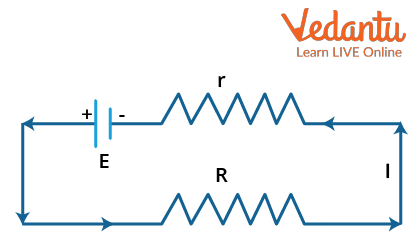
Diagram: Emf with an Internal Resistance
In diagrams, the typical representation involves a voltage source symbol (emf) in series with a small resistor denoting internal resistance. The terminal voltage formula, which students encounter in JEE, quantifies this outcome effectively and is essential for solving circuit problems involving real sources.

Terminal Voltage Formula and Its Interpretation
The terminal voltage of a battery is given by:
V = E – Ir
Here, V is the terminal voltage, E is the emf of the source, I is the current delivered, and r is the internal resistance. “Terminal voltage formula” and its rearrangements are often used in JEE to test understanding of how internal losses reduce the delivered voltage, especially under maximum load or zero-load conditions.
A micro-example: if no current flows (I = 0), then V = E. But as I increases, Ir subtracts more from emf, so the terminal voltage drops. JEE often tests this by varying I or r and observing how V responds.
A common misconception is that only large currents matter, but even small currents cause measurable drops if internal resistance is not negligible, underscoring the importance of accurate measurements and calculations.
Influence of Circuit Connection
The role of terminal voltage vs emf is clearly visible when a source powers an external resistor R. According to basic circuit analysis and Kirchhoff’s Voltage Law:
E – IR – Ir = 0
Thus, E = I(R + r), leading to I = E / (R + r). This shows that as internal resistance increases or as load resistance decreases, the current distribution and voltage drops change. For problems, it’s crucial to estimate these values to avoid overloading cells or misjudging circuit performance, a frequent JEE pitfall.
For example, a high-quality battery with low r can sustain a higher terminal voltage under heavy loads, which is why premium batteries are chosen for high-drain devices.
Terminal Voltage vs Emf vs Voltage: Key Differences
Terminal voltage vs emf concerns the real measurable voltage across a battery’s ends, compared to the ideal emf which the battery provides without any current. The term “voltage” can refer to either, so precise language is important in problems and solutions.
| Comparison | Description |
|---|---|
| Emf (E) | Theoretical maximum voltage, no current drawn |
| Terminal Voltage (V) | Measured across cell during current flow |
| Voltage (General) | Any potential difference across circuit elements |
JEE often crafts questions that require comparing and contrasting terminal voltage and emf, especially for mixed circuits or batteries with non-zero resistance.
Practical Significance and Real-World Implications
Understanding the terminal voltage of a cell has practical significance in engineering and technology. For instance, automotive batteries are rated not just on emf but also on their ability to maintain terminal voltage during high current output, ensuring reliable engine starts. A common misconception is that battery age is mainly about charge, but actually increased internal resistance (and not just loss of emf) weakens performance.
In real circuits, using a terminal voltage calculator is vital for system designers to predict how devices will behave under various loads. For example, in solar panels, the output terminal voltage under sunlight drops as higher current is drawn to power appliances.
Analogy: Just as electrical friction within wires (resistance) lowers current, internal resistance causes a “hidden” voltage loss inside the battery source itself, affecting only the load part of the circuit.
How JEE Tests Terminal Voltage Understanding
JEE problems often explore what happens as parameters are varied: reducing R increases current, decreasing terminal voltage; increasing r exaggerates this effect. Sometimes, boundary conditions are tested—such as determining the load for maximum power transfer, which occurs when external resistance R equals internal resistance r, making the terminal voltage equal to half the emf. Dimensional consistency helps eliminate wrong options.
For students, mastering both the conceptual distinctions (“terminal voltage vs voltage” questions) and calculation methods strengthens problem-solving confidence in circuit analysis scenarios.
Common Misconceptions and Clarifications
- A common misconception is that terminal voltage never exceeds emf; but actually, in recharging scenarios, reverse current can cause V > E momentarily.
- Some believe terminal voltage is affected only at high currents, but even low currents matter for delicate circuits.
- Many conflate “emf” with “terminal voltage,” while in practice, load and internal resistance cannot be ignored.
Addressing these errors is essential for robust JEE conceptual clarity, ensuring students do not overlook subtle distinctions in multi-step problems.
Terminal Voltage in Different Languages
In educational contexts, especially in India, students may seek “terminal voltage in hindi” or “terminal voltage kya hai” for approachable explanations. Vedantu provides multi-lingual support to serve such diverse student needs while maintaining accuracy about concepts like internal resistance and emf in all materials.
Summary Table: Key Points on Terminal Voltage
| Aspect | Key Note |
|---|---|
| Terminal Voltage Formula | V = E – Ir (core calculation) |
| Impact of Internal Resistance | Directly lowers usable voltage in external circuit |
| When V = E? | Only when I = 0 (no load) |
| Real Circuit Implication | Device performance relies on terminal voltage, not emf alone |
Conclusion
Terminal voltage, as distinct from emf, provides a bridge between ideal theoretical models and real-world circuitry. Understanding this allows students to analyze, design, and troubleshoot practical electrical systems more effectively, a skill repeatedly assessed in JEE through both numerical and conceptual approaches. For deeper insights, students can refer to resources like Understanding Terminal Voltage for additional solved questions and practice papers.


FAQs on What Is Terminal Voltage?
1. What is terminal voltage?
Terminal voltage is the actual voltage output measured across the terminals of a cell or battery when it is connected to an external circuit and supplying current.
- Terminal voltage is usually less than the EMF of the cell due to internal resistance.
- It depends on the current drawn and the internal resistance present in the cell.
- It is calculated using the formula: V = E – Ir, where E = EMF, I = current, r = internal resistance.
2. What is the difference between emf and terminal voltage?
EMF (Electromotive Force) and terminal voltage are related but distinct electrical quantities.
- EMF is the maximum potential difference the cell can provide when no current is drawn (open circuit).
- Terminal voltage is the potential difference across the cell's terminals when a current is being supplied (closed circuit).
- Terminal voltage is always less than EMF when current flows because of the voltage drop across internal resistance.
3. Why is the terminal voltage less than the emf of a cell?
The terminal voltage is less than the EMF because of energy lost as current passes through the cell's internal resistance.
- When current flows, part of the EMF is used to overcome internal resistance.
- This causes the voltage available to the external circuit to drop.
- The voltage drop across internal resistance is Ir (current × internal resistance).
4. How do you calculate terminal voltage?
Terminal voltage can be calculated by subtracting the voltage drop across the internal resistance from the EMF.
- Use the formula: V = E – Ir
- Where V = terminal voltage, E = EMF, I = current, r = internal resistance
- Terminal voltage depends on both the current drawn and the value of internal resistance in the cell.
5. What happens to the terminal voltage if the current increases?
When the current increases, the terminal voltage decreases due to a greater voltage drop across the internal resistance.
- A higher current causes more energy loss inside the cell (Ir increases).
- The terminal voltage (V) is reduced further from the EMF (E).
- It is important during heavy loads or short-circuit calculations.
6. What factors affect the terminal voltage of a cell?
Several factors affect the terminal voltage of a cell:
- Internal resistance of the cell
- Magnitude of current drawn from the cell
- Temperature (internal resistance can change with temperature)
- Age and condition of the cell
7. Define internal resistance of a cell. How does it relate to terminal voltage?
Internal resistance is the resistance offered to current by the materials inside the cell. It directly affects the terminal voltage as per the formula V = E – Ir.
- Higher internal resistance leads to a larger voltage drop for a given current.
- This reduces the available terminal voltage during operation.
- Cells with low internal resistance are preferred in practical circuits for stable terminal voltage.
8. In what condition is the terminal voltage equal to the emf of the cell?
The terminal voltage is equal to the EMF of the cell when no current is being drawn (open circuit).
- This happens because there is no current, so the voltage drop across internal resistance is zero (Ir = 0).
- Therefore, V = E – 0, so V = E.
- This is often asked in theoretical questions.
9. How does internal resistance influence the efficiency of a battery?
A battery’s internal resistance lowers its efficiency by reducing the terminal voltage and wasting electrical energy as heat.
- More energy is lost inside the cell as current increases.
- Lower terminal voltage reduces the actual energy delivered to the external circuit.
- Batteries with high internal resistance drain faster and provide less usable power.
10. State the formula relating terminal voltage, emf, current and internal resistance.
The relationship between terminal voltage, EMF, current, and internal resistance is given by:
- V = E – Ir
- Where V = terminal voltage, E = EMF, I = current, r = internal resistance
