








How Does a Step Down Transformer Reduce Voltage?
A step-down transformer reduces high AC voltage to a lower, usable level quietly and efficiently for safe device operation.
In Physics, a step-down transformer demonstrates the application of electromagnetic induction for converting dangerous line voltages to safer outputs.
What Is a Step Down Transformer?
A step-down transformer is a static device that converts high input AC voltage to a proportionally lower output AC voltage across two linked windings.
It is crucial for protecting electronics by adjusting power line voltages, such as converting 220V mains to 12V for chargers or 480V to 120V in industrial uses.
How a Step Down Transformer Works: Core Principle and Analogy
Picture a seesaw with children of unequal weights on each side; the transformer’s windings balance voltage and current in a similar inverse way.
The device operates on Faraday’s law: an AC in the primary coil produces a magnetic flux, inducing a lower voltage in the secondary coil due to fewer turns.
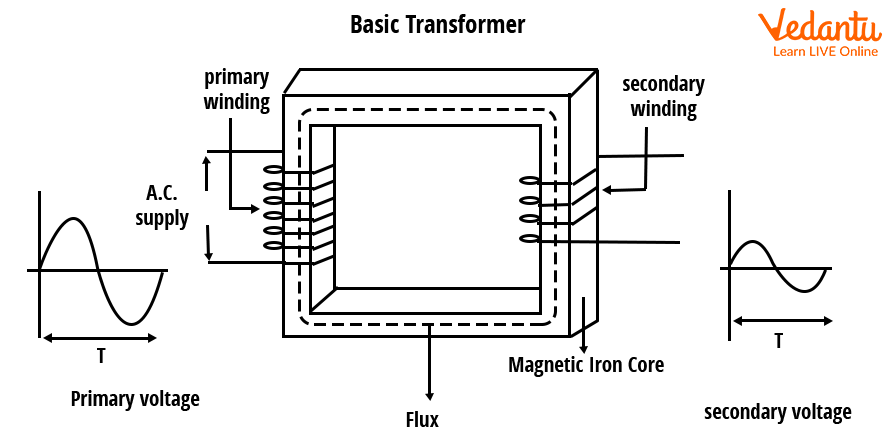
The primary coil, with more turns, generates a strong magnetic field; the secondary, with fewer turns, receives a reduced portion of the field, lowering voltage output.
This makes step-down transformers ideal for household, laboratory, and gadget applications where safety and device compatibility depend on correct voltage levels.
Construction: Main Components
The essential parts include a laminated soft iron core, primary winding (input side), and secondary winding (output side), all working together to channel magnetic flux efficiently.
- Laminated core: minimizes energy-wasting eddy currents
- Primary winding: more turns, takes high AC voltage input
- Secondary winding: fewer turns, delivers reduced AC voltage
- High-conductivity wire: usually copper for low resistance
The core's magnetic permeability is maximized by stacking thin iron sheets, ensuring less heat is produced and energy is not wasted.
Good transformers use separate layers of insulation between windings and core, preventing dangerous shorts and improving lifespan.
Working Principle and Formulae
The heart of transformer function is mutual induction, where changing primary current creates a changing flux, which in turn induces EMF in the secondary coil.
The transformer equation, central to JEE questions, relates voltage ratio to coil turns: $ \dfrac{V_p}{V_s} = \dfrac{N_p}{N_s} $.
Since $N_p > N_s$, the output voltage $V_s$ is always less than input $V_p$. Current increases as voltage decreases, preserving power (ideally).
| Symbol | Meaning |
|---|---|
| $V_p$ | Primary voltage (input) |
| $V_s$ | Secondary voltage (output) |
| $N_p$ | Turns on primary |
| $N_s$ | Turns on secondary |
For example, $ V_s = V_p \times \dfrac{N_s}{N_p} $ lets you directly calculate output voltage if turns and input voltage are known, a common JEE scenario.
Practical Types of Step Down Transformer
- Single-phase: Used in homes and small offices
- Center-tapped: Audio, rectifier, and amplifier applications
- Multi-tapped: Provides selectable voltages for lab/test setups
In JEE, understanding these types helps clarify circuit solutions and real-world device choices, especially in modern power electronics studies.
Industrial settings often use step-down transformers for converting 480V to 240V or 480V to 208V, matching equipment requirements safely.
Step Down vs Step Up Transformer: Key Differences
| Parameter | Step Down |
|---|---|
| Turns ratio ($N_p > N_s$) | Output voltage less than input |
| Current relation ($I_s > I_p$ ideally) | Secondary current increases |
| Main use | Lowering supply voltage |
Knowing these contrasts, as highlighted in Step Up Transformer, is essential for board and JEE-type comparison questions.
Real-World Applications of Step Down Transformer
- Mobile/laptop chargers (220V to 12V, 220V to 5V)
- AC adapters, SMPS circuits
- Distribution substations lowering transmission voltages
- Welding machines, ovens, industrial motors
- Voltage stabilizers and laboratory power supplies
For instance, a step down transformer 220V to 110V lets you safely use international appliances with different standards.
These devices also enable Transformer design for high-voltage power transmission and efficient local energy delivery.
Solved Example: JEE-Style Numerical
A transformer has $N_p = 2000$, $N_s = 100$, and $V_p = 230$ V AC. Find $V_s$ and comment on its application.
Use $V_s = V_p \times \dfrac{N_s}{N_p}$, so $V_s = 230 \times \dfrac{100}{2000} = 11.5$ V. Thus, this transformer can safely power a 12V device from the 230V mains.
Notice that as the voltage drops by a factor of 20, current available increases, crucial for charging circuits and heavy-duty gadgets requiring more current at low voltage.
Short Practice Question
If a step-down transformer reduces 480V to 120V, and primary winding has 800 turns, how many turns are needed in the secondary?
Try: $N_s = N_p \times \dfrac{V_s}{V_p} = 800 \times \dfrac{120}{480} = 200$ turns.
Explaining the Step Down Transformer Diagram
The most informative diagrams clearly label the high-turn primary, low-turn secondary, and laminated iron core, visually emphasizing why $V_s < V_p$ due to fewer output coil turns.
Visual clarity helps link internal construction with exam formulas and practical uses, strengthening memory for both conceptual and visual questions.
Step Down Transformer in JEE and Common Mistakes
- Applying transformer equations to DC circuits (works only for AC)
- Confusing which winding has more turns
- Overlooking core losses in efficiency questions
- Assuming frequency changes after transformation (it does not)
JEE often tests transformer logic in electromagnetic induction, AC, and practical electronics, rewarding clear understanding of proportionality and device operation.
Related topics worth revising: Step Up Transformer, Transformer working principle, Self-Inductance, Inductor properties, Circuit Solving techniques, Ohm’s Law and Resistance fundamentals.


FAQs on Understanding Step Down Transformers
1. What is a step down transformer?
A step down transformer is an electrical device that reduces the voltage from its primary winding to a lower voltage at its secondary winding while increasing the current.
Main points include:
- Used to decrease the input voltage to a safer or usable level
- Commonly found in devices requiring lower voltage than the supply
- Operates based on electromagnetic induction and the transformer principle
- Secondary winding has fewer turns than the primary winding
2. How does a step down transformer work?
A step down transformer works by electromagnetic induction to convert high voltage and low current to low voltage and high current.
Key working steps:
- AC voltage supplied to primary coil creates a varying magnetic field
- This magnetic field induces an EMF in the secondary coil
- The secondary coil has fewer turns, thus output voltage is lower than input
3. Where is a step down transformer used?
Step down transformers are widely used in both households and industries to provide the required voltage for different devices.
Common uses include:
- Charging electronics like mobile phones and laptops
- Supplying lower voltage to household appliances
- In power distribution at substations to make electricity suitable for home use
- Industrial equipment needing lower operational voltage
4. What is the formula for the output voltage of a step down transformer?
The output or secondary voltage (Vs) of a step down transformer is calculated using the transformer equation:
- Vs/Vp = Ns/Np
- Vs = Secondary voltage
- Vp = Primary voltage
- Ns = Number of secondary turns
- Np = Number of primary turns
5. What is the difference between step up and step down transformer?
Step up and step down transformers differ in how they change voltage:
- Step down transformer reduces the input voltage (secondary voltage is less than primary)
- Step up transformer increases the input voltage (secondary voltage is higher than primary)
- Used for different applications—transmission vs. distribution
6. Why is the ratio of turns important in a step down transformer?
The ratio of turns between the primary and secondary windings determines how much the voltage will be decreased.
Key points:
- Turns ratio (Np:Ns) controls voltage reduction
- Lower turns in the secondary means lower output voltage
- Maintains the principle of energy conservation and electromagnetic induction
7. What happens if a step down transformer is used in reverse?
If a step down transformer is used in reverse, it becomes a step up transformer.
Points to note:
- Secondary now acts as primary, primary as secondary
- Input voltage gets increased instead of decreased
- Not recommended in practice as design constraints may differ
8. What are the main parts of a step down transformer?
The main parts of a step down transformer are essential for its operation:
- Primary coil/winding (receives the input voltage)
- Secondary coil/winding (outputs the reduced voltage)
- Core (commonly made of laminated iron)
- Insulating materials and enclosures for safety
9. State two uses of step down transformer.
Step down transformers have versatile applications:
- Lowering voltage for electrical devices like chargers
- Power distribution to make high-voltage transmission suitable for residential use
10. What are the advantages of a step down transformer?
A step down transformer offers several advantages in power systems:
- Enables safe operation of low voltage devices from high voltage sources
- Improves energy efficiency and safety in homes and industries
- Simple design with no moving mechanical parts
11. Write the working principle of a transformer.
The working principle of a transformer is based on electromagnetic induction between coils.
Core points:
- An alternating current in the primary winding creates a changing magnetic field in the core
- This field induces a voltage in the secondary winding
- The voltage ratio depends on the turns ratio between windings
12. Why do we use a laminated core in transformers?
A laminated core is used in transformers to minimize energy losses.
Main reasons:
- Reduces eddy current losses in the core
- Improves efficiency and performance
- Prevents overheating and reduces waste of energy
