








How Does Resistance Affect Electric Current?
Resistance is a fundamental property of materials that opposes the flow of electric current. It determines how much a material restricts the movement of electric charges when a potential difference is applied across its ends. Resistance plays a critical role in analyzing and designing electrical circuits.
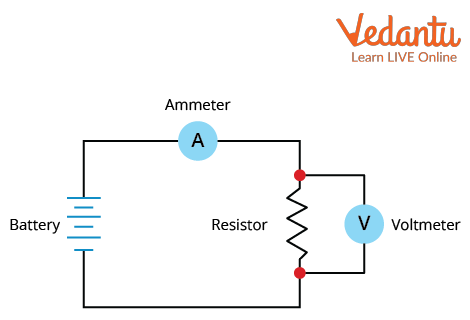
Definition and Nature of Resistance
Resistance refers to the property of a material that restricts the flow of electric charge. It arises due to the collision of electrons with atoms within a conductor, which impedes electron movement and causes energy dissipation as heat.
The SI unit of resistance is the ohm ($\Omega$). If a conductor has a resistance of one ohm, a current of one ampere flows through it when a potential difference of one volt is applied across its ends.
Ohm’s Law and Resistance
Ohm’s Law states that the electric current ($I$) flowing through a conductor between two points is directly proportional to the potential difference ($V$) across the two points at constant temperature.
Mathematically, Ohm’s Law is expressed as $V = IR$, where $R$ is the resistance. This relationship enables the determination of resistance using measurable circuit quantities.
For further information on this relationship and its implications, refer to Ohm's Law and Resistance.
Mathematical Expression for Resistance
The resistance $R$ of a uniform conductor is given by the relation $R = \rho \dfrac{L}{A}$, where $\rho$ is the resistivity of the material, $L$ is the length, and $A$ is the cross-sectional area of the conductor.
This formula shows that resistance increases with length and decreases with cross-sectional area. Material-specific resistivity further determines how much resistance the conductor offers.
Detailed differences between resistance and resistivity can be found at Resistance vs Resistivity.
Types of Materials Based on Resistance
Materials can be classified on the basis of their resistance into conductors, insulators, and semiconductors. Conductors have low resistance and allow significant current flow, whereas insulators exhibit very high resistance and impede current.
- Conductors: Low resistance, e.g., copper
- Insulators: High resistance, e.g., glass
- Semiconductors: Intermediate resistance
For an introduction to current electricity and its interaction with resistance, visit Current Electricity Fundamentals.
Factors Affecting Resistance
Several factors influence the resistance of a conductor. The most significant factors are:
- Length of the conductor (directly proportional)
- Cross-sectional area (inversely proportional)
- Nature of material (resistivity)
- Temperature of the conductor
As temperature increases, the resistance of most metallic conductors also increases, while that of semiconductors usually decreases.
Dimensional Formula of Resistance
The dimensional formula of resistance is derived from Ohm’s Law. The potential difference $V$ has dimensions $[M^1L^2T^{-3}I^{-1}]$ and electric current $I$ has $[I^1]$. Therefore,
$R = \dfrac{V}{I}$ has dimensions $[M^1L^2T^{-3}I^{-2}]$.
| Physical Quantity | Dimensional Formula |
|---|---|
| Resistance ($R$) | $[M^1L^2T^{-3}I^{-2}]$ |
Resistivity and Its Relation to Resistance
Resistivity ($\rho$) is an intrinsic property of a material that quantifies how strongly it opposes current flow. It is independent of the shape and size of the material but depends on temperature and the material’s nature.
The resistance $R$ can be related to resistivity as $R = \rho \dfrac{L}{A}$. The SI unit of resistivity is ohm-metre ($\Omega\,\text{m}$).
Measurement of Resistance
Resistance in a circuit is commonly measured using an ohmmeter or a multimeter. Direct measurement is conducted in an open circuit, as the presence of current influences measurement accuracy.
Alternatively, resistance can be determined indirectly using Ohm’s Law, by measuring voltage and current and applying $R = \dfrac{V}{I}$ in a circuit.
Applications and Practical Importance of Resistance
Resistance is utilized in designing electronic circuits to control current flow. High-resistance elements convert electrical energy into heat, as in heaters and filament bulbs, while low-resistance conductors are used for efficient power transmission.
Calculation Example: Circuit Resistance Using Ohm’s Law
If a wire has a resistance of $R$, and a potential difference $V$ is applied across it, the current $I$ is $I = \dfrac{V}{R}$. For example, if $V = 10\,\text{V}$ and $R = 5\,\Omega$, then $I = 2\,\text{A}$.
Equivalent Resistance in Circuits
When multiple resistors are connected in a circuit, the total or equivalent resistance depends on the configuration. In series, the resistances add: $R_{eq} = R_1 + R_2 + \ldots$. In parallel, $1/R_{eq} = 1/R_1 + 1/R_2 + \ldots$.
A structured explanation is available at Understanding Equivalent Resistance.
Summary Table: Resistance vs Resistivity
| Resistance | Resistivity |
|---|---|
| Property of an object | Property of material |
| Depends on shape, size, material | Independent of size, depends on material |
| Unit: Ohm ($\Omega$) | Unit: Ohm-metre ($\Omega\,\mathrm{m}$) |
| $R = \rho \dfrac{L}{A}$ | $\rho = R\dfrac{A}{L}$ |
A detailed discussion separating resistance from resistivity is found at Resistance vs Resistivity.


FAQs on What Is Electrical Resistance?
1. What is resistance in electricity?
Resistance is the opposition offered by a material to the flow of electric current.
Key points:
- Measured in ohms (Ω)
- Caused by collisions of free electrons with atoms
- Main factors: material, length, area, and temperature
2. What is the SI unit of resistance?
The SI unit of resistance is the ohm (Ω).
- 1 ohm (Ω) = 1 volt / 1 ampere
- Symbol: Ω
- Used to express how strongly a material opposes current flow
3. State Ohm's Law.
Ohm's Law states that the electric current flowing through a conductor is directly proportional to the potential difference applied across its ends, provided the temperature remains constant.
- Formula: V = IR
- V = voltage (in volts)
- I = current (in amperes)
- R = resistance (in ohms)
4. What factors affect the resistance of a wire?
The resistance of a wire depends on:
- Length (l): Directly proportional to resistance
- Area of cross-section (A): Inversely proportional
- Material: Different substances conduct electricity differently
- Temperature: Usually, resistance increases with temperature in metals
5. How can resistance be calculated for a uniform wire?
For a uniform wire, resistance (R) is calculated using:
- R = ρ (l/A) where,
- ρ = resistivity of the material
- l = length of the wire
- A = area of cross-section
6. What is resistivity, and how is it different from resistance?
Resistivity is a material-specific property that measures the resistance of a material per unit length and unit area.
- SI unit: ohm-meter (Ω m)
- It does not depend on the shape or size of the material
- Resistance changes with length, area, and temperature, while resistivity is constant for a given material at a fixed temperature
7. What are the applications of resistors in daily life?
Resistors are widely used in electronic and electrical devices to control current.
- Used in fans, radios, televisions, chargers
- Limit current in circuits
- Divide voltages in electronics
- Protect devices from high current
8. How is resistance affected when the length of a wire is doubled?
If the length of a wire is doubled, its resistance also doubles (when material and area remain the same).
- R' = ρ (2l)/A = 2R
- This shows direct proportionality between length and resistance
9. Why are copper and aluminum used for making electrical wires?
Copper and aluminum are preferred for electrical wires due to:
- Low resistivity (good conductors)
- High ductility and flexibility
- Ability to carry large currents safely
10. How does temperature affect the resistance of a conductor?
The resistance of a conductor usually increases with temperature.
- Metals: Resistance increases due to increased atomic vibrations
- Alloys: Resistance increases slightly, making them suitable for resistors
11. What is the difference between a conductor and an insulator in terms of resistance?
Conductors have low resistance, allowing current to pass easily, while insulators have high resistance, blocking current flow.
- Conductors: e.g., copper, aluminum
- Insulators: e.g., rubber, plastic
12. Define electric current and state its relationship with resistance.
Electric current is the flow of electric charge through a conductor. According to Ohm's Law:
- Current (I) = Voltage (V) / Resistance (R)
- For a constant voltage, increasing resistance decreases current
