








Deriving the Equation of Range on an Inclined Surface
Projectile motion on an inclined plane refers to the two-dimensional motion of a projectile that is launched with an initial velocity at an angle, where the landing surface is inclined at a certain angle from the horizontal. This scenario requires resolving vectors and analyzing displacement, time of flight, and range using modified equations compared to horizontal projections.
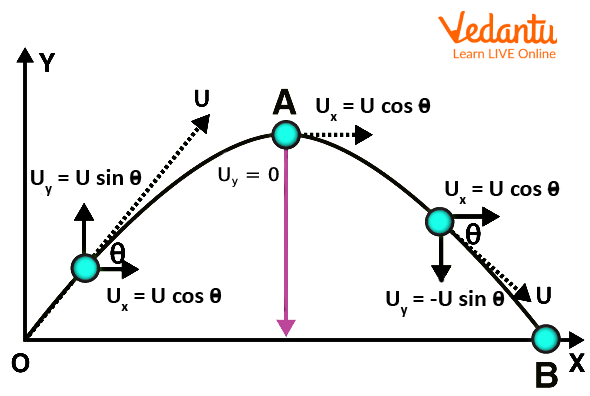
Concept of Projectile on an Inclined Plane
When a body is projected with an initial velocity $u$ at an angle $\theta$ to the horizontal, and lands on a plane inclined at angle $\alpha$ to the horizontal, the analysis of its trajectory differs from standard horizontal projections. Motion is resolved along axes parallel and perpendicular to the incline for accurate calculation of range, time of flight, and height.
Resolving the initial velocity into components with respect to the inclined plane is essential. This technique allows the use of kinematic equations with the effective acceleration due to gravity and helps determine exam-relevant quantities. For foundational concepts, refer to Understanding Projectile Motion.
Key Parameters and Formulas
A projectile on an inclined plane is characterized by specific measurable quantities such as range along the slope, time of flight before landing, and maximum height attained. The formulas listed in the table below are derived based on vector resolution and standard kinematic principles.
| Quantity | Formula (Inclined Plane) |
|---|---|
| Range ($R$) | $\dfrac{2u^2 \cos\theta\, \sin(\theta-\alpha)}{g \cos^2\alpha}$ |
| Time of Flight ($T$) | $\dfrac{2u\, \sin(\theta-\alpha)}{g\cos\alpha}$ |
| Maximum Height ($H$) | $\dfrac{u^2 \sin^2\theta}{2g\cos^2\alpha}$ |
Here, $u$ is the initial speed, $\theta$ is the angle of projection with the horizontal, $\alpha$ is the inclination angle of the plane, and $g$ is the acceleration due to gravity. All trigonometric functions retain their standard definitions as per angle measurement conventions used in physics.
Derivation of Range for Projectile on an Inclined Plane
For a projectile launched at angle $\theta$ with speed $u$ towards an inclined plane at angle $\alpha$, set up a coordinate system with the origin at the point of projection. Let the x-axis be horizontal and the y-axis be vertical, using standard kinematic equations:
$x = u\cos\theta \cdot t$
$y = u\sin\theta \cdot t - \dfrac{1}{2}gt^2$
The plane’s equation is $y = x \tan\alpha$. At the landing point, the projectile satisfies this plane equation. Substitute $x$ and $y$ into $y = x \tan\alpha$ to get:
$u\sin\theta \, t - \dfrac{1}{2}gt^2 = (u\cos\theta \, t) \tan\alpha$
Upon simplifying and solving for $t$ (time of flight):
$T = \dfrac{2u\sin(\theta-\alpha)}{g\cos\alpha}$
For range along the inclined plane, resolve the displacement vector along the plane, giving:
$R = \dfrac{2u^2 \cos\theta\, \sin(\theta-\alpha)}{g \cos^2\alpha}$
Trajectory Equation on an Inclined Plane
The general equation for trajectory is modified to accommodate the inclined surface. By replacing $x$ and $y$ in terms of time, and using the plane’s equation, the trajectory’s equation relative to ground remains parabolic but is analyzed using parameters specific to the inclined reference frame.
For a systematic study of two-dimensional kinematics and reference frames, see Motion In Two Dimensions.
Numerical Example: Projectile on an Inclined Surface
A projectile is launched with $u = 20$ m/s at $\theta = 45^\circ$ onto an inclined plane with $\alpha = 30^\circ$. Compute the range along the incline using $g = 10$ m/s$^2$.
$\cos\theta = \dfrac{1}{\sqrt{2}}$, $\sin(\theta-\alpha) = \sin(15^\circ) \approx 0.2588$, $\cos\alpha = \dfrac{\sqrt{3}}{2}$.
Insert values into the range formula:
$R = \dfrac{2 \times 20^2 \times \dfrac{1}{\sqrt{2}} \times 0.2588}{10 \times (\dfrac{3}{4})}$
$R \approx \dfrac{2 \times 400 \times 0.7071 \times 0.2588}{7.5}$
$R \approx \dfrac{146.16}{7.5} \approx 19.5$ m
Common Mistakes and Conceptual Errors
- Mixing projection angle $\theta$ and incline angle $\alpha$
- Incorrect vector resolution of velocity components
- Misapplying gravity’s sign or direction
- Forgetting $\cos^2\alpha$ in the denominator
- Ignoring appropriate angle for $\sin(\theta-\alpha)$
Careful diagram analysis is recommended to avoid these errors and improve accuracy in numericals and conceptual questions. Relevant practice and vector analysis help reinforce concepts for JEE-level preparation.
Comparison: Inclined vs. Horizontal Plane Projectile
On a horizontal plane ($\alpha=0$), the standard range formula applies: $R = \dfrac{u^2 \sin2\theta}{g}$. For an inclined plane, the modified formula accounts for the orientation, which can either increase or decrease the range depending on the values of $\theta$ and $\alpha$.
The change in effective gravity component and displacement direction with respect to the slope must be incorporated for accurate results. The maximum range does not occur at $\theta=45^\circ$ for inclines, but at a specific value depending on $\alpha$. For foundational gravity concepts, refer to Motion Under Gravity.
Applications of Inclined Plane Projectile Analysis
- Projectile launches in sports on sloped fields
- Designing slopes in civil engineering projects
- Physics Olympiad questions involving complex trajectories
- Ballistics and trajectory simulations on irregular terrain
Key Points for Exam Preparation
- Know all formulas for range, time of flight, and height on inclines
- Resolve velocity vectors carefully along and perpendicular to the incline
- Apply correct trigonometric relations and sign conventions
- Review concept differences between horizontal and inclined surfaces
- Attempt mock tests on kinematics, such as Kinematics Mock Test 1
Mastery of projectile motion on inclined planes supports accuracy in complex kinematics and vector-based problems in competitive exams. For comprehensive revision and deeper insights, refer to Introduction To Kinematics.


FAQs on Understanding Projectile Motion on an Inclined Plane
1. What is projectile motion on an inclined plane?
Projectile motion on an inclined plane refers to the path followed by an object thrown at a certain angle relative to an inclined surface, rather than horizontal ground.
Key features include:
- The initial velocity makes a specific angle with the inclined plane, not the horizontal.
- The acceleration due to gravity acts vertically downward, affecting both parallel and perpendicular components of motion.
- The resulting trajectory is typically a parabolic arc relative to the inclined plane.
2. How do you derive the range of a projectile on an inclined plane?
To derive the range of a projectile on an inclined plane, apply kinematic equations considering the inclination angle.
Steps include:
- Resolve the initial velocity (u) into components parallel and perpendicular to the inclined plane.
- Use the angle of projection (α) with respect to the plane, and the angle of inclination (θ).
- Range, R, is derived as: R = (2u² sin α cos(α + θ)) / (g cos²θ)
- Remember, g is the acceleration due to gravity.
3. What is the equation of trajectory for a projectile on an inclined plane?
The equation of trajectory for a projectile on an inclined plane expresses the path mathematically in relation to the plane.
It is given by:
- y = x tan α - (g x²) / (2u² cos²α) * (1 + tan θ tan α)
- Here, α is the angle of projection with respect to the inclined plane, θ is the inclination of the plane, and u is the initial velocity.
4. What are the components of velocity in projectile motion on an inclined plane?
In projectile motion on an inclined plane, initial velocity is resolved into two components:
- Parallel to the plane: u cos α
- Perpendicular to the plane: u sin α
5. How does the angle of projection affect the range on an inclined plane?
The angle of projection directly impacts the range of a projectile on an inclined plane.
Important points:
- Maximum range is achieved at a specific angle, which depends on the inclination θ.
- The angle for maximum range (αmax) is: (π/4) - (θ/2)
- If the angle is too steep or too shallow, the range decreases due to gravity acting against or along the direction of motion.
6. What is the condition for maximum range of a projectile on an inclined plane?
For a projectile on an inclined plane, maximum range occurs when the angle of projection α satisfies:
- α = (45° - θ/2)
7. What is the time of flight formula for projectile motion on an inclined plane?
The time of flight (T) is the total time the projectile remains in the air on an inclined plane.
It is given by:
- T = (2u sin(α + θ)) / (g cos θ)
8. How do you resolve the initial velocity of a projectile on an inclined surface?
To resolve the initial velocity of a projectile on an inclined plane:
- Choose axes parallel and perpendicular to the plane.
- Component parallel to the plane: u cos α
- Component perpendicular to the plane: u sin α
9. What are some real-life applications of projectile motion on inclined planes?
Projectile motion on inclined planes is applied in many practical scenarios:
- Designing ski jumps and launch ramps.
- Military ballistics calculations on hilly or mountainous terrain.
- Engineering of inclined conveyor belts for material movement.
- Sports like mountain biking or ski jumping for optimal launch angles.
10. Why is the trajectory of a projectile on an inclined plane different from that on level ground?
The trajectory on an inclined plane differs from horizontal ground because the base is sloped, altering the initial velocity components and the effect of gravity.
Main points:
- Gravity always acts downward, but resolving it along the plane changes the net effect.
- The path becomes a parabola relative to the slope, not the horizontal.
- This requires modified equations for range, time, and height.
